Elon Musk Revives ‘Dogecoin To The Moon’ With Hint For 2027

bitcoinist2026-02-04 tarihinde yayınlandı2026-02-04 tarihinde güncellendi

Özet

Elon Musk has reignited speculation about the Dogecoin-funded DOGE-1 lunar mission, suggesting in a recent X post that SpaceX could send Dogecoin “to the Moon” as early as next year—potentially 2027. This comment, referencing a pledge from 2021, sparked a modest 4-5% price increase in DOGE, though the reaction was more subdued compared to past Musk-driven rallies. The DOGE-1 mission, a cubesat paid for entirely in Dogecoin and set to launch on a Falcon 9, has faced multiple delays. Market conditions remain risk-averse, with DOGE still down significantly from its peaks. The project, developed by Geometric Energy Corporation in partnership with SpaceX, aims to demonstrate blockchain technology in lunar orbit.

Elon Musk on Tuesday reignited a long-running narrative linking Dogecoin to space exploration, telling a fan on X (that SpaceX “maybe next year” could send Dogecoin to the Moon — a phrase interpreted by many in the crypto community as a timeline for fulfilling the long-teased DOGE-1 lunar mission. The brief exchange with a supporter has lifted investor interest and triggered a modest price response in DOGE.

Dogecoin To The Moon, Literally?

Musk’s latest comment came in reply to a repost of his own old pledge that SpaceX would put a “literal Dogecoin on the literal Moon,” a promise dating back to 2021 and tied to the DOGE-1 lunar project. With “Maybe next year”, he signaled that the long-delayed mission might materialize as soon as 2027, reviving a narrative that has periodically surfaced over the past few years.

The DOGE-1 mission is a commercial cubesat funded entirely in Dogecoin, booked as a rideshare aboard a Falcon 9 rocket with the objective of reaching lunar orbit and collecting basic imagery and data, marking one of the first attempts to use cryptocurrency as the payment medium for a space mission.

Originally announced in 2021, the launch has been postponed multiple times, and as of the latest filings and reporting, it remains on track for a launch window in the next year or so.


Market reaction to Musk’s retweet has been measurable but subdued compared with previous comment-driven pumps. Prices for DOGE rose roughly 4–5 percent on the day of the remark, with the token reclaiming the $0.10 mark. The gain slightly outpaced broader crypto markets on the session, positioning DOGE among the better performing large cap assets in the short term after the post.

Although Musk’s social influence on meme coins is well documented, the tone this time appeared more cautious. DOGE remains more than 77 percent below the 2024 high and orders of magnitude beneath its 2021 peak. Previous Musk-linked tweets have historically triggered more pronounced rallies, including sharp single-day surges when he first reignited interest in the space mission concept.

Musk’s post also landed in an unfriendly tape. Since October, the market’s mood has shifted sharply risk-off, with many experts now treating the move as a bear-market regime rather than a routine pullback. Bitcoin has slid roughly 20% over the past two weeks alone, and DOGE has largely tracked the same drawdown, a backdrop that helps explain why the reaction to the tweet looked more like a brief headline bid than the kind of sustained momentum meme coins sometimes get in cleaner conditions.

The broader status of DOGE-1 remains that of a mission expected but not yet executed. Geometric Energy Corporation, the entity behind the payload, has partnered with SpaceX to book the flight, and the satellite is designed to demonstrate blockchain technology beyond low Earth orbit. The exact timeline for launch is still evolving, and Musk’s prompt “maybe next year” implicitly extends prior schedules into 2027.

At press time, DOGE traded at $0.10832.
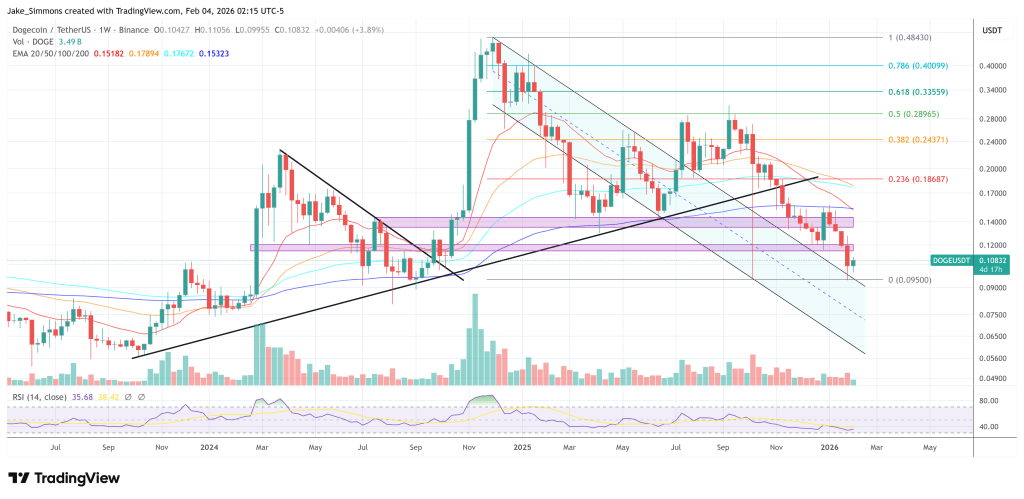
DOGE sweeps the Oct.10 low, 1-week chart | Source: DOGEUSDT on TradingView.com

İlgili Sorular

QWhat did Elon Musk hint at regarding Dogecoin and space exploration in his recent X post?

AElon Musk hinted that SpaceX 'maybe next year' could send Dogecoin to the Moon, which is interpreted as a timeline for the DOGE-1 lunar mission.

QWhat is the market reaction to Musk's comment about Dogecoin going to the Moon?

AThe market reaction was measurable but subdued, with DOGE prices rising roughly 4-5% on the day, reclaiming the $0.10 mark, and slightly outpacing broader crypto markets.

QWhat is the DOGE-1 mission and what is it intended to achieve?

AThe DOGE-1 mission is a commercial cubesat funded entirely in Dogecoin, booked on a Falcon 9 rocket, with the objective of reaching lunar orbit to collect basic imagery and data, marking one of the first attempts to use cryptocurrency as payment for a space mission.

QHow does the current market environment affect the reaction to Musk's Dogecoin-related tweets?

AThe current environment is risk-off, with Bitcoin down 20% in two weeks and DOGE tracking similar losses, which explains why the reaction was a brief headline bid rather than sustained momentum compared to previous rallies in cleaner conditions.

QWhat is the current trading price of DOGE mentioned at press time in the article?

AAt press time, DOGE traded at $0.10832.

İlgili Okumalar

MY Group Completes Web4.0 First Stock Listing Layout, SEC Officially Discloses Form 8-K Announcement

MY Group has completed the listing layout for the "Web4.0 First Share," with the U.S. Securities and Exchange Commission (SEC) formally disclosing a Form 8-K report. According to the filing, the company's board has officially appointed Mr. Zhang Dingwen as Chief Executive Officer (CEO) and Executive Director, marking a significant upgrade in management and the entry into a new phase of its global capital market strategy. The disclosure of Form 8-K, used for reporting major corporate events, coincides with market information indicating the company is advancing several key capital market initiatives. These include a global brand system upgrade, corporate strategic restructuring, and a change of its stock ticker symbol. These moves are viewed by industry experts as signals of accelerated internationalization and enhanced global market presence. Concurrently, MY Group's proposed "Web4.0 Ecosystem" is garnering market attention. The company is integrating core capabilities across social traffic portals, global payment systems, public blockchain infrastructure, digital asset trading, and AI-powered financial systems. Analysts suggest that by closing this ecosystem loop, MY Group has the potential to become a next-generation platform merging Web2 user scale with Web3 asset frameworks and AI financial capabilities. With the management upgrade finalized, the global brand strategy launched, and the stock ticker change pending, MY Group is positioning itself as a focal point in the global technology capital market as a potential leading Web4.0 platform enterprise.

marsbit1 saat önce

MY Group Completes Web4.0 First Stock Listing Layout, SEC Officially Discloses Form 8-K Announcement

marsbit1 saat önce

3 People with 100 AI Programmers, Burning Through $1.3 Million a Month! OpenAI: I'll Foot the Bill

In a striking demonstration of AI-powered development, Peter Steinberger (creator of OpenClaw) shared that his three-person team spent $1.3 million in one month to run approximately 100 AI agents (primarily Codex instances). OpenAI covered the cost. The expenditure consumed 6.03 trillion tokens across 7.6 million requests. Steinberger argues that, with "fast mode" disabled, the cost falls below that of a single engineer while providing significantly greater output. This "cloud programmer army" handles core but tedious software engineering tasks: reviewing pull requests, finding security vulnerabilities, deduplicating issues, fixing bugs, monitoring benchmarks, and even generating PRs after meetings. This shifts AI's role from merely writing code to maintaining the entire collaborative fabric of a project. Steinberger's tool, CodexBar (a macOS menu bar app), tracks usage and costs across various AI coding services, highlighting how token consumption is becoming a key metric—a new "means of production." The experiment poses a profound question: if token cost ceases to be a barrier, how will software development transform? As model prices fall, the capability for small teams to leverage large numbers of AI agents could become commonplace, fundamentally altering the scale and speed of development. The future, Steinberger suggests, is arriving rapidly.

marsbit3 saat önce

3 People with 100 AI Programmers, Burning Through $1.3 Million a Month! OpenAI: I'll Foot the Bill

marsbit3 saat önce

In the AI Era, How to Onboard Without Starting from Scratch

In the AI era, onboarding new employees often resembles a botched relay race baton handoff, where the organization maintains speed while the newcomer starts from zero. The author, after joining Ramp, argues the core problem is a lack of accessible, shared organizational "context"—the collective knowledge from meetings, documents, Slack discussions, and decisions. Instead of relying on slow, manual onboarding or isolated AI tools, the solution is building a continuously updated "company brain." This system acts as a central, AI-native knowledge base that absorbs all company signals. The author describes building a prototype using an Obsidian vault powered by Claude, fed by automated meeting transcripts and notes, and topped with reusable agent "skills." The current enterprise AI approach, deploying specific workflow agents, is likened to the "chatbot era"—useful but disconnected. The real gap is the absence of a shared brain that all agents and employees can access from day one. The future lies in making context layer infrastructure the priority: write context first, then install tools; record every meeting; build the wiki before the dashboard. When new hires, AI agents, and even customers can immediately access this living company brain, the costly "ramp-up" period becomes obsolete. True organizational speed is achieved when maximum velocity and seamless context transfer happen simultaneously.

marsbit3 saat önce

In the AI Era, How to Onboard Without Starting from Scratch

marsbit3 saat önce

İşlemler

Spot
Futures

Popüler Makaleler

ELON Nasıl Satın Alınır

HTX.com’a hoş geldiniz! Dogelon Mars (ELON) satın alma işlemlerini basit ve kullanışlı bir hâle getirdik. Adım adım açıkladığımız rehberimizi takip ederek kripto yolculuğunuza başlayın. 1. Adım: HTX Hesabınızı OluşturunHTX'te ücretsiz bir hesap açmak için e-posta adresinizi veya telefon numaranızı kullanın. Sorunsuzca kaydolun ve tüm özelliklerin kilidini açın. Hesabımı Aç2. Adım: Kripto Satın Al Bölümüne Gidin ve Ödeme Yönteminizi SeçinKredi/Banka Kartı: Visa veya Mastercard'ınızı kullanarak anında Dogelon Mars (ELON) satın alın.Bakiye: Sorunsuz bir şekilde işlem yapmak için HTX hesap bakiyenizdeki fonları kullanın.Üçüncü Taraflar: Kullanımı kolaylaştırmak için Google Pay ve Apple Pay gibi popüler ödeme yöntemlerini ekledik.P2P: HTX'teki diğer kullanıcılarla doğrudan işlem yapın.Borsa Dışı (OTC): Yatırımcılar için kişiye özel hizmetler ve rekabetçi döviz kurları sunuyoruz.3. Adım: Dogelon Mars (ELON) Varlıklarınızı SaklayınDogelon Mars (ELON) satın aldıktan sonra HTX hesabınızda saklayın. Alternatif olarak, blok zinciri transferi yoluyla başka bir yere gönderebilir veya diğer kripto para birimlerini takas etmek için kullanabilirsiniz.4. Adım: Dogelon Mars (ELON) Varlıklarınızla İşlem YapınHTX'in spot piyasasında Dogelon Mars (ELON) ile kolayca işlemler yapın.Hesabınıza erişin, işlem çiftinizi seçin, işlemlerinizi gerçekleştirin ve gerçek zamanlı olarak izleyin. Hem yeni başlayanlar hem de deneyimli yatırımcılar için kullanıcı dostu bir deneyim sunuyoruz.

255 Toplam GörüntülenmeYayınlanma 2024.12.12Güncellenme 2025.03.21

ELON Nasıl Satın Alınır

Tartışmalar

HTX Topluluğuna hoş geldiniz. Burada, en son platform gelişmeleri hakkında bilgi sahibi olabilir ve profesyonel piyasa görüşlerine erişebilirsiniz. Kullanıcıların ELON (ELON) fiyatı hakkındaki görüşleri aşağıda sunulmaktadır.

活动图片













