Elon Musk: In 5 Years, People on the Internet Will Become a Statistical Error — Only Bots Will Remain

cryptonews.ru2026-08-11 tarihinde yayınlandı2026-08-11 tarihinde güncellendi

Özet

Elon Musk commented on social media X, agreeing with a Cloudflare forecast that AI agent traffic will "significantly exceed" human traffic. Cloudflare predicts that within five years, bot traffic could be 1,000 times greater than human traffic. The company's CEO, Matthew Prince, noted that bot traffic first surpassed human traffic in May 2026, earlier than their original forecast of late 2027. Cloudflare's CFO, Thomas Seifert, stated that at current growth rates, humans risk becoming a "statistical margin of error" online, not due to declining human activity, but due to the explosive growth of AI agent activity. The company tracks this ratio via its Cloudflare Radar dashboard, which measures bot versus human traffic based on HTTP requests for HTML content. However, methodologies for measuring bot traffic vary. Another report from Thales/Imperva recorded automated traffic at 53% of global internet traffic in 2025, differing from Cloudflare's figures due to different sampling and criteria. This lack of a unified measurement standard poses a challenge for regulators and infrastructure developers seeking a clear picture of online activity.

Elon Musk wrote on social network X that the traffic of AI agents will "definitely significantly exceed" human traffic, citing a forecast by Cloudflare. The entrepreneur's comment referred to the company's assessment that in five years, bot traffic will exceed human traffic by 1,000 times.

The traffic of AI agents will clearly and significantly exceed human traffic, there is no question about it. The Cloudflare forecast is accurate.

Cloudflare has been developing the idea that automated systems are surpassing humans in terms of internet activity volume for several months. Back on June 3, 2026, the company's CEO, Matthew Prince, announced that bot traffic had for the first time in internet history surpassed human traffic. According to him, the company expected this event closer to the end of 2027, then shifted the forecast to early 2027, but AI agent traffic grew so rapidly that the tipping point was recorded in May 2026.

Humans as a 'Statistical Error'

At the conference on the results of the second quarter of 2026, held on August 6, Cloudflare's CFO, Thomas Seifert, stated that if the current trend continues, in five years, bot traffic will exceed human traffic by 1,000 times. Seifert clarified that the company's previous forecasts on this topic had been incorrect — but not in the usual direction: reality consistently outpaced expectations. In his words, humans risk becoming a "statistical error" on the internet — not due to a decrease in human activity, but due to the rate of growth in agent activity.
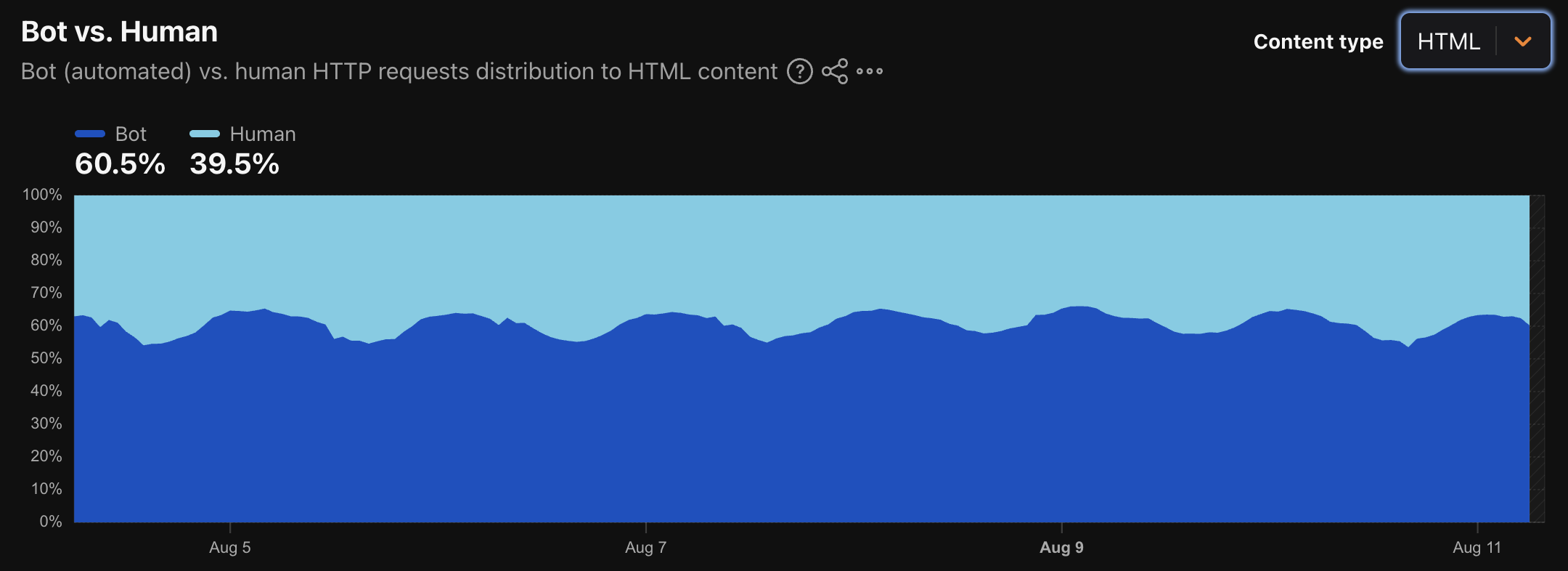
Ratio of bot traffic to human traffic based on HTTP requests for HTML content. Source: Cloudflare

The data referenced by Prince and Seifert is updated daily on the Cloudflare Radar dashboard, which tracks the ratio of bot traffic to human traffic. It was this section that Prince linked to in his June post, and a month later, Musk drew attention to it while commenting on Cloudflare's conclusions.

AI's Opinion

From a methodological standpoint, comparing different sources of telemetry opens an interesting perspective. Cloudflare Radar measures the share of bots based on HTTP requests for HTML content on the company's servers, whereas Thales/Imperva recorded a different figure in its annual report: in 2025, the share of automated traffic across the entire global network reached 53%, compared to 51% the previous year. The discrepancy in numbers between providers is explained by different domain samples and different criteria for classifying a request as a "bot" — a unified measurement standard does not yet exist.

A historical parallel can be drawn with early disputes about internet provider coverage in the 1990s, when each company used its own methodology for counting users. The technical risk that remains off-screen: the more vendor metrics diverge, the harder it becomes for regulators and infrastructure developers to rely on a unified picture of what's happening. Will the market be left without a common standard for accounting for agent traffic?

end-content

Trend Kriptolar

İlgili Sorular

QWhat did Elon Musk claim about the future of internet traffic, according to the article?

AElon Musk claimed that the traffic of AI agents will "clearly and significantly exceed" human traffic. He agreed with a Cloudflare forecast stating that within five years, bot traffic would exceed human traffic by 1,000 times, making people a "statistical error."

QWhat key milestone regarding bot traffic did Cloudflare report occurring in mid-2026?

AIn mid-2026, specifically in May 2026, Cloudflare reported that bot traffic surpassed human internet traffic for the first time in history. This event occurred earlier than the company's previous forecasts, which had predicted it for late 2027 or early 2027.

QWhat was the financial director of Cloudflare's prediction about the future ratio of bot-to-human traffic?

AThomas Seifert, the CFO of Cloudflare, predicted that if current trends continue, bot traffic would exceed human traffic by 1,000 times within five years. He clarified that past forecasts on this topic were not incorrect but were too conservative, as reality consistently outpaced expectations.

QWhy do different cybersecurity companies report different figures for bot traffic, as mentioned in the article?

ADifferent companies report different figures due to differing methodologies. For example, Cloudflare Radar measures bot share based on HTTP requests to HTML content on its servers, while others like Thales/Imperva use different samples of domains and criteria for classifying a request as a "bot." There is currently no unified standard for measurement.

QWhat potential problem does the article suggest could arise from the lack of a unified standard for measuring agent traffic?

AThe article suggests that the greater the divergence in metrics between different vendors, the harder it becomes for regulators and infrastructure developers to rely on a single, coherent picture of what is happening on the internet. This creates a technical risk and raises the question of whether the market will remain without a common standard for accounting for agent traffic.

İlgili Okumalar

New Claude models will embed invisible watermarks in generated text

Anthropic has announced that starting from August 2, 2026, new Claude models deployed in the European Union will incorporate machine-readable invisible watermarks into generated text. This measure will apply globally wherever Claude is offered, including via its API, applications, and through partners like AWS, Google Cloud, and Microsoft Foundry. The watermarking mechanism for text is distinct from file provenance. For text, invisible watermarks will be woven directly into the model's responses without altering meaning, quality, or readability, and are designed to persist through copying and pasting and partially through editing. This system is separate from the C2PA standard. For files (e.g., .png, .jpg), Claude already attaches C2PA-compliant metadata signatures to indicate AI origin. Models released before August 2, 2026 (including the current Claude Opus 5) are in a transitional period and do not embed text watermarks, though Anthropic is working to add support. Currently, there are no public tools to detect these text watermarks; Anthropic states it is developing such tools and will release technical details later. The timing aligns with the EU AI Act's Article 50, which from August 2, 2026, mandates labeling of AI-generated content, with potential fines for non-compliance. A key technical question remains regarding the watermark's resilience to paraphrasing or translation by other AI models, which in other industry experiments has significantly reduced detection accuracy.

cryptonews.ru24 dk önce

New Claude models will embed invisible watermarks in generated text

cryptonews.ru24 dk önce

İşlemler

Spot

Popüler Makaleler

ELON Nasıl Satın Alınır

HTX.com’a hoş geldiniz! Dogelon Mars (ELON) satın alma işlemlerini basit ve kullanışlı bir hâle getirdik. Adım adım açıkladığımız rehberimizi takip ederek kripto yolculuğunuza başlayın. 1. Adım: HTX Hesabınızı OluşturunHTX'te ücretsiz bir hesap açmak için e-posta adresinizi veya telefon numaranızı kullanın. Sorunsuzca kaydolun ve tüm özelliklerin kilidini açın. Hesabımı Aç2. Adım: Kripto Satın Al Bölümüne Gidin ve Ödeme Yönteminizi SeçinKredi/Banka Kartı: Visa veya Mastercard'ınızı kullanarak anında Dogelon Mars (ELON) satın alın.Bakiye: Sorunsuz bir şekilde işlem yapmak için HTX hesap bakiyenizdeki fonları kullanın.Üçüncü Taraflar: Kullanımı kolaylaştırmak için Google Pay ve Apple Pay gibi popüler ödeme yöntemlerini ekledik.P2P: HTX'teki diğer kullanıcılarla doğrudan işlem yapın.Borsa Dışı (OTC): Yatırımcılar için kişiye özel hizmetler ve rekabetçi döviz kurları sunuyoruz.3. Adım: Dogelon Mars (ELON) Varlıklarınızı SaklayınDogelon Mars (ELON) satın aldıktan sonra HTX hesabınızda saklayın. Alternatif olarak, blok zinciri transferi yoluyla başka bir yere gönderebilir veya diğer kripto para birimlerini takas etmek için kullanabilirsiniz.4. Adım: Dogelon Mars (ELON) Varlıklarınızla İşlem YapınHTX'in spot piyasasında Dogelon Mars (ELON) ile kolayca işlemler yapın.Hesabınıza erişin, işlem çiftinizi seçin, işlemlerinizi gerçekleştirin ve gerçek zamanlı olarak izleyin. Hem yeni başlayanlar hem de deneyimli yatırımcılar için kullanıcı dostu bir deneyim sunuyoruz.

323 Toplam GörüntülenmeYayınlanma 2024.12.12Güncellenme 2025.03.21

ELON Nasıl Satın Alınır

Tartışmalar

HTX Topluluğuna hoş geldiniz. Burada, en son platform gelişmeleri hakkında bilgi sahibi olabilir ve profesyonel piyasa görüşlerine erişebilirsiniz. Kullanıcıların ELON (ELON) fiyatı hakkındaki görüşleri aşağıda sunulmaktadır.

活动图片