Dubai, Hong Kong, and now Japan as regulatory heat intensifies for KuCoin!

ambcrypto2026-03-27 tarihinde yayınlandı2026-03-27 tarihinde güncellendi

Özet

Japan's Financial Services Agency (FSA) has issued a warning to KuCoin and several other firms for operating unregistered over-the-counter (OTC) derivative services. This action is part of broader regulatory challenges for the exchange, which has recently faced operational bans or restrictions in Hong Kong, Austria, and Dubai for failing to meet local licensing and anti-money laundering requirements. These persistent regulatory issues have significantly eroded user trust, leading to a substantial decline in user funds. The exchange's stablecoin reserves plummeted from over $1.3 billion to $543 million in one year, indicating ongoing user caution and persistent outflows despite market rallies.

Japan’s financial market watchdog, the Financial Services Agency (FSA), has flagged KuCoin and other crypto exchanges and firms for operating certain services without proper registration.

In a statement on Thursday, the watchdog included KuCoin in the list of “unregistered businesses to which warning letters have been issued.”

The agency added that KuCoin, NeonFX, TheOption, and GTCFX were slapped with notices in March for “soliciting over-the-counter (OTC) derivative transactions via the internet.”

Interestingly, the escalation comes after the agency requested Apple and Google to block access to five unregistered crypto exchanges in February 2025. Amongst those targeted during the crackdown were KuCoin, Bybit, MEXC Global, LBank, and Bitget.

KuCoin’s regulatory headwinds

However, KuCoin’s regulatory woes go well beyond Japan. In May 2024, the exchange was forced to wind down its operations in Hong Kong. This followed restrictions and a crackdown on platforms with ties to mainland China.

Failure to meet the new licensing requirements prompted KuCoin to withdraw from Hong Kong and block users from the region from accessing the platform.

Fast forward to February 2026, and the exchange was partially banned by the Austrian Financial Market Authority (FMA). It failed to implement proper procedures to enforce anti-money laundering laws, as required by the EU’s MiCA guidelines. This was just three months after getting the MiCA license.

Earlier in March, the firm faced another regulatory hiccup with Dubai’s Virtual Assets Regulatory Authority (VARA). The agency issued a “cease and desist” order against KuCoin, alongside three other exchanges, for operating without a license. As such, the firms were banned from advertising or operating in Dubai without a valid license.

Impact of regulatory pressure on KuCoin

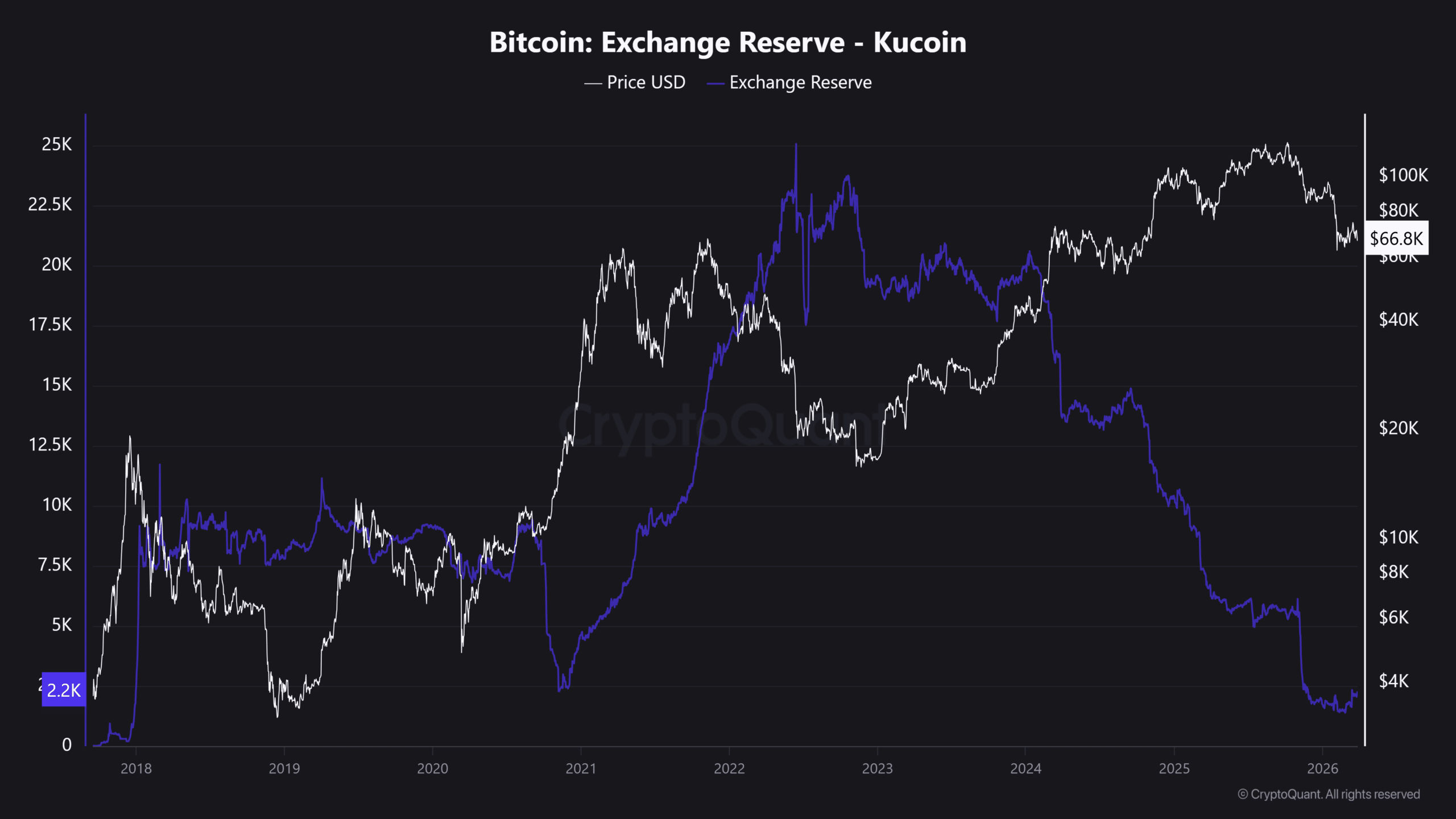
Unsurprisingly, the recurring patterns of regulatory hiccups have begun to affect user trust. This was illustrated by the Bitcoin and stablecoin reserves on the exchange. For Bitcoin, the exchange reserves dropped from 14K BTC in 2024 to 2100 BTC in early 2026.
Source: CryptoQuant

Here, it’s worth noting that the BTC exchange reserve decline was a broader trend across other platforms, likely due to transfers to self-custody wallets.

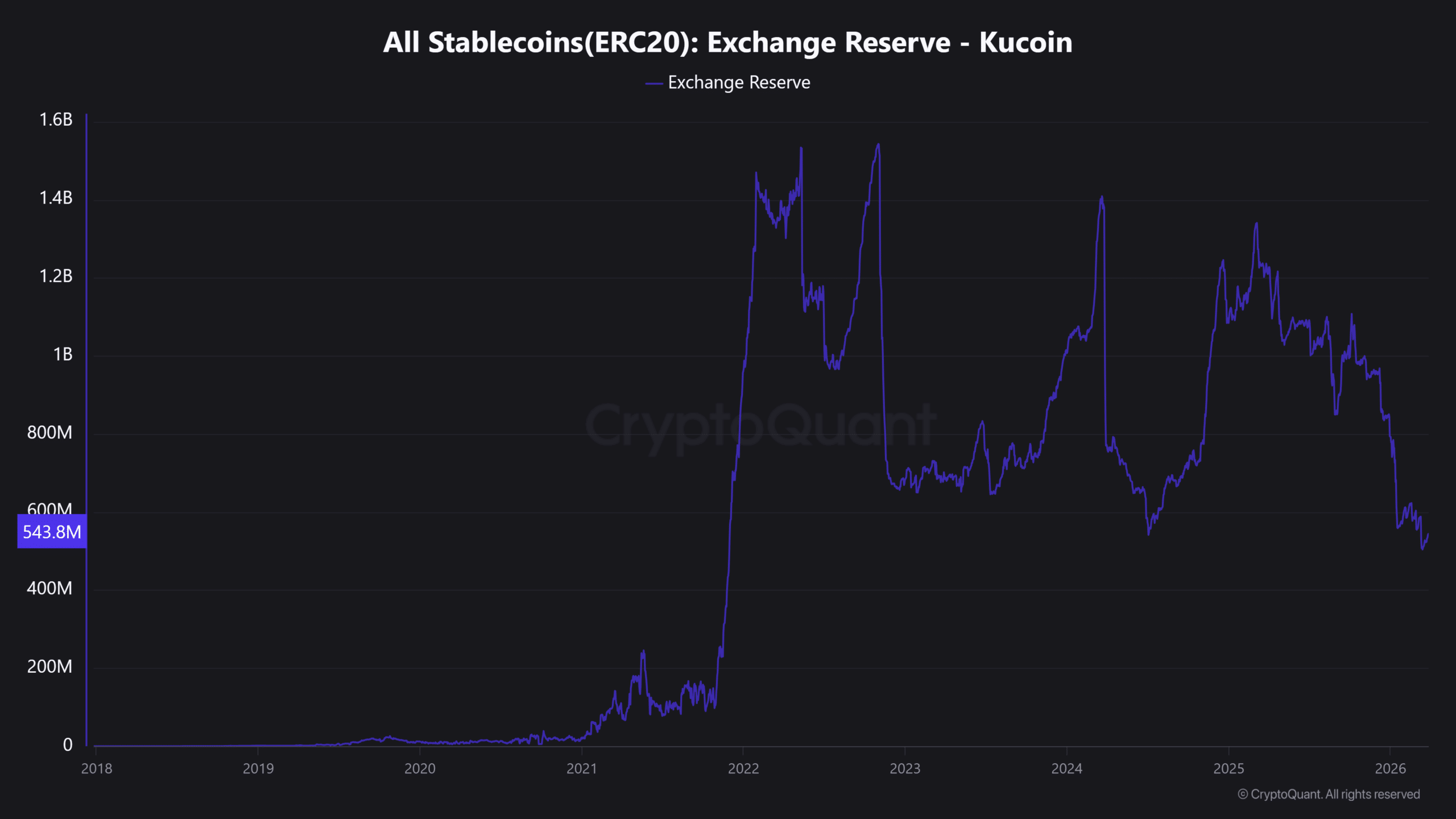
However, a deeper look at the liquidity or user funds held by the exchange, as painted by the stablecoin reserves, underscored a somewhat worried user base. The stablecoin exchange reserves fell from over $1.3 billion to $543M in just one year.

Even the mid-2025 rally and early 2026 recovery didn’t attract much flow into the exchange – Hinting at caution from users.
Source: CryptoQuant

Final Summary

  • Japan has sent a warning letter to KuCoin and other firms for operating unlicensed OTC derivatives trading.
  • Ongoing regulatory headwinds have eroded user trust, with user funds dropping from over $1.3B to $543M amid persistent outflows.


İlgili Sorular

QWhat regulatory action did Japan's FSA take against KuCoin in March 2026?

AJapan's Financial Services Agency (FSA) issued a warning letter to KuCoin for soliciting over-the-counter (OTC) derivative transactions without proper registration.

QWhich other regions has KuCoin faced regulatory challenges in besides Japan?

AKuCoin has faced regulatory challenges in Hong Kong (May 2024), Austria (February 2026), and Dubai (March 2026).

QHow did KuCoin's stablecoin reserves change between 2025 and early 2026?

AKuCoin's stablecoin reserves dropped from over $1.3 billion to $543 million in just one year, indicating significant user fund outflows.

QWhy did KuCoin wind down its operations in Hong Kong in 2024?

AKuCoin withdrew from Hong Kong after failing to meet new licensing requirements following a crackdown on platforms with ties to mainland China.

QWhat was the consequence of KuCoin's failure to comply with EU's MiCA guidelines in Austria?

AThe Austrian Financial Market Authority (FMA) partially banned KuCoin for failing to implement proper anti-money laundering procedures as required by MiCA, just three months after obtaining the license.

İlgili Okumalar

The AI Agent Era Accelerates Its Arrival: Questflow Defines a New Paradigm of Financial Intelligence with On-Chain AI Brokerage

The AI Agent era is accelerating, with the CB Insights AI 100 list highlighting global investment confidence. The focus has shifted from whether AI works to its speed of deployment and ability to manage complex workflows, with autonomous AI Agents driving this transformation. At the forefront is Questflow, a Singapore-based startup redefining financial intelligence through its on-chain AI brokerage. Unlike tools that merely provide data dashboards, Questflow deploys AI Agents that proactively scan markets, form judgments, and execute trades via a conversational interface—operating 24/7 without requiring manual confirmation for each decision. This embodies the new AI paradigm of agents capable of executing multi-step workflows autonomously. Questflow's mission is to democratize institutional-grade trading intelligence. Historically reserved for the ultra-wealthy, this capability is now accessible starting from just $1 through Questflow's "AI Clone + Copy Trade" model. The platform charges only a 1% execution fee, aligning its incentives directly with users and eliminating traditional management or performance fees. The timing is opportune, aligning with key trends identified by CB Insights: the scalable deployment of AI Agents, accelerated AI adoption in financial services, and the maturation of on-chain infrastructure. With robust liquidity on platforms like Hyperliquid and Polymarket, alongside advancements in AI reasoning and non-custodial wallet security, Questflow is positioned to merge the roles of broker, fund, and exchange into a single, accessible platform for millions.

链捕手39 dk önce

The AI Agent Era Accelerates Its Arrival: Questflow Defines a New Paradigm of Financial Intelligence with On-Chain AI Brokerage

链捕手39 dk önce

Why Pricing Social Interactions is Doomed to Fail?

Titled "Why Putting a Price on Social Interaction Is Doomed to Fail," this article critiques attempts to monetize social networks directly through SocialFi models, arguing their inevitable failure stems from a fundamental misunderstanding of media dynamics. Using Marshall McLuhan's theory of "hot" and "cold" media, the author posits that social networks are inherently "cold" media. Their value isn't contained in individual posts but is co-created through user participation, interpretation, and fragmented, ongoing interaction (e.g., replies, shares). This ambiguity and need for user involvement are core to their function. The article asserts that SocialFi projects like Friend.tech failed because introducing real-time, tradable financial pricing (a definitive "hot" signal) into this "cold" environment doesn't add a layer—it replaces the medium's essence. The unambiguous price signal overshadows and nullifies the nuanced, participatory social signal. Users become traders, not participants, and when speculative profits vanish, the underlying social ecosystem—never genuinely cultivated—collapses entirely. This principle extends beyond crypto. The author argues platforms like Twitter have gradually "heated up" through metrics (likes, retweets counts, algorithmically defined value), shifting users from participants to performers and eroding organic engagement. The solution isn't to abandon capital but to manage its entry point. Successful models like Substack, Patreon, or Bandcamp allow capital to "condense" at specific, isolated nodes (e.g., subscriptions, one-time payments) without permeating and "heating" every social interaction. They preserve the core "cold," participatory medium while enabling monetization at designated boundaries. The NFT boom and bust serves as a stark parallel: the ancient "cold" medium of collecting (valued for story, community, gradual accumulation) was rapidly destroyed by platforms that introduced real-time floor prices, rarity scores, and trading dashboards, transforming collectors into speculators and vaporizing cultural value when prices fell. The core lesson: "Liquidity equals heat." Injecting high liquidity and definitive pricing into a "cold" participatory medium doesn't optimize it; it fundamentally alters and destroys its value-creating mechanism. The future lies not in pricing every social gesture but in finding precise, non-invasive points for capital to condense without overheating the entire ecosystem.

marsbit47 dk önce

Why Pricing Social Interactions is Doomed to Fail?

marsbit47 dk önce

İşlemler

Spot
Futures
活动图片




