Dubai, Hong Kong, and now Japan as regulatory heat intensifies for KuCoin!

ambcrypto2026-03-27 tarihinde yayınlandı2026-03-27 tarihinde güncellendi

Özet

Japan's Financial Services Agency (FSA) has issued a warning to KuCoin and several other firms for operating unregistered over-the-counter (OTC) derivative services. This action is part of broader regulatory challenges for the exchange, which has recently faced operational bans or restrictions in Hong Kong, Austria, and Dubai for failing to meet local licensing and anti-money laundering requirements. These persistent regulatory issues have significantly eroded user trust, leading to a substantial decline in user funds. The exchange's stablecoin reserves plummeted from over $1.3 billion to $543 million in one year, indicating ongoing user caution and persistent outflows despite market rallies.

Japan’s financial market watchdog, the Financial Services Agency (FSA), has flagged KuCoin and other crypto exchanges and firms for operating certain services without proper registration.

In a statement on Thursday, the watchdog included KuCoin in the list of “unregistered businesses to which warning letters have been issued.”

The agency added that KuCoin, NeonFX, TheOption, and GTCFX were slapped with notices in March for “soliciting over-the-counter (OTC) derivative transactions via the internet.”

Interestingly, the escalation comes after the agency requested Apple and Google to block access to five unregistered crypto exchanges in February 2025. Amongst those targeted during the crackdown were KuCoin, Bybit, MEXC Global, LBank, and Bitget.

KuCoin’s regulatory headwinds

However, KuCoin’s regulatory woes go well beyond Japan. In May 2024, the exchange was forced to wind down its operations in Hong Kong. This followed restrictions and a crackdown on platforms with ties to mainland China.

Failure to meet the new licensing requirements prompted KuCoin to withdraw from Hong Kong and block users from the region from accessing the platform.

Fast forward to February 2026, and the exchange was partially banned by the Austrian Financial Market Authority (FMA). It failed to implement proper procedures to enforce anti-money laundering laws, as required by the EU’s MiCA guidelines. This was just three months after getting the MiCA license.

Earlier in March, the firm faced another regulatory hiccup with Dubai’s Virtual Assets Regulatory Authority (VARA). The agency issued a “cease and desist” order against KuCoin, alongside three other exchanges, for operating without a license. As such, the firms were banned from advertising or operating in Dubai without a valid license.

Impact of regulatory pressure on KuCoin

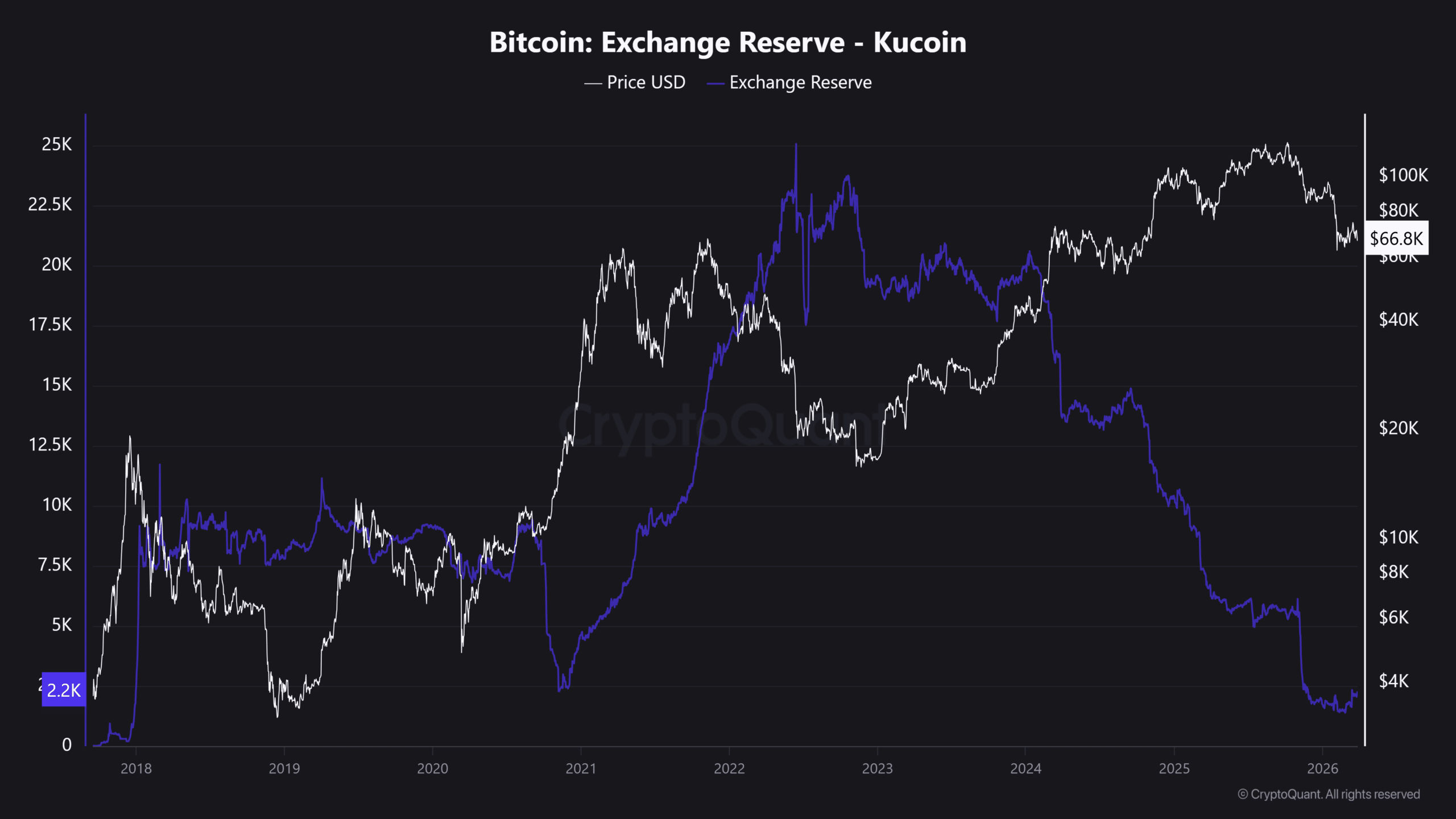
Unsurprisingly, the recurring patterns of regulatory hiccups have begun to affect user trust. This was illustrated by the Bitcoin and stablecoin reserves on the exchange. For Bitcoin, the exchange reserves dropped from 14K BTC in 2024 to 2100 BTC in early 2026.
Source: CryptoQuant

Here, it’s worth noting that the BTC exchange reserve decline was a broader trend across other platforms, likely due to transfers to self-custody wallets.

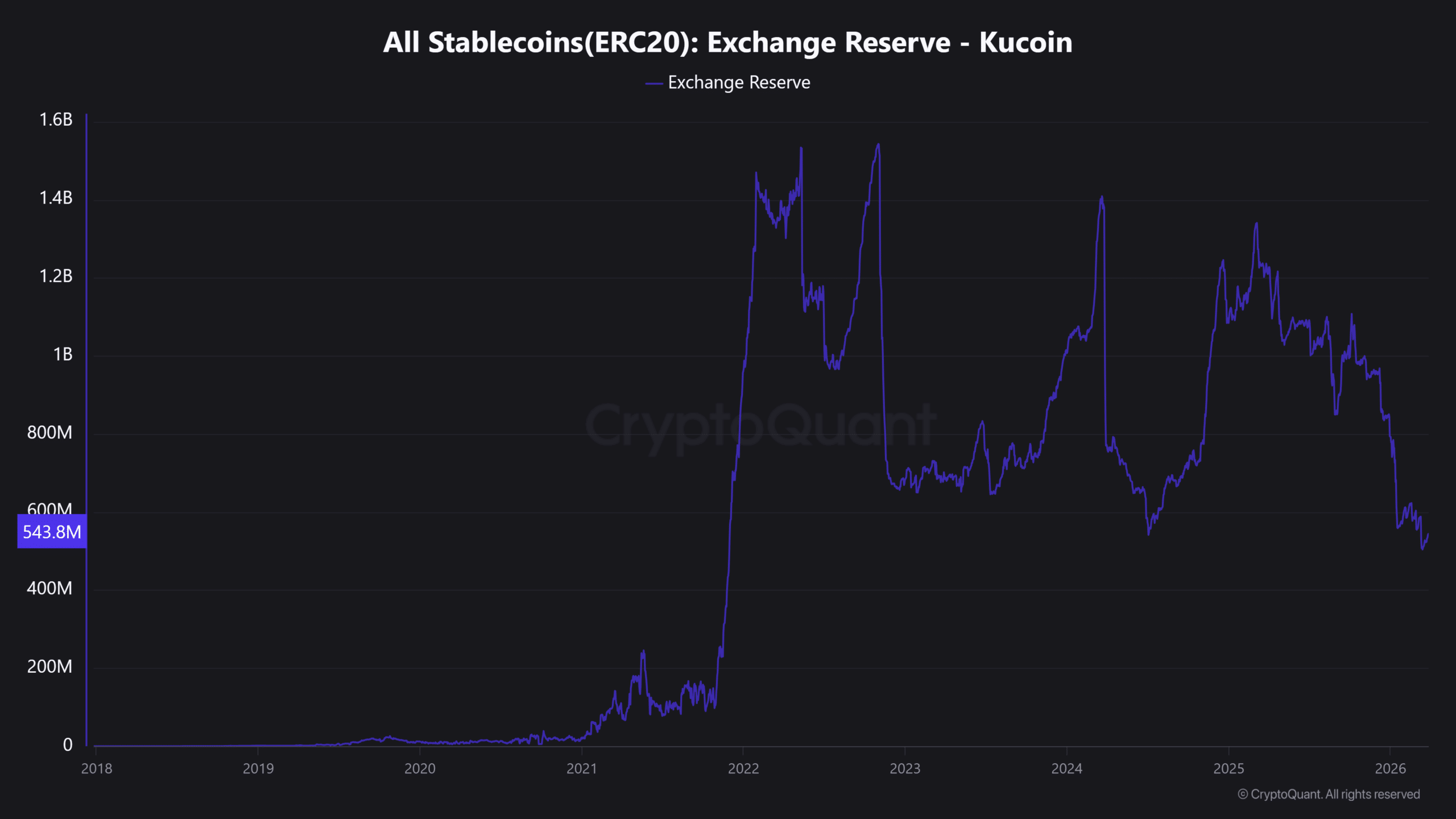
However, a deeper look at the liquidity or user funds held by the exchange, as painted by the stablecoin reserves, underscored a somewhat worried user base. The stablecoin exchange reserves fell from over $1.3 billion to $543M in just one year.

Even the mid-2025 rally and early 2026 recovery didn’t attract much flow into the exchange – Hinting at caution from users.
Source: CryptoQuant

Final Summary

  • Japan has sent a warning letter to KuCoin and other firms for operating unlicensed OTC derivatives trading.
  • Ongoing regulatory headwinds have eroded user trust, with user funds dropping from over $1.3B to $543M amid persistent outflows.


İlgili Sorular

QWhat regulatory action did Japan's FSA take against KuCoin in March 2026?

AJapan's Financial Services Agency (FSA) issued a warning letter to KuCoin for soliciting over-the-counter (OTC) derivative transactions without proper registration.

QWhich other regions has KuCoin faced regulatory challenges in besides Japan?

AKuCoin has faced regulatory challenges in Hong Kong (May 2024), Austria (February 2026), and Dubai (March 2026).

QHow did KuCoin's stablecoin reserves change between 2025 and early 2026?

AKuCoin's stablecoin reserves dropped from over $1.3 billion to $543 million in just one year, indicating significant user fund outflows.

QWhy did KuCoin wind down its operations in Hong Kong in 2024?

AKuCoin withdrew from Hong Kong after failing to meet new licensing requirements following a crackdown on platforms with ties to mainland China.

QWhat was the consequence of KuCoin's failure to comply with EU's MiCA guidelines in Austria?

AThe Austrian Financial Market Authority (FMA) partially banned KuCoin for failing to implement proper anti-money laundering procedures as required by MiCA, just three months after obtaining the license.

İlgili Okumalar

Within Strategy's Framework, STRC's Dividend Yield Remains at 12% as Share Price Stays Below Par Value

Michael Saylor, Executive Chairman of Strategy (MSTR), confirmed that the dividend rate for its STRC perpetual preferred shares will remain at 12.00% through August 2026. The rate has increased from 9% at its July 2025 launch to the current high via a "ratchet" mechanism, which permanently raises the rate by 0.5% whenever the share price falls below $95. This mechanism is intended to push the price back toward its $100 par value and support Strategy's "at-the-market" (ATM) program for issuing new shares to fund Bitcoin purchases. However, the mechanism has not worked as intended. STRC shares closed at $89.46 on July 31, remaining about 10-11% below par value despite the record-high dividend. Competition from rival Strive's higher-yielding SATA securities has pressured demand. The persistent discount has forced Strategy to suspend new STRC issuances via its ATM program, limiting this funding channel for Bitcoin acquisitions. STRC's struggles reflect Bitcoin's own volatility, as the preferred shares historically move in tandem. Analysts have warned the ratchet structure carries long-term, one-way risk. A law firm is investigating Strategy's ability to maintain dividend payments if Bitcoin's price stays low. Retail investors own roughly 83% of outstanding STRC shares, a group seen as prone to panic selling during downturns. In response, Strategy has established financial reserves, including a liquidity cushion covering about 26 months of dividend/interest obligations, and a $2 billion share buyback program alongside a Bitcoin monetization framework, though the company emphasized it is not obligated to sell any Bitcoin.

cryptonews.ru38 dk önce

Within Strategy's Framework, STRC's Dividend Yield Remains at 12% as Share Price Stays Below Par Value

cryptonews.ru38 dk önce

Analyst: Bitcoin's Price Will Drop to $60k in August, Then Rebound to $70k

Financial analyst Andrey Poroshin has provided a new forecast for Bitcoin's price dynamics in August. Poroshin, an analyst at the Bitbanker exchange, expects the cryptocurrency market to experience a downturn this month, with prices retesting the $60,000 level due to a lack of supportive macroeconomic catalysts. He noted that the recent US Federal Reserve decision to hold interest rates did not significantly impact the market, while inflation remains above the 2% target. Poroshin stated that Bitcoin is ending July under pressure from moderate volatility and a lack of new macroeconomic stimuli, leading to continued market caution. According to his base scenario, Bitcoin will drop to a range of $60,000 to $62,000 before recovering to $70,000. He pointed out that even $70,000 remains below the cost of mining in the US, which has prompted some miners to shift towards AI data center operations. Poroshin cited the winding down of BitMEX's operations as a potential catalyst for a price rebound, suggesting the exit of weaker players often coincides with market reversals and reduced short-term selling pressure. He believes Bitcoin is currently less susceptible to geopolitical shocks, such as the Iran-US conflict, and does not expect significant market changes in August related to the pending CLARITY Act. Looking ahead, Poroshin forecasts that September will bring more active price fluctuations driven by potential Fed rate decisions and possible discussions or approval of the CLARITY Act.

cryptonews.ru38 dk önce

Analyst: Bitcoin's Price Will Drop to $60k in August, Then Rebound to $70k

cryptonews.ru38 dk önce

İşlemler

Spot
活动图片




