DRAM ETF Issuer: Samsung, SK Hynix, Micron All Surpass $1 Trillion, the AI Era of Memory Chips Has Only Just Begun

marsbit2026-06-24 tarihinde yayınlandı2026-06-24 tarihinde güncellendi

Özet

Authors: Dave Mazza, Thomas DiFazio | Source: Deep Tide TechFlow The article, written by Roundhill Investments (issuer of the DRAM ETF), responds to Morningstar's caution about investing in memory chip stocks. Morningstar warns of the sector's history of boom-bust cycles, a lack of economic moats, and potential momentum-driven overvaluation. Roundhill argues the current situation is structurally different due to AI. Key points in Roundhill's rebuttal include: * **Changed Demand & Supply Dynamics:** AI infrastructure, not consumer electronics, is now the primary growth driver for memory demand. New, strict long-term supply agreements with hyperscalers reflect the high capital intensity of advanced manufacturing. * **Existence of a Moat:** High-Bandwidth Memory (HBM), essential for AI, has extremely high manufacturing barriers. The market is dominated by Samsung, SK Hynix, and Micron, with new entrants blocked by technological complexity and long lead times for equipment like ASML's EUV machines. * **Strong Fundamental Outlook:** Analyst consensus projects the three companies will rank among the world's most profitable by 2027, with combined profits of $704 billion on over $1 trillion in revenue. Their operating margins have already reached record highs. * **Valuation Re-rating:** Despite significant stock price gains, memory stocks trade at attractive valuations (e.g., a median NTM P/E of 8.37x for the DRAM ETF) relative to projected explosive EPS growth. Roundhill su...

Authors:Dave Mazza, Thomas DiFazio

Compiled by: Deep Chao TechFlow

Deep Chao Guide: The market capitalizations of the world's three largest memory chip manufacturers have all surpassed $1 trillion. Morningstar promptly published an article reminding investors not to forget fundamentals. Roundhill Investments (the issuer of the DRAM ETF) countered point by point: AI infrastructure has reshaped the supply and demand structure of the memory industry; the manufacturing barriers of HBM make it impossible for new players to enter; and the combined projected profits of the three giants for 2027 are expected to reach $704 billion. Please note that the authors of this article are the managers of the DRAM ETF, a naturally bullish position.

The world's three largest memory chip manufacturers—Samsung Electronics (005930 KS), SK Hynix (000660 KS), and Micron (MU)—have all surpassed a market capitalization of $1 trillion, joining an exceedingly rare club. However, this milestone has also invited scrutiny.

Morningstar recently published a blog post reminding memory ETF investors not to overlook fundamentals, raising several pointed questions:

  • A Cautionary Tale from History: The memory industry has repeatedly experienced boom-bust cycles. Investors might be ignoring this history.
  • Memory Companies Lack Moats: Memory is essentially a commodity business. New capacity can always enter the market and erode pricing power; companies lack true barriers to protect profit margins.
  • The Rally Might Be Momentum-Driven, Not Fundamentals-Driven: The enthusiasm surrounding memory stocks reflects more excitement about AI than a sober analysis of earnings, profit margins, and supply-demand dynamics.
  • Valuations Have Skyrocketed: Memory stock prices have surged significantly, possibly running ahead of fundamentals.
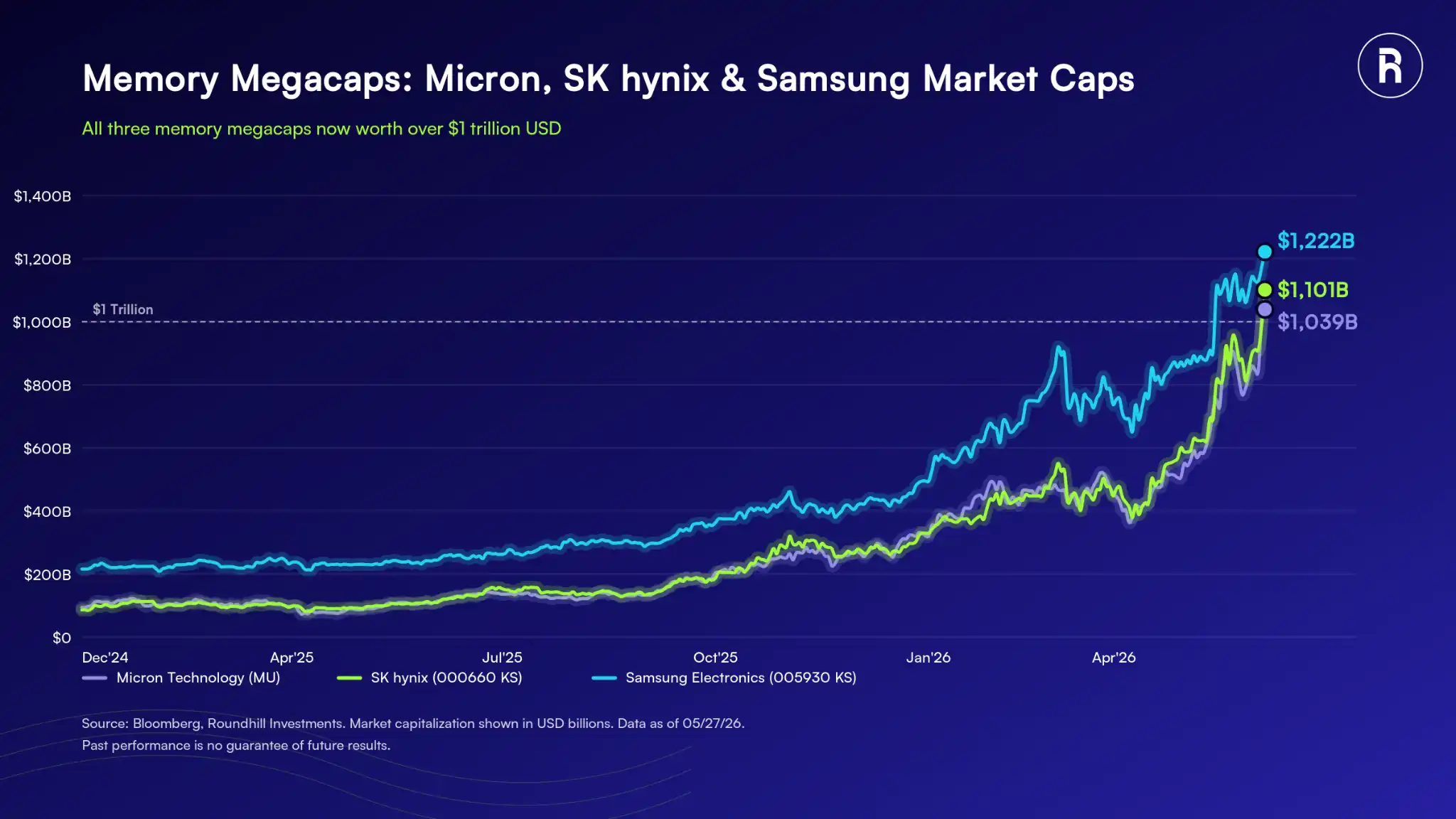
Caption: Overview of the Memory Chip Industry

Roundhill's position is: this time is different. To understand the future of the memory industry, one must first look back at its past.

History is Indeed a Warning, But Is History Still Relevant?

The boom-bust cycles of memory chips are a fact. A classic cycle occurred in the mid-1990s. Microsoft released Windows 95 in August 1995, transforming personal computers from business-exclusive to consumer goods. The DRAM capacity per PC quadrupled from 1-2 megabits to 4-8 megabits. Manufacturers were caught off guard by the sudden demand, leading to a frenzy of factory construction and expansion, ultimately resulting in oversupply and a price collapse.

A similar story unfolded in the mid-2010s. When Apple released the iPhone 7 and upgraded the base storage from 16GB to 32GB, it seemed like a small change. But scaled up, demand surged dramatically. Manufacturers again invested heavily, followed by oversupply and price drops.

These cycles share a common pattern: technological breakthrough → surge in demand → manufacturer expansion → oversupply → price collapse.

The question is, is this pattern still applicable today?

The memory chip industry has undergone structural changes. Memory demand is no longer tied to consumer electronics upgrade cycles but to the compute power expansion of AI infrastructure. The scale of this market far exceeds a single smartphone upgrade wave, and its growth potential is much larger.

DRAM and NAND prices have increased more than fivefold since January 2024, leading hyperscale customers to begin demanding long-term supply agreements to lock in bandwidth. Historically, long-term supply agreements in the memory industry have been loose frameworks subject to market changes. But this model has changed. During its January 2026 earnings call, SK Hynix stated that current agreements reflect "strong reciprocal commitments" between customers and suppliers, citing the high capital intensity of advanced memory manufacturing. Micron also reported similar long-term agreement conditions.
Caption: DRAM and NAND Price Trends

The Moat of Memory Chips: Manufacturing Complexity

Not all memory chips are created equal. The memory driving today's AI systems is called High Bandwidth Memory (HBM), which is entirely different from the memory in phones and computers. HBM is specifically designed for AI workloads, with extremely demanding manufacturing conditions.

Data from Goldman Sachs shows that SK Hynix, Samsung, and Micron control nearly the entire global supply of HBM. This industry has consolidated over decades, and the accumulated manufacturing expertise cannot be replicated overnight. Manufacturing complexity itself is the moat, and it's the very reason these three companies have reached this point.
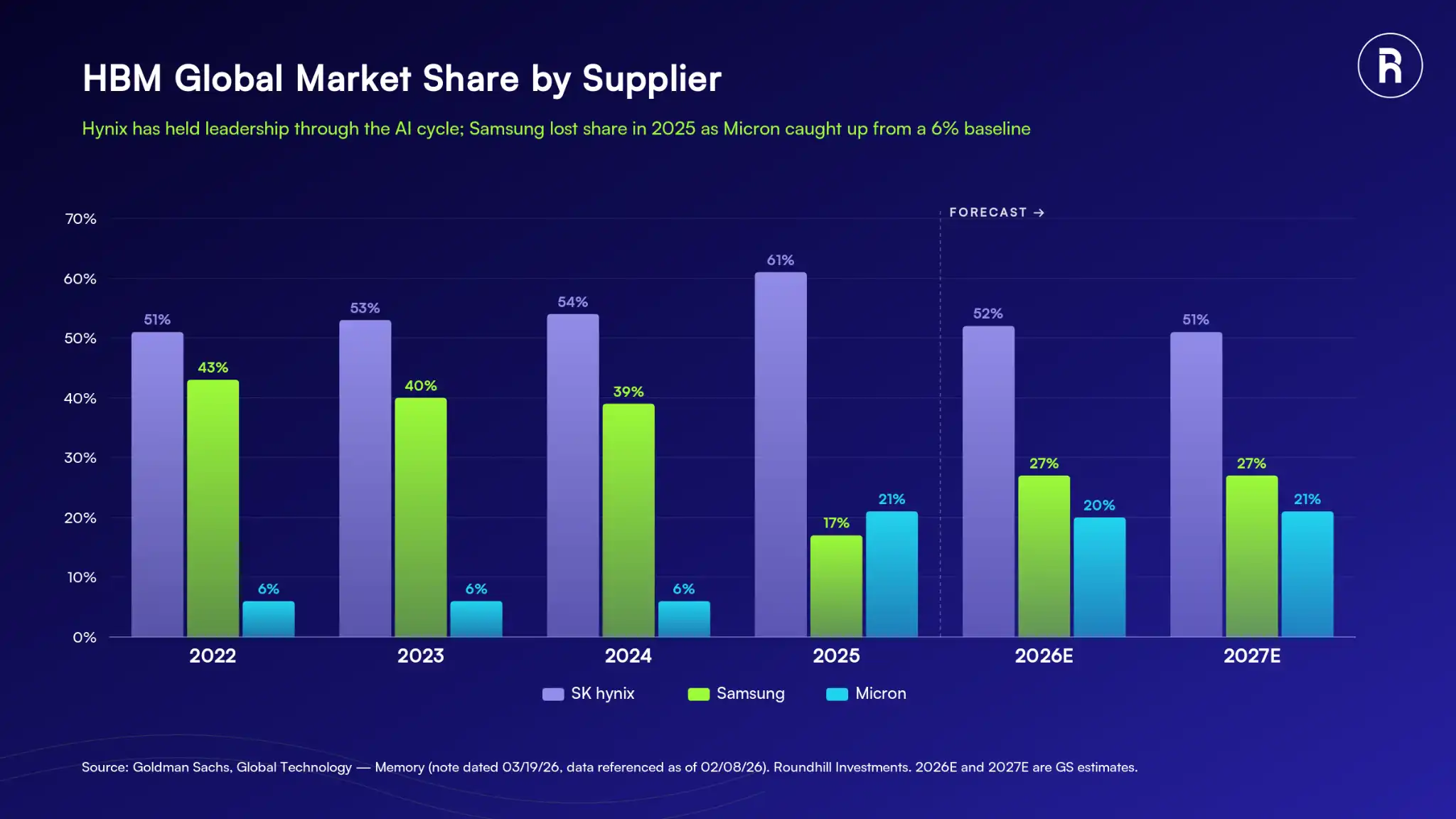
Caption: Global HBM Market Share Distribution

This logic is completely different from that of the old cycles. The past was: demand rises → new capacity enters → prices collapse. The current bottleneck is not capital or willingness, but technical capability. SK Hynix currently controls about 58% of the global HBM supply. On June 2, it announced plans to double wafer capacity over the next five years while warning that supply shortages would persist until 2030. Building a new factory takes at least 3 years, or over 5 years for a completely new site.

Furthermore, ASML—the sole manufacturer of extreme ultraviolet (EUV) lithography machines, essential for producing advanced memory chips—entered 2026 with a backlog of €38.8 billion, exceeding its full-year projected sales. The delivery lead time for a single EUV machine exceeds 12 months. This bottleneck cannot be resolved in the short term.

Fundamentals: Memory Manufacturers Poised to Join Ranks of World's Most Profitable Companies

The earnings, revenue, and margin expectations for Samsung, SK Hynix, and Micron reflect the secular wave of AI adoption. Bloomberg consensus estimates show that by 2027, these three companies will rank among the world's top ten most profitable companies.
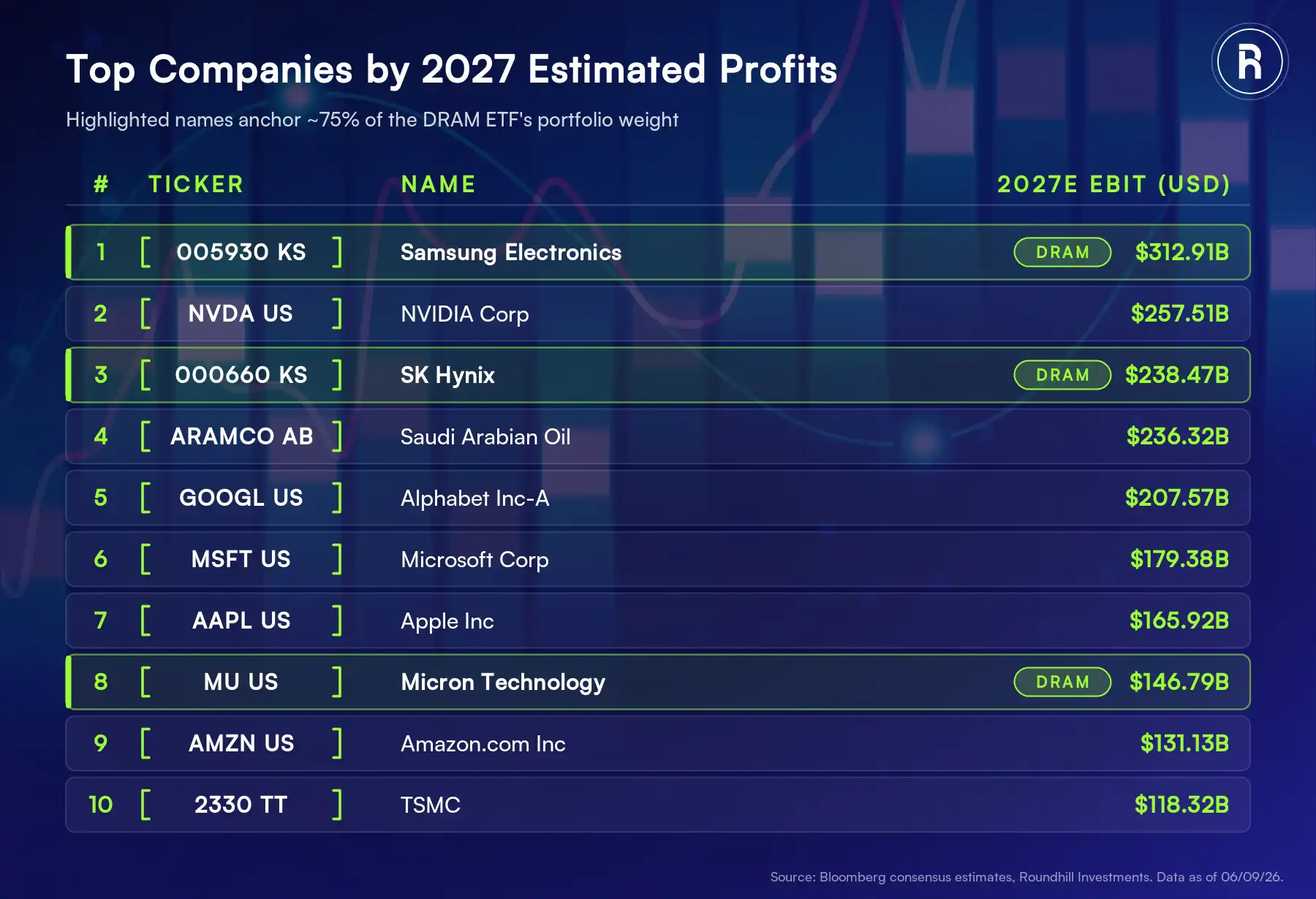
Caption: Forecast of the World's Most Profitable Companies for 2027 (Bloomberg Consensus)

The combined bottom-line profit forecast for the three companies for 2027 is $704 billion, with total revenue exceeding $1 trillion.
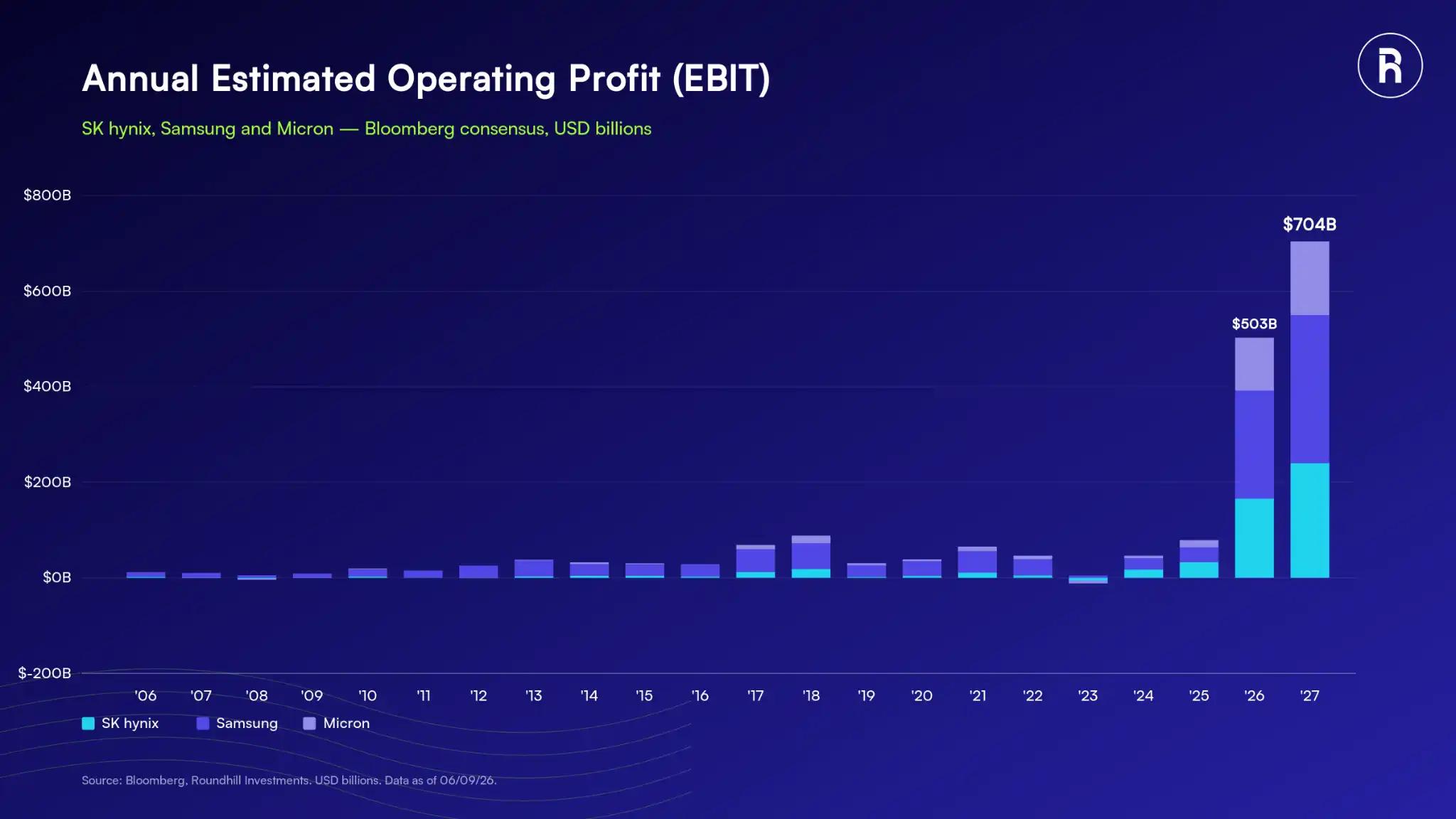
Caption: Revenue Forecast for the Three Major Memory Manufacturers
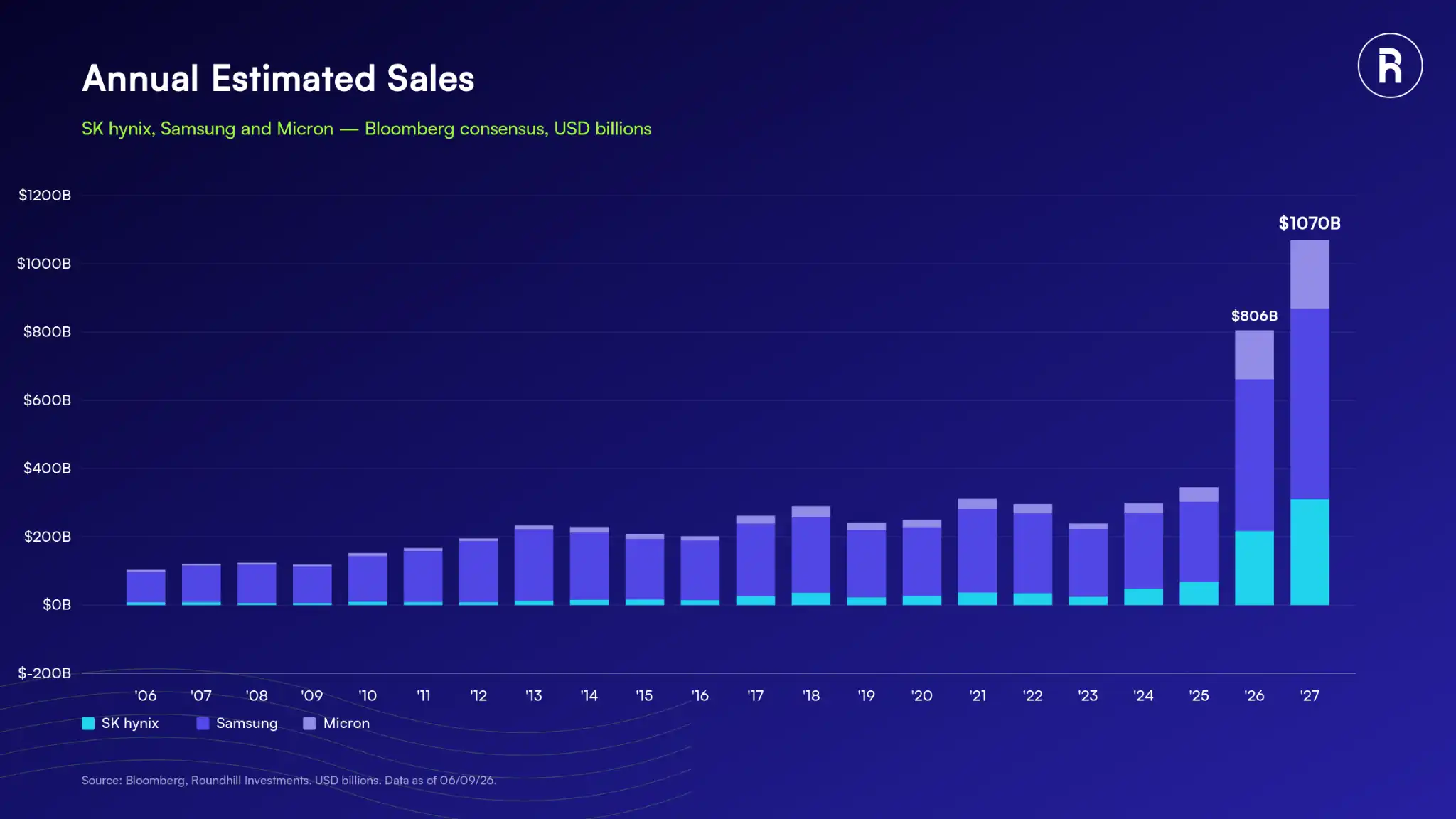
Caption: Profit Forecast for the Three Major Memory Manufacturers

In terms of margins, the operating gross margins of Samsung, SK Hynix, and Micron have reached historical records, surpassing the previous highs of 2018.
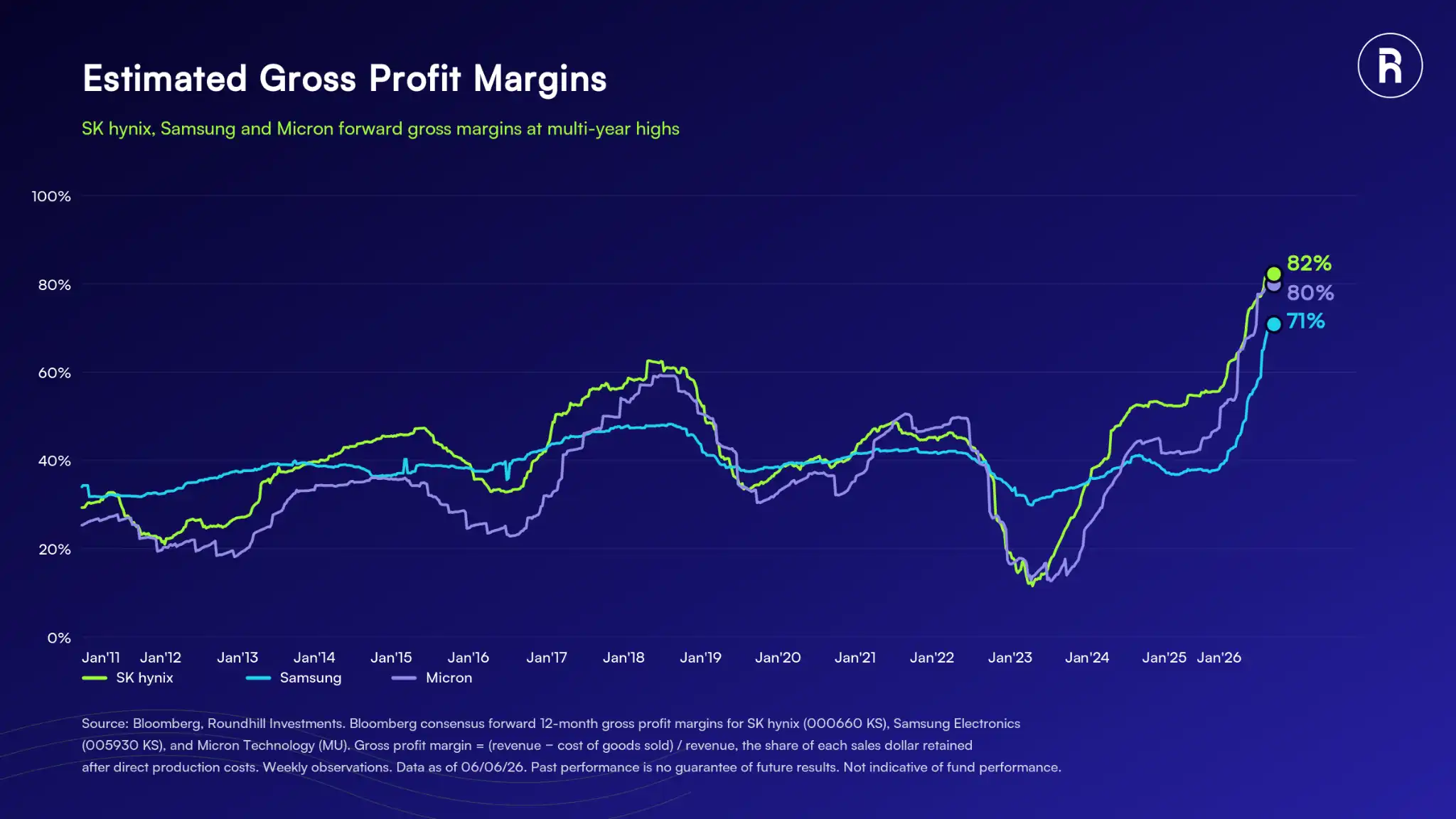
Caption: Historical Gross Margin Trends for the Three Major Memory Manufacturers

Numbers like these have never been seen in the history of the memory industry. Even if growth slows, in the context of generative AI's continued integration into the global economy, the memory industry is expected to settle on an unprecedentedly high baseline.

Valuation Reassessment in the New Era of Profitability

Historic stock price performance combined with substantial upward revisions to fundamentals suggests the industry is undergoing a significant revaluation driven by earnings growth and margin expansion.

SK Hynix and Samsung are two case studies. For nearly a decade, the NTM (Next Twelve Months) price-to-book ratios of both stocks fluctuated within a certain range, constrained by the boom-bust earnings characteristics of the memory industry. But this ceiling may no longer apply. The expected ROE (Return on Equity) for both companies has surged to levels never before seen in the history of the memory industry. The valuation frameworks investors have long used to judge these stocks need to be re-examined.
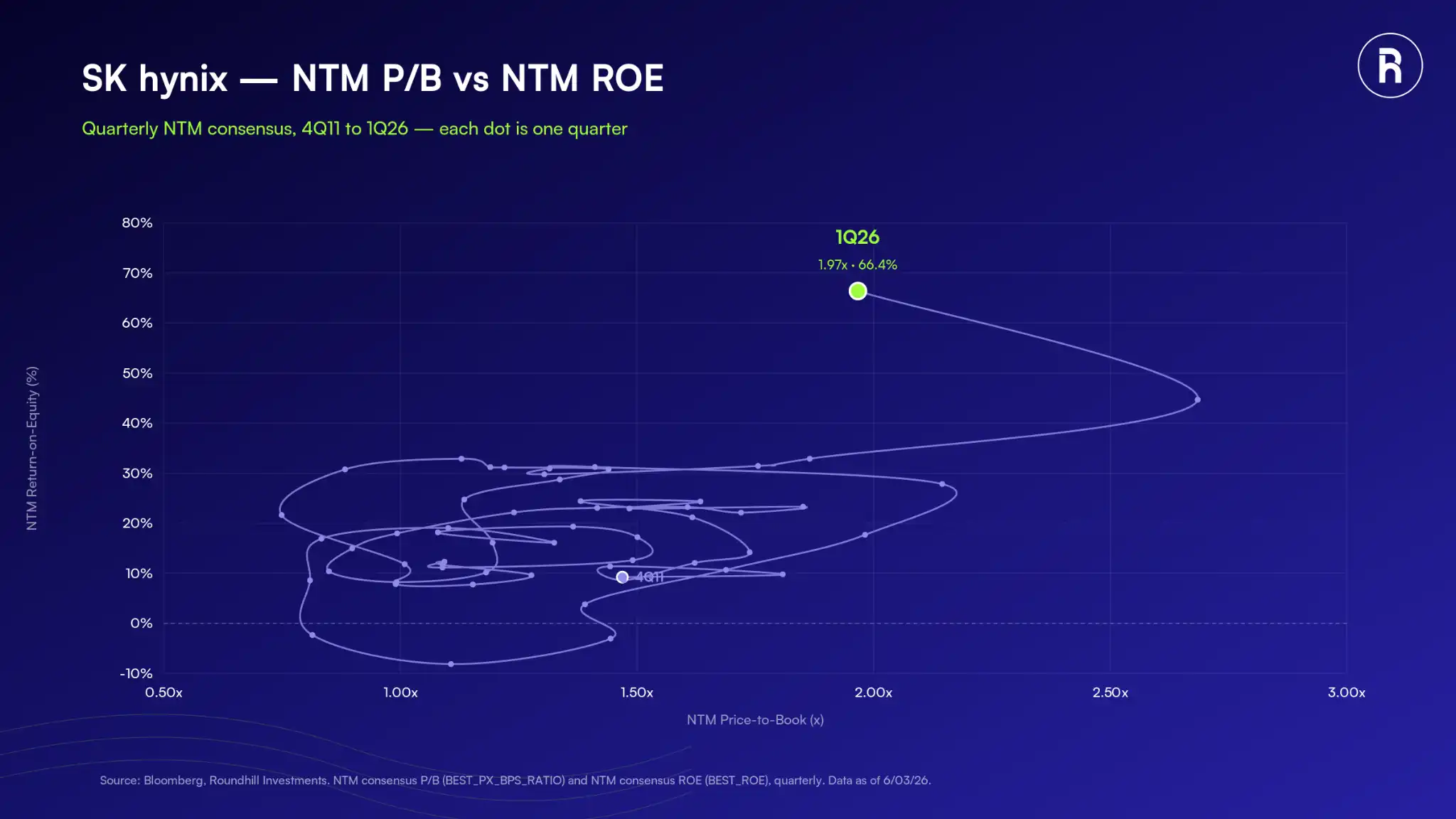
Caption: SK Hynix NTM Price-to-Book Ratio and ROE Trend
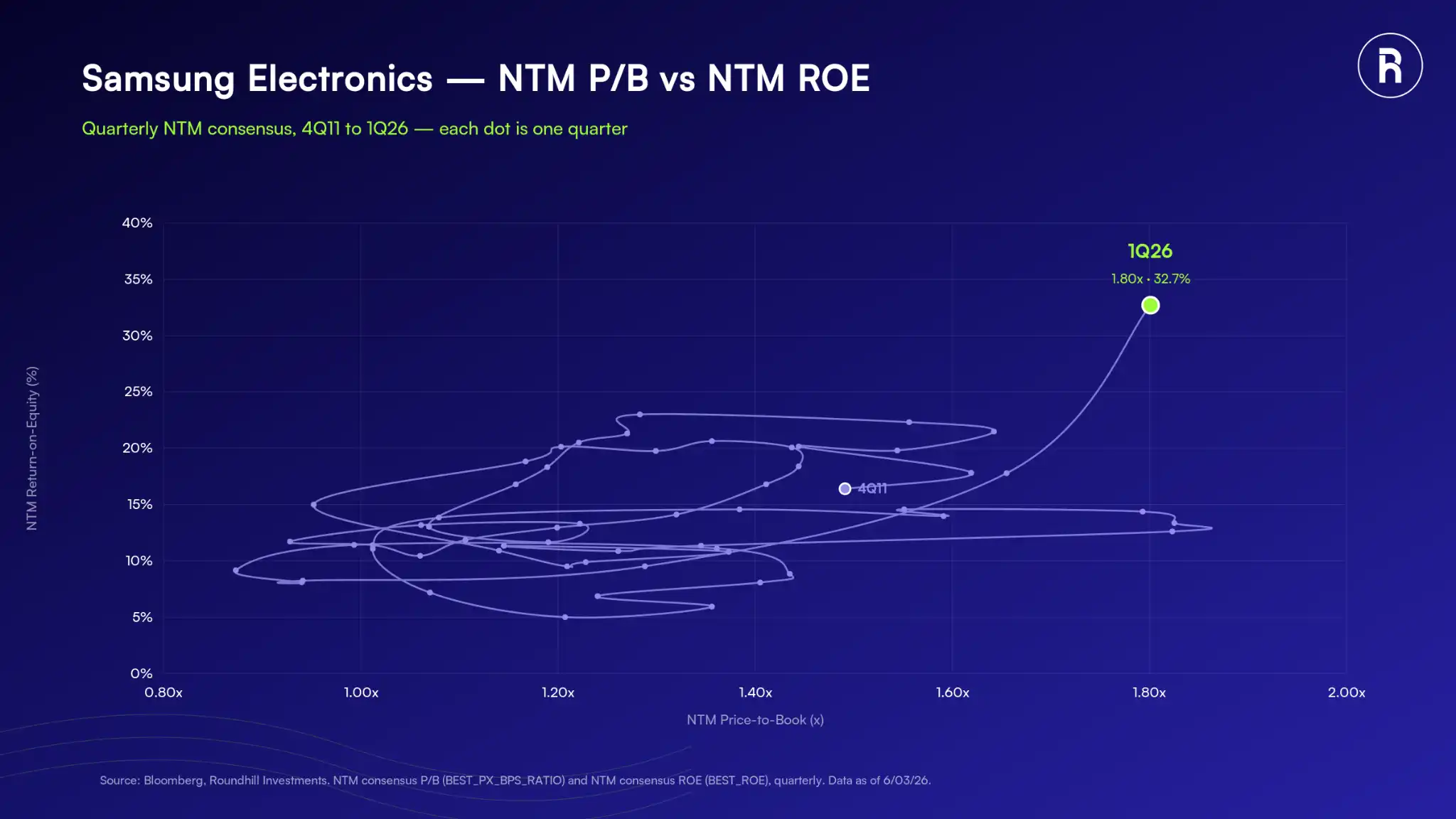
Caption: Samsung Electronics NTM Price-to-Book Ratio and ROE Trend

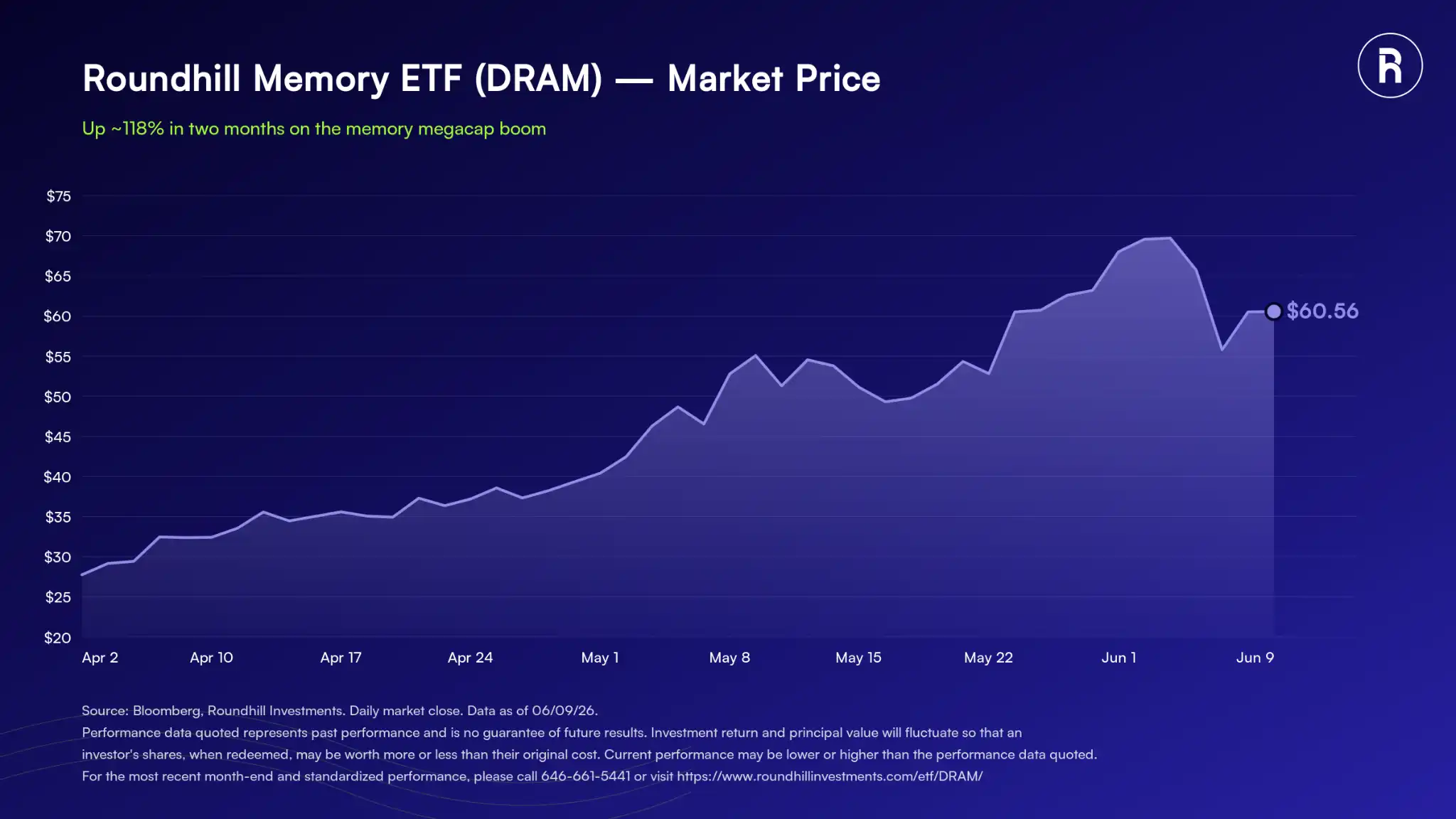
Despite the recent dramatic stock price gains, the median NTM P/E ratio of the DRAM ETF's holdings is only 8.37x, which is attractive compared to the broader tech sector. Meanwhile, the median current fiscal year EPS growth rate for the portfolio is 632%. Arguing that memory stocks are overvalued is essentially applying old data to a new industry. In Roundhill's view, the gap between historical valuation conventions and current fundamental performance represents opportunity.
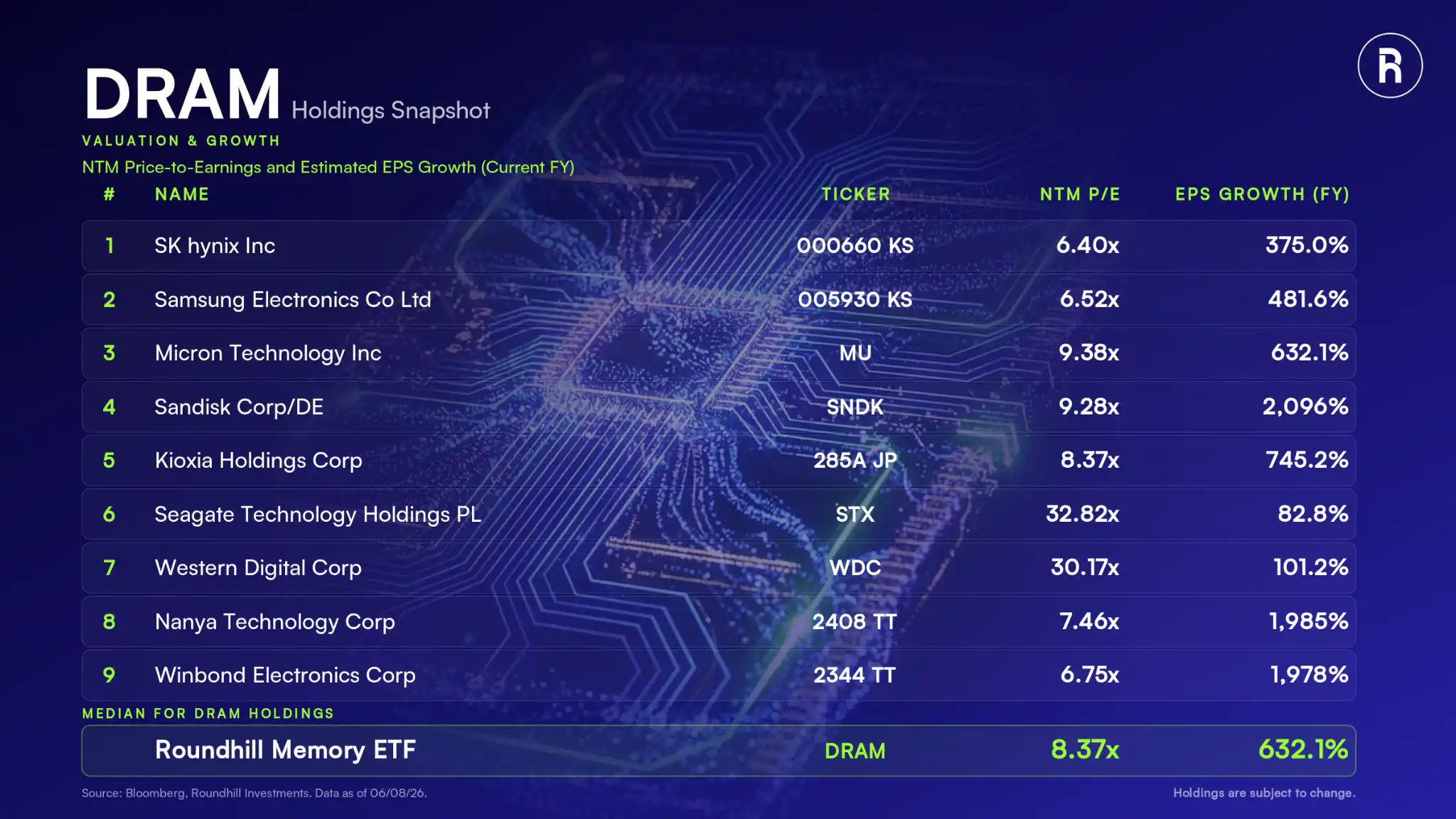
Caption: DRAM ETF Holdings Valuation and Earnings Growth Overview

Conclusion: Why Roundhill Isn't Worried

Being skeptical of surging stock prices is reasonable; fundamentals always matter in the long run. But in this case, fundamentals are precisely the reason for the rise in memory stocks.

The old cycles were characterized by: demand explosions without an upper bound, manufacturers over-expanding, and an inevitable price collapse. Today's situation is structurally different: manufacturing barriers limit new entrants; industry leaders themselves say supply shortages will persist until 2030; and the earnings cycle has just begun to reflect the scale of AI infrastructure buildout.

Roundhill believes the market is currently pricing not a bubble, but an industry that has struggled through booms and busts for decades entering a new era.

⚠️ Editor's Note: The authors of this article, Dave Mazza and Thomas DiFazio, are both members of Roundhill Investments, the issuer and manager of the DRAM ETF (Roundhill Memory ETF). The article's position is naturally bullish. Readers should form their judgment by considering third-party views such as those from Morningstar. The ETF risk disclosures and legal disclaimers from the end of the original article have been omitted. Please refer to the original link for complete information.


Trend Kriptolar

İlgili Sorular

QWhat is the main reason why Roundhill Investments argues that the current boom in memory chip stocks is different from historical cycles?

ARoundhill Investments argues that the current boom is structurally different because AI infrastructure demand is reshaping supply/demand dynamics. Unlike past cycles tied to consumer electronics, demand is now driven by secular AI infrastructure expansion. High manufacturing barriers for HBM, long-term supply agreements with hyperscalers, and severe capital/technology bottlenecks (e.g., ASML EUV tool backlogs) prevent new competitors from easily entering and causing oversupply.

QWhat are the key arguments made by Morningstar to urge caution among memory ETF investors?

AMorningstar's key arguments are: 1) The memory industry has a history of boom-bust cycles, which investors may be ignoring. 2) Memory is essentially a commodity business where new capacity can enter and erode pricing power, implying a lack of sustainable moats. 3) The recent rally may be driven by AI hype and momentum rather than冷静 (calm) analysis of fundamentals like profits and supply/demand. 4) Valuations have already soared, potentially running ahead of fundamentals.

QWhat is HBM and why does its manufacturing create a moat for the leading memory companies?

AHBM (High Bandwidth Memory) is a specialized memory chip designed for AI workloads. Its manufacturing creates a moat due to extreme complexity and high barriers to entry. The process requires advanced technology (like EUV lithography from ASML), decades of accumulated manufacturing expertise, and is highly capital intensive. This limits production almost entirely to the three incumbents—SK Hynix, Samsung, and Micron—and prevents new players from quickly adding capacity to disrupt the market.

QAccording to the article's projections, what is the combined profit for Samsung, SK Hynix, and Micron expected to be by 2027?

AAccording to Bloomberg consensus estimates cited in the article, the combined bottom-line profit for Samsung, SK Hynix, and Micron is projected to reach $704 billion by 2027.

QHow does Roundhill justify that memory stocks are not overvalued despite their significant price increases?

ARoundhill justifies this by pointing to a disconnect between historical valuation frameworks and new fundamental realities. They note that while prices have risen, the median NTM P/E ratio of the DRAM ETF holdings is only 8.37x, which is attractive compared to broader tech stocks. Meanwhile, the median EPS growth for the current fiscal year is 632%. They argue that soaring expected ROE and profit margins justify a re-rating, meaning old valuation ceilings based on boom-bust cycles no longer apply to the new, more profitable AI-driven era.

İlgili Okumalar

Tiger Research: Zuckerberg Begins Betting on Prediction Markets, While Asian Nations Still View Them as Gambling

This article examines the rise of prediction markets, contrasting their growing institutional acceptance in the West with their restrictive regulation in Asia. It details how prediction markets, which originated from informal political betting and academic experiments like the Iowa Electronic Market, aggregate crowd wisdom into probabilistic prices through binary contracts. Their growth accelerated around 2020, reaching over $14 billion in monthly volume. A key driver is the "skin in the game" principle, where users risk their own capital, leading to high accuracy in predicting events like Fed rate decisions and elections, as demonstrated by platforms like Polymarket. Meta's entry, with Mark Zuckerberg reportedly leading the development of the Arena app, signals the market's maturation. In the U.S., court rulings have distinguished prediction markets from gambling, facilitating entry by traditional financial institutions. However, most Asian jurisdictions still classify them as gambling, focusing on social control rather than financial innovation. The article argues this stance creates three problems for Asia: 1) regulatory arbitrage pushes users to riskier offshore platforms, 2) loss of sovereign information infrastructure as valuable social sentiment data accumulates abroad, and 3) abandonment of user protection. It concludes that Asia needs a policy shift from prohibition to constructive regulation, integrating these markets into the formal system to harness their data as a national asset, as initiatives like Limitless Research are beginning to do.

marsbit1 saat önce

Tiger Research: Zuckerberg Begins Betting on Prediction Markets, While Asian Nations Still View Them as Gambling

marsbit1 saat önce

Ethereum's Next Decade in the Eyes of Vitalik

"Lean Ethereum" Long-Term Roadmap Unveiled by Vitalik Buterin On July 5, 2026, Vitalik Buterin published the "Lean Ethereum" roadmap, positioning it as Ethereum's third major evolution following the Merge. This multi-year, multi-phase upgrade aims to fundamentally transform Ethereum's core protocol through staged network upgrades extending to 2029. Key goals include achieving 1 gigagas per second L1 throughput (a massive increase from the current ~32 TPS), near-instant finality, and quantum-resistant cryptography. The plan involves transitioning Ethereum's security model from full transaction re-execution by all nodes to native verification via recursive STARK proofs. A major proposed change is replacing the EVM with a proof-friendly architecture like RISC-V or leanISA, though this remains a point of contention, especially with L2s like Arbitrum favoring alternatives like WASM. Other planned upgrades include a restructured state model with a large, cheap "warehouse" storage layer to drastically reduce fees for migrated applications, multi-dimensional gas pricing, and a new focus on making privacy a first-class, native protocol feature. While the roadmap significantly raises Ethereum's long-term technical ceiling, analysts note it does not directly address ETH's mid-term token economics or value capture. The plan's multi-year timeline means near-term price impact will likely depend on observable progress milestones, such as the successful deployment of the upcoming Glamsterdam gas limit increase, growth in L2 activity and blob usage, and trends in L1 fee revenue and ETH burn.

链捕手2 saat önce

Ethereum's Next Decade in the Eyes of Vitalik

链捕手2 saat önce

In Just 11 Days, Claude Rewrote Millions of Lines of Code, an Epic AI Engineering Feat Sparks Fury

In just 11 days, Bun's founder Jarred Sumner used Anthropic's Claude AI models to rewrite its million lines of code from Zig to Rust. This move sparked significant controversy, particularly from Zig's creator, Andrew Kelley, who publicly criticized Sumner's engineering practices and the decision to use AI for such a massive rewrite. Bun, a high-performance JavaScript/TypeScript runtime and rival to Node.js, was originally written in Zig. After Anthropic acquired Bun, the team encountered persistent stability and memory safety bugs in the Zig codebase. These issues, combined with Zig's strict policy against LLM-generated code, led to the decision to rewrite in Rust. The rewrite was executed using Claude AI tools at an estimated API cost of $165,000, dramatically reducing the expected time and financial cost. Andrew Kelley's response was scathing. He blamed the original bugs on poor engineering habits, calling Bun's Zig code a collection of "hacks on top of hacks." He expressed relief that Bun was no longer associated with Zig, fearing it would misrepresent the language and attract low-quality, AI-generated contributions. The tech community is divided; some view Kelley's critique as unprofessional, while others see it as a defense of engineering integrity. A major concern about the AI-driven rewrite is the resulting code quality. The translation from Zig left approximately 27,000 lines of unsafe Rust code, raising fears about long-term maintainability and technical debt. The debate centers on whether this project is a milestone in AI-assisted development or a future maintenance nightmare.

marsbit3 saat önce

In Just 11 Days, Claude Rewrote Millions of Lines of Code, an Epic AI Engineering Feat Sparks Fury

marsbit3 saat önce

From Auto Finance to Bitcoin to AI Engines: An Analysis of Cango's 'What Not to Do' Strategy

From Auto Finance to Bitcoin and Now AI: Cango's "What Not to Do" Strategy Cango, a Chinese auto finance platform that went public on the NYSE in 2018, is undergoing its third major transformation. After selling its entire auto business in 2024, it pivoted to become a large-scale Bitcoin miner, acquiring 50 exahash of mining rigs from Bitmain. However, its true goal was never Bitcoin, but owning and controlling energy infrastructure. Now, Cango is pivoting again. While most listed Bitcoin miners are leasing power to giant hyperscalers for AI training clusters, Cango is taking the opposite path. It has launched an AI inference subsidiary called EcoHash, focusing not on training but on distributed inference. The company's strategy hinges on the insight that over 70% of mining industry power is controlled by small, independent sites (10-50 MW), which are too small for hyperscalers but ideal for low-latency AI inference. Cango aims to partner with these small operators, providing the AI technology, customers, and financing through its EcoLink software layer, which can distribute workloads across sites for reliability. Cango maintains a hybrid model, running roughly 31.7 EH/s of Bitcoin mining for cash flow while aggressively cleaning its balance sheet—slashing long-term debt by 94.5% to $30.6 million and raising $75 million for its AI venture. Its first AI deployment will be at a 50 MW site in Georgia. The strategy faces skepticism, given the high costs of converting mining sites and the potential for an AI bubble. However, Cango's leadership believes discipline around "what not to do"—avoiding direct competition with hyperscalers in training—positions it to capture the long-tail demand for distributed AI inference power.

Foresight News4 saat önce

From Auto Finance to Bitcoin to AI Engines: An Analysis of Cango's 'What Not to Do' Strategy

Foresight News4 saat önce

İşlemler

Spot

Popüler Makaleler

ERA Nasıl Satın Alınır

HTX.com’a hoş geldiniz! Caldera (ERA) satın alma işlemlerini basit ve kullanışlı bir hâle getirdik. Adım adım açıkladığımız rehberimizi takip ederek kripto yolculuğunuza başlayın. 1. Adım: HTX Hesabınızı OluşturunHTX'te ücretsiz bir hesap açmak için e-posta adresinizi veya telefon numaranızı kullanın. Sorunsuzca kaydolun ve tüm özelliklerin kilidini açın. Hesabımı Aç2. Adım: Kripto Satın Al Bölümüne Gidin ve Ödeme Yönteminizi SeçinKredi/Banka Kartı: Visa veya Mastercard'ınızı kullanarak anında Caldera (ERA) satın alın.Bakiye: Sorunsuz bir şekilde işlem yapmak için HTX hesap bakiyenizdeki fonları kullanın.Üçüncü Taraflar: Kullanımı kolaylaştırmak için Google Pay ve Apple Pay gibi popüler ödeme yöntemlerini ekledik.P2P: HTX'teki diğer kullanıcılarla doğrudan işlem yapın.Borsa Dışı (OTC): Yatırımcılar için kişiye özel hizmetler ve rekabetçi döviz kurları sunuyoruz.3. Adım: Caldera (ERA) Varlıklarınızı SaklayınCaldera (ERA) satın aldıktan sonra HTX hesabınızda saklayın. Alternatif olarak, blok zinciri transferi yoluyla başka bir yere gönderebilir veya diğer kripto para birimlerini takas etmek için kullanabilirsiniz.4. Adım: Caldera (ERA) Varlıklarınızla İşlem YapınHTX'in spot piyasasında Caldera (ERA) ile kolayca işlemler yapın.Hesabınıza erişin, işlem çiftinizi seçin, işlemlerinizi gerçekleştirin ve gerçek zamanlı olarak izleyin. Hem yeni başlayanlar hem de deneyimli yatırımcılar için kullanıcı dostu bir deneyim sunuyoruz.

513 Toplam GörüntülenmeYayınlanma 2025.07.17Güncellenme 2026.06.02

ERA Nasıl Satın Alınır

Tartışmalar

HTX Topluluğuna hoş geldiniz. Burada, en son platform gelişmeleri hakkında bilgi sahibi olabilir ve profesyonel piyasa görüşlerine erişebilirsiniz. Kullanıcıların ERA (ERA) fiyatı hakkındaki görüşleri aşağıda sunulmaktadır.

活动图片