DraftKings eyes crypto offerings as it expands into prediction markets

cointelegraph2025-12-19 tarihinde yayınlandı2025-12-19 tarihinde güncellendi

Özet

DraftKings is expanding beyond sports betting into prediction markets with its new DraftKings Predictions app, which allows users to trade contracts on sports and financial outcomes. Initially available in 38 states, the company plans to eventually include crypto-linked contracts, as well as entertainment and cultural events. The trading operates through Railbird Exchange, a CFTC-regulated derivatives venue, providing a established regulatory framework. This move aligns with a broader trend of prediction markets gaining mainstream traction in the U.S., driven by platforms like Polymarket and Kalshi. Other crypto-native firms, including Coinbase and Gemini, are also entering the prediction market space.

DraftKings is expanding beyond sports betting into the realm of prediction markets, laying the groundwork for future crypto-linked contracts as regulated event trading gains momentum in the United States.

As Bloomberg reported, the company announced on Friday that it has launched the DraftKings Predictions app, which allows users to trade contracts on sports and financial outcomes. At launch, the app is available in 38 states, with sports-related trading permitted in 17 of them.

DraftKings ultimately plans to expand its prediction market offerings beyond sports and finance to include contracts linked to crypto, entertainment and cultural events, according to Bloomberg.

DraftKings’ push into prediction markets is underpinned by regulated derivatives infrastructure connected to CME Group–style market standards.

The company said trading will be conducted through Railbird Exchange, a derivatives venue it acquired and which is registered with the US Commodity Futures Trading Commission, allowing DraftKings to offer event-based contracts within an established regulatory framework.
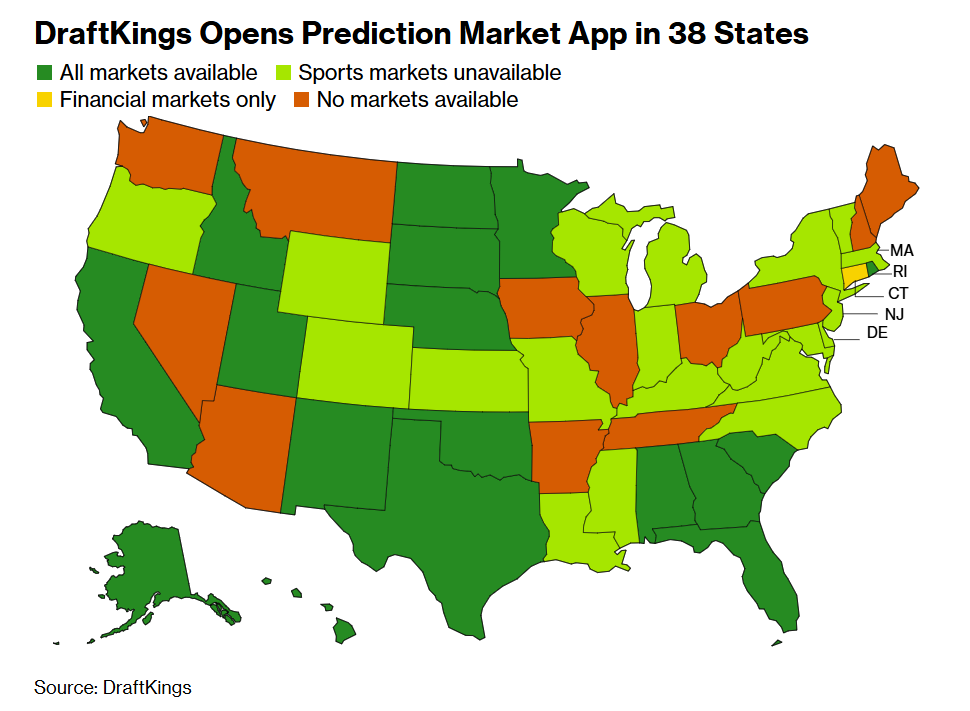
DraftKings’ growing national footprint. Source: Bloomberg

As a publicly traded US-based sports betting and entertainment company, DraftKings brings increased visibility and mainstream exposure to prediction markets and potentially crypto-linked contracts as regulated event trading gains traction in the United States.

In early November, DraftKings reported third-quarter revenue of $1.14 billion, up 4% year over year, alongside an adjusted loss of $127 million. The company said it expects to generate up to $6.1 billion in revenue this year, roughly triple the amount it generated in 2022.

Related: Polymarket shows stronger retention than most DeFi, wallets and exchanges

From Polymarket to Wall Street: Prediction markets go mainstream

While DraftKings’ prediction market offering is not built on blockchain or decentralized technology, the broader sector has gained momentum in recent years largely due to crypto-native platforms that redefined how prediction markets operate.

The most prominent example is Polymarket, which brought prediction markets onchain by using crypto rails to enable global participation and near-instant settlement.

The platform helped popularize prediction markets among crypto-native users, particularly during major political events and most notably the 2024 US presidential election. Its rise has coincided with growing interest in other event-based trading venues, including Kalshi, a US-regulated prediction market operating under the Commodity Futures Trading Commission (CFTC).

Beyond consumer-facing platforms, crypto-focused financial infrastructure providers are also expanding into the space. Bitnomial Clearinghouse, a derivatives clearing organization regulated by the CFTC, has signaled plans to support prediction markets tied to cryptocurrency and macroeconomic outcomes.

Crypto-native exchanges are also broadening their product suites to include prediction-style offerings. Coinbase recently announced plans to integrate stock trading and prediction markets into its long-term vision of becoming an “everything app.”

Source: Gemini

Meanwhile, the Winklevoss-led Gemini cryptocurrency exchange has launched prediction markets in the US, having secured the necessary regulatory approvals.

Related: Phantom taps Kalshi to offer regulated prediction markets in wallet

İlgili Sorular

QWhat new market is DraftKings expanding into, and what future offerings are they planning?

ADraftKings is expanding into prediction markets and is planning future crypto-linked contracts, as well as offerings related to entertainment and cultural events.

QThrough which regulated entity will DraftKings conduct its prediction market trading?

ADraftKings will conduct its trading through Railbird Exchange, a derivatives venue it acquired that is registered with the US Commodity Futures Trading Commission (CFTC).

QWhat is a key crypto-native platform that helped popularize onchain prediction markets?

APolymarket is the key crypto-native platform that helped popularize onchain prediction markets by using crypto rails for global participation and near-instant settlement.

QBesides DraftKings, name two other US-based companies or platforms mentioned that are involved in prediction markets.

ATwo other US-based companies involved in prediction markets are Kalshi, a CFTC-regulated prediction market, and the Gemini cryptocurrency exchange, which has launched its own prediction markets.

QWhat was DraftKings' reported third-quarter revenue and how does it compare to the previous year?

ADraftKings reported third-quarter revenue of $1.14 billion, which was up 4% year over year.

İlgili Okumalar

Net Profit Soars 1299.9%, Samsung's Q2 Reports the Most Profitable Quarter in History

Samsung Electronics posts record-breaking Q2 2026 results, driven primarily by explosive AI-driven demand for its semiconductor business. Revenue surged 130% year-on-year (YoY) to 171.5 trillion won, while operating profit skyrocketed 1,813.8% to 89.49 trillion won. Net profit reached 71.62 trillion won, a 1,299.9% increase YoY. The Device Solutions (DS) division, which includes memory chips, was the core engine, contributing over 99% of total operating profit. Sales for the DS unit hit a record 127.5 trillion won, with memory revenue reaching 120.8 trillion won, fueled by AI server demand for products like HBM. The company has begun mass production of next-generation HBM4. In contrast, the Device eXperience (DX) division, covering mobile phones and consumer electronics, reported an operating loss of 0.8 trillion won due to rising component costs, highlighting a significant performance split within the company. Other segments showed improvement: Samsung Display's profit rose to 0.7 trillion won, and Harman's profit recovered to 0.4 trillion won. Financially, Samsung's position strengthened dramatically, with cash and equivalents reaching 190 trillion won and operating cash flow hitting a record 105.1 trillion won. The company also engaged in significant share buybacks and dividend payments. Looking ahead, Samsung expects sustained strong demand from AI infrastructure, though acknowledges softer demand in some consumer segments.

marsbit14 dk önce

Net Profit Soars 1299.9%, Samsung's Q2 Reports the Most Profitable Quarter in History

marsbit14 dk önce

E Fund "Quits Drinking"

"Yi Fang Da 'Gives Up Alcohol'" - Summary The article analyzes the recent portfolio adjustments of star fund manager Zhang Kun, focusing on his flagship funds, the Yi Fang Da Blue Chip Select and Yi Fang Da Quality Select. The key trend highlighted is a significant and ongoing reduction in exposure to the consumer sector, particularly liquor (baijiu) stocks like Kweichow Moutai and Wuliangye, which were once core holdings. This shift is driven by several factors: a downturn in the consumer sector's business cycle post-pandemic, with slowing earnings growth for major players; a change in consumer behavior towards value over premium brands; and high channel inventory pressures, especially in the liquor industry. These fundamentals have led to a prolonged phase of valuation contraction for consumer stocks. Concurrently, market capital has rotated aggressively towards the high-growth technology sector, especially AI-related chains, which have dominated fund inflows. This style shift has further diminished the attractiveness of traditional consumer "core assets" for many funds. As a result, Zhang Kun's funds have drastically cut their consumer stock allocations. For example, the Blue Chip Select's baijiu holding proportion has fallen from over 40% to around 20%, and its overall top 10 holdings concentration dropped sharply. This mirrors a broader trend in the active equity fund industry, where allocations to consumer staples have plummeted to multi-year lows while technology holdings have surged. The article concludes that while the consumer sector's valuations are now at historical lows, offering some margin of safety, the fundamental outlook remains challenging due to weak macro consumption recovery and intense internal competition. Therefore, the sector is likely to see only sporadic rebounds rather than a sustained recovery, continuing to weigh on the performance of funds still heavily invested in it. Zhang Kun's timely reduction of Korean semiconductor holdings in his Asia Select fund amid a market crash is also noted as a contrast to his domestic strategy.

marsbit44 dk önce

E Fund "Quits Drinking"

marsbit44 dk önce

İşlemler

Spot
活动图片