Don't Rush to Declare Crypto Dead, AI Is Reviving It

比推2026-03-12 tarihinde yayınlandı2026-03-12 tarihinde güncellendi

Özet

Summary: The article argues that AI is revitalizing the crypto space by enabling an emerging "agent economy" where AI agents autonomously conduct transactions on-chain. It notes crypto's stagnation since 2021 but highlights how AI agents could drive demand. Key projects like Bankr and Venice, alongside infrastructure from Stripe and Coinbase, are building the foundation for this shift. The piece explains why blockchains are ideal for agent economies due to standards like ERC-8004 (digital identity), x402 (micro-payments), and stablecoins (global currency). Current on-chain agent activities include deploying apps, creating content, trading DeFi, and even hiring humans. With major tech companies racing to develop agent infrastructure and AI capabilities growing exponentially, the author concludes that the agent economy—though still early—is too significant to ignore.

Author: Nick, Investment Partner at Breed.vc

Compiled and Edited by: BitpushNews


"Imagine somewhere around 2027, a real 'nation of geniuses' emerges. Picture, say, 50 million people, each more capable than any Nobel laureate, politician, or technologist. Now imagine that, because AI systems operate hundreds of times faster than humans, this 'nation' has a time advantage over all others: for every cognitive action we take, this nation can take ten." — Dario Amodei

"In our view, agents will likely soon be responsible for most internet transactions, and we will need blockchains." — Stripe

We can imagine the creativity, economic progress, and level of wealth that the agent economy will generate.

Last month, the crypto community predicted that this economy would run on-chain, and as the largest companies, capital allocators, and developers put forward this proposition, the prediction seems reasonable.

We had similar fantasies at the end of '24, but in typical crypto fashion, it was too early then, and the hype was short-lived.

Since then, the quality of AI models and blockchain infrastructure has developed to a point where we are conducting this experiment again.

In this report, we will examine the current state of the crypto economy, review the history of crypto agents, discuss why the agent economy might exist on-chain, explore what agents are doing today, and look at what comes next.

The Current State of the Crypto Economy
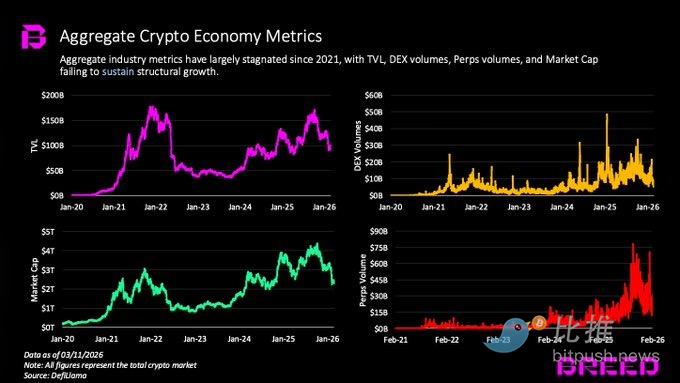
The lack of growth in the crypto asset class since the 2021 bull market has been disappointing. Most industry-wide metrics are at or below 2021 levels. Crypto world supremacy did not arrive.

AI agents provide a credible path to expanding demand.

The Seeds of the Crypto Agent Revival
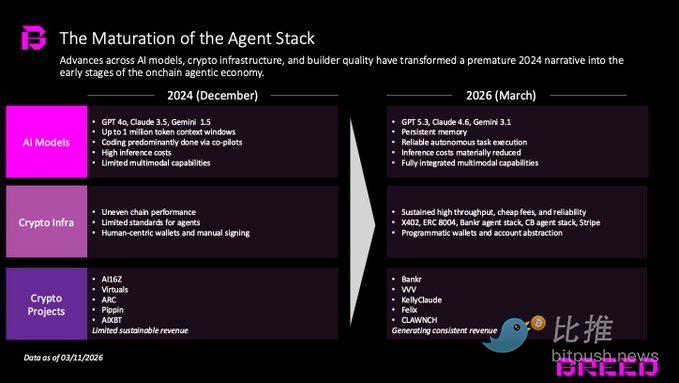
The "AI agents on blockchain" meta-narrative in 2024 was premature. The models, crypto infrastructure, and teams were not ready.

However, it wasn't all for nothing, as these lessons became the seeds of today's revival.

Projects like Bankr and Venice continued building so they could support today's models. Companies like Coinbase and Stripe recognized the potential and began developing their own supportive infrastructure.

Combine higher-quality teams with the continued building of a new generation of models, and you have the early stages of an on-chain agent economy.

Some projects are now generating recurring revenue and attracting high-quality developers—like Austen Allred, Nat Eliason, and Nik Pash—which is exactly what the crypto space desperately needs.

However, an on-chain agent economy is far from a certainty, as every payments company on Earth is racing to build this infrastructure.

Why the Agent Economy Will Run On-Chain
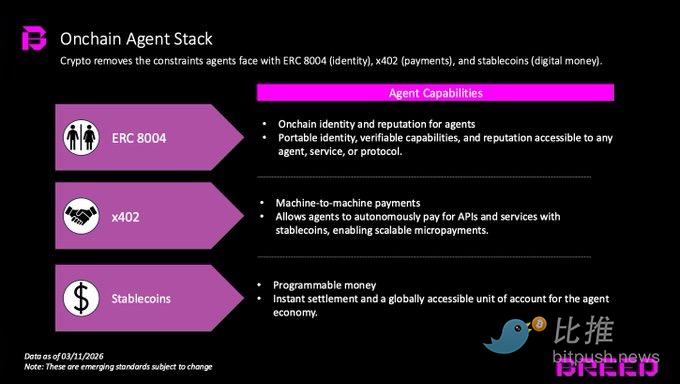
There is no stronger signal than Stripe explicitly stating that agents will run on blockchain rails. Their reasoning: every API call an agent makes today requires an account, an API key, and a linked credit card. This model breaks down when you have thousands of agents executing millions of microtransactions daily.

Blockchain solves these limitations by combining ERC-8004, x402, and stablecoins.

  • ERC-8004 gives each agent an on-chain identity, portable reputation, and verifiable capabilities that any other agent or service can query—the digital equivalent of identity and credit scores.

  • x402 allows agents to autonomously pay for APIs and services using stablecoins and scale micro-payments—the machine-to-machine payment layer for the internet.

  • Stablecoins give agents a globally accessible, programmable unit of account that can settle transactions instantly—the currency of the agent economy.

What Agents Are Doing Today

Today, agents are increasing their activity on-chain: launching applications, generating videos to promote these applications, contracting with other agents, handling governance matters for their users, selling NFTs, trading in DeFi, and even hiring humans.

The most exciting of these developments is the interaction with DeFi. Uniswap and Fluid are riding the agent narrative and beginning to build supportive infrastructure.

Furthermore, in the past month, OpenAI has made two agent-related announcements: Frontier, a platform designed to help businesses build, deploy, and manage AI colleagues; and EVM Bench, an evaluation framework for testing AI agents' ability to detect, patch, and exploit smart contract vulnerabilities.

Agents Are Coming
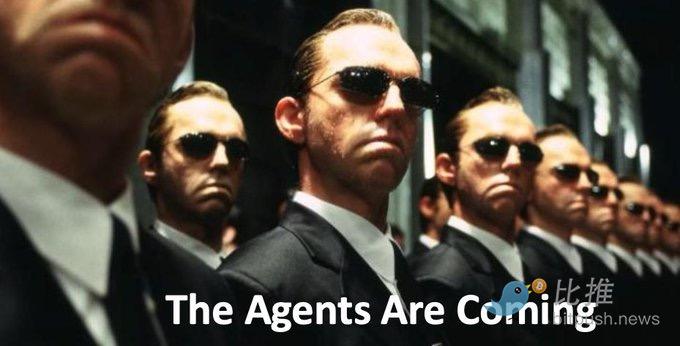
You might dismiss it as AI doom fiction, but the predictions of "AI 2027" are alarmingly accurate. If anything, AI progress is moving faster than the proposed timeline.

If this trajectory continues, we will see exponential growth in agent capabilities and intelligence over the next year.

Key parts of the stack still need to be built, but every major tech company in the world is racing against the clock to do so.

The social discussion around agents today might be frenzied, but the reality on the ground and the scale of the opportunity are too large to ignore.

Marc Andreessen (a16z partner) put it well: "Is it real? Or is it fake? It doesn't really matter. It's out there, and models are being trained on it."


Twitter:https://twitter.com/BitpushNewsCN

Bitpush TG Discussion Group:https://t.me/BitPushCommunity

Bitpush TG Subscription: https://t.me/bitpush

Original link:https://www.bitpush.news/articles/7619270

İlgili Sorular

QWhat is the main argument presented in the article regarding the future of Crypto and AI?

AThe article argues that AI is revitalizing the crypto space by creating an on-chain agent economy, where AI agents will drive demand, economic activity, and innovation through blockchain infrastructure.

QAccording to the article, why might the agent economy need to operate on-chain?

AThe agent economy needs to operate on-chain because traditional payment models (requiring accounts, API keys, and credit cards) fail at scale for micro-transactions. Blockchain solutions like ERC-8004, x402, and stablecoins provide identity, micro-payments, and a global programmable currency for agents.

QWhat are some specific activities that AI agents are already performing on-chain today, as mentioned in the article?

AAI agents are currently deploying applications, generating promotional videos, contracting other agents, handling governance tasks, selling NFTs, trading in DeFi, and even hiring humans on-chain.

QWhich companies or projects are cited as recognizing the potential of on-chain AI agents and building supportive infrastructure?

ACompanies like Stripe, Coinbase, Bankr, Venice, Uniswap, and Fluid are recognized for seeing the potential and developing infrastructure to support on-chain AI agents.

QWhat key blockchain technologies are highlighted as enabling the agent economy, and what role does each play?

AERC-8004 provides on-chain identity and reputation, x402 enables autonomous micro-payments for APIs and services, and stablecoins offer a global, programmable unit of account for instant settlement in the agent economy.

İlgili Okumalar

Must-Watch Events Next Week|CLARITY Act Could Face Senate Vote; SpaceX, Circle to Report Earnings (8.3-8.9)

**Summary: Key Events and Developments to Watch (August 3-9)** The upcoming week is marked by significant financial disclosures, key legislative deadlines, and notable product updates. **Major Financial Events:** Several companies are scheduled to release their Q2 2026 earnings. American Bitcoin (ABTC) will report on August 3, followed by SpaceX and Hut 8 Mining Corp. on August 4, and Circle on August 5. Notably, a significant portion of SpaceX shares (up to 12% of total shares) will be unlocked on August 6 following their earnings release. **Key Legislative Deadline:** The U.S. Senate faces an August 7 deadline to secure 60 votes for the CLARITY Act, a bipartisan bill aiming to establish a federal regulatory framework for cryptocurrencies. The Senate may hold a full vote on the bill during the week. **Economic Data:** The U.S. July Non-Farm Payrolls report will be released on August 7, providing crucial labor market data. **Technology & Product Updates:** * **Shutdowns:** DeFi portfolio tracker Zapper and wallet app Ctrl Wallet will cease operations on August 3. * **Upgrades:** LayerZero will deprecate its v1 relayers on August 3. XRP Ledger's new version 3.3.0, featuring five new functions, is expected next week. * **AI:** Elon Musk announced that the advanced Grok 4.6 AI model is set for release around August 7. * **Bitcoin:** The BIP-110 forced signaling for a potential Bitcoin network change is scheduled to begin around August 8. **Other Notable Events:** Chinese robotics firm Unitree Tech has set its preliminary price inquiry for its IPO for August 5. South Korean exchange Upbit will delist AQT and AERGO tokens on August 3.

marsbit4 dk önce

Must-Watch Events Next Week|CLARITY Act Could Face Senate Vote; SpaceX, Circle to Report Earnings (8.3-8.9)

marsbit4 dk önce

Stocks Are Plummeting More Sharply Than Cryptocurrencies. Where Has the Money Gone?

Stock Markets Plunge Deeper Than Cryptocurrencies: Where Did the Money Go? In late July, Seoul's Kospi index triggered circuit breakers for two consecutive days, plummeting over 40% from its June high. The collapse was led by heavyweight stocks like SK Hynix, whose record profits still disappointed investors, and devastating leveraged ETFs, with one major product losing over 83% of its value. This signaled a global, forced deleveraging targeting the most crowded trades. Interestingly, while stocks exhibited extreme volatility akin to crypto markets, Bitcoin rose nearly 15% in July after a prior steep drop. Analysis shows the money fleeing equities did not flow into Bitcoin. Instead, Bitcoin had already absorbed its sell-off in May-June, when U.S. spot Bitcoin ETFs saw historic outflows. The true safe-haven beneficiary was gold, whose price rose over 20% year-on-year, highlighting a decoupling between Bitcoin and gold as "digital gold." The sell-off was a targeted unwinding of leveraged positions in tech and semiconductors, accelerated by broker-dealer risk management and shifts in the AI narrative, including new competition from Chinese memory chipmakers. The retreat path was clear: from high-valuation tech stocks to cash and U.S. Treasuries, then to gold. For Bitcoin to attract sustained institutional inflows, conditions like eased global liquidity pressure, a "soft-landing" Fed rate cut, and U.S. regulatory clarity via legislation like the stalled CLARITY Act are needed. Currently, Bitcoin is not a safe haven but an already-cleared asset. Its low correlation with tech stocks, however, makes it a potential diversification play for institutional portfolios once the storm passes. The money isn't here yet, but the positioning is underway.

marsbit4 dk önce

Stocks Are Plummeting More Sharply Than Cryptocurrencies. Where Has the Money Gone?

marsbit4 dk önce

In Conversation with Ray Dalio: We Are Currently in an AI Bubble, with 1% of My Portfolio in Bitcoin

Ray Dalio, founder of Bridgewater Associates, warns in an interview that the current AI boom shows classic bubble characteristics, which could lead to significant economic downturns as seen in past cycles like 1929 or 2000. He explains that speculative enthusiasm, fueled by debt and overvaluation, often precedes a crash when rising rates or taxation force asset sales, causing widespread losses and recession. Dalio also outlines his "Big Cycle" theory, describing an approximate 80-year pattern where widening wealth gaps, massive government deficits, and shifting geopolitical power (like China's rise) create internal conflict and global instability. He emphasizes that we are in a late-cycle, transitional phase where traditional powers like the US and UK face decline. For personal wealth protection, Dalio advises diversification beyond cash into assets like stocks, bonds, real estate, and particularly gold, which he prefers over Bitcoin. While he holds about 1% of his portfolio in Bitcoin as a non-printable hard asset, he views gold as more secure from technological or governmental threats. Regarding AI's impact, Dalio believes it will disproportionately benefit capital owners, worsening inequality by replacing both physical and cognitive labor. He suggests that human intuition and emotional intelligence, combined with AI, will be key for future workers. On taxation, Dalio argues that wealth taxes are impractical and risk triggering asset sell-offs, reducing productive investment. He points to the UK as a cautionary example of debt, low productivity, and political strife. Geopolitically, Dalio foresees a more regionalized world, with the US showing weakness in prolonged conflicts like with Iran, akin to past imperial declines. The ideal outcome, he suggests, is coexisting powerful blocs (e.g., Americas, China-Asia Pacific) without major war.

marsbit3 saat önce

In Conversation with Ray Dalio: We Are Currently in an AI Bubble, with 1% of My Portfolio in Bitcoin

marsbit3 saat önce

Daily 7.2 Trillion KRW: Foreign Capital's Record Net Buying on Friday! Wall Street Says Headwinds for Korean Stock Fund Flows Have Subsided

South Korean stock market sees a dramatic shift in fund flows. On July 31, foreign investors made a record net purchase of approximately KRW 7.2 trillion in KOSPI stocks, marking a fundamental reversal from the persistent large-scale net outflows seen in previous months. This contributed to a significant narrowing of foreign net selling in July to KRW 9.8 trillion, down sharply from KRW 48.4 trillion in June and KRW 44.5 trillion in May. Simultaneously, domestic institutional pressure eased. South Korean pension funds and asset managers turned to a net buying position in July, purchasing KRW 1.0 trillion worth of KOSPI shares, contrasting with net sales in May and June. Market volatility is expected to be dampened by new financial regulations. Effective July 31, the Financial Services Commission tightened access for retail investors to single-stock leveraged ETFs by raising the minimum cash deposit requirement. Trading volumes for these products subsequently dropped to about 50% of their monthly average. Citigroup Research maintains its year-end KOSPI target of 10,000 points. The firm cites several supportive factors: the substantial easing of headwinds from capital outflows, a robust fundamental outlook for the semiconductor sector, historically low market valuations, strong economic fundamentals, and the potential for policy support from financial authorities if needed.

marsbit3 saat önce

Daily 7.2 Trillion KRW: Foreign Capital's Record Net Buying on Friday! Wall Street Says Headwinds for Korean Stock Fund Flows Have Subsided

marsbit3 saat önce

İşlemler

Spot
活动图片





