Don't Care if You Know Football or Not, Buying the Draw Is the Best Strategy for This World Cup?

Odaily星球日报2026-06-22 tarihinde yayınlandı2026-06-22 tarihinde güncellendi

Özet

The article analyzes the 2026 FIFA World Cup group stage and argues that betting on a draw has been a surprisingly profitable strategy. Based on data from the prediction market Polymarket, a strategy of betting $1000 on a draw for each of the first 40 matches would have yielded a return of over 100%, despite only 13 matches ending in a draw. The core of the strategy is not the frequency of wins, but the high payout when low-probability draws occur, such as Spain's 0-0 draw with Cape Verde, where pre-match odds for a draw were only 5.5%. The article identifies common draw scores, like 1-1, which provide stability, and high-value 0-0 stalemates, where favorites fail to break down resilient defenses. It highlights Group G as an example, where 3 of the first 4 matches ended in draws, illustrating that draws are a tactical part of group stage calculus as teams often prioritize not losing. In conclusion, while strong teams remain favorites on the pitch, the article claims that for traders, betting on draws has so far produced the most significant profits.

Original | Odaily Planet Daily (@OdailyChina)

Author | Asher(@Asher_ 0210)
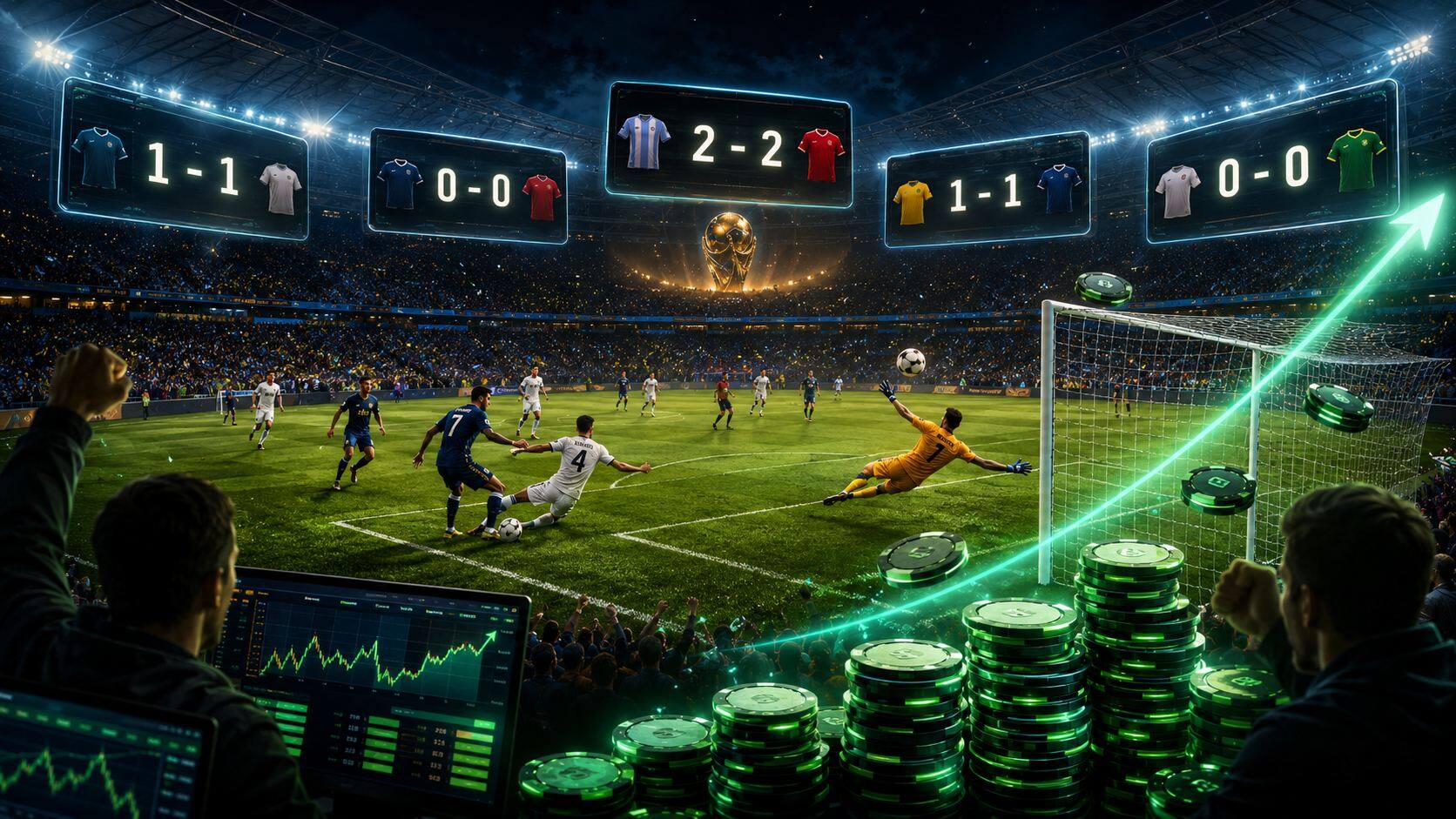
As the World Cup group stage progresses, a very counter-intuitive phenomenon is becoming increasingly clear—buying the favorite, doesn't necessarily make money; buying the underdog, isn't necessarily easy to hold onto either, but if you blindly buy the draw for every match, you might actually be raking it in.

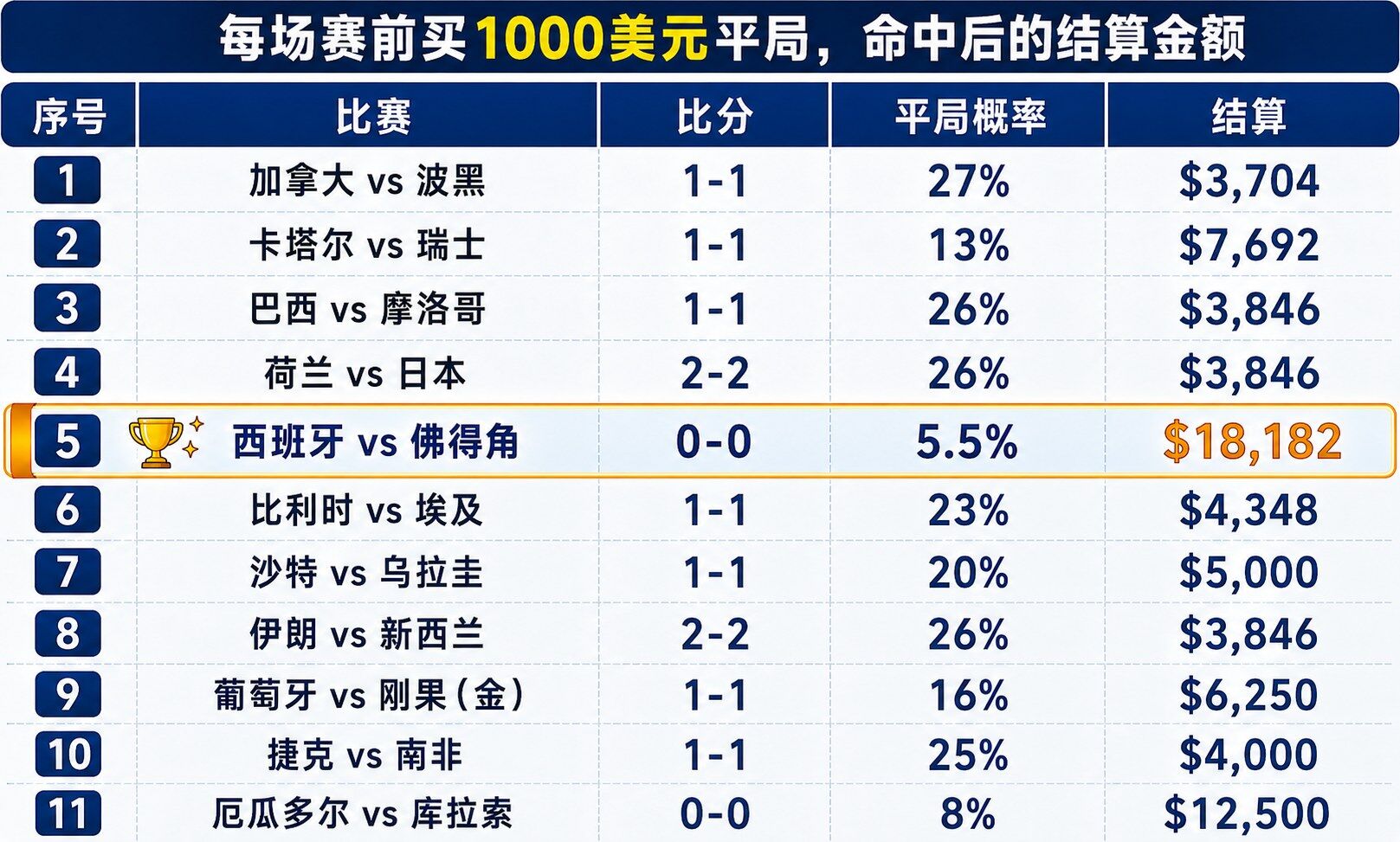
Calculated based on Polymarket pre-match prediction data, if you put $1000 on "Draw" for every match, there have been 11 draws in the previous 36 matches (as shown below). That is to say, with a total investment of $36,000, the winnings from successful bets amount to $73,214. After deducting the principal, the net profit is $37,214, representing a return of over 100%.
Even more impressive, according to Polymarket pre-match prediction data, if we continue the strategy of "$1000 on Draw per match" for today's 4 matches (total investment of $4000). Looking at the results: Spain 4-0 Saudi Arabia, New Zealand 1-3 Egypt—these two resulted in a loss of the stake; but Belgium 0-0 Iran and Uruguay 2-2 Cape Verde were hits, with a combined payout of approximately $8,700. This means that even with only 2 hits out of the 4 matches today, the daily net profit is still around $4,700.

Including today's 4 matches, out of 40 World Cup group stage matches, there have been 13 draws. With a total investment of $40,000, the total payout from winning bets is approximately $81,914. After deducting all investments, the net profit is about $41,914, representing a return of nearly 105%.

A hit rate of 13/40 isn't particularly high, but the key to the draw strategy is never about "hitting often," but about "hitting big." The lower the pre-match probability of a draw, the higher the payout multiplier when it hits. Matches like Spain vs. Cape Verde with a 5.5% draw probability, Ecuador vs. Curaçao with an 8% draw probability, or Qatar vs. Switzerland with a 13% draw probability—hitting just a few of these is enough to turn the entire strategy from a small loss into a massive gain.

Cape Verde's Draw Against Spain Is the Most Typical "Liquidation Game" of the World Cup So Far

The Spain vs. Cape Verde group stage match wasn't just a big win for the draw strategy; it was also a nightmare for pre-match buyers backing the favorite.

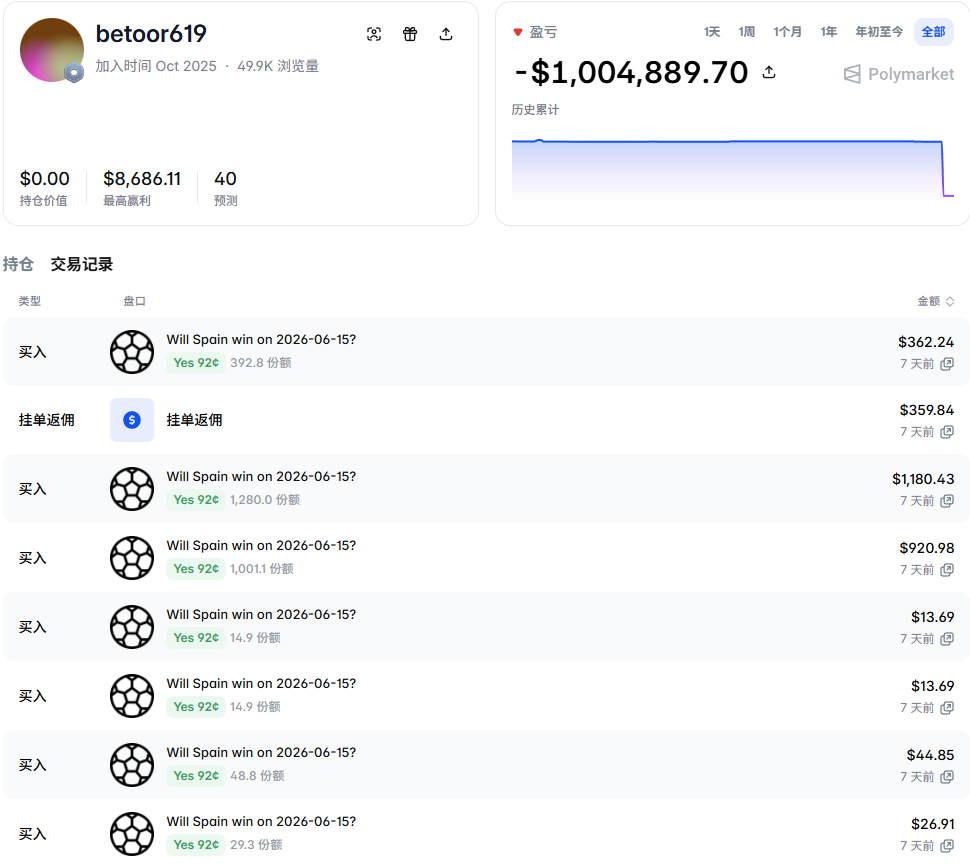
In this group stage match, Spain's pre-match win probability was as high as 92%. Polymarket data shows that account @betoor619 (address: 0x70088c990ffae782c699b9250f5aa6cbe4e3c666) bought Spain to win in the World Cup group stage match Spain vs. Cape Verde. The match ended 0:0, resulting in a loss of $999,000 for this user.

It's worth noting that this user bought in at the 92-cent moment, meaning they staked $1 million in principal for a potential profit of $85,000. A seemingly sure-win trade ultimately resulted in a cold loss due to the 7 incredible saves by Cape Verde's 40-year-old goalkeeper and Cape Verde's extremely resilient defense.
0-0 and 1-1 Are Becoming the Main Theme of This World Cup So Far

Looking at the draw results that have hit so far, draws in this World Cup group stage aren't appearing randomly but are concentrated in a few typical scorelines.

The most common is 1-1. Canada vs. Bosnia and Herzegovina, Qatar vs. Switzerland, Brazil vs. Morocco, Belgium vs. Egypt, Saudi Arabia vs. Uruguay, Portugal vs. DR Congo, Czech Republic vs. South Africa—all ended with this score. The commonality in these matches is that neither side was completely without chances, nor did the weaker team simply park the bus until the end. More often, the stronger team failed to convert their advantage into a win, while the weaker team seized an opportunity to respond. The matches seemed back-and-forth, but in the end, neither side could truly break through the other.

For traders, the value of 1-1 lies in its stability. It's not the most exaggerated source of profit, but it occurs frequently, forming the foundation of this "buy draw every match" strategy.

What really boosts the profits are the 0-0 draws.

Spain vs. Cape Verde is the most typical example. Spain was considered the absolute favorite pre-match, with only a 5.5% draw probability. But the match ended 0-0. If $1,000 was invested pre-match on the draw, the payout would be approximately $18,182. Ecuador vs. Curaçao follows a similar logic. With only an 8% draw probability, it also resulted in 0-0, with $1,000 invested corresponding to a payout of $12,500.

Therefore, the real money-making aspect of the draw strategy isn't about hitting every match, but rather that a few low-probability draws, when they do hit, come with very exaggerated payout multipliers. This is especially true for 0-0 matches, where the on-field action often involves the favorite team attacking constantly while the underdog's goalkeeper and defense repeatedly clear the ball.

Group G Is Even More Ridiculous: 3 Draws in 4 Matches

If Spain vs. Cape Verde represents low-probability draws, then Group G is more like a microcosm of the "draw density" in this group stage.

Out of the first 4 matches, Group G has produced 3 draws. In the first round: Belgium 1-1 Egypt, Iran 2-2 New Zealand; in the second round: Belgium 0-0 Iran. The only match with a decisive result was New Zealand vs. Egypt, but this doesn't change one fact: the overall rhythm of this group has been completely slowed down by draws.

Especially Belgium, who have drawn both of their group stage matches so far. For the team, this means the pressure to qualify from the group continues; but for those who bought a Belgium win pre-match, the outcome of both matches was the same—no loss, but their position wiped out.

This is also where the draw is most underestimated in prediction markets. The market prefers to buy the favorite to win because it seems more intuitive; but the real logic of group stage football isn't "the favorite must win," but rather that many teams are willing to settle for 1 point. The weaker team doesn't want to lose, the stronger team doesn't want to take risks too early. Once a match reaches a stalemate, a draw becomes a very realistic outcome.

3 draws in the first 4 matches of Group G indicates that draws are not accidental upsets, but part of the group stage tactical game. Especially when the points haven't been significantly separated, every team starts calculating—winning is of course best, but avoiding losing first is often the safer choice.

Summary

In this World Cup, the strong teams are still the main characters.

Spain will win, Brazil will win, and favorites will always have matches where they deliver a crushing victory. But if we look purely at trading profits, the most profitable script in the group stage so far might not be the big wins by the giants, but rather those recurring 1-1s, 0-0s, and 2-2s.

Those who bought the favorites are waiting for goals, those who bought the draw are waiting for the final whistle, and so far, the latter are laughing louder.


İlgili Sorular

QAccording to the article, what has been the most profitable betting strategy for the World Cup group stage so far?

AAccording to the article, the most profitable betting strategy so far has been to consistently bet on a draw in every match. Using a hypothetical strategy of betting $1000 on a draw for each of the first 40 group stage matches, the strategy yielded a net profit of approximately $41,914, representing a return of nearly 105%.

QWhy is the 'bet on draw' strategy considered effective despite a relatively low win rate?

AThe 'bet on draw' strategy is effective not because it wins frequently, but because it 'wins valuably'. The pre-match probability for a draw is often very low, which means the payout multiplier is very high when a draw does occur. Hitting just a few of these low-probability draws can turn the overall strategy from a slight loss into a significant profit.

QWhich specific match is highlighted as the most typical 'liquidation game' for favorite bettors?

AThe match between Spain and Cape Verde is highlighted as the most typical 'liquidation game'. One user on Polymarket bet $1 million on Spain to win when the probability was 92%, aiming for an $85,000 profit. The match ended 0-0, resulting in a loss of 99.9% of their stake.

QWhat are the two most common draw scorelines mentioned, and how do they differ in their impact on the betting strategy?

AThe two most common draw scorelines are 1-1 and 0-0. The 1-1 draws are more frequent and form the 'base' of the strategy's returns. The 0-0 draws, while less frequent, are the key profit drivers because they often occur in matches where one team is a heavy favorite, leading to very low pre-match draw probabilities and therefore extremely high payout multipliers when they hit.

QWhat does the high frequency of draws in Group G (3 draws in 4 matches) illustrate about the nature of group stage matches?

AThe high frequency of draws in Group G illustrates that draws are not merely accidental upsets, but are an integral part of group stage tactics. In the early stages, many teams prioritize not losing over aggressively seeking a win. The calculus for teams often involves securing at least 1 point to maintain their position, leading to more cautious play and a higher likelihood of drawn matches.

İlgili Okumalar

From South Korea to the United States: Blue-Collar Jobs Are Becoming Increasingly Popular, Thanks to AI

AI is reshaping the labor market's value proposition. The traditional four-year college degree is losing its appeal as a guaranteed career path, while skilled blue-collar trades like electricians, welders, and plumbers are experiencing historic demand and wage premiums. This shift is driven by dual pressures: AI's displacement of certain white-collar roles and a booming need for physical infrastructure and data center construction. Data confirms the trend. In the U.S., vocational school revenue surged, and a significant portion of recent layoffs are AI-related. Surveys show a majority of Gen Z adults plan to pursue blue-collar work, citing better job security against AI automation. Vocational education interest has exploded recently. Experts cite a psychological shift as younger generations seek tangible, AI-resistant careers and avoid high student debt. In many cases, salaries for skilled trades now match or exceed those requiring a bachelor's degree. In South Korea, semiconductor vocational high schools boast near-total employment, with graduates securing high-paying roles at companies like Samsung. The shortage is structural, exacerbated by a retiring baby boomer workforce and massive infrastructure projects. Companies like JPMorgan Chase, Meta, and Lowe's are investing heavily in training programs. However, overcoming historical stigma and a "perception gap" around trade careers remains a key challenge to closing the talent gap.

marsbit19 dk önce

From South Korea to the United States: Blue-Collar Jobs Are Becoming Increasingly Popular, Thanks to AI

marsbit19 dk önce

Qualcomm: AI Hype Subsides, When Will Smartphones Emerge from the Gloom?

Qualcomm reported its Q3 FY2026 results (ending June 2026), with revenue of $9.95B, down 4% YoY but above expectations. Gross margin declined to 53.1%, pressured by rising costs across manufacturing and memory. Key business segments showed mixed performance: Handset revenue fell 19.6% YoY to $5.09B, dragged by an 11% decline in non-Apple Android shipments and weaker high-end mix. Conversely, Automotive revenue surged 61% to $1.59B, and IoT grew 9% to $1.83B. Core operating profit dropped 41% YoY due to margin compression and higher expenses. Management's Q4 FY2026 guidance projects revenue of $9.7B-$10.5B, in line with consensus, but Non-GAAP EPS guidance of $2.05-$2.25 fell short of expectations. Amidst persistent weakness in its core handset market, Qualcomm is pursuing growth in AI, focusing on Edge AI (smartphones, PCs, automotive) and Data Center AI. Its data center strategy includes four pillars: AI accelerators (e.g., AI200), commercial CPUs (Dragonfly C1000), custom silicon, and connectivity solutions. While these initiatives initially boosted its stock, concerns over AI capital expenditure sustainability have since erased those gains. The company targets $5B in data center revenue for FY2027 and $15B for FY2029. The report concludes that with the traditional handset business still under pressure, the data center opportunity is currently viewed as a longer-term option, and a more conservative valuation based on core operations may be warranted until AI contributions materialize.

marsbit23 dk önce

Qualcomm: AI Hype Subsides, When Will Smartphones Emerge from the Gloom?

marsbit23 dk önce

From TPU to Self-Evolving Agents: How Jeff Dean Predicts the Next Step in AI

At the 2026 YC Startup School, Jeff Dean outlined his vision for AI's next phase, shifting focus from simply scaling models to building intelligent, autonomous systems. He believes AI's progress is no longer just about creating smarter models, but about integrating them into systems capable of long-term, iterative work, automated experimentation, and continuous learning. This evolution moves the competition from "who has the bigger model" to "who can best organize intelligence." Dean suggests AI capabilities are now comparable to a junior engineer, enabling the automation of complex workflows. However, the true challenge and opportunity lie in managing these AI "workers" at scale. He emphasizes the importance of **context engineering**—structuring tools, memory, and feedback loops—over raw model power. For startups, this means building deep expertise in niche domains where general models currently fail (near 0-1% success rates), leveraging proprietary data, specialized tools, and domain-specific evaluators. A recurring theme is re-examining fundamental constraints. Dean's past work, like moving Google's search index to memory or creating the TPU, stemmed from questioning outdated assumptions about hardware and cost. He sees similar inflection points today, particularly in **specialized inference hardware** to drastically reduce latency and energy consumption for real-time Agent operation. Notably, he points out that in modern AI systems, the dominant cost is often not computation but **data movement**. Reliable, long-running Agents require robust system design, borrowing concepts from distributed computing like checkpointing, state management, and parallel exploration to handle failures and maintain progress over days or weeks. As AI automates execution, the scarcest human skills will shift to **defining clear specifications**, **judging what problems are worth solving** (taste), and designing effective feedback loops. Ultimately, Dean's framework prioritizes understanding the problem deeply, identifying the true bottlenecks, and systematically building closed-loop systems where AI can not only perform tasks but also improve AI itself.

marsbit23 dk önce

From TPU to Self-Evolving Agents: How Jeff Dean Predicts the Next Step in AI

marsbit23 dk önce

İşlemler

Spot
活动图片




