DOJ, Europol Freeze $3.5M In Crypto After Dismantling Global Proxy Fraud Network

bitcoinist2026-03-14 tarihinde yayınlandı2026-03-14 tarihinde güncellendi

Özet

US and European authorities dismantled SocksEscort, a global proxy service that used malware (AVrecon) to hijack over 369,000 devices in 163 countries, allowing criminals to hide their locations. The service, operating for years, generated at least $5.7 million from users who paid in cryptocurrency for anonymity. A coordinated law enforcement effort across multiple countries resulted in the seizure of 34 domains, takedown of servers, and freezing of $3.5 million in crypto. The network was linked to various crimes, including a $1 million cryptocurrency theft from a New York resident, bank fraud, and account takeovers.

A New York resident lost close to $1 million in cryptocurrency. That single case became one of the clearest examples of the damage done by SocksEscort — a for-hire proxy service that gave criminals across the globe a way to hide while they stole.

A Network Built On Hijacked Devices

US and European authorities announced Thursday they had shut down SocksEscort after years of operation. The service worked by infecting routers and other internet-connected devices with malware, turning them into cover points that masked the real locations of cybercriminals.

According to the Department of Justice, the network had quietly burrowed into at least 369,000 devices spread across 163 countries. Criminals could then route their attacks through those compromised machines, making them far harder to trace.

The malware at the heart of the operation — known as AVrecon — had been publicly identified by cybersecurity firm Black Lotus Labs as far back as July 2023. The network kept running anyway.
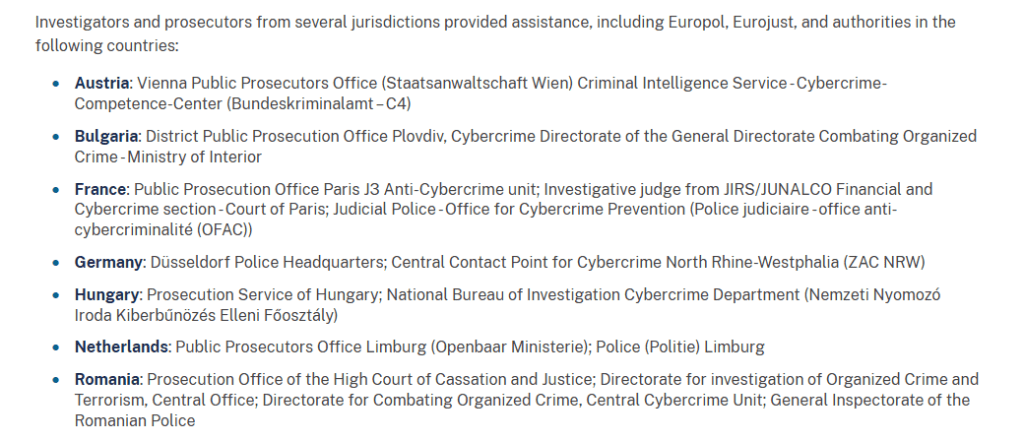
Source: DOJ

The takedown was not a single agency effort. Law enforcement from Austria, France, Germany, Hungary, the Netherlands, Romania, and the US worked the case together.

On the American side, the FBI’s Sacramento Field Office, the IRS Criminal Investigation Oakland Field Office, and the Department of Defense’s Defense Criminal Investigative Service all had a hand in it.

Europol and Eurojust provided cross-border coordination support. Black Lotus Labs and the nonprofit Shadowserver Foundation supplied technical intelligence that helped investigators connect the dots.

Bitcoin is now trading at $70,541. Chart: TradingView

Criminals Paid In Crypto To Stay Anonymous

SocksEscort did not just attract individual bad actors. It ran like a business. Customers paid to access the service, and they did so anonymously — using cryptocurrency to avoid leaving a financial trail.

Based on reports from Europol, the platform pulled in at least 5 million euros, roughly $5.7 million, from its paying users over the course of its run.

Authorities were ultimately able to seize 34 domains, take down about two dozen servers operating across seven countries, and freeze approximately $3.5 million in crypto tied to the operation.

Europol Executive Director Catherine De Bolle said proxy services of this kind give criminals the cover to carry out attacks, move illegal content, and dodge detection. She credited the international cooperation for exposing the infrastructure behind it.

Fraud Stretched From Bank Accounts To Crypto Wallets

The crimes enabled by SocksEscort went beyond any single method. Officials linked the network to bank fraud and cryptocurrency account takeovers dating back to 2020.

The New York victim’s case stood out for its scale, but reports indicate the damage was spread across multiple countries and target types.

Featured image from Pexels, chart from TradingView

İlgili Sorular

QWhat was the name of the proxy service dismantled by US and European authorities?

ASocksEscort

QHow many devices were infected by the malware used in the SocksEscort operation according to the Department of Justice?

AAt least 369,000 devices

QWhat was the name of the malware at the heart of the SocksEscort operation?

AAVrecon

QHow much cryptocurrency was frozen by authorities in connection with the SocksEscort network?

AApproximately $3.5 million

QWhich cybersecurity firm had publicly identified the AVrecon malware as far back as July 2023?

ABlack Lotus Labs

İlgili Okumalar

Bitcoin Withdrawals Continue: 8 Years of Storage in a Coldcard Cold Wallet Ended in Zero

Coldcard Hardware Wallet Hacked: Losses Mount Due to Vulnerable Seed Generation A critical vulnerability in Coldcard hardware wallets has led to a continued wave of fund thefts. According to Galaxy Research, the total stolen has reached 1,367.05 BTC (approx. $88.6 million) from 4,585 addresses, a significant increase from the initial 594.5 BTC reported on July 30, 2026. Most of the stolen funds remain on the attackers' addresses. The issue is not with the current firmware, which Coinkite has updated, but with seed phrases generated on vulnerable devices between March 2021 and the release of fixed firmware versions. Due to a programmer error, devices switched from using a hardware random number generator to the software-based Yasmarang generator, which was initialized with publicly accessible data like the chip's serial number. This made the seed phrases predictable through offline brute-force attacks, meaning wallets remain at risk until funds are moved to a new wallet generated with the patched firmware. Affected devices include Mk2/Mk3 with firmware 4.0.1–4.1.9 (and up to 5.0.3), Mk4/Mk5 up to version 5.6.0, and Q models up to 1.5.0Q. The only exceptions are seeds created with a high-entropy method like at least 50 independent dice rolls or a strong unique BIP-39 passphrase. All other owners must generate a new seed on the fixed firmware and transfer their assets. A case highlighting the human impact involves a 39-year-old long-term investor who lost 2 BTC (approx. $130,000) in minutes. He had accumulated the Bitcoin over eight years through physical labor, viewing it as a financial lifeline and a retirement plan in a country suffering from hyperinflation. His story underscores that even conservative "buy and hold in cold storage" strategies can be compromised by such underlying technical flaws. From a technical perspective, this incident echoes historical failures where weak random number generators undermined cryptographic security, challenging the assumption that offline storage is automatically foolproof.

cryptonews.ru52 dk önce

Bitcoin Withdrawals Continue: 8 Years of Storage in a Coldcard Cold Wallet Ended in Zero

cryptonews.ru52 dk önce

İşlemler

Spot
活动图片





