DOJ Crypto Unit Closure Sparks Scrutiny Of Deputy AG’s Personal Crypto Stakes

bitcoinist2026-01-29 tarihinde yayınlandı2026-01-29 tarihinde güncellendi

Özet

The Justice Department's decision to disband its National Cryptocurrency Enforcement Team (NCET) in April 2025 is under scrutiny from six US senators. They are questioning Deputy Attorney General Todd Blanche about potential conflicts of interest due to his personal cryptocurrency holdings. The senators, including Mazie Hirono and Elizabeth Warren, demand documents and a full explanation for the unit's closure and whether Blanche's finances influenced the decision. Critics argue the timing of his divestment raises ethical concerns, while supporters claim it was approved by ethics officials. The lawmakers are seeking a detailed timeline and records to ensure federal conflict-of-interest laws were followed.

The Justice Department’s move last year to shut a specialized crypto enforcement team is drawing fresh fire after six US senators pressed the deputy attorney general for answers about his personal stakes in digital assets.

The lawmakers say the timing and Deputy Attorney General Todd Blanche’s holdings raise real questions about conflicts that need clear records and a full explanation.

Senators Demand Answers

Reports say the letter, dated January 28, 2026, was sent by Senator Mazie Hirono and joined by Senators Elizabeth Warren, Richard Durbin, Sheldon Whitehouse, Chris Coons, and Richard Blumenthal.

They asked Blanche to provide documents and explain why the National Cryptocurrency Enforcement Team (NCET) was disbanded in April 2025 and whether his own finances played any role in that decision. The lawmakers pointed to federal conflict rules and asked for the timeline and approvals behind the memo.
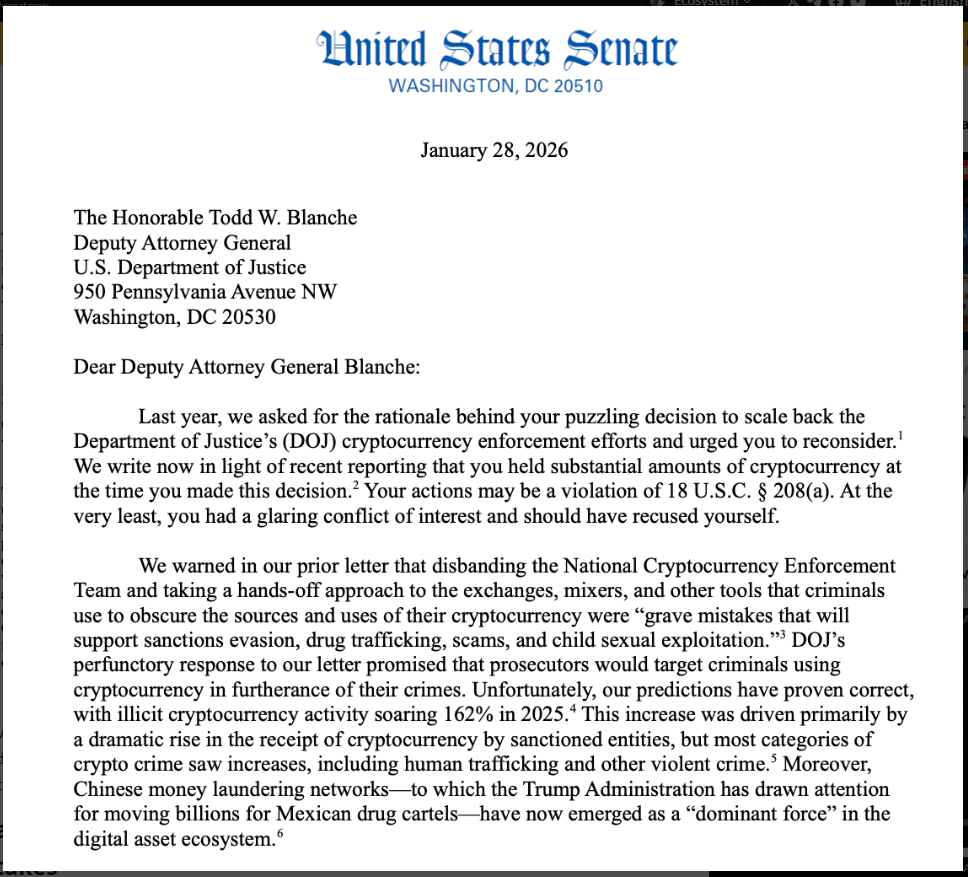
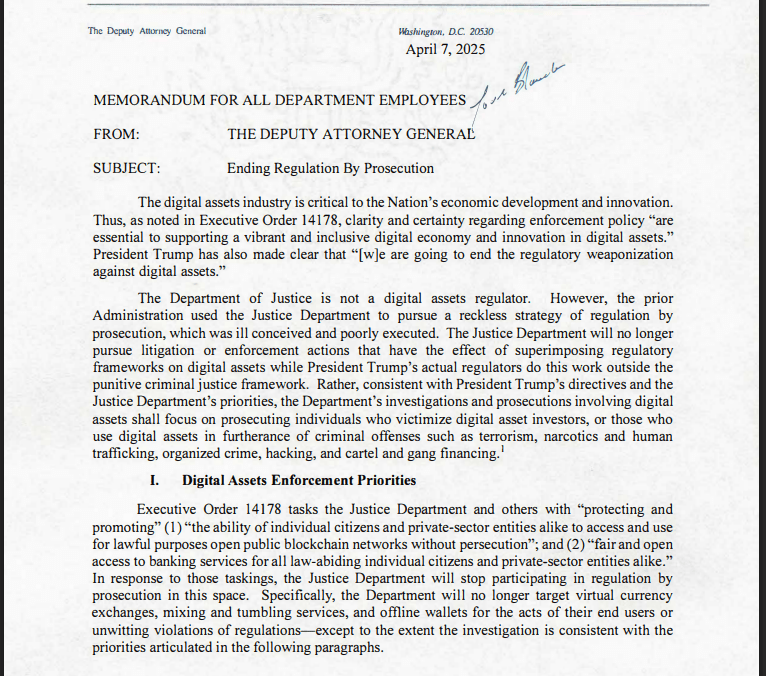
The memo signed by Deputy Attorney General Todd Blanche. Source: DOJ

He agreed to divest, and some sales or transfers happened weeks to months after the memo. Critics say that sequence looks bad and could run afoul of conflict rules; supporters say the matters were cleared by ethics officials.

People On Both Sides Are Talking

Proponents of the policy change argued it would avoid “regulation by prosecution” and let regulators handle oversight instead of criminal cases.

Industry groups welcomed the move as a way to reduce legal uncertainty for exchanges and developers.

Opponents, including the senators, say scaling back a focused enforcement unit risks leaving gaps that bad actors can exploit, especially as illicit activity in crypto has shown sharp swings in recent years.

BTCUSD now trading at $87,783. Chart: TradingView

What Comes Next

Lawmakers are now pushing for documents and sworn answers. They want to see when Blanche learned of the holdings, how fast divestment happened, and who inside DOJ reviewed and approved the memo.

The senators pointed to federal law that bars an official from participating in a matter when they have a financial interest, and they requested a timeline and supporting records to judge whether that law was respected.

Featured image from Getty Images, chart from TradingView

Trend Kriptolar

İlgili Sorular

QWhat action by the US senators has brought renewed scrutiny to the closure of the DOJ's crypto enforcement team?

ASix US senators, led by Senator Mazie Hirono, sent a letter to Deputy Attorney General Todd Blanche pressing him for answers about his personal cryptocurrency holdings and the decision to disband the National Cryptocurrency Enforcement Team (NCET).

QWhat specific concerns did the senators raise regarding Deputy AG Todd Blanche?

AThe senators raised concerns about a potential conflict of interest, questioning whether Blanche's personal financial stakes in digital assets played a role in the decision to shut down the NCET and if the timing of his divestment complied with federal conflict-of-interest rules.

QWhat was the main argument from proponents who supported the policy change of closing the NCET?

AProponents argued that closing the specialized crypto enforcement team would avoid 'regulation by prosecution' and allow regulators, rather than criminal prosecutors, to handle oversight of the cryptocurrency industry.

QAccording to the article, what is the primary concern of the senators and other opponents of closing the NCET?

AOpponents are concerned that scaling back the focused enforcement unit creates gaps that bad actors can exploit, especially given the volatile nature of illicit activity in the cryptocurrency space in recent years.

QWhat specific information are the lawmakers demanding from Deputy AG Blanche and the DOJ?

AThe lawmakers are demanding documents and sworn answers detailing when Blanche learned of his crypto holdings, the timeline of his divestment, and which DOJ officials reviewed and approved the memo to disband the NCET, to ensure compliance with federal conflict-of-interest laws.

İlgili Okumalar

Can Japan Buy Growth with AI? Will the Bond Market Believe It?

Japan's cabinet has introduced the 2026 Basic Policy on Economic and Fiscal Management and Reform, shifting its primary fiscal target. The new framework moves away from the traditional annual primary balance goal and instead prioritizes a stable reduction of the debt-to-GDP ratio. This change is tied to a strategy of increased "responsible proactive fiscal" spending, aiming to boost long-term growth through investments in strategic sectors like AI, semiconductors, energy, and robotics. The government estimates total public and private investment in 62 key technologies could exceed 370 trillion yen by 2040. The market reaction has been mixed and cautious. While equity markets may respond to policy signals, bond markets are focused on fiscal credibility. Concerns center on whether the weakening of the clear primary balance anchor could lead to looser fiscal discipline. If investors doubt that these strategic investments will generate sufficient productivity gains, tax revenue, and nominal growth to outpace rising interest costs, they may demand higher yields on Japanese Government Bonds (JGBs). Recent volatility in the yen and JGB yields, with the 10-year yield briefly reaching 2.9%, reflects this skepticism. The success of this new framework hinges on two factors: whether Japan can achieve a nominal growth rate consistently higher than its long-term interest rates, and whether future budgets demonstrate disciplined control over bond issuance. The government's narrative is that strategic investment is essential to break Japan's cycle of low growth, aging, and labor shortages. However, the bond market will continuously assess the credibility of this plan, pricing the risk that it may represent fiscal expansion rather than a viable growth strategy.

marsbit4 dk önce

Can Japan Buy Growth with AI? Will the Bond Market Believe It?

marsbit4 dk önce

Misjudged A-Shares: Resilience, Expectations, and Confidence

China's A-share market recently faced selling pressure, especially in tech sectors, initially triggered by a global tech sell-off that began in South Korea. However, the article argues this is a case of "mistaken injury" and highlights the market's underlying resilience. This resilience stems from three main pillars: **1) Tech Sector Fundamentals:** Unlike Korea's market dominated by a few memory chip stocks, China's tech sector is diversified across computing, communications, electronics, and semiconductors, supported by dual narratives of global AI supply chains and domestic substitution. Core areas like optical modules and fiber optics continue to show strong earnings growth. **2) "National Team" Support:** State-backed institutions and large corporations have made significant market purchases and announced buybacks, providing liquidity and signaling confidence. This is seen as a stabilizing policy signal, often associated with market bottoms. **3) Broader Market Pillars:** Other major sectors are showing endogenous recovery momentum. Consumer stocks benefit from stabilizing CPI and signs of sector recovery (e.g., liquor price hikes). Cyclical sectors like aluminum have high earnings, potential price increases due to tight supply, and low valuations. The financial sector offers stable dividends and low valuations. The conclusion is that the sell-off was driven by external contagion, not a collapse in fundamentals. With strong policy support and recovering momentum across key sectors, the A-share market possesses the toughness to regain stability.

marsbit35 dk önce

Misjudged A-Shares: Resilience, Expectations, and Confidence

marsbit35 dk önce

The Clarity Act's Journey Through Congress: The Thorny Path of Bipartisan Compromise in the U.S.

The U.S. Congress is struggling to advance the crypto market structure bill known as the Clarity Act, with bipartisan compromise proving difficult. Key hurdles include unresolved disputes over "yield" products and, more critically, the inclusion of strong ethics provisions for elected officials—a non-negotiable demand for many Democrats. While a compromise on yield was reached in May, securing only limited Democratic support in committee, the separate Senate Agriculture Committee version later passed with no Democratic votes due to the ethics impasse. As Republicans push for a full Senate vote in July, demands for ethics rules have expanded, and other contentious issues like developer protections and concerns from law enforcement and large banks further complicate negotiations. Despite consensus on the need for legislation, the path forward is unclear. Recent discussions between senators and White House officials aim to find acceptable ethics language. Some lawmakers question whether a compromise text can garner enough bipartisan support, with one Democrat stating the current proposal lacks the strong ethics provisions required for their vote. Potential short-term goals for the crypto community include symbolic Senate action before the August recess, a longer-term aim for passage by 2026, or establishing a detailed framework that addresses ethics and other compromises. The process remains arduous, relying on the traditional, vote-by-vote effort to build bipartisan support.

marsbit54 dk önce

The Clarity Act's Journey Through Congress: The Thorny Path of Bipartisan Compromise in the U.S.

marsbit54 dk önce

İşlemler

Spot

Popüler Makaleler

MOVE Nasıl Satın Alınır

HTX.com’a hoş geldiniz! Movement (MOVE) satın alma işlemlerini basit ve kullanışlı bir hâle getirdik. Adım adım açıkladığımız rehberimizi takip ederek kripto yolculuğunuza başlayın. 1. Adım: HTX Hesabınızı OluşturunHTX'te ücretsiz bir hesap açmak için e-posta adresinizi veya telefon numaranızı kullanın. Sorunsuzca kaydolun ve tüm özelliklerin kilidini açın. Hesabımı Aç2. Adım: Kripto Satın Al Bölümüne Gidin ve Ödeme Yönteminizi SeçinKredi/Banka Kartı: Visa veya Mastercard'ınızı kullanarak anında Movement (MOVE) satın alın.Bakiye: Sorunsuz bir şekilde işlem yapmak için HTX hesap bakiyenizdeki fonları kullanın.Üçüncü Taraflar: Kullanımı kolaylaştırmak için Google Pay ve Apple Pay gibi popüler ödeme yöntemlerini ekledik.P2P: HTX'teki diğer kullanıcılarla doğrudan işlem yapın.Borsa Dışı (OTC): Yatırımcılar için kişiye özel hizmetler ve rekabetçi döviz kurları sunuyoruz.3. Adım: Movement (MOVE) Varlıklarınızı SaklayınMovement (MOVE) satın aldıktan sonra HTX hesabınızda saklayın. Alternatif olarak, blok zinciri transferi yoluyla başka bir yere gönderebilir veya diğer kripto para birimlerini takas etmek için kullanabilirsiniz.4. Adım: Movement (MOVE) Varlıklarınızla İşlem YapınHTX'in spot piyasasında Movement (MOVE) ile kolayca işlemler yapın.Hesabınıza erişin, işlem çiftinizi seçin, işlemlerinizi gerçekleştirin ve gerçek zamanlı olarak izleyin. Hem yeni başlayanlar hem de deneyimli yatırımcılar için kullanıcı dostu bir deneyim sunuyoruz.

333 Toplam GörüntülenmeYayınlanma 2024.12.13Güncellenme 2026.06.02

MOVE Nasıl Satın Alınır

Tartışmalar

HTX Topluluğuna hoş geldiniz. Burada, en son platform gelişmeleri hakkında bilgi sahibi olabilir ve profesyonel piyasa görüşlerine erişebilirsiniz. Kullanıcıların MOVE (MOVE) fiyatı hakkındaki görüşleri aşağıda sunulmaktadır.

活动图片













