Dogecoin Whales Remain Quiet, What’s Going On And Is DOGE At Risk?

bitcoinist2026-01-09 tarihinde yayınlandı2026-01-09 tarihinde güncellendi

Özet

Dogecoin started 2026 with a significant price surge, briefly reclaiming the $0.15 level after a bearish end to 2025. However, on-chain data reveals that mega whales (holders of 100M-1B DOGE) remained largely inactive during this rally, even reducing their holdings slightly. In contrast, smaller "shark" wallets (10M-100M DOGE) and mid-sized holders (1M-10M DOGE) were the primary accumulators, driving the buying pressure and increased trading volume. Despite the initial jump, DOGE has since pulled back to $0.1424, facing continued resistance at $0.15. The lack of participation from the largest whales introduces uncertainty into the meme coin's near-term outlook.

Dogecoin didn’t ease into 2026 quietly. Following several weeks of drifting and bearish price action at the end of last year, the memecoin suddenly picked up speed, jumping in the first few days of January and briefly reclaiming levels above $0.15. However, on-chain data shows that Dogecoin’s mega whales did not have a hand in the rally. These large Dogecoin holders have mostly stayed on the sidelines, avoiding both heavy buying and selling.

Dogecoin’s Whales Quiet During Recent Price Action

Dogecoin began the week with a quick burst of upside that carried the price from below $0.12 into mid-$0.15. Trading activity picked up during the move, and there was genuine buying interest. During this period, Dogecoin’s trading volume nearly tripled those seen during the last days of December, with notable examples of $3.56 billion trading volume on January 2 and $2.34 billion on January 4.

This intense trading activity briefly placed the Dogecoin price above $0.15 on January 5, a price level that has served as a resistance level that stopped the meme coin’s price action throughout December 2025. However, an interesting detail from recent on-chain analysis is how little large holders reacted to the price rally.

According to data from on-chain analytics platform Santiment, Dogecoin addresses holding 100 million to 1 billion DOGE saw their collective holdings increase into January 4, peaking around 35.8 billion DOGE, before a decline beginning on January 5.

Starting on January 5, this group began trimming exposure, and even as Dogecoin’s price action continued climbing to the $0.15 level, their combined holdings fell to roughly 34.59 billion DOGE by January 6. Since then, balances in this cohort have largely remained flat.
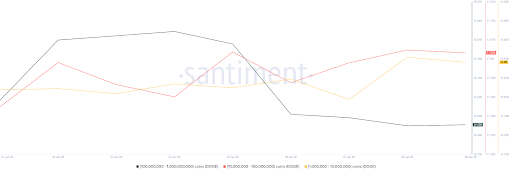
Dogecoin Large Holder Distribution. Source: Santiment

Sharks Doing Most Of The Bullish Work

On the other hand, Dogecoin sharks, i.e., wallets holding between 10 million and 100 million DOGE showed a much stronger appetite. After a brief pullback between January 2 and January 4, this group returned to accumulation during Dogecoin’s push higher. That buying trend has continued through the rest of the week, lifting their collective holdings to about 17.63 billion DOGE at the time of writing.

Smaller large holders in the 1 million to 10 million DOGE range followed a similar pattern, though with more hesitation early on. Activity in this group increased at the start of the week, followed by a dip around January 7. That decline was short-lived, however, as balances rebounded on January 8 and 9, rising to roughly 10.9 billion DOGE at the time of writing.

As it stands, Dogecoin’s price action seems to be taking a pause from the rally and is back to facing resistance at $0.15. The meme coin is now trading at $0.1424, and the lack of clear commitment from large whales is also keeping the outlook uncertain.

DOGE price fails to hold up | Source: DOGEUSDT on Tradingview.com

İlgili Sorular

QWhat was the initial price movement of Dogecoin at the beginning of January 2026?

ADogecoin suddenly picked up speed, jumping in the first few days of January and briefly reclaiming levels above $0.15.

QHow did the trading volume of Dogecoin change during the price surge?

ADogecoin's trading volume nearly tripled compared to the last days of December, with notable examples of $3.56 billion on January 2 and $2.34 billion on January 4.

QWhat was the behavior of Dogecoin mega whales (addresses holding 100 million to 1 billion DOGE) during the rally?

AThey mostly stayed on the sidelines, avoiding both heavy buying and selling. Their collective holdings peaked around 35.8 billion DOGE on January 4 before declining to roughly 34.59 billion DOGE by January 6.

QWhich group of Dogecoin holders showed the strongest buying appetite during the price increase?

ADogecoin sharks (wallets holding between 10 million and 100 million DOGE) showed a much stronger appetite and returned to accumulation during Dogecoin's push higher.

QWhat is Dogecoin's current price and key resistance level mentioned in the article?

ADogecoin is trading at $0.1424 and is facing resistance at the $0.15 level.

İlgili Okumalar

In Jinjiang, Fujian, a Storage Super Unicorn Lies Quiet

In Fujian's Jinjiang, a city known for sportswear, lies a quiet semiconductor giant: Fujian Jinhua Integrated Circuit Co. (JHICC). Once a promising domestic DRAM manufacturer alongside Yangtze Memory and ChangXin Memory Technologies (CXMT), its journey was derailed in 2018 when the U.S. placed it on an Entity List and filed criminal charges for alleged trade secret theft. This halted production for years. A turning point came in February 2024 when a U.S. federal court found JHICC not guilty. However, it had lost crucial time. While CXMT soared to become a top-valued A-share company in 2024, JHICC, with an estimated valuation of 80 billion RMB, was just restarting. Its current output is primarily customized DDR4 chips, not the advanced DDR5/HBM demanded for AI, but it still benefits from the broader memory chip upcycle. JHICC's story is tied to Chen Zhengkun, a veteran engineer who left Micron to lead the venture. Founded in 2016 with state-backed funding, JHICC partnered with Taiwan's UMC to develop DRAM technology. Rapid progress was cut short by the U.S. actions, which Micron initiated, partly due to its heavy reliance on the Chinese market. Post-sanctions, Chen's team worked to rebuild the production line with reduced reliance on U.S. technology. According to its records, JHICC achieved small-scale production and revenue growth under immense pressure. It now focuses on the stable "niche" DRAM market (e.g., TVs, routers) with a monthly capacity of ~40,000 wafers, aiming for 60,000 by 2026. It holds over 1,000 patents but remains on the Entity List. For Jinjiang, investing in JHICC was a bold industrial leap. The local government provided unwavering financial and logistical support during the crisis, helping the company survive. JHICC has become the anchor for a growing local semiconductor cluster. Though its scale lags behind domestic peers, JHICC's persistence symbolizes a hard-won foothold in a global market long dominated by Samsung, SK Hynix, and Micron. Having missed one boom, it seeks a place in the new AI-driven memory supercycle.

marsbit1 saat önce

In Jinjiang, Fujian, a Storage Super Unicorn Lies Quiet

marsbit1 saat önce

İşlemler

Spot
活动图片





