Dogecoin Whales Remain Quiet, What’s Going On And Is DOGE At Risk?

bitcoinist2026-01-09 tarihinde yayınlandı2026-01-09 tarihinde güncellendi

Özet

Dogecoin started 2026 with a significant price surge, briefly reclaiming the $0.15 level after a bearish end to 2025. However, on-chain data reveals that mega whales (holders of 100M-1B DOGE) remained largely inactive during this rally, even reducing their holdings slightly. In contrast, smaller "shark" wallets (10M-100M DOGE) and mid-sized holders (1M-10M DOGE) were the primary accumulators, driving the buying pressure and increased trading volume. Despite the initial jump, DOGE has since pulled back to $0.1424, facing continued resistance at $0.15. The lack of participation from the largest whales introduces uncertainty into the meme coin's near-term outlook.

Dogecoin didn’t ease into 2026 quietly. Following several weeks of drifting and bearish price action at the end of last year, the memecoin suddenly picked up speed, jumping in the first few days of January and briefly reclaiming levels above $0.15. However, on-chain data shows that Dogecoin’s mega whales did not have a hand in the rally. These large Dogecoin holders have mostly stayed on the sidelines, avoiding both heavy buying and selling.

Dogecoin’s Whales Quiet During Recent Price Action

Dogecoin began the week with a quick burst of upside that carried the price from below $0.12 into mid-$0.15. Trading activity picked up during the move, and there was genuine buying interest. During this period, Dogecoin’s trading volume nearly tripled those seen during the last days of December, with notable examples of $3.56 billion trading volume on January 2 and $2.34 billion on January 4.

This intense trading activity briefly placed the Dogecoin price above $0.15 on January 5, a price level that has served as a resistance level that stopped the meme coin’s price action throughout December 2025. However, an interesting detail from recent on-chain analysis is how little large holders reacted to the price rally.

According to data from on-chain analytics platform Santiment, Dogecoin addresses holding 100 million to 1 billion DOGE saw their collective holdings increase into January 4, peaking around 35.8 billion DOGE, before a decline beginning on January 5.

Starting on January 5, this group began trimming exposure, and even as Dogecoin’s price action continued climbing to the $0.15 level, their combined holdings fell to roughly 34.59 billion DOGE by January 6. Since then, balances in this cohort have largely remained flat.
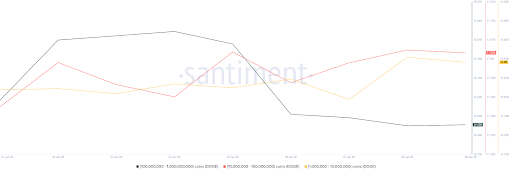
Dogecoin Large Holder Distribution. Source: Santiment

Sharks Doing Most Of The Bullish Work

On the other hand, Dogecoin sharks, i.e., wallets holding between 10 million and 100 million DOGE showed a much stronger appetite. After a brief pullback between January 2 and January 4, this group returned to accumulation during Dogecoin’s push higher. That buying trend has continued through the rest of the week, lifting their collective holdings to about 17.63 billion DOGE at the time of writing.

Smaller large holders in the 1 million to 10 million DOGE range followed a similar pattern, though with more hesitation early on. Activity in this group increased at the start of the week, followed by a dip around January 7. That decline was short-lived, however, as balances rebounded on January 8 and 9, rising to roughly 10.9 billion DOGE at the time of writing.

As it stands, Dogecoin’s price action seems to be taking a pause from the rally and is back to facing resistance at $0.15. The meme coin is now trading at $0.1424, and the lack of clear commitment from large whales is also keeping the outlook uncertain.

DOGE price fails to hold up | Source: DOGEUSDT on Tradingview.com

İlgili Sorular

QWhat was the initial price movement of Dogecoin at the beginning of January 2026?

ADogecoin suddenly picked up speed, jumping in the first few days of January and briefly reclaiming levels above $0.15.

QHow did the trading volume of Dogecoin change during the price surge?

ADogecoin's trading volume nearly tripled compared to the last days of December, with notable examples of $3.56 billion on January 2 and $2.34 billion on January 4.

QWhat was the behavior of Dogecoin mega whales (addresses holding 100 million to 1 billion DOGE) during the rally?

AThey mostly stayed on the sidelines, avoiding both heavy buying and selling. Their collective holdings peaked around 35.8 billion DOGE on January 4 before declining to roughly 34.59 billion DOGE by January 6.

QWhich group of Dogecoin holders showed the strongest buying appetite during the price increase?

ADogecoin sharks (wallets holding between 10 million and 100 million DOGE) showed a much stronger appetite and returned to accumulation during Dogecoin's push higher.

QWhat is Dogecoin's current price and key resistance level mentioned in the article?

ADogecoin is trading at $0.1424 and is facing resistance at the $0.15 level.

İlgili Okumalar

Cursor, Why Boarded Musk's Starship?

SpaceX announced its acquisition of AI programming startup Cursor's parent company, Anysphere, for $60 billion in an all-stock deal, just days after its record-breaking IPO. The move sent SpaceX's stock soaring, briefly making it the most valuable U.S. company. Cursor, founded in 2022 by MIT graduate Michael Truell and his classmates, is a popular AI coding assistant that allows developers to switch between models from OpenAI, Anthropic, and others. It saw explosive revenue growth, reaching a $4 billion annualized run rate in early 2026. However, its market share was eroded by the launch of competitor Claude Code from its key AI supplier, Anthropic. This dependence prompted Cursor to develop its own AI model, Composer, in early 2026. To scale Composer, Cursor needed immense computing power. In April 2026, it struck a deal with SpaceX, granting the latter an option to acquire it post-IPO. SpaceX exercised this option, offering Cursor access to its Colossus supercomputer, powered by hundreds of thousands of top-tier Nvidia AI chips. For SpaceX, the acquisition is a strategic move to bolster its AI capabilities, particularly for its xAI division, and advance its broader ambition of building orbital, solar-powered data centers. While the deal surprised some employees and investors given Truell's earlier stance on independence, it represents a high-stakes partnership. SpaceX CEO Elon Musk has projected the company could reach $1 trillion in revenue by 2030. For Truell, joining forces with SpaceX is a monumental gamble on an unprecedented scale in the race for AI dominance.

链捕手2 dk önce

Cursor, Why Boarded Musk's Starship?

链捕手2 dk önce

The More It Rises, the More Dangerous? The Systemic Risks Behind SpaceX's Soaring Valuation

Summary: The article raises concerns about the systemic risks posed by SpaceX's skyrocketing valuation, arguing that modern market mechanics, rather than fundamentals, are driving its price discovery. Following SpaceX's market capitalization surpassing $3 trillion in after-hours trading, the author contends that the market is no longer functioning properly. The core issue is not SpaceX's business prospects but the unhealthy market structure surrounding it. With limited float and the imminent launch of options trading, the stage is set for a potential "gamma squeeze"—a feedback loop where market makers hedging call options are forced to buy shares, pushing the price higher and attracting more speculative momentum traders. This mechanism, seen previously with Tesla and meme stocks, can decouple valuation from financial reality. The danger escalates as extreme valuations force passive funds, ETFs, pensions, and major indices to hold the stock. If SpaceX grows large enough—hypothetically reaching $5 or even $10 trillion—its performance would increasingly dictate broader market indices, embedding systemic risk. The author warns that when price appreciation itself becomes the primary bullish thesis, the market transforms from a capital allocation mechanism into a self-reinforcing speculative machine, endangering the retirement savings of ordinary investors tied to passive strategies. The piece questions whether such a system can still perform its fundamental role of price discovery.

marsbit7 dk önce

The More It Rises, the More Dangerous? The Systemic Risks Behind SpaceX's Soaring Valuation

marsbit7 dk önce

How Much of the Subscription Fee You Pay to Claude Can Optical Module Companies Get?

How much of your $20 Claude Pro subscription actually goes to AI model companies like Anthropic? A viral breakdown image highlights the fundamental valuation challenge for AI applications versus traditional SaaS. Unlike SaaS with high software margins, AI subscriptions face variable "inference costs": every user query consumes GPU time, power, and cloud resources. This creates a tension between fixed subscription fees and usage-driven expenses. While the specific dollar splits are illustrative, the core question is whether AI revenue can achieve SaaS-like margins as usage scales. Currently, infrastructure providers (cloud platforms, GPU makers like Nvidia, HBM suppliers, power/data centers) capture more certain revenue from growing AI usage. Their financials reflect pricing power and faster earnings validation. The bullish case hinges on efficiency improvements: model optimization, caching, smaller models, and custom chips could lower per-token costs over time. The key debate is whether cost declines can outpace increases in user workload complexity and volume. Ultimately, for AI companies to command high SaaS-like valuations, they must demonstrate not just user growth but also improving gross margins after accounting for inference costs. Investors will scrutinize not just subscriber numbers, but usage patterns, enterprise pricing tiers, and real efficiency gains.

marsbit17 dk önce

How Much of the Subscription Fee You Pay to Claude Can Optical Module Companies Get?

marsbit17 dk önce

OpenAI's Hyperliquid Pre-IPO Pricing Venture: Why Did It Last Only Half a Year?

The article discusses the rise and fall of Pre-IPO pricing markets on the Hyperliquid blockchain. Trade.xyz, an anonymous team, successfully built the largest pre-market for SpaceX (SPCX) by launching a contract with a clear anchor: the eventual Nasdaq listing price. This provided inherent price stability and validation. In contrast, Ventuals, a team backed by Paradigm, failed despite holding exclusive contracts for highly sought-after companies like OpenAI and Anthropic. Its key mistake was its pricing mechanism. For companies with no near-term IPO date, Ventuals' oracle relied partly on opaque private market transactions and, critically, partly on its own contract's moving average price. This created a self-referential feedback loop where prices were artificially propped up and detached from genuine supply and demand, leading to illiquid markets. Ventuals shut down after nine months, settling positions at final prices of $1,341.80 for OpenAI and $1,618.90 for Anthropic. Ironically, some employees and late-stage investors of these very companies reportedly used these flawed Ventuals prices for valuation reference, highlighting the acute demand for any price signal in illiquid private markets. The article concludes that while demand for pre-IPO trading is real and growing, with players like Coinbase now entering the space, the fundamental challenge remains: without a public listing to provide a definitive price anchor, these markets struggle to establish truly accurate and liquid pricing. The need for a transparent, self-correcting market is the critical lesson from Ventuals' failure.

marsbit33 dk önce

OpenAI's Hyperliquid Pre-IPO Pricing Venture: Why Did It Last Only Half a Year?

marsbit33 dk önce

İşlemler

Spot
Futures
活动图片





