Dogecoin nears $0.088 support – But THESE signals hint at downside

ambcrypto2026-03-23 tarihinde yayınlandı2026-03-23 tarihinde güncellendi

Özet

Dogecoin (DOGE) is nearing a critical support level at $0.088, with recent on-chain activity showing increased transfers and transactions, yet failing to boost its price. This is attributed to a distribution phase, where whale inflows into exchanges have created selling pressure. Market sentiment remains bearish due to global tensions, affecting both crypto and stock markets. Bitcoin's drop below $70,000 has added to the downward pressure. Technical indicators like the RSI at 35 confirm bearish momentum, though the CMF suggests slightly easing outflows. A cluster of long liquidations between $0.084 and $0.088 could drive prices lower, potentially testing $0.086. A break below this level would weaken bullish prospects, while a hold could set the stage for a recovery.

Dogecoin [DOGE] witnessed an increase in onchain activity recently. It was reported that both the Daily Transfer Volume and the Transaction Count numbers were elevated, but failed to translate into any notable price gains.

This was likely because DOGE was going through a distribution phase.

AMBCrypto reported that whale flows into exchanges translated into immediate sell pressure. This pushed prices further toward the month-long range lows at $0.0887.

What can happen at the Dogecoin range lows?

Generally, one would expect a bullish reaction at the lows of a range.

At the same time, the market sentiment was once more in extreme despair. Worries of escalation in the US-Iran conflict and a worsening energy crisis have already sent Asian stock markets reeling.

Bitcoin [BTC] faced profit-taking pressure and has slumped below the $70k psychological support. In these settings, Dogecoin bulls will have a tough time sparking a price rally.
Source: DOGE/USDT on TradingView

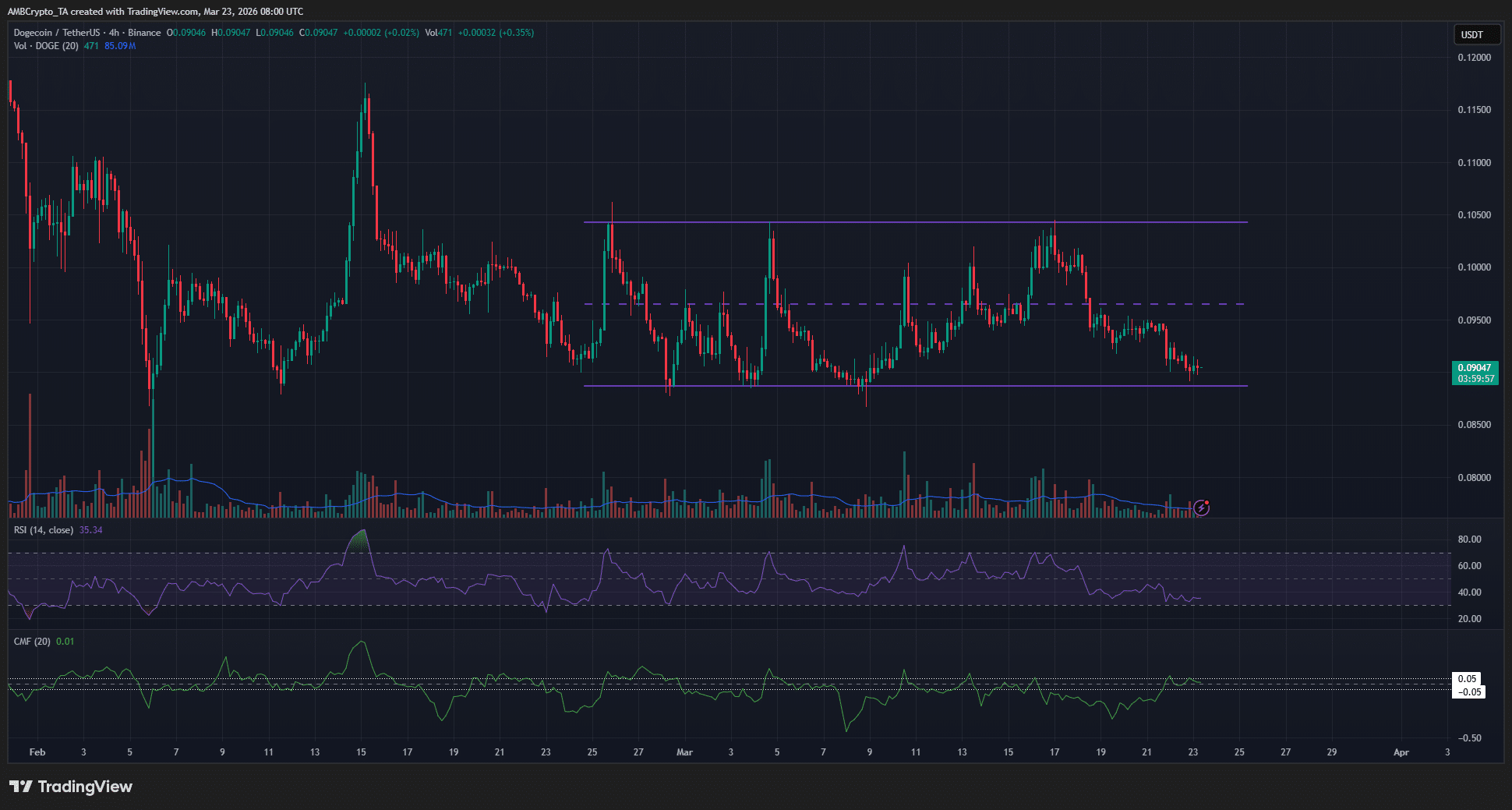
The range extended from $0.0887 to $0.104, with the mid-point at $0.0965. The $0.088 area has had added importance as a support level since the first week of February.

The RSI on the 4-hour chart was at 35, indicating bearish momentum was prevalent.

On the other hand, the CMF was at +0.01. It had climbed higher within the past week to signal easing capital outflows as the price approached a key local support.

It is unclear if this is enough for the bulls to initiate a move toward the range highs. It would depend on Bitcoin and the crypto market sentiment, which also hinges on the global investor sentiment.

Traders’ call to action- Brace for a sweep of the local lows
Source: CoinGlass

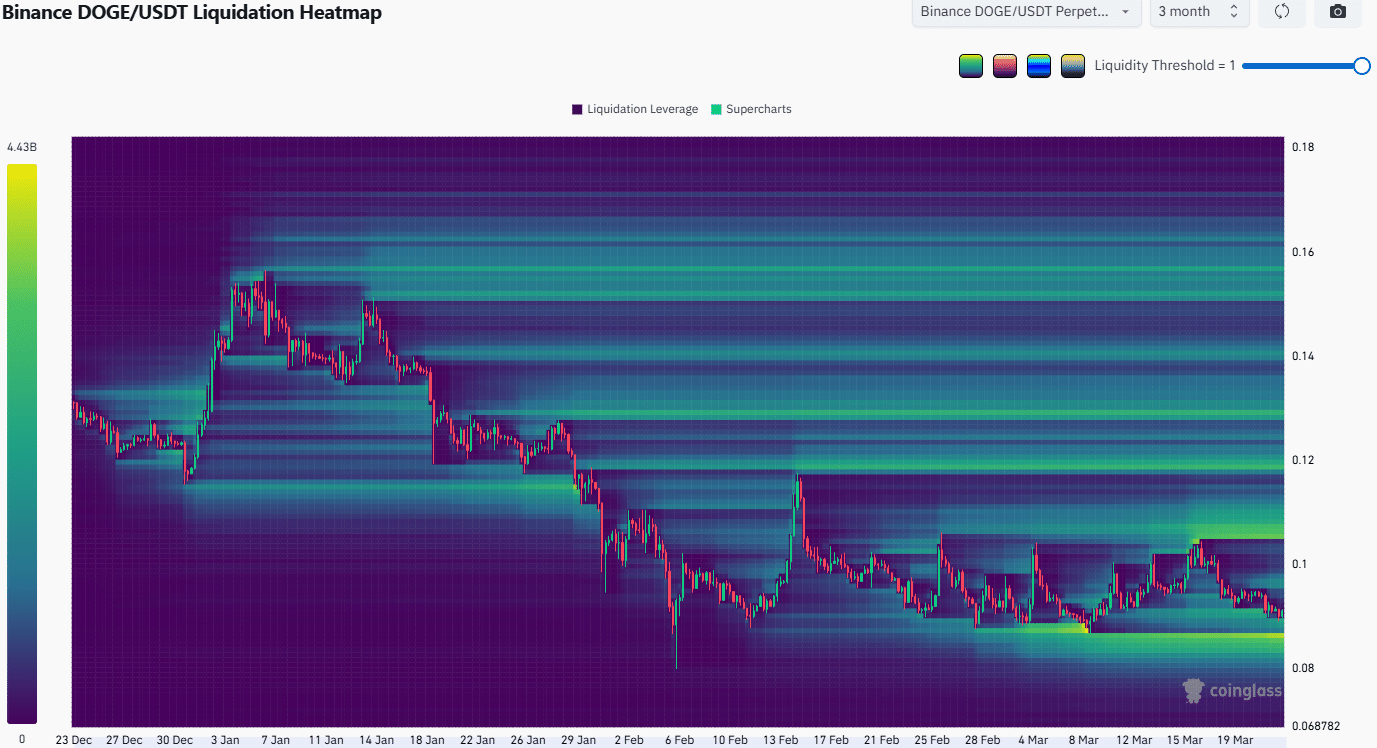
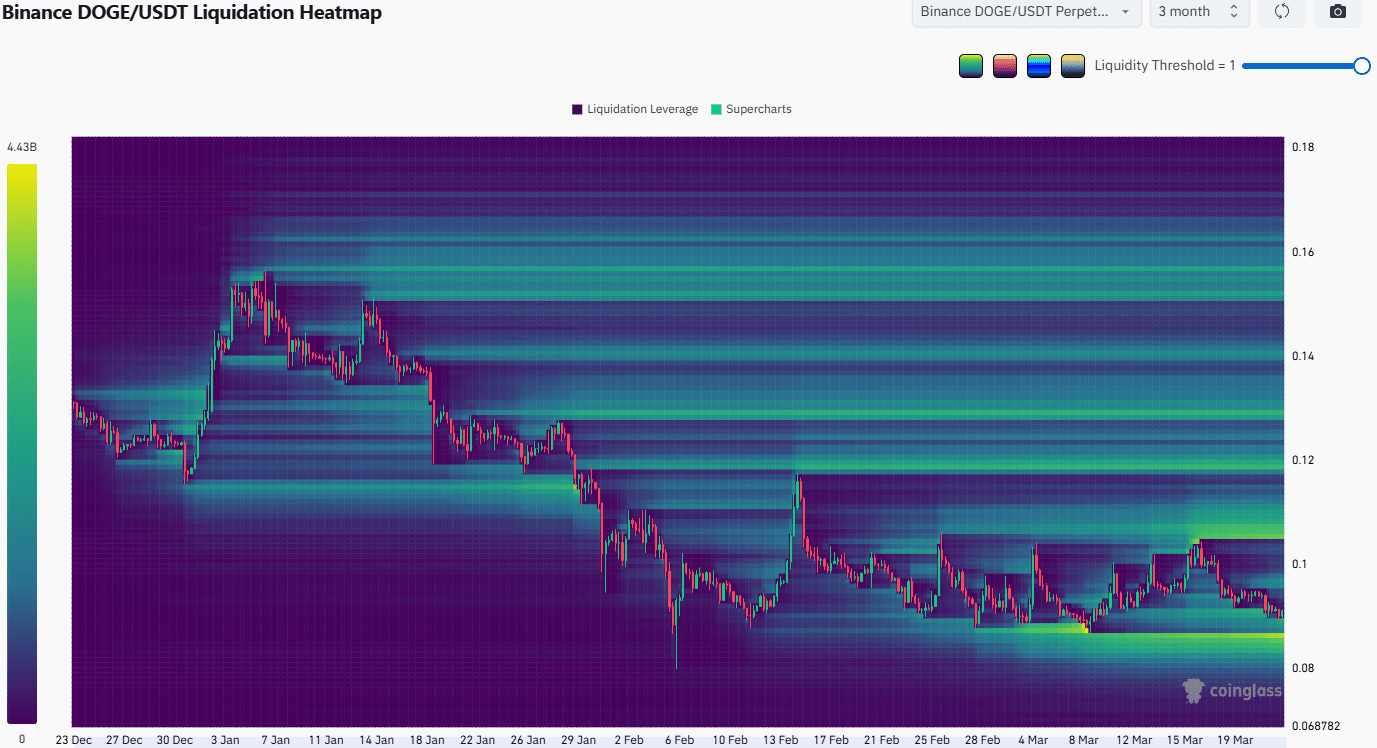
The 3-month Liquidation Heatmap showed that the $0.084-$0.088 was a nearby cluster of long liquidations. They have built up over the past three weeks and could pull prices lower.

Such a liquidity sweep, combined with the range lows as support, could give DOGE a platform for recovery. On the other hand, a slide below $0.086 would make the bulls’ position more tenuous.


Final Summary

  • Dogecoin swiftly approached a key local support as the crypto and stock markets experienced extreme fear.
  • The combination of the month-long range lows and a cluster of long liquidations could see DOGE prices pushed to $0.086 soon.


İlgili Sorular

QWhat key support level is Dogecoin approaching according to the article?

ADogecoin is approaching the key support level at $0.0887, which is the month-long range low.

QWhat two on-chain metrics increased for DOGE but failed to result in price gains?

AThe Daily Transfer Volume and the Transaction Count numbers increased but failed to translate into any notable price gains.

QWhat does the RSI value of 35 on the 4-hour chart indicate about Dogecoin's momentum?

AThe RSI value of 35 indicates that bearish momentum was prevalent.

QAccording to the liquidation heatmap, what price zone is a cluster of long liquidations that could pull prices lower?

AThe $0.084-$0.088 zone is a nearby cluster of long liquidations that could pull prices lower.

QWhat two broader market conditions are mentioned as reasons why Dogecoin bulls will have a tough time sparking a rally?

AWorries of escalation in the US-Iran conflict and a worsening energy crisis, which have sent Asian stock markets reeling, and Bitcoin facing profit-taking pressure and slumping below the $70k support.

İlgili Okumalar

Qualcomm: AI Hype Subsides, When Will Smartphones Emerge from the Gloom?

Qualcomm reported its Q3 FY2026 results (ending June 2026), with revenue of $9.95B, down 4% YoY but above expectations. Gross margin declined to 53.1%, pressured by rising costs across manufacturing and memory. Key business segments showed mixed performance: Handset revenue fell 19.6% YoY to $5.09B, dragged by an 11% decline in non-Apple Android shipments and weaker high-end mix. Conversely, Automotive revenue surged 61% to $1.59B, and IoT grew 9% to $1.83B. Core operating profit dropped 41% YoY due to margin compression and higher expenses. Management's Q4 FY2026 guidance projects revenue of $9.7B-$10.5B, in line with consensus, but Non-GAAP EPS guidance of $2.05-$2.25 fell short of expectations. Amidst persistent weakness in its core handset market, Qualcomm is pursuing growth in AI, focusing on Edge AI (smartphones, PCs, automotive) and Data Center AI. Its data center strategy includes four pillars: AI accelerators (e.g., AI200), commercial CPUs (Dragonfly C1000), custom silicon, and connectivity solutions. While these initiatives initially boosted its stock, concerns over AI capital expenditure sustainability have since erased those gains. The company targets $5B in data center revenue for FY2027 and $15B for FY2029. The report concludes that with the traditional handset business still under pressure, the data center opportunity is currently viewed as a longer-term option, and a more conservative valuation based on core operations may be warranted until AI contributions materialize.

marsbit5 dk önce

Qualcomm: AI Hype Subsides, When Will Smartphones Emerge from the Gloom?

marsbit5 dk önce

From TPU to Self-Evolving Agents: How Jeff Dean Predicts the Next Step in AI

At the 2026 YC Startup School, Jeff Dean outlined his vision for AI's next phase, shifting focus from simply scaling models to building intelligent, autonomous systems. He believes AI's progress is no longer just about creating smarter models, but about integrating them into systems capable of long-term, iterative work, automated experimentation, and continuous learning. This evolution moves the competition from "who has the bigger model" to "who can best organize intelligence." Dean suggests AI capabilities are now comparable to a junior engineer, enabling the automation of complex workflows. However, the true challenge and opportunity lie in managing these AI "workers" at scale. He emphasizes the importance of **context engineering**—structuring tools, memory, and feedback loops—over raw model power. For startups, this means building deep expertise in niche domains where general models currently fail (near 0-1% success rates), leveraging proprietary data, specialized tools, and domain-specific evaluators. A recurring theme is re-examining fundamental constraints. Dean's past work, like moving Google's search index to memory or creating the TPU, stemmed from questioning outdated assumptions about hardware and cost. He sees similar inflection points today, particularly in **specialized inference hardware** to drastically reduce latency and energy consumption for real-time Agent operation. Notably, he points out that in modern AI systems, the dominant cost is often not computation but **data movement**. Reliable, long-running Agents require robust system design, borrowing concepts from distributed computing like checkpointing, state management, and parallel exploration to handle failures and maintain progress over days or weeks. As AI automates execution, the scarcest human skills will shift to **defining clear specifications**, **judging what problems are worth solving** (taste), and designing effective feedback loops. Ultimately, Dean's framework prioritizes understanding the problem deeply, identifying the true bottlenecks, and systematically building closed-loop systems where AI can not only perform tasks but also improve AI itself.

marsbit5 dk önce

From TPU to Self-Evolving Agents: How Jeff Dean Predicts the Next Step in AI

marsbit5 dk önce

İşlemler

Spot
活动图片