Do Not Apply Blindly: A Comprehensive Evaluation of the Eight Main Pathways to Hong Kong Residency by 2026

marsbit2026-06-24 tarihinde yayınlandı2026-06-24 tarihinde güncellendi

Özet

Hong Kong has recently updated its talent attraction policies, offering eight mainstream pathways to residency. These include programs like the Top Talent Pass Scheme (TTPS), Quality Migrant Admission Scheme (QMAS), the newly introduced Technology Professionals Admission Scheme (TP Stream), and Vocational Professionals Admission Scheme (VPAS). Navigating these options involves understanding key details such as core eligibility criteria, employer sponsorship requirements, and the respective advantages and drawbacks of each scheme. A comprehensive comparison chart is provided to help applicants evaluate their choices and potentially save on consultancy fees. Applicants are reminded to always verify information with the official announcements from the Hong Kong Immigration Department.

Author: Biteye

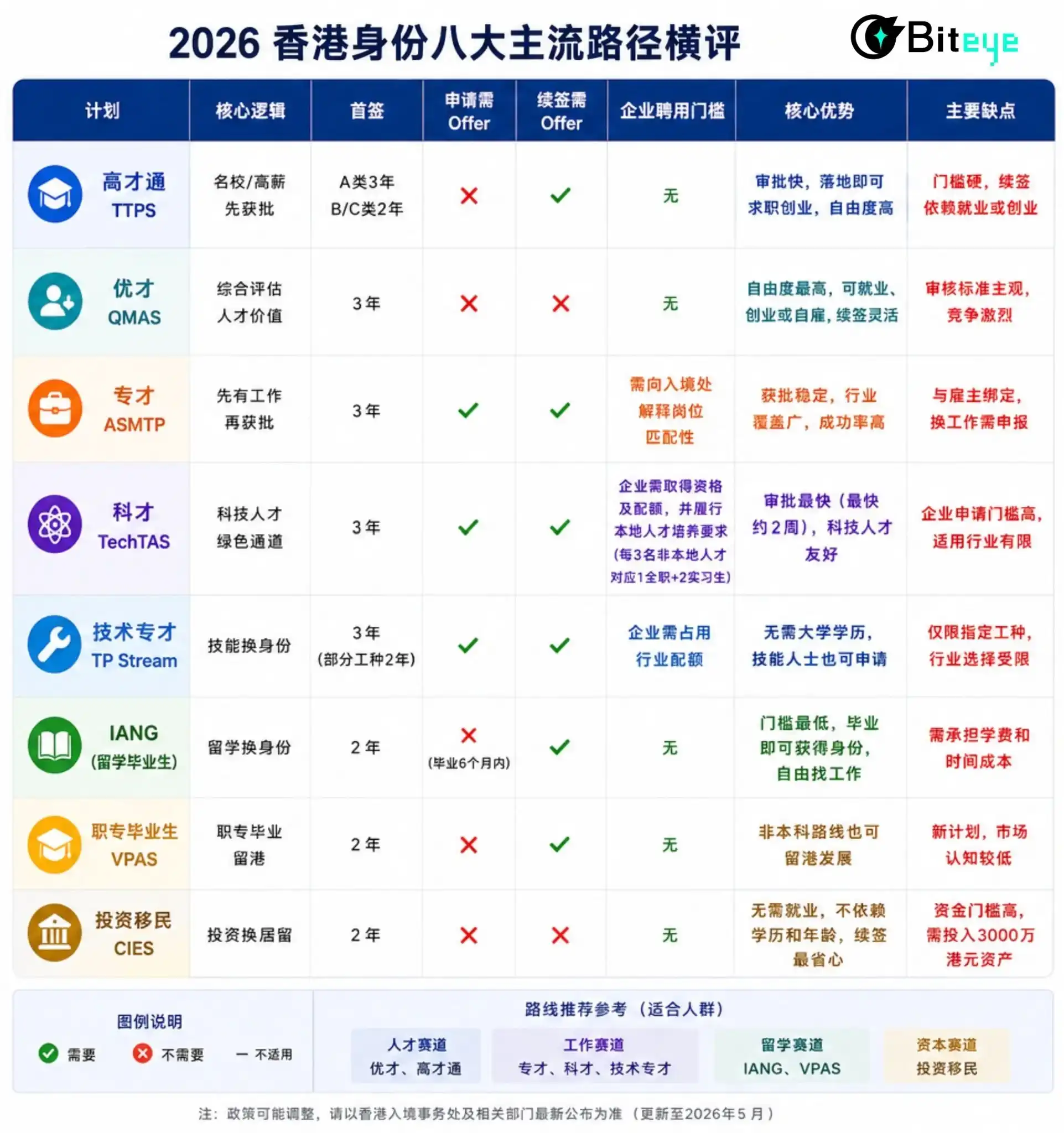
Recently, Hong Kong's talent policies have undergone intensive adjustments. From the Top Talent Pass Scheme (TTPS) and Quality Migrant Admission Scheme (QMAS) to the latest Technical Professionals Stream (TP Stream) and Vocational Professionals Admission Scheme (VPAS), there are now a total of eight mainstream pathways to obtaining residency.

There are many underlying unspoken rules regarding Hong Kong residency. Biteye has distilled the core logic, corporate sponsorship requirements, as well as the advantages and disadvantages of these eight schemes into the comprehensive comparison chart below.

This one chart can save you tens of thousands in agency fees.

(All interested individuals must remember: all information should be verified against the official announcements from the Hong Kong Immigration Department.)

İlgili Sorular

QAccording to the article, how many main pathways are there to obtain Hong Kong residency status in 2026?

AAccording to the article, there are eight main pathways to obtain Hong Kong residency status in 2026.

QWhat does the article claim its comprehensive comparison chart can help readers save money on?

AThe article claims its comprehensive comparison chart can help readers save tens of thousands of dollars on agency or intermediary fees.

QWhich Hong Kong government department's official announcements does the article advise readers to refer to for the final authoritative information?

AThe article advises readers to refer to the official announcements of the Hong Kong Immigration Department for the final authoritative information on all policies.

QWhat are two examples of the eight Hong Kong talent schemes mentioned in the article?

ATwo examples of the eight Hong Kong talent schemes mentioned in the article are the Top Talent Pass Scheme (TTPS) and the Quality Migrant Admission Scheme (QMAS).

QWhat does the article say are the key aspects condensed into its comparison chart regarding the eight residency pathways?

AThe article states that its comparison chart condenses the core logic, employer hiring thresholds, as well as the advantages and disadvantages of each of the eight residency pathways.

İlgili Okumalar

Pharos Introduces On-Chain Institutional-Grade U.S. Corporate Bond Credit, Expanding Its RealFi Asset Portfolio

Pharos Network has launched the pRNH Vault, introducing institutional-grade US corporate high-yield bond exposure to its on-chain RealFi (Real World Finance) ecosystem. Developed by the R25 protocol, the vault provides qualified users access to a tokenized portfolio of high-yield corporate debt, broadening Pharos's asset offerings beyond stablecoins and cash-equivalents. The vault's underlying asset is the NYLIM Anemoy US High Yield Corporate Bond separate account (HYB), managed by New York Life Investment Management (NYLIM) and tokenized in collaboration with Anemoy and Centrifuge. Users can deposit USDC into the vault to receive pRNH tokens, representing indirect ownership of the HYB portfolio, which targets an annualized yield of approximately 7%. The structure offers programmability and composability for on-chain financial applications. Pharos views this move as a key evolution from basic asset tokenization towards building a dynamic marketplace where institutional assets can be actively discovered, evaluated, and utilized programmatically. The pRNH Vault architecture incorporates agent-assisted functionalities for credit screening, liquidity monitoring, and on-chain operations, signaling tighter integration between real-world finance and intelligent on-chain systems. To support this vision, Pharos employs a technical stack including the SALI engine for parallel execution, modular SPNs, protocol-level compliance, ZK-KYC/AML, and native AI agent support. The network positions itself as the "value discovery layer" for the agent economy, aiming to make real-world value, smart agents, and institutional assets widely accessible. The pRNH launch adds a core credit asset to this ecosystem and serves as a practical test case for its infrastructure.

marsbit3 dk önce
Pharos Introduces On-Chain Institutional-Grade U.S. Corporate Bond Credit, Expanding Its RealFi Asset Portfolio

marsbit3 dk önce

Deposits in RWA Tripled — Traditional Finance Chooses Blockchain

The decentralized finance (DeFi) sector is undergoing a structural shift, with tokenized real-world assets (RWA) taking center stage. According to a joint report by CoinShares and Token Terminal, deposits in RWA lending and trading platforms tripled year-over-year, reaching $7.4 billion in Q2 2026. This explosive growth starkly contrasts with a 15% decline in overall DeFi deposits and a nearly 70% drop in DEX trading volumes over the same period. Analysts highlight this divergence as evidence of a fundamental shift: demand is driven not by speculation but by the genuine utility of blockchain for traditional finance. The primary drivers are tokenized U.S. Treasury bonds and multi-strategy funds, like BlackRock's BUIDL, which investors use as reliable collateral to secure stablecoin loans while earning yield. The Ethereum network hosts about 70% of all RWA collateral. Beyond government bonds, the tokenization of equities and commodity derivatives is advancing. The tokenized equity market is estimated at $2.2 billion, while perpetual futures on assets like oil and the S&P 500 have seen explosive growth on platforms like TradeXYZ. Standard Chartered projects the total tokenized asset market could reach $4 trillion by 2028. This growth signals that RWA has moved beyond crypto market cycles, offering tangible value, deep liquidity, and 24/7 global access, marking a new phase of institutional scaling for blockchain-based finance.

cryptonews.ru38 dk önce

Deposits in RWA Tripled — Traditional Finance Chooses Blockchain

cryptonews.ru38 dk önce

İşlemler

Spot
活动图片