Disrupting the Billion-Dollar Gambling Industry, Prediction Markets Face Crackdown from the Established Order

marsbit2026-01-12 tarihinde yayınlandı2026-01-12 tarihinde güncellendi

Özet

Pioneering prediction markets like Polymarket, Kalshi, and Crypto.com’s Truth Predict are facing regulatory pushback in the U.S., particularly from state authorities overseeing sports betting. On January 9, the Tennessee Sports Wagering Council (SWC) issued cease-and-desist orders to these platforms, accusing them of offering illegal sports gambling products without state licensing, despite being registered with the CFTC as designated contract markets. The conflict stems from the rapid growth of both sectors. Since the federal ban on sports betting was overturned in 2018, 30 states—including Tennessee—have legalized online sports betting, generating billions in wagers and significant tax revenue. In 2024 alone, U.S. sports betting handle reached $148.74 billion, with taxes contributing $2.82 billion. Tennessee collected $97.16 million in taxes from sports betting in 2024. Prediction markets, which trade “event contracts” classified as financial derivatives under CFTC jurisdiction, have surged in popularity. Their 2025 trading volume hit $40 billion, a 400% increase from 2023, with sports-related contracts being the largest category. This growth threatens traditional sportsbooks, whose stocks have underperformed the market. Multiple states—including Maryland, Ohio, and Nevada—have taken action against prediction markets. Kalshi has challenged these actions in court, arguing federal compliance should preempt state regulations, but court rulings have been mixed. The legal bat...

Original | Odaily Planet Daily (@OdailyChina)

Author | Azuma (@azuma_eth)

The booming prediction markets are now facing a real challenge.

On January 9, US local time, the Tennessee Sports Wagering Council (SWC) issued cease-and-desist orders to prediction market platforms such as Kalshi, Polymarket, and Crypto.com, demanding that these platforms stop offering sports event prediction contracts to residents of the state. The reason cited was that these companies were engaged in illegal gambling operations without obtaining a license from the state government.

In the notice, the SWC accused these three firms of illegally offering sports betting products under the guise of "event contracts." Although these platforms are registered with the U.S. Commodity Futures Trading Commission (CFTC) as designated contract markets, according to Tennessee state law, any entity offering sports event betting services in the state must hold a license issued by the SWC.

The SWC demanded that Kalshi, Polymarket, and Crypto.com cease all activities in the state by January 31, close open contracts, and refund resident deposits. Failure to comply by the deadline could result in civil penalties of up to $25,000 per violation and even criminal charges.

The Rapidly Growing Sports Betting Market

To understand why Tennessee is taking such a hard line against prediction market platforms, one must look at the current state of the US sports betting market.

Since the U.S. Supreme Court overturned the federal law prohibiting commercial sports betting, the Professional and Amateur Sports Protection Act (PASPA), on May 14, 2018, individual states have gained the authority to decide whether to legalize sports betting within their jurisdictions. Currently, sports betting in the US is regulated by state-level agencies responsible for licensing, compliance, and enforcement. Each state can set its own tax rates, market entry barriers, and responsible gambling requirements.

According to a report by the sports betting media Legal Sports Report, as of now, 38 US states (including Washington D.C. and Puerto Rico) have allowed the legal operation of sports betting services (both online and offline), with 30 states permitting online sports betting services — Tennessee is one of them and is the first state to allow only online sports betting while prohibiting physical betting venues.

Home to multiple popular leagues such as the NFL, MLB, NBA, and NHL, the US is undoubtedly a sports powerhouse, and sports betting is a gambling service clearly defined and heavily taxed by state governments.

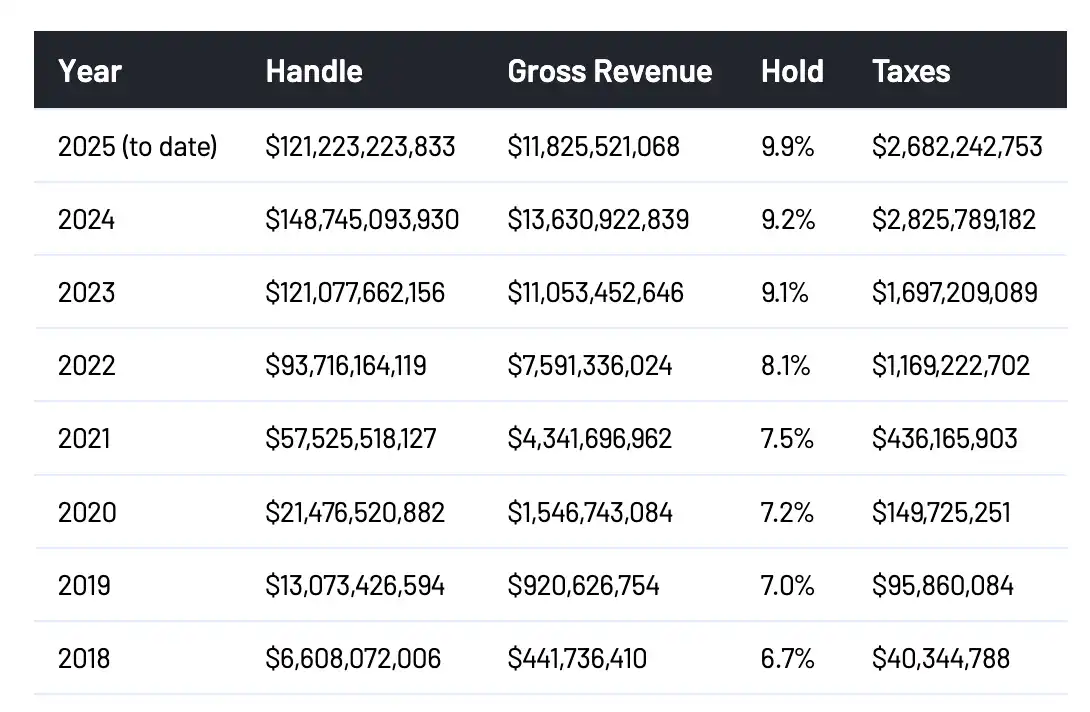
Statistics from another major sports betting media, Sports Book Review (chart below, data as of August 2025), show that since the regulatory relaxation in 2018, the total betting handle (Handle) and tax revenue (Taxes) of the US sports betting market have shown astonishing growth over the past few years — the total market betting handle reached $148.74 billion in 2024, with tax contributions reaching $2.82 billion; in the first 8 months of 2025 alone, the total betting handle ($121.22 billion) and tax revenue ($2.68 billion) have nearly matched the full-year 2024 figures.
Focus on Tennessee: What Does Sports Betting Mean?

Now, let's focus on the protagonist of this incident, Tennessee.

In 2019, Tennessee passed the Tennessee Sports Gaming Act, formally legalizing sports betting. Although the then-Governor Bill Lee had reservations about gambling, he still allowed the bill to pass without exercising his veto power. Between 2021 and 2022, the Tennessee legislature passed laws establishing a dedicated regulatory council to be fully responsible for licensing and oversight. This council was initially called the Sports Wagering Advisory Council and later renamed the Tennessee Sports Wagering Council, the SWC that issued the cease-and-desist orders to Kalshi, Polymarket, and Crypto.com at the beginning of this article.
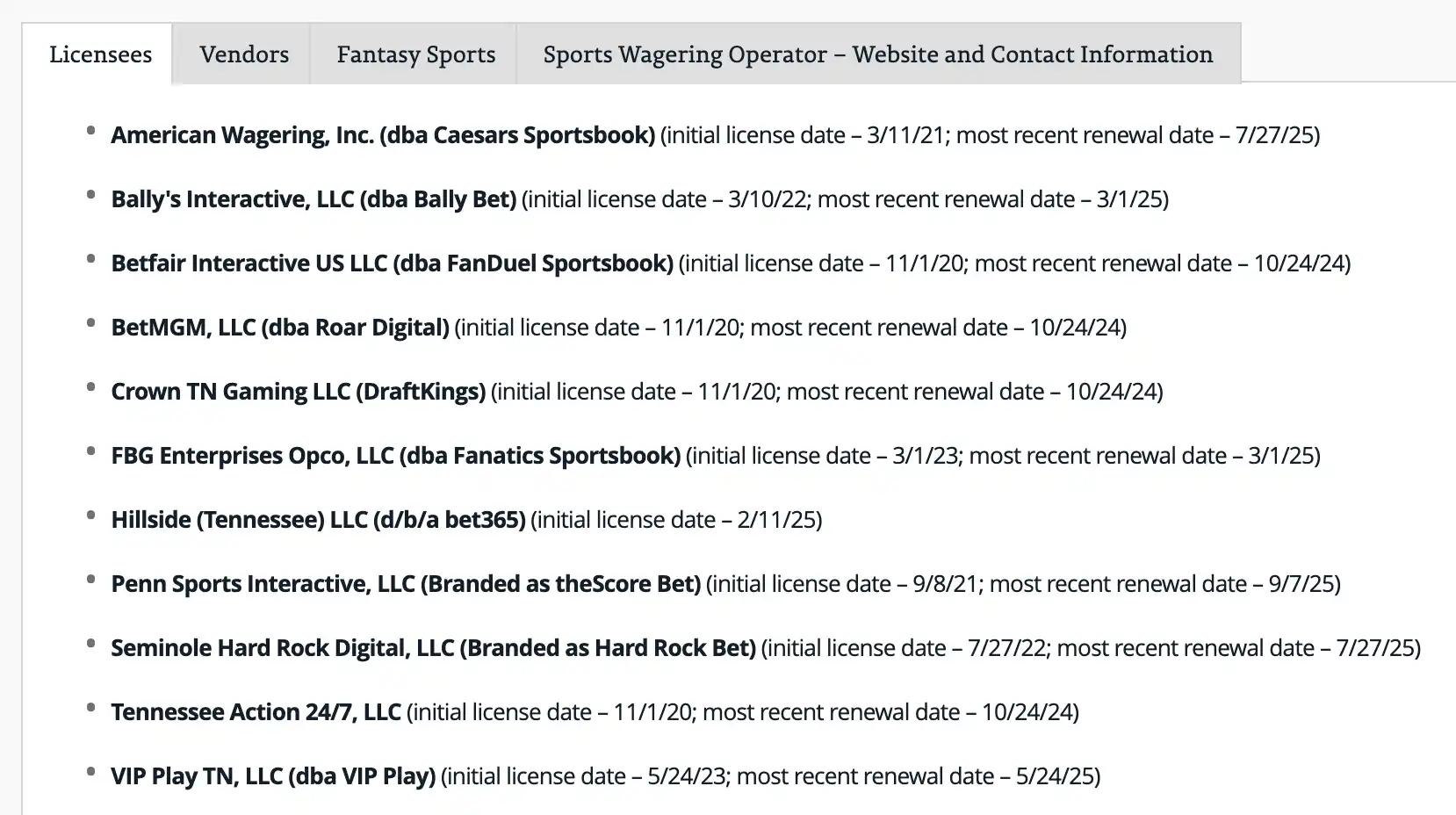
Currently, the SWC is Tennessee's sole sports betting regulatory body, responsible for operational licensing, compliance supervision, rule-making, and enforcement. The SWC stipulates that all sports betting providers must obtain a license from the SWC to offer services in the state. A total of 11 licenses have been issued so far (see chart above); only residents aged 21 and over can access related services, and they must pass geolocation verification to ensure bets are placed within the state; regarding taxation, the state levies a 1.85% tax on the total handle — an earlier scheme based on revenue was replaced in 2023 by taxation based on the total handle.

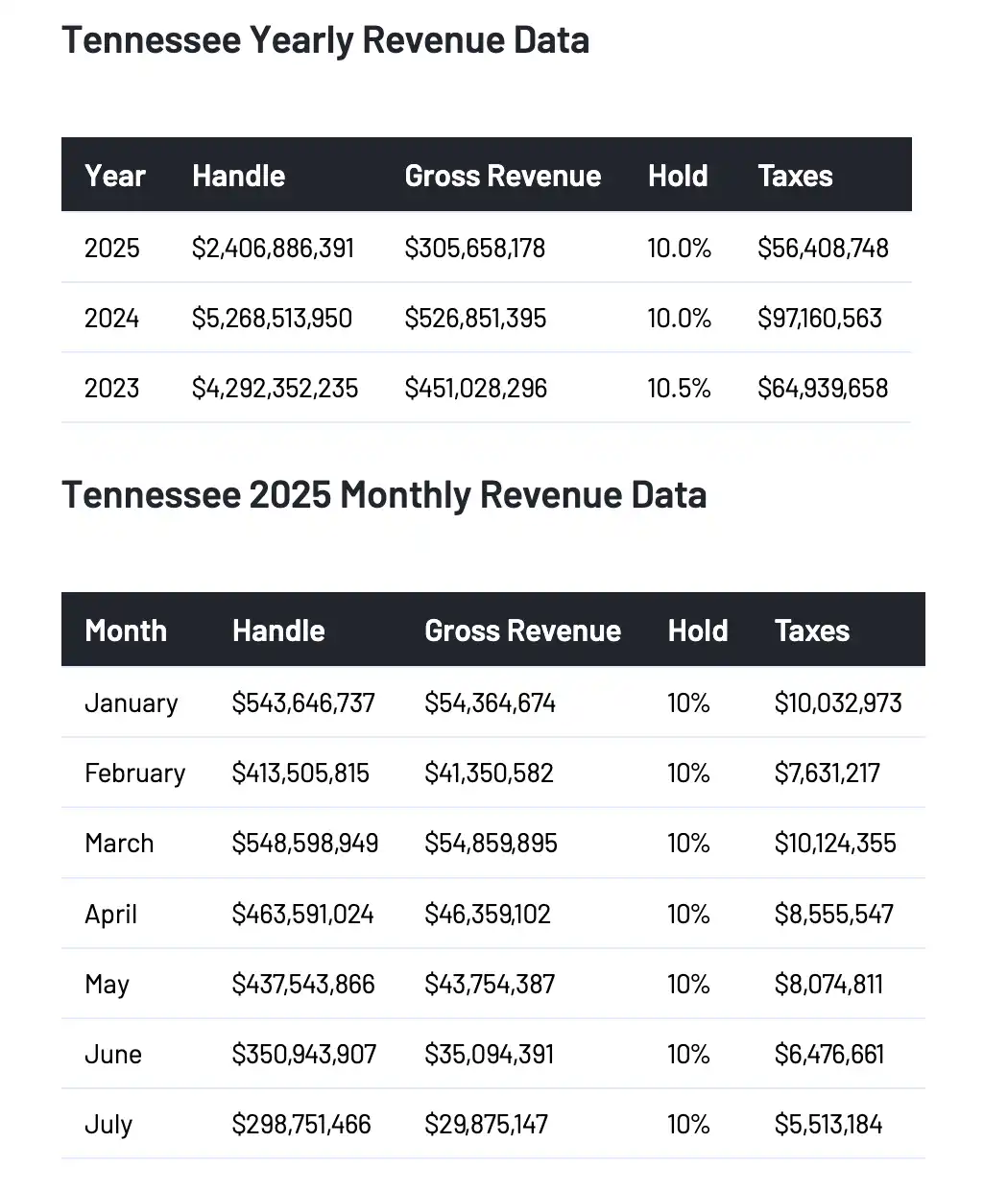
The sports betting market has contributed significant tax revenue to Tennessee. Statistics from Sports Book Review (chart below, data as of July 2025) show that in 2024, the total sports betting handle in Tennessee reached $5.268 billion, with tax contributions amounting to $97.16 million; in the first 7 months of 2025, the total handle has reached $2.4 billion, with tax contributions already reaching $56.4 million.
But this huge and still growing cake is now being gradually eroded by the likes of Polymarket.

How Are Prediction Markets Eroding the Old World?

On December 3, 2025, Polymarket announced that it had obtained CFTC approval to return to the US market after nearly four years; even earlier, Kalshi and Crypto.com's prediction market platform Truth Predict had already opened their doors to US users under CFTC approval.

The current regulatory situation is that sports betting is clearly classified as a gambling service, with regulatory authority belonging to the states, but prediction market platforms like Polymarket are generally regarded as new entities providing "event contract" trading services, and "event contracts" are considered financial derivatives in terms of asset nature, falling under the regulatory purview of the CFTC. This allows prediction markets to bypass the stringent regulations of gambling services — no need for state-level licenses, no need to follow addiction control and other user protection regulations, no need to pay high gambling taxes to the states; but at the same time, they can offer sports event outcome betting services similar to gambling,客观上 forming a certain "regulatory arbitrage."

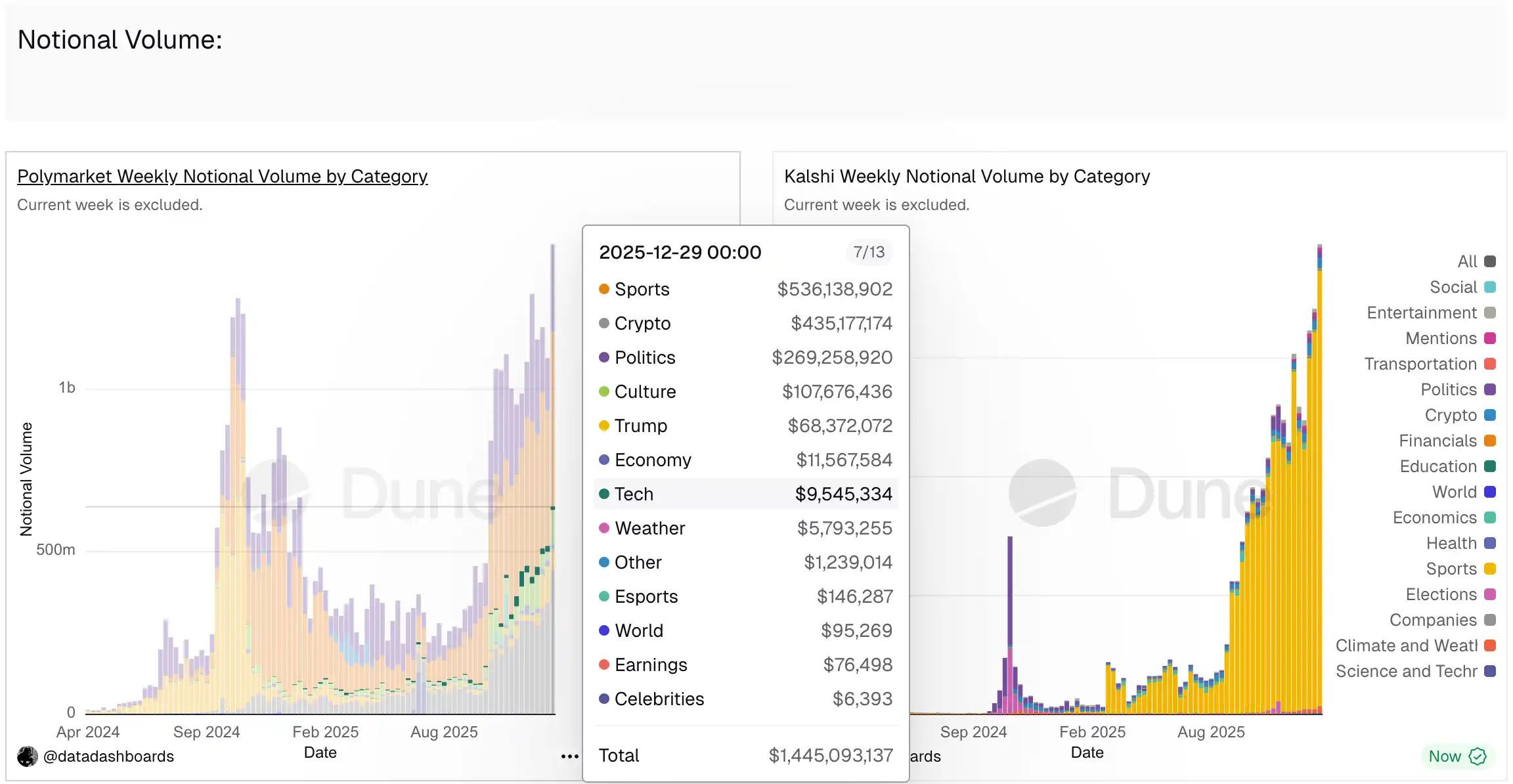
If prediction markets were still just small experimental fields, it might be fine, but the fact is that the growth rate of prediction markets is even more outrageous than that of the already夸张 sports betting market — in 2025, the total trading volume of prediction markets was approximately $40 billion, an increase of about 400% from $9 billion in 2024. Data Dashboards compiled on Dune (chart below) show that sports-related event contracts have long become the category with the highest trading volume share in prediction markets.
The capital market has long sensed the growing threat of Polymarket to traditional sports betting services. Two giants of the sports betting market, DraftKings and Flutter Entertainment, recorded declines of 11.7% and 16.1% respectively over the past year — during the same period, the US stock market was in a bull market, with the Dow Jones rising 12.97% for the year, the Nasdaq up 20.36%, and the S&P 500 up 16.39%; and the size of the sports betting market continued its eight-year upward trend.
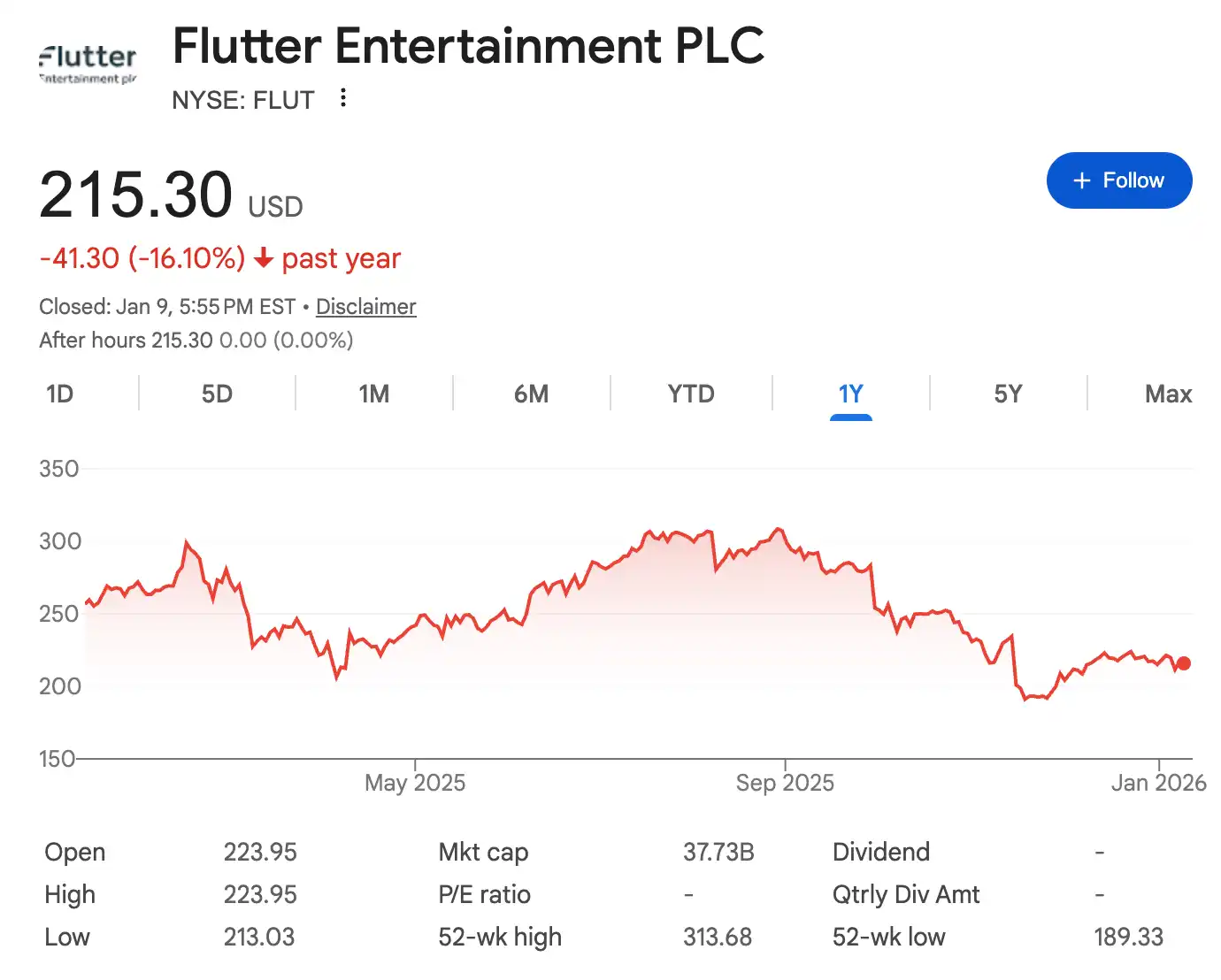
Whether it is Tennessee, which needs sports betting as a source of tax revenue, or the capital forces that actually control the sports betting market, it is difficult for them to agree to let prediction markets, this new player, come and share the pie.

Friction Is Not an Isolated Case; How Do Prediction Markets Fight Back?

In fact, Tennessee's ban on prediction markets is not an isolated incident. Maryland, Ohio, Illinois, New Jersey, Nevada, Montana, Michigan, and Connecticut have all cracked down on prediction markets for similar reasons. Since Polymarket only returned to the US market in December last year, Kalshi has borne the brunt of more regulatory impacts.

In response, Kalshi has filed lawsuits against three states — Nevada, New Jersey, and Maryland — on the grounds that it "has complied with higher-priority federal regulations and does not need to comply with state-level regulations." However, the results have not been ideal.

  • The lawsuit in Nevada was the first to proceed. The district court initially supported Kalshi, but then turned around and ruled against Kalshi last November. Judge Andrew Gordon determined that sports-related event contracts on Kalshi were very similar to sports betting wagers and therefore fell under the regulatory scope of Nevada's gambling laws. Kalshi has appealed to the U.S. Court of Appeals for the Ninth Circuit;
  • In New Jersey, the district court sided with Kalshi, but the state's gaming regulatory agency has appealed to the U.S. Court of Appeals for the Third Circuit;
  • In Maryland, the district court sided with the gaming regulatory agency. Judge Judge Adam B believed that Kalshi failed to prove that "Congress has clearly and manifestly intended to deprive states of the power to regulate gambling." Kalshi has appealed this to the U.S. Court of Appeals for the Fourth Circuit.

The law firm Benesch commented on this, stating that as the national debate continues, similar divisions are expected at the appellate court level, which will lay the groundwork for the Supreme Court to resolve this issue in the coming years... If the appellate courts happen to consistently support Kalshi's position, other prediction markets might emulate its model and proceed with similar businesses before the Supreme Court hears the case; but if the appellate courts reach different conclusions, companies in similar situations may wait for clearer legal signals before taking action. In any case, Kalshi's lawsuit will create a precedent with direct and profound implications for the national sports betting and gambling industry.

In summary, whether prediction markets need to follow state gambling regulations remains an unresolved issue for now. The fundamental contradiction of this issue lies in the similarity of the products and services offered by prediction markets and sports betting, and the differences in regulatory requirements.

This is a tug-of-war over institutional adaptation. Before the appellate courts or even the Supreme Court give a final ruling, the gray area between prediction markets and sports betting will persist for a long time, and regulatory conflicts will be hard to avoid. In the short term, states will likely continue to defend their regulatory authority and tax base through enforcement and litigation; while prediction market platforms will try to use federal compliance and innovation narratives as a shield to fight for more living room.

Recommended Reading:

《Why Prediction Markets Are Truly Not Gambling Platforms》

Trend Kriptolar

İlgili Sorular

QWhy did the Tennessee Sports Wagering Council (SWC) issue a cease-and-desist order to prediction market platforms like Kalshi, Polymarket, and Crypto.com?

AThe SWC issued the order because these platforms were offering sports event prediction contracts to Tennessee residents without obtaining a state-required license, which the SWC considers illegal gambling operations under state law.

QWhat is the key regulatory difference that allows prediction markets to operate under federal oversight while traditional sports betting is state-regulated?

APrediction markets are classified as offering 'event contracts,' which are considered financial derivatives and fall under the regulatory jurisdiction of the CFTC (Commodity Futures Trading Commission). In contrast, sports betting is explicitly defined as a gambling service and is regulated at the state level.

QHow significant is the sports betting market in the United States in terms of handle and tax revenue?

AIn 2024, the US sports betting market's total handle was $148.74 billion, contributing $2.82 billion in taxes. For the first eight months of 2025, the handle reached $121.22 billion, with tax contributions of $2.68 billion, nearly matching the full-year 2024 figures.

QWhat legal argument has Kalshi used to challenge state-level bans on its operations, and what has been the outcome so far?

AKalshi has argued that it 'complies with higher-priority federal regulations and does not need to comply with state-level regulations.' The outcomes have been mixed: it lost its case in Nevada and Maryland (with appeals filed) but won at the district court level in New Jersey (which the state has appealed).

QWhat is the fundamental conflict between prediction markets and the established sports betting industry according to the article?

AThe fundamental conflict stems from the similarity in the services offered (betting on sports event outcomes) but the vast difference in regulatory requirements. Prediction markets operate under federal CFTC oversight with lighter restrictions, while sports betting is heavily taxed and regulated, creating a 'regulatory arbitrage' that threatens the tax base and business models of the traditional industry.

İlgili Okumalar

From South Korea to the United States: Blue-Collar Jobs Are Becoming Increasingly Popular, Thanks to AI

AI is reshaping the labor market's value proposition. The traditional four-year college degree is losing its appeal as a guaranteed career path, while skilled blue-collar trades like electricians, welders, and plumbers are experiencing historic demand and wage premiums. This shift is driven by dual pressures: AI's displacement of certain white-collar roles and a booming need for physical infrastructure and data center construction. Data confirms the trend. In the U.S., vocational school revenue surged, and a significant portion of recent layoffs are AI-related. Surveys show a majority of Gen Z adults plan to pursue blue-collar work, citing better job security against AI automation. Vocational education interest has exploded recently. Experts cite a psychological shift as younger generations seek tangible, AI-resistant careers and avoid high student debt. In many cases, salaries for skilled trades now match or exceed those requiring a bachelor's degree. In South Korea, semiconductor vocational high schools boast near-total employment, with graduates securing high-paying roles at companies like Samsung. The shortage is structural, exacerbated by a retiring baby boomer workforce and massive infrastructure projects. Companies like JPMorgan Chase, Meta, and Lowe's are investing heavily in training programs. However, overcoming historical stigma and a "perception gap" around trade careers remains a key challenge to closing the talent gap.

marsbit59 dk önce

From South Korea to the United States: Blue-Collar Jobs Are Becoming Increasingly Popular, Thanks to AI

marsbit59 dk önce

Qualcomm: AI Hype Subsides, When Will Smartphones Emerge from the Gloom?

Qualcomm reported its Q3 FY2026 results (ending June 2026), with revenue of $9.95B, down 4% YoY but above expectations. Gross margin declined to 53.1%, pressured by rising costs across manufacturing and memory. Key business segments showed mixed performance: Handset revenue fell 19.6% YoY to $5.09B, dragged by an 11% decline in non-Apple Android shipments and weaker high-end mix. Conversely, Automotive revenue surged 61% to $1.59B, and IoT grew 9% to $1.83B. Core operating profit dropped 41% YoY due to margin compression and higher expenses. Management's Q4 FY2026 guidance projects revenue of $9.7B-$10.5B, in line with consensus, but Non-GAAP EPS guidance of $2.05-$2.25 fell short of expectations. Amidst persistent weakness in its core handset market, Qualcomm is pursuing growth in AI, focusing on Edge AI (smartphones, PCs, automotive) and Data Center AI. Its data center strategy includes four pillars: AI accelerators (e.g., AI200), commercial CPUs (Dragonfly C1000), custom silicon, and connectivity solutions. While these initiatives initially boosted its stock, concerns over AI capital expenditure sustainability have since erased those gains. The company targets $5B in data center revenue for FY2027 and $15B for FY2029. The report concludes that with the traditional handset business still under pressure, the data center opportunity is currently viewed as a longer-term option, and a more conservative valuation based on core operations may be warranted until AI contributions materialize.

marsbit1 saat önce

Qualcomm: AI Hype Subsides, When Will Smartphones Emerge from the Gloom?

marsbit1 saat önce

From TPU to Self-Evolving Agents: How Jeff Dean Predicts the Next Step in AI

At the 2026 YC Startup School, Jeff Dean outlined his vision for AI's next phase, shifting focus from simply scaling models to building intelligent, autonomous systems. He believes AI's progress is no longer just about creating smarter models, but about integrating them into systems capable of long-term, iterative work, automated experimentation, and continuous learning. This evolution moves the competition from "who has the bigger model" to "who can best organize intelligence." Dean suggests AI capabilities are now comparable to a junior engineer, enabling the automation of complex workflows. However, the true challenge and opportunity lie in managing these AI "workers" at scale. He emphasizes the importance of **context engineering**—structuring tools, memory, and feedback loops—over raw model power. For startups, this means building deep expertise in niche domains where general models currently fail (near 0-1% success rates), leveraging proprietary data, specialized tools, and domain-specific evaluators. A recurring theme is re-examining fundamental constraints. Dean's past work, like moving Google's search index to memory or creating the TPU, stemmed from questioning outdated assumptions about hardware and cost. He sees similar inflection points today, particularly in **specialized inference hardware** to drastically reduce latency and energy consumption for real-time Agent operation. Notably, he points out that in modern AI systems, the dominant cost is often not computation but **data movement**. Reliable, long-running Agents require robust system design, borrowing concepts from distributed computing like checkpointing, state management, and parallel exploration to handle failures and maintain progress over days or weeks. As AI automates execution, the scarcest human skills will shift to **defining clear specifications**, **judging what problems are worth solving** (taste), and designing effective feedback loops. Ultimately, Dean's framework prioritizes understanding the problem deeply, identifying the true bottlenecks, and systematically building closed-loop systems where AI can not only perform tasks but also improve AI itself.

marsbit1 saat önce

From TPU to Self-Evolving Agents: How Jeff Dean Predicts the Next Step in AI

marsbit1 saat önce

İşlemler

Spot

Popüler Makaleler

ORDER Nasıl Satın Alınır

HTX.com’a hoş geldiniz! Orderly (ORDER) satın alma işlemlerini basit ve kullanışlı bir hâle getirdik. Adım adım açıkladığımız rehberimizi takip ederek kripto yolculuğunuza başlayın. 1. Adım: HTX Hesabınızı OluşturunHTX'te ücretsiz bir hesap açmak için e-posta adresinizi veya telefon numaranızı kullanın. Sorunsuzca kaydolun ve tüm özelliklerin kilidini açın. Hesabımı Aç2. Adım: Kripto Satın Al Bölümüne Gidin ve Ödeme Yönteminizi SeçinKredi/Banka Kartı: Visa veya Mastercard'ınızı kullanarak anında Orderly (ORDER) satın alın.Bakiye: Sorunsuz bir şekilde işlem yapmak için HTX hesap bakiyenizdeki fonları kullanın.Üçüncü Taraflar: Kullanımı kolaylaştırmak için Google Pay ve Apple Pay gibi popüler ödeme yöntemlerini ekledik.P2P: HTX'teki diğer kullanıcılarla doğrudan işlem yapın.Borsa Dışı (OTC): Yatırımcılar için kişiye özel hizmetler ve rekabetçi döviz kurları sunuyoruz.3. Adım: Orderly (ORDER) Varlıklarınızı SaklayınOrderly (ORDER) satın aldıktan sonra HTX hesabınızda saklayın. Alternatif olarak, blok zinciri transferi yoluyla başka bir yere gönderebilir veya diğer kripto para birimlerini takas etmek için kullanabilirsiniz.4. Adım: Orderly (ORDER) Varlıklarınızla İşlem YapınHTX'in spot piyasasında Orderly (ORDER) ile kolayca işlemler yapın.Hesabınıza erişin, işlem çiftinizi seçin, işlemlerinizi gerçekleştirin ve gerçek zamanlı olarak izleyin. Hem yeni başlayanlar hem de deneyimli yatırımcılar için kullanıcı dostu bir deneyim sunuyoruz.

381 Toplam GörüntülenmeYayınlanma 2024.12.10Güncellenme 2026.06.02

ORDER Nasıl Satın Alınır

Tartışmalar

HTX Topluluğuna hoş geldiniz. Burada, en son platform gelişmeleri hakkında bilgi sahibi olabilir ve profesyonel piyasa görüşlerine erişebilirsiniz. Kullanıcıların ORDER (ORDER) fiyatı hakkındaki görüşleri aşağıda sunulmaktadır.

活动图片













