Did DeepSeek Intentionally Make an Unfriendly Agent?

marsbit2026-08-15 tarihinde yayınlandı2026-08-15 tarihinde güncellendi

Özet

DeepSeek is shifting its strategy from being a low-cost model provider to building a foundational ecosystem for AI agents. This pivot is marked by two recent moves: increasing the price of its flagship V4 Pro model and launching the DeepSeek Harness agent framework. Previously, DeepSeek's success was built on creating powerful, affordable models and open-sourcing them to drive adoption. Now, the focus is moving "beyond the model" to the runtime environment where agents operate. Harness is key to this new approach. Unlike integrated agent products from competitors, Harness deconstructs the agent stack—separating the model, tools, skills, workflows, and UI into modular, replaceable components. Its core innovation is the Cordis kernel, which enables dynamic loading, unloading, and management of plugins, allowing agents to modify their own capabilities during execution. Significantly, Harness does not lock users into DeepSeek's models; it allows integration with third-party models. This suggests DeepSeek's ambition is not to control the model layer but to establish the standard runtime environment for future agents—akin to an operating system for the agent era. The V4 Pro price increase aligns with this shift: the model transitions from a loss-leading acquisition tool to a core revenue engine within a broader ecosystem. Harness is currently complex and developer-focused, prioritizing ecosystem builders over end-users. Its success will be measured not by immediate user numbers,...

Written by | Beyond the Layout, Author | Painting

One thing DeepSeek has excelled at in the past is making complex things cheap.

The stronger the model, the lower the price. While others burn cash, it drives prices to the floor. After V3 and R1, the industry's impression of it was consistent: a top-tier model doesn't have to be expensive.

But two recent moves have suddenly shifted this narrative.

First, V4 Pro raised its price. Immediately after, the agent framework DeepSeek Harness was launched.

One starts to bring models back into the commercial world, the other simply lays out all that complex stuff beyond the model in front of developers.

Two seemingly unrelated events, when viewed together, instead seem to be answering the same question: What exactly does DeepSeek want to compete for next?

I. DeepSeek Begins to Change Its Strategy

Looking back over the past two years, DeepSeek has actually been answering three questions.

V3 and R1 proved that a Chinese team can build world-class foundation models, and can push inference and training efficiency to a very high level with limited resources.

With the model proven, the next question is whether it's cheap enough. This is where it shook the industry most, continuously driving prices down.

Then, whether these capabilities can be taken by more people. DeepSeek chose open source, extending from model weights to API, to the developer ecosystem.

The logic of DeepSeek in the past was complete: build a strong model, lower the price, open up capabilities, let more people use it.

With V4 Pro, the model continues to upgrade, but the price is no longer pushed down. The price increase alone is not surprising. What's really worth watching is its almost simultaneous appearance with Harness.

DeepSeek may have started calculating a different account.

In the past, it was competing for model call volume; now, it's beginning to compete for *where* the calls happen. These are two completely different battles.

For a model to truly generate value, it must pass through another layer of runtime environment: calling tools, reading files, managing permissions, running tasks. In the past, this layer was encapsulated inside products; users didn't even know it existed.

Harness is the first time DeepSeek has taken this layer out separately.

V4 Pro and Harness are actually two hands. One brings the model itself back to the commercial ledger, the other reaches towards the infrastructure beyond the model.

II. Dismantling the Agent

To understand DeepSeek Harness, the best reference is Apple.

Apple has a very important product philosophy: bear complexity for the user. You don't need to know how the CPU schedules, how memory is managed, how the file system runs. Open a Mac, an iPhone, and just use it.

This logic later entered the Agent world. Claude Code, Codex, WorkBuddy all packaged up the complex capabilities needed for an Agent to run. Tools, Skills, sandbox, permissions, workflows, all there, but the user doesn't need to know. You just say 'help me get this done,' and the product decides the rest for you.

This has been the direction of AI product efforts in recent years. Models become more complex, products become simpler. DeepSeek Harness does the opposite, breaking these things out one by one.

Model, tools, Skills, workflows, UI, all become components that can be individually replaced. Even plugins during runtime can be dynamically loaded, unloaded, and recombined.

What's most noteworthy about Harness is that it redefines the boundary of encapsulation. Apple's logic is: I encapsulate complexity for you into a product. Harness breaks complexity into modules, then hands you the right to modify.

This also explains why it's called Harness, not DeepSeek Code. Code refers to purpose, Harness refers to the runtime environment.

Breaking down an Agent, it's Agent = Model + Harness. The model is responsible for thinking, Harness is responsible for turning thought into action. In the past, this entire set was hidden behind the product.

What DeepSeek did was make this layer of encapsulation itself the object of openness.

III. Enabling Software to Evolve During Runtime

If you only view Harness as an Agent product, it's even a bit abnormal. Why would a model company proactively allow you to use other companies' models?

The answer may lie outside Agent products.

Here we must mention Cordis behind the plugins.

Cordis is the underlying kernel of Harness, specifically managing how plugins are installed, uninstalled, and how they cooperate with each other. It is very restrained, not touching the model, tools, or specific Agent capabilities, only managing this one thing:

Enabling plugins to be dynamically loaded, unloaded, managed, and maintain system stability during the process of change.

Just by doing this, it touches upon two hardcore technical concepts.

One is called temporal composability. After a plugin is uninstalled, can the effects it previously caused be completely undone? The other is spatial composability: if one plugin depends on another, and the latter suddenly disappears or changes, can the former reconnect its dependencies on its own?

It sounds technical, but they're actually answering a big question: Can an Agent change itself while it's running?

Traditional software doesn't do this. Once a program starts, its capabilities are basically set. You can upgrade the version, but you don't suddenly say mid-run, "I'm missing a capability, let me add one now."

Cordis aims to provide this possibility. The Creation Mode in Harness is the most direct demonstration of this concept. The Agent can inspect the environment it's running in, discover what's missing, create it on the spot, hook it back, and continue working.

You can have it make a security audit Agent that only reads code and cannot modify files, or have it make an enterprise research Agent that connects to internal search, uses a fixed model, and is equipped with three proprietary Skills.

Traditional Agents need to be configured first by people. Harness explores another path: people only set the goal, the Agent adjusts its own runtime environment.

This is like a machine that, while running, discovers it's missing a part, and on the spot manufactures one and installs it.

And today it is changing the way software is created.

In the past, people wrote software, and the software executed tasks. In the future, it might be: people propose goals, the Agent generates capabilities, installs them, and then completes the goal.

If this path truly works, the very meaning of the word "Agent" will change. It becomes less like pre-programmed software, and more like a runtime environment that can modify its own capability boundaries at any time.

IV. The Real Battlefield is Beyond the Model

There's a detail here with significant commercial meaning.

Harness does not restrict users to DeepSeek's own models.

The most natural move for a model company making an Agent is to tie it to its own model. OpenAI has GPT, Anthropic has Claude, Google has Gemini. Agents are the last mile for models to reach users; the tighter the binding, the more calls for its own model. Model companies naturally want to fuse model and Agent together.

DeepSeek precisely did not do this. It allows you to customize the model, protocol, Base URL, even connect to other companies' models.

Theoretically, you could completely use a competitor's model inside DeepSeek Harness.

From the perspective of an Agent product, this is strange. But from an infrastructure perspective, it makes sense. What it really wants to control might not be the model, but the layer beneath the model, the runtime environment of the Agent.

This is like an operating system. Windows doesn't make all the software itself, nor does Android. The truly valuable part of an OS is making others willing to develop on it. More developers mean more software, more software means more users, and the platform's weight naturally increases.

This is the logic Harness wants to replicate.

Its real competitors may not be Claude Code and Codex, but rather the runtime for the Agent era. Whoever controls the runtime environment has the chance to dictate how future Agents run.

V. Starting to Calculate the Ecosystem's Account

Reaching this point, another explanation emerges for why V4 Pro raised its price.

In the past, DeepSeek relied on low-priced models to attract more users, more users brought more calls, more calls brought more developers and influence, ultimately nurturing a stronger model.

After Harness appeared, a new ecosystem cycle is taking shape.
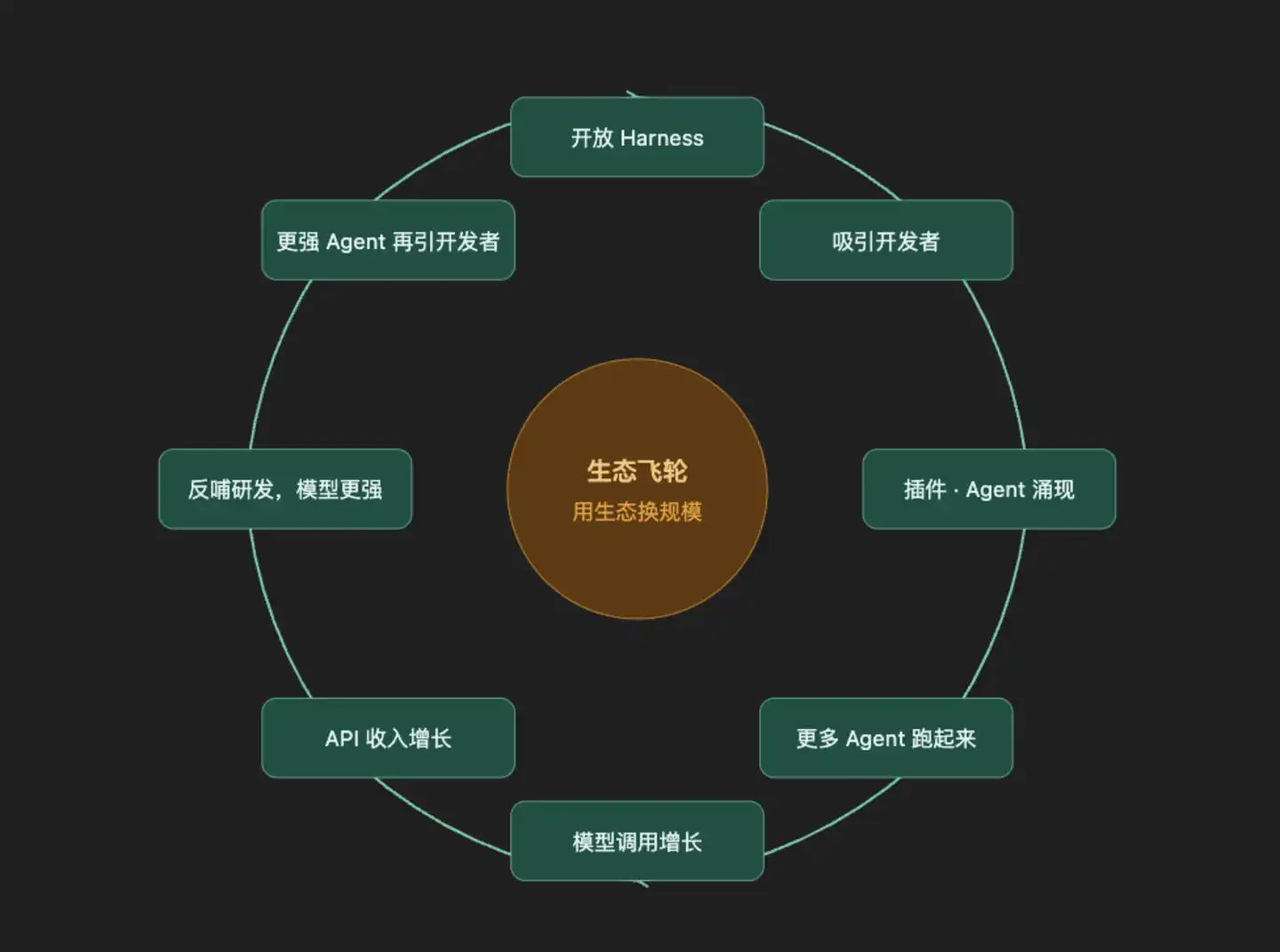
The biggest difference between this model and the past is the changed position of the model; it moves from the endpoint to the engine.

In the past, DeepSeek relied on low prices to get more people to use the model. Now, it's beginning to try to have the entire Agent ecosystem continuously consume the model.

This is also why Harness doesn't need to forcefully lock users into DeepSeek's model.

What it truly wants is for all Agents to run on the runtime it defines; as for which model is used at the bottom, it's less concerned.

As long as the runtime becomes an ecosystem, model calls will naturally occur.

Behind the price increase, the reason lies here. It no longer needs to forever play the role of price slasher; the model is starting to become a machine that can continuously generate cash flow.

VI. Being Unfriendly Might Precisely Be Its Answer

Frankly, when I opened DeepSeek Harness, I didn't know how to use it.

The UI is very engineer-like, the documentation is full of terminology. An ordinary user opening it for the first time would most likely ask: Who exactly is this for?

The issue might be right there. It probably didn't target ordinary users as its first batch of users at all.

But looking at it now, I actually think it's not that important.

The earliest need of a platform is its first batch of builders; consumers come later. Windows, Linux, Android — which one started by relying on developers?

So, judging whether Harness is successful shouldn't even start by looking at downloads.

Look at plugins, look at Agents, look at who is building things on it.

If people start making various Agents around it, even someone uses Harness to build their own Harness, that's when the platform truly begins to grow.

Today, we view an Agent as a product.

If one day, Agents could also be continuously built, modified, combined, and even built upon by Agents themselves?

Then the Agent we understand today might just be its earliest form.

A word from [Beyond the Layout]:

A company's ambition is sometimes hidden in what it releases, sometimes in what it doesn't do for you.

DeepSeek Harness did not make Agent into a finished product.

It placed something unfinished into the hands of developers.

But for a company wanting to be infrastructure, being unfinished sometimes precisely means there's still enough space.

This space, DeepSeek has placed it in the hands of developers and users.

Trend Kriptolar

İlgili Sorular

QAccording to the article, what are the two key recent moves by DeepSeek that signal a shift in its strategy?

AThe two key recent moves are: 1) The price increase of the V4 Pro model, and 2) The release of the DeepSeek Harness agent framework.

QHow does the article describe DeepSeek Harness's approach to complexity, compared to companies like Apple?

AThe article states that while companies like Apple follow a philosophy of encapsulating complexity for the user, DeepSeek Harness reverses this by breaking complexity into modules and handing the modification rights to the user. It redefines the boundaries of encapsulation.

QWhat is Cordis, and what fundamental concept about Agent behavior does it enable according to the article?

ACordis is the underlying kernel of Harness that manages how plugins are installed, uninstalled, and coordinate with each other. It enables the concept of Agents being able to evolve or change themselves during runtime, such as creating and adding new capabilities on the fly to complete a task.

QWhat does the article suggest is DeepSeek's potential 'real battlefield' with the launch of Harness, and what is the strategic reasoning given?

AThe article suggests the real battlefield is not just the model, but the runtime environment for Agents. The strategic reasoning is that by controlling the runtime (like an operating system), DeepSeek can build an ecosystem. Once the runtime becomes the standard ecosystem, model calls will naturally occur, regardless of which underlying model is used.

QWhy does the article argue that DeepSeek Harness might seem 'difficult to use,' and why might this be intentional?

AThe article argues Harness seems difficult because its UI is very engineering-focused and its documentation is full of technical terms, which can be confusing for ordinary users. This might be intentional because its first target audience is likely developers and builders, not general consumers. A platform's earliest need is for builders who will create on top of it, consumers come later.

İlgili Okumalar

"AI God of Stocks" Blowup Dragged Down, Jane Street Suffered Massive 15 Billion Loss in July, First Monthly Loss in a Decade

Jane Street, a major proprietary trading firm, suffered an estimated $15 billion loss in July, marking its first monthly loss in about a decade. The loss was primarily triggered by the blow-up of the AI-focused hedge fund Situational Awareness, which faced massive margin calls amid a sharp sell-off in AI and semiconductor stocks in July. Jane Street, an investor in the fund, was significantly impacted. Compounding the loss were substantial declines in Jane Street's own Asian non-AI equity long positions, which had performed well earlier in the year. The firm described the losses as a concentrated reversal of previously successful trading strategies in AI and tech sectors. Despite the historic monthly loss, Jane Street's net trading income for the year to date remains strong at over $40 billion. In response, the firm stated it has become more selective in risk-taking, closing specific losing exposures and reducing risk in other strategies. Coinciding with the loss, Jane Street is undergoing a major debt refinancing of approximately $14.6 billion, led by JPMorgan. The move aims to shift more debt from public markets to private investors like Pimco and Fidelity, accepting higher costs for greater flexibility and less public disclosure. The Situational Awareness incident highlights systemic risks in the prime brokerage ecosystem, where leveraged bets on crowded AI trades can lead to forced liquidations and market volatility. Jane Street's subsequent risk reduction and debt restructuring are seen as key responses to this costly lesson.

marsbit7 dk önce

"AI God of Stocks" Blowup Dragged Down, Jane Street Suffered Massive 15 Billion Loss in July, First Monthly Loss in a Decade

marsbit7 dk önce

QCP Capital Analysts Explained Why Bitcoin Stalled at $63,000

QCP Capital's latest report explains that Bitcoin has stalled around $63,000, testing the lower boundary of its recent trading range ($62,500–$64,000). The retreat wasn't due to a single catalyst but stems from several cross-market pressures: heightened geopolitical risks, rising oil prices, uncertainty around global liquidity, and a muted reaction to positive U.S. macroeconomic data. While U.S. inflation and jobs data softened, reducing expectations of imminent Fed tightening, Bitcoin's price response has been subdued. This highlights the importance of other factors like trader positioning, liquidity conditions, and overall risk appetite. The regulatory landscape is progressing on two tracks: congressional legislation (like the CLARITY Act) is delayed, but SEC rulemaking continues. Corporate treasury activity, exemplified by Strategy's new Bitcoin monetization program, now creates a potential two-way flow, adding complexity to supply dynamics. Geopolitical tensions around the Strait of Hormuz keep oil prices elevated, impacting crypto indirectly through inflation expectations and financial conditions. Historical seasonality shows August and September are typically weak for Bitcoin, but this is descriptive, not predictive, in today's ETF-driven market. In conclusion, Bitcoin has shown resilience by absorbing multiple negative forces without a decisive breakdown. However, it has failed to convert improving macro fundamentals into sustained upward momentum. The market awaits key events like the U.S. PCE data, the Jackson Hole symposium, and the September FOMC meeting for a potential catalyst to break the current range.

cryptonews.ru36 dk önce

QCP Capital Analysts Explained Why Bitcoin Stalled at $63,000

cryptonews.ru36 dk önce

Metrics Ventures Market Observation: Talk is Cheap

This monthly market analysis extends its timeline to incorporate critical July comments from the Fed Chair, noting that bond markets have already priced in perceived policy shortcomings. The report observes a growing divergence: equity markets, after some deleveraging, continue a "trust-based" rally, while bond and currency markets signal persistent distrust. Precious metals bottoming suggests a central bank consensus that the era of "competitive currency devaluation" is ending, with verbal interventions losing power. Looking forward to Q3-Q4, the analysis remains bullish on supply-constrained global resources like copper and power, as well as gold, which prices ongoing monetary失信. It argues that digital assets are unlikely to see major outperformance until excess liquidity is released and AI growth rates are fully priced. Key market views include: 1. Commodities like gold remain primary liquidity absorbers over Bitcoin, with recent consolidation seen as healthy. 2. The bull trend for RMB-denominated assets (e.g., STAR 50 Index) is firmly established. 3. Key resource country indices and currencies are near inflection points, with spot copper already at new highs. The report suggests resource equities, particularly in China's market, are at the end of their consolidation phase, offering attractive valuations with embedded optionality on rising metal prices. It highlights the predictive significance of recent US-Japan FX interventions and Treasury-Fed dynamics, suggesting a shift towards less communication and data management to maintain stability. A long position in resource assets is presented as a positive expected-value strategy over a multi-year horizon.

marsbit3 saat önce

Metrics Ventures Market Observation: Talk is Cheap

marsbit3 saat önce

The Value, Growth, and Risks of Prediction Markets

The article discusses the explosive growth and complex nature of prediction markets in the United States, focusing on their value, risks, and regulatory challenges. Key drivers include sports betting, which fueled a 1795% year-over-year trading volume increase in Q2 2026, with platforms like Kalshi and Polymarket dominating. These markets offer significant potential as superior hedging tools for businesses and more efficient price discovery mechanisms than traditional polls or derivatives for events like Fed rate decisions, elections, or GPU prices. They also serve as customer acquisition channels for platforms like Robinhood. However, major challenges persist. A central conflict exists between federal regulators (CFTC), which classify event contracts as derivatives under its jurisdiction, and state authorities, which view sports-related contracts as illegal gambling, leading to numerous lawsuits. There is significant consumer protection risk: data shows most retail users lose money to professional traders, platforms market high-risk products like parlays, and protections (e.g., age limits, addiction help) are weaker than in state-regulated sports betting. The "self-certification" process allows rapid contract launches but creates regulatory uncertainty. The author argues prediction markets are fundamentally "better markets" but currently fail to provide adequate consumer safeguards. Proposals include integrating protection mechanisms (cooling-off periods, position limits), aligning risk warnings with product risks, creating paths from speculation to long-term investing, and applying specific consumer protections and taxes to sports contracts. The piece concludes by urging stakeholders to address these issues before a potential regulatory backlash undermines the markets' legitimate utility.

marsbit3 saat önce

The Value, Growth, and Risks of Prediction Markets

marsbit3 saat önce

İşlemler

Spot

Popüler Makaleler

ONE Nasıl Satın Alınır

HTX.com’a hoş geldiniz! Harmony (ONE) satın alma işlemlerini basit ve kullanışlı bir hâle getirdik. Adım adım açıkladığımız rehberimizi takip ederek kripto yolculuğunuza başlayın. 1. Adım: HTX Hesabınızı OluşturunHTX'te ücretsiz bir hesap açmak için e-posta adresinizi veya telefon numaranızı kullanın. Sorunsuzca kaydolun ve tüm özelliklerin kilidini açın. Hesabımı Aç2. Adım: Kripto Satın Al Bölümüne Gidin ve Ödeme Yönteminizi SeçinKredi/Banka Kartı: Visa veya Mastercard'ınızı kullanarak anında Harmony (ONE) satın alın.Bakiye: Sorunsuz bir şekilde işlem yapmak için HTX hesap bakiyenizdeki fonları kullanın.Üçüncü Taraflar: Kullanımı kolaylaştırmak için Google Pay ve Apple Pay gibi popüler ödeme yöntemlerini ekledik.P2P: HTX'teki diğer kullanıcılarla doğrudan işlem yapın.Borsa Dışı (OTC): Yatırımcılar için kişiye özel hizmetler ve rekabetçi döviz kurları sunuyoruz.3. Adım: Harmony (ONE) Varlıklarınızı SaklayınHarmony (ONE) satın aldıktan sonra HTX hesabınızda saklayın. Alternatif olarak, blok zinciri transferi yoluyla başka bir yere gönderebilir veya diğer kripto para birimlerini takas etmek için kullanabilirsiniz.4. Adım: Harmony (ONE) Varlıklarınızla İşlem YapınHTX'in spot piyasasında Harmony (ONE) ile kolayca işlemler yapın.Hesabınıza erişin, işlem çiftinizi seçin, işlemlerinizi gerçekleştirin ve gerçek zamanlı olarak izleyin. Hem yeni başlayanlar hem de deneyimli yatırımcılar için kullanıcı dostu bir deneyim sunuyoruz.

704 Toplam GörüntülenmeYayınlanma 2024.12.12Güncellenme 2026.06.02

ONE Nasıl Satın Alınır

Tartışmalar

HTX Topluluğuna hoş geldiniz. Burada, en son platform gelişmeleri hakkında bilgi sahibi olabilir ve profesyonel piyasa görüşlerine erişebilirsiniz. Kullanıcıların ONE (ONE) fiyatı hakkındaki görüşleri aşağıda sunulmaktadır.

活动图片