Delphi Digital: The Era of Tokenization Has Arrived

比推2026-02-18 tarihinde yayınlandı2026-02-18 tarihinde güncellendi

Özet

Tokenized U.S. Treasuries surpassed $10 billion in January 2024, led by institutions like BlackRock and Franklin Templeton. While government bonds are relatively straightforward to tokenize due to their standardized nature, equities present greater complexity because they involve shareholder rights such as voting and legal ownership. Two primary models exist: custodian-backed tokens (e.g., xStocks, Backed) offer price exposure but not direct ownership, while transfer agent-registered tokens (e.g., Superstate, Securitize) record holders directly on the shareholder registry, granting full rights. The latter enables functionalities like 24/7 trading, use as collateral in DeFi, cross-margin capabilities with crypto assets, and direct capital raises without traditional underwriters. However, challenges remain, including fragmented liquidity across blockchains, KYC/AML compliance friction, varying international regulations, and limited integration with traditional exchanges. While Nasdaq has applied to trade tokenized securities, broader market adoption depends on regulatory clarity and improved liquidity. The market is betting that the transfer agent model—which offers real ownership—will outperform custodian-based structures. Equities can now be settled instantly, traded around the clock, and used as collateral, but whether this becomes standard depends on regulatory and liquidity developments.

Source: Delphi Digital

Compiled and Edited: BitpushNews


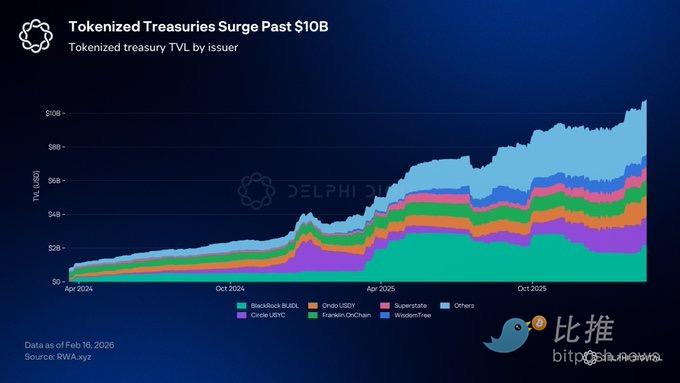
In January, the scale of tokenized treasury bonds exceeded $10 billion, with BlackRock, Franklin Templeton, Ondo, and Circle leading the market. Government bonds were the first to be tokenized because they have standardized instruments and liquid markets, making the process relatively straightforward.

But the real challenge lies with stocks.

Stocks represent shareholders, who possess voting rights and legal rights that must be enforced. Tokenization projects have all hit the same wall: you can mint a token representing a stock, but you do not actually own the share.
Not all tokenized stocks operate in the same way. Tokens issued by platforms like xStocks, Backed, and similar are backed 1:1 by shares held by a custodian. Investors gain price exposure and can trade 24/7, but ownership remains with the custodian.

Custodian vs. Transfer Agent

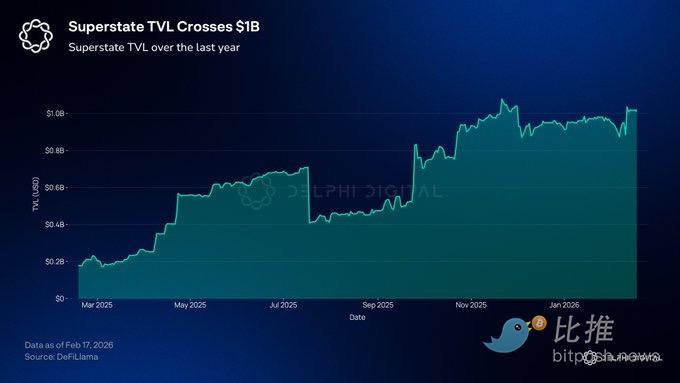
Superstate and Securitize are registered as transfer agents with the U.S. Securities and Exchange Commission (SEC), directly recording token holders on the company's shareholder registry. In September 2025, when Galaxy Digital was tokenized via Superstate's Opening Bell platform, GLXY token holders became genuine shareholders with voting rights and dividend entitlements. The blockchain was integrated with the shareholder registry.

Securitize has adopted a similar approach on the fund side. As the transfer agent behind BlackRock's BUIDL, they manage one of the largest tokenized treasury funds. They are also bringing institutional-grade private funds on-chain, lowering investment barriers and expanding access to alternative assets that were previously out of reach for most investors.

Recent guidance from SEC staff clarifies this distinction. Issuer-led tokenization through registered transfer agents creates ownership with full shareholder rights. Custodian-backed tokens may face different regulatory treatment and limitations compared to direct shareholder registration.
Genuine shareholder status enables functionalities that custodian-backed token structures cannot achieve.

Shareholders can trade 24/7 on supported trading platforms without waiting for the Toronto Stock Exchange to open. Shareholders of Forward Industries can pledge their equity as collateral on Kamino. Even if shares are deposited in lending pools, Superstate tracks beneficial ownership, ensuring dividends are distributed to the correct holders regardless of where the tokens are stored.

Backpack Exchange and Superstate have announced plans to enable cross-margining between tokenized stocks and crypto assets. Once live, traders can hold both tokenized stocks and SOL in the same account and use both as margin. Traditional brokers typically cannot offer this service because stocks and cryptocurrencies exist in completely separate custody and clearing systems.

This is unprecedented capital efficiency. Shareholders can obtain liquidity without selling, hedge across asset classes in a single account, and trade globally without settlement delays.

Raising Capital Without Underwriters

Superstate's direct issuance program allows publicly traded companies to reduce reliance on traditional underwriters for on-chain fundraising. Investors pay with stablecoins, shares are minted directly into their wallets, and companies receive funds instantly, with no cash settlement delays.

Traditional equity fundraising involves underwriters, roadshows, and settlement delays that can last weeks. Direct issuance compresses this into a single transaction, with the shareholder registry updated in real time.

The first issuances are expected later this year, likely from small-cap public companies that find traditional capital market infrastructure too costly relative to their trading size.

Missing Pieces

Liquidity remains fragmented. Tokenized stocks exist on multiple chains with no unified order book connecting them. Trading volumes are small compared to traditional markets, limiting the scale investors can move without impacting prices.

KYC requirements create friction with DeFi's permissionless architecture. Only whitelisted addresses can hold tokenized stocks, meaning they cannot be integrated into every lending protocol or liquidity pool. Issuers need to verify investors before they receive shares, and this verification must persist as tokens move between wallets.

Outside the U.S., regulatory frameworks vary significantly. SEC guidance applies to matters involving U.S. federal securities laws, but Europe, Asia, and other markets have their own rules, which may not align.

Traditional exchanges are watching closely. Nasdaq has filed an application with the SEC to trade tokenized securities. But until regulators and existing participants figure out how this fits into the existing market structure, actual exchange support for on-chain stocks remains pending.

Conclusion

Tokenized treasury bonds have proven that this mechanism can work at scale. Now, the stock space is catching up, achieving genuine compliance and true DeFi integration.

The market is betting that the transfer agent model, which records token holders as actual shareholders, will outperform indirect ownership structures that only provide price exposure.

Stocks can now be settled instantly, traded 24/7, and used as collateral in markets that never close. Whether this becomes the standard for how stocks operate or remains a niche play for crypto-native companies depends on whether liquidity and regulatory clarity can keep up with the infrastructure already in place.


Twitter:https://twitter.com/BitpushNewsCN

Bitpush TG Discussion:https://t.me/BitPushCommunity

Bitpush TG Subscription: https://t.me/bitpush

Original link:https://www.bitpush.news/articles/7612882

İlgili Sorular

QWhat is the key difference between tokenized stocks issued by platforms like xStocks/Backed and those registered with the SEC as transfer agents like Superstate/Securitize?

APlatforms like xStocks and Backed issue tokens that are 1:1 backed by stocks held by a custodian, providing price exposure but not actual ownership. In contrast, SEC-registered transfer agents like Superstate and Securitize record token holders directly on the company's shareholder registry, granting them full shareholder rights including voting and dividends.

QWhat major milestone did tokenized treasury products achieve in January, and which companies are leading this market?

AIn January, the size of tokenized treasury products surpassed $10 billion. Companies such as BlackRock, Franklin Templeton, Ondo, and Circle are leading this market.

QWhat are some of the unique functionalities enabled by true shareholder status in tokenized stocks, according to the article?

ATrue shareholder status enables functionalities like 24/7 trading on supported platforms, the ability to use equity as collateral (e.g., on Kamino), receiving dividends regardless of where the token is held, and cross-margining between tokenized stocks and crypto assets in a single account for unprecedented capital efficiency.

QHow does Superstate's direct issuance plan aim to change the traditional capital raising process for public companies?

ASuperstate's direct issuance plan allows public companies to raise capital on-chain with reduced reliance on traditional underwriters. Investors pay with stablecoins, shares are minted directly to their wallets, the company receives funds instantly, and the shareholder registry is updated in real-time, compressing a process that traditionally takes weeks into a single transaction.

QWhat are the main challenges or missing pieces currently hindering the wider adoption of tokenized stocks?

AThe main challenges include fragmented liquidity across different blockchains without a central order book, smaller trading volumes limiting large-scale moves, friction between KYC requirements and DeFi's permissionless architecture, and varying regulatory frameworks outside the U.S. that are not necessarily aligned with the SEC's guidance.

İlgili Okumalar

Should You Buy SpaceX Stock at $1.7 Trillion? Here's What the Market Is Worried About

SpaceX is preparing for a massive IPO aiming to raise around $75 billion at a valuation of approximately $1.75 trillion. While its achievements in reusable rockets and the profitable Starlink satellite internet service are clear, the market is concerned about the aggressive valuation. Key issues include: the current $1.75 trillion valuation, which is about 94 times 2025 revenue, seems to price in not just existing businesses but also unproven future ventures like AI infrastructure and orbital data centers. Financially, while Starlink is profitable, the AI division, bolstered by the acquisition of xAI, is incurring massive losses and consuming the majority of capital expenditures. This acquisition also introduced complex related-party financing arrangements and debt onto SpaceX's balance sheet. Furthermore, corporate governance poses a challenge. SpaceX's dual-class share structure ensures founder Elon Musk retains absolute control, limiting ordinary shareholders' influence over high-risk, long-term strategic decisions. The future success of ambitious projects like the Starship rocket—critical for lowering costs and enabling new services—remains a significant variable for the valuation. In summary, the market's apprehension (FUD) centers not on doubting SpaceX's past technological triumphs but on questioning how much premium public investors should pay for a future that combines proven profits with highly speculative and capital-intensive new ventures, all under a governance structure that offers limited shareholder oversight.

marsbit13 dk önce

Should You Buy SpaceX Stock at $1.7 Trillion? Here's What the Market Is Worried About

marsbit13 dk önce

Breaking the DeFi Cascading Liquidation Curse: Vitalik Proposes a New Solution

Vitalik Buterin has proposed a new DeFi design to eliminate the automatic liquidation mechanism that causes market instability during sharp downturns. The current system, used by protocols like Aave, triggers forced sales when collateral value falls below a threshold, often exacerbating price drops and creating systemic selling pressure. Buterin's alternative model is based on splitting an asset like ETH into two synthetic option-like tokens, P and N, pegged to a price index. Their combined value always equals one ETH. Instead of sudden liquidation, a position's value gradually drifts from its target peg if the market moves. Users must proactively rebalance their holdings to maintain their desired exposure, transferring the management burden from the protocol to the user or automated tools. A key advantage is the reduced reliance on real-time oracles. Pricing decisions are deferred until contract expiry, allowing for more robust, fault-tolerant oracle designs. This removes a clear liquidation threshold that speculators can target for manipulation or MEV extraction. However, significant challenges remain. Frequent rebalancing could incur high slippage and transaction costs, necessitating new liquidity provider models. The design is better suited for hedging instruments than for stablecoins requiring a rigid 1:1 peg. While not an immediate replacement for existing systems, the proposal challenges the foundational assumption that instantaneous forced liquidation is an unavoidable necessity in DeFi, opening the door for fundamentally different risk management architectures.

marsbit17 dk önce

Breaking the DeFi Cascading Liquidation Curse: Vitalik Proposes a New Solution

marsbit17 dk önce

The End of Single-Factor Cryptography

The article "The End of Single-Factor Crypto" posits a fundamental shift in the cryptocurrency ecosystem. It argues the era where crypto asset valuations were predominantly driven by, and correlated with, Bitcoin's price is ending. The space is bifurcating into two distinct economies: endogenous and exogenous. The endogenous economy represents traditional crypto, where token and project values are directly tied to crypto market prices. The emerging exogenous economy comprises projects and businesses that may utilize blockchain technology or tokens but derive their fundamental value from external, non-crypto factors like consumer demand, subscription revenue, or real-world utility. Examples include AI inference platforms like Venice, fintech lenders using blockchain for efficiency, and stablecoin/payment infrastructure companies acquired by giants like Mastercard and Stripe. This shift means investment analysis must change. For exogenous assets, evaluating traditional business fundamentals—such as revenue streams, unit economics, and competitive moats—becomes more critical than tracking Bitcoin charts. While endogenous assets like Bitcoin remain relevant, the growth of the exogenous category is driven by measurable demand independent of crypto price cycles, paving the way for a new, more diversified market phase. Consequently, crypto is evolving from a single-factor, reflexive asset class into a multifaceted ecosystem with varied drivers and investment theses.

marsbit18 dk önce

The End of Single-Factor Cryptography

marsbit18 dk önce

Morning Post | Bitmine Plans to Raise $300 Million Through Preferred Stock Issuance; Polymarket Accuses Kalshi of Commercial Espionage

ChainCatcher's Daily Crypto Brief: Key developments from the past 24 hours include significant funding moves, regulatory actions, and market predictions. Bitmine announced a $300 million preferred stock fundraising. Polymarket accused rival prediction platform Kalshi of corporate espionage, citing numerous suspicious coincidences in product launches, a claim Kalshi strongly denied. The U.S. Department of Justice, in a joint "Disruption Week" anti-fraud operation with companies like Coinbase and Meta, froze over $3.8 million in cryptocurrency linked to scams. In infrastructure news, Macau completed its integration with the multi-central bank digital currency bridge, mBridge, aiming to build efficient cross-border payment channels. Cosmos Labs acquired the block explorer Mintscan. Market-wise, Geoffrey Kendrick, Standard Chartered's Head of Digital Assets Research, stated Bitcoin is nearing a bottom around $63,000, maintaining a year-end target of $100,000. He noted stability in U.S. spot Bitcoin ETF holdings. Ahead of SpaceX's anticipated IPO, internal insiders at Rocket Lab (RKLB) sold over $18.41 million in stock. In tokenization, Goldman Sachs partnered with Apex and Archax to launch a tokenized real estate fund. The meme token tracker GMGN reported the top trending tokens: on Ethereum, HEX, SHIB, LINK, PEPE, mUSD; on Solana, TROLL, swarms, WORLDCUP, neet, Buttcoin; and on Base, PEPE, toby, ODDS, ELSA, SKI.

链捕手32 dk önce

Morning Post | Bitmine Plans to Raise $300 Million Through Preferred Stock Issuance; Polymarket Accuses Kalshi of Commercial Espionage

链捕手32 dk önce

İşlemler

Spot
Futures

Popüler Makaleler

ERA Nasıl Satın Alınır

HTX.com’a hoş geldiniz! Caldera (ERA) satın alma işlemlerini basit ve kullanışlı bir hâle getirdik. Adım adım açıkladığımız rehberimizi takip ederek kripto yolculuğunuza başlayın. 1. Adım: HTX Hesabınızı OluşturunHTX'te ücretsiz bir hesap açmak için e-posta adresinizi veya telefon numaranızı kullanın. Sorunsuzca kaydolun ve tüm özelliklerin kilidini açın. Hesabımı Aç2. Adım: Kripto Satın Al Bölümüne Gidin ve Ödeme Yönteminizi SeçinKredi/Banka Kartı: Visa veya Mastercard'ınızı kullanarak anında Caldera (ERA) satın alın.Bakiye: Sorunsuz bir şekilde işlem yapmak için HTX hesap bakiyenizdeki fonları kullanın.Üçüncü Taraflar: Kullanımı kolaylaştırmak için Google Pay ve Apple Pay gibi popüler ödeme yöntemlerini ekledik.P2P: HTX'teki diğer kullanıcılarla doğrudan işlem yapın.Borsa Dışı (OTC): Yatırımcılar için kişiye özel hizmetler ve rekabetçi döviz kurları sunuyoruz.3. Adım: Caldera (ERA) Varlıklarınızı SaklayınCaldera (ERA) satın aldıktan sonra HTX hesabınızda saklayın. Alternatif olarak, blok zinciri transferi yoluyla başka bir yere gönderebilir veya diğer kripto para birimlerini takas etmek için kullanabilirsiniz.4. Adım: Caldera (ERA) Varlıklarınızla İşlem YapınHTX'in spot piyasasında Caldera (ERA) ile kolayca işlemler yapın.Hesabınıza erişin, işlem çiftinizi seçin, işlemlerinizi gerçekleştirin ve gerçek zamanlı olarak izleyin. Hem yeni başlayanlar hem de deneyimli yatırımcılar için kullanıcı dostu bir deneyim sunuyoruz.

475 Toplam GörüntülenmeYayınlanma 2025.07.17Güncellenme 2026.06.02

ERA Nasıl Satın Alınır

Tartışmalar

HTX Topluluğuna hoş geldiniz. Burada, en son platform gelişmeleri hakkında bilgi sahibi olabilir ve profesyonel piyasa görüşlerine erişebilirsiniz. Kullanıcıların ERA (ERA) fiyatı hakkındaki görüşleri aşağıda sunulmaktadır.

活动图片













