DeFi vs. SEC: Should ‘non-custodial platforms’ be treated like exchanges?

ambcrypto2026-04-02 tarihinde yayınlandı2026-04-02 tarihinde güncellendi

Özet

DeFi Education Fund (DEF) argues that non-custodial DeFi protocols, AMMs, and their developers should not be regulated as exchanges or intermediaries, as they don’t perform exchange functions or control user assets. They oppose SIFMA’s push for SEC regulation based on function rather than decentralization. SIFMA and Citadel Securities advocate for regulating DeFi platforms handling tokenized securities to ensure investor protection, citing risks and scams. DEF suggests Wall Street’s stance may be motivated by business interests, as DeFi disrupts traditional intermediaries. The SEC faces the challenge of balancing innovation and regulation in its upcoming framework.

DeFi regulation is back in the headlines as the crypto industry and Wall Street disagree on the proposed ‘innovation exemption’ for tokenized assets.

On the 1st of April, a DeFi advocacy group, the DeFi Education Fund (DEF), wrote to the SEC arguing that decentralized protocols should not be ‘misclassified as intermediaries’ like centralized traditional exchanges.

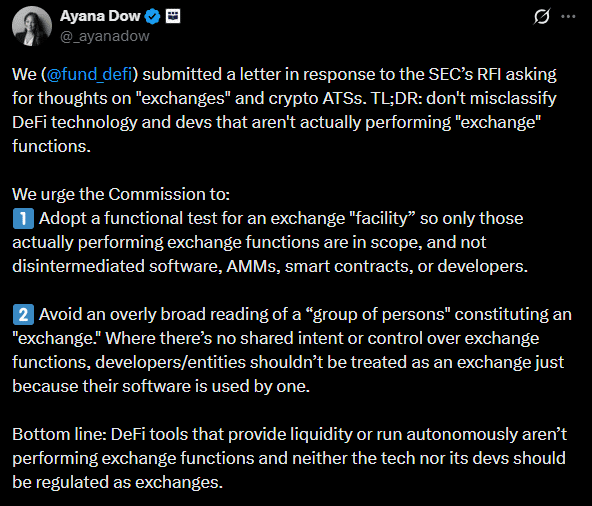
Ayan Dow, legal officer at DEF, added,

DeFi tools that provide liquidity or run autonomously aren’t performing exchange functions, and neither the tech nor its devs should be regulated as exchanges.
Source: X

According to the advocacy group, any non-custodial application does not fall within the legal definition of an intermediary or exchange. Additionally, classifying developers as intermediaries, yet they don’t control the ‘non-custodial platforms’ they’ve built, would place an overwhelming regulatory burden on them.

As such, the advocacy group pressed that any suggested DeFi regulation scope should exclude disintermediated software, automated market makers (AMMs), smart contracts, and non-controlling developers.

Wall Street opposes DeFi legal exemption

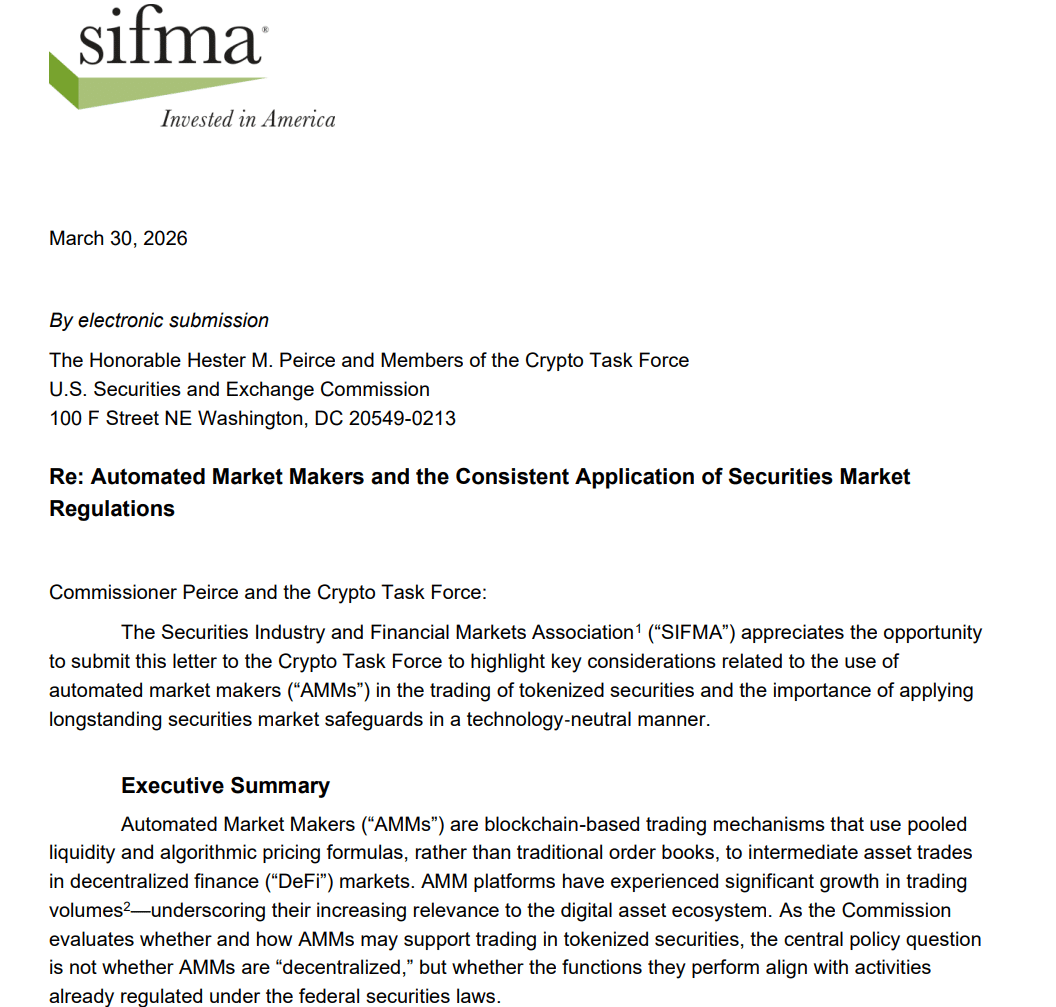
The DEF letter was also a response to SIFMA (Securities Industry and Financial Markets Association). The TradFi umbrella group recently argued that the SEC should regulate AMMs, citing risk to investor protections.

According to SIFMA, the SEC should regulate AMMs and DeFi platforms based on their functions in supporting tokenized securities trading. And not based on whether they’re decentralized, as DeFi supporters propose.

SIFMA believes the Commission should maintain technology neutrality by regulating AMMs based on their market function rather than protocol architecture.
Source: SEC

SIFMA’s stance echoed Citadel Securities’ position. Last year, Citadel called for a strict regulation of DeFi platforms that handle tokenized securities.

SIFMA and Citadel’s opposition to unregulated DeFi could be genuine concerns, given the scams and blowouts seen in the past across the sector. For Wall Street, compliance should apply to everyone handling tokenized securities.

However, Citadel gets most of its revenue from being a centralized intermediary, especially for retail platforms like Robinhood. As a result, DEF views the Wall Street opposition as motivated by the potential disruption of DeFi tech (removing intermediaries) to its business interests.

It remains to be seen how the SEC will address these competing interests while still supporting innovation in the upcoming ‘exemption’ framework for tokenized securities.


Final Summary

  • Advocacy group DeFi Education Fund (DEF) has opposed SIFMA’s push to regulate AMMs and other non-custodial DeFi platforms
  • However, SIFMA claims most ‘decentralized’ platforms pose investor protection risks.

İlgili Sorular

QWhat is the main argument made by the DeFi Education Fund (DEF) in their letter to the SEC?

AThe DEF argues that decentralized protocols should not be misclassified as intermediaries like centralized exchanges. They state that DeFi tools providing liquidity or running autonomously are not performing exchange functions, and neither the technology nor its developers should be regulated as exchanges.

QWhy does the DEF believe that regulating developers as intermediaries would be problematic?

AThe DEF believes that classifying developers as intermediaries when they do not control the 'non-custodial platforms' they built would place an overwhelming and inappropriate regulatory burden on them.

QWhat is SIFMA's position on the regulation of Automated Market Makers (AMMs) and DeFi platforms?

ASIFMA argues that the SEC should regulate AMMs and DeFi platforms based on their function in supporting tokenized securities trading, not on whether they are decentralized. They believe regulation should be technology-neutral and based on market function.

QWhat potential conflict of interest does the DEF suggest motivates Wall Street's opposition to DeFi exemptions?

AThe DEF suggests that Wall Street firms, like Citadel Securities which earns most of its revenue as a centralized intermediary, are motivated by the potential disruption that DeFi technology (which removes intermediaries) poses to their business interests.

QWhat is the core issue that the SEC must address regarding the proposed 'innovation exemption' for tokenized assets?

AThe SEC must address the competing interests between the crypto industry, which seeks exemptions for non-custodial DeFi platforms, and traditional finance (Wall Street), which argues for function-based regulation, all while still trying to support innovation.

İlgili Okumalar

Why Bitcoin Holds Above $64,000 After Fed's Hard Pause

**Bitcoin Stabilizes Near $64,000 Following Hawkish Fed Pause** The cryptocurrency market, led by Bitcoin, remained stable around $64,000 despite a volatile reaction to the latest U.S. Federal Reserve meeting. The Fed paused interest rates but signaled a hawkish stance, with three committee members voting for an increase—the highest dissent since 2016. This limits risk appetite but hasn't triggered panic selling. Key market highlights include Bitcoin ETFs seeing a net inflow of $32.1 million, breaking a streak of outflows, while Ethereum ETFs experienced outflows of $18.65 million. Liquidations affected about 90,000 traders. Technically, Bitcoin finds support around $63,000-$63,500, with major resistance near $66,000. While its price is about 49% below its all-time high, institutional demand via ETFs and the absence of mass capitulation support a potential recovery scenario in the second half of the year. Major altcoins showed mixed movements, with Solana attracting capital while Ethereum faced selling pressure despite strong on-chain metrics like a growing staking queue. Regulatory news took a pause as the U.S. Senate delayed the CLARITY Act vote until at least autumn. For the final trading day of July, U.S. inflation and consumer spending data will be crucial. Bitcoin's key levels to watch are $63,000 support and $66,000 resistance. Sustained ETF inflows and Bitcoin holding above $63,000 are seen as positive signs for a potential market recovery later in the year.

cryptonews.ru2 saat önce

Why Bitcoin Holds Above $64,000 After Fed's Hard Pause

cryptonews.ru2 saat önce

İşlemler

Spot
活动图片





