DeFi stops the liquidation leak: Protocols reclaim billions lost to MEV bots

ambcrypto2026-03-30 tarihinde yayınlandı2026-03-30 tarihinde güncellendi

Özet

DeFi protocols are addressing a major inefficiency by reclaiming billions in value that was previously extracted by MEV bots during liquidations. For years, these bots profited from liquidation events, draining value from users and weakening protocol sustainability. With over $2 billion in liquidatable positions on Ethereum alone, protocols like Aave are now implementing new mechanisms such as Smoothing Varying Rate (SVR) to internalize this value. Aave has already recaptured $16.7 million in MEV on Ethereum and is expanding SVR to Arbitrum and Base. This shift turns liquidations into controlled revenue channels, strengthening protocol economics and sustainability. While Aave’s revenue has increased—reaching a $76 million annual run rate—long-term growth remains dependent on sustained market activity and volatility.

DeFi is addressing a key inefficiency as protocols move to reclaim value once captured by external Maximal Extractable Value (MEV) bots during liquidations.

For years, bots exploited liquidation windows, extracting profits while value leaked from users and weakened protocol sustainability over time.

As this leakage grew too large to ignore, Ethereum’s [ETH] lending markets started holding about $2.16 billion in liquidatable positions.

Within this, Compound accounted for $1.23 billion, while Sky held around $801 million, highlighting persistent extraction opportunities during volatility.
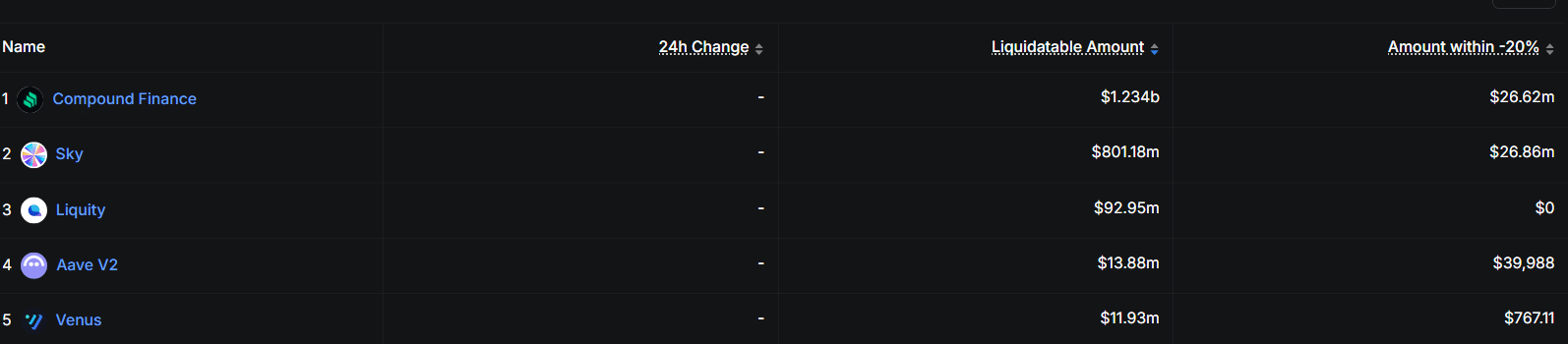
Source: DeFiLlama

However, protocols are redesigning mechanisms through auctions and controlled liquidations to retain value internally rather than letting it escape. This shift changes who benefits from market stress, allowing protocols to capture and recycle value instead of losing it.

As a result, DeFi strengthens its economic structure, improving sustainability and reinforcing long-term resilience

Aave reclaims MEV as SVR reshapes liquidation flows

Aave [AAVE] is not just refining its system; it is expanding a model that is already changing how value moves during liquidations. After proving effective on Ethereum, where Aave recaptured over $16.7 million in MEV, the protocol now extends SVR to Arbitrum and Base.
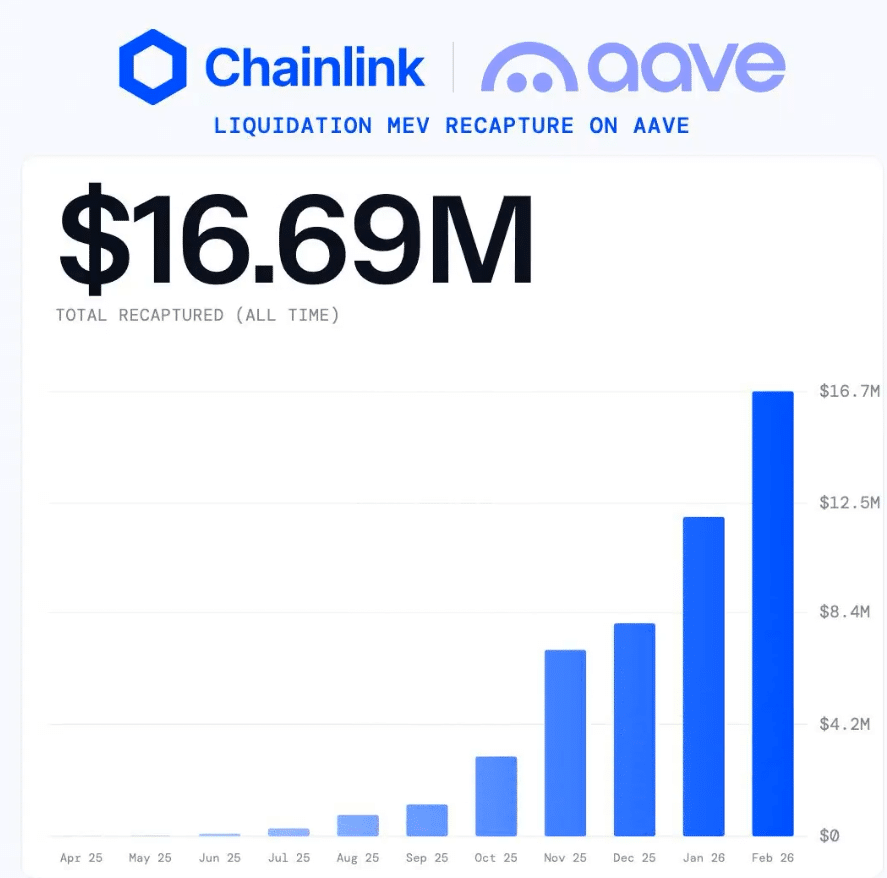
Source: ChainLink/X

This expansion is happening because the previous model left too much value on the table. Bots consistently captured liquidation profits, especially during volatility, while protocols saw little benefit. SVR changes this by redirecting that flow back into Aave’s ecosystem.

As this rollout scales across chains, liquidation events no longer act as pure extraction points. Instead, they become controlled revenue channels that strengthen the protocol.

The implication of these changes is clear. Aave is turning volatility into income, which improves sustainability and sets a precedent for how DeFi protocols capture value going forward.

SVR boosts revenue, but sustainability remains uncertain

As SVR begins to scale across networks, the focus shifts from early success to whether these gains can actually hold over time. The initial results look strong, yet they raise a deeper question about durability.

Aave now sits near $23.87 billion in TVL, while revenue reaches $6.24 million over 30 days, pointing to a $76 million annual run rate. This growth is not accidental, since liquidation activity is now feeding directly into protocol income.

This shift happens because value no longer escapes to bots and instead flows back into the ecosystem, strengthening internal cash flow. However, this strength is conditional. Revenue rises with volatility and lending demand, yet fades when activity slows.

All in all, this approach leaves a clear outcome. SVR improves Aave’s economics, but only sustained market activity can turn these gains into durable value growth.


Final Summary

  • The Aave protocol internalizes MEV through SVR, strengthening DeFi’s shift toward sustainable value capture.
  • AAVE shows rising revenue and improved efficiency, yet long-term growth remains dependent on volatility.


İlgili Sorular

QWhat is the main problem that DeFi protocols are addressing with their new liquidation mechanisms?

ADeFi protocols are addressing the problem of value leakage during liquidations, where external Maximal Extractable Value (MEV) bots were extracting profits, weakening protocol sustainability and causing billions in losses to users.

QHow much MEV value has Aave recaptured on Ethereum after implementing its new system?

AAave has recaptured over $16.7 million in MEV on Ethereum after implementing its SVR (Smart Vault Recovery) system.

QWhat are the two major Ethereum lending markets mentioned, and what were their respective liquidatable positions?

AThe two major Ethereum lending markets mentioned are Compound, with about $1.23 billion in liquidatable positions, and Aave (referred to as 'Sky' in the context, likely a typo for Aave), with around $801 million.

QWhat is the key change that protocols like Aave are making to their liquidation process?

AProtocols like Aave are redesigning their liquidation mechanisms through auctions and controlled processes (like SVR) to retain value internally, turning liquidation events into controlled revenue channels for the protocol instead of allowing value to be extracted by external bots.

QWhat is the primary condition for Aave's SVR model to generate sustainable revenue growth, according to the article?

AThe primary condition for sustainable revenue growth from Aave's SVR model is sustained market activity and volatility, as the revenue gains are dependent on lending demand and market stress, and can fade when activity slows down.

İlgili Okumalar

Bitcoin Withdrawals Continue: 8 Years of Storage in a Coldcard Cold Wallet Ended in Zero

Coldcard Hardware Wallet Hacked: Losses Mount Due to Vulnerable Seed Generation A critical vulnerability in Coldcard hardware wallets has led to a continued wave of fund thefts. According to Galaxy Research, the total stolen has reached 1,367.05 BTC (approx. $88.6 million) from 4,585 addresses, a significant increase from the initial 594.5 BTC reported on July 30, 2026. Most of the stolen funds remain on the attackers' addresses. The issue is not with the current firmware, which Coinkite has updated, but with seed phrases generated on vulnerable devices between March 2021 and the release of fixed firmware versions. Due to a programmer error, devices switched from using a hardware random number generator to the software-based Yasmarang generator, which was initialized with publicly accessible data like the chip's serial number. This made the seed phrases predictable through offline brute-force attacks, meaning wallets remain at risk until funds are moved to a new wallet generated with the patched firmware. Affected devices include Mk2/Mk3 with firmware 4.0.1–4.1.9 (and up to 5.0.3), Mk4/Mk5 up to version 5.6.0, and Q models up to 1.5.0Q. The only exceptions are seeds created with a high-entropy method like at least 50 independent dice rolls or a strong unique BIP-39 passphrase. All other owners must generate a new seed on the fixed firmware and transfer their assets. A case highlighting the human impact involves a 39-year-old long-term investor who lost 2 BTC (approx. $130,000) in minutes. He had accumulated the Bitcoin over eight years through physical labor, viewing it as a financial lifeline and a retirement plan in a country suffering from hyperinflation. His story underscores that even conservative "buy and hold in cold storage" strategies can be compromised by such underlying technical flaws. From a technical perspective, this incident echoes historical failures where weak random number generators undermined cryptographic security, challenging the assumption that offline storage is automatically foolproof.

cryptonews.ru1 saat önce

Bitcoin Withdrawals Continue: 8 Years of Storage in a Coldcard Cold Wallet Ended in Zero

cryptonews.ru1 saat önce

İşlemler

Spot
活动图片




