DeFi Recent Updates: Stablecoin Public Chains Face Internal Competition and Cooling Off, RWA Welcomes Its 'SEC Moment'

marsbit2025-12-17 tarihinde yayınlandı2025-12-17 tarihinde güncellendi

Özet

The DeFi market is currently bearish, with sentiment leaning towards further downside for Bitcoin and a shift of attention and capital towards AI. The author's strategy involves moving away from most altcoins to focus on major assets like BTC and ETH, retaining only a few with strong cash flows like AAVE and LINK. Key developments include a governance dispute between Aave DAO and Aave Labs, highlighting industry-wide governance challenges, and an update to Aave V4's liquidation mechanism to reduce over-liquidations. The article discusses the underwhelming performance of new stablecoin-focused Layer 1 blockchains, which have failed to significantly capture market share from established players like Ethereum and Tron. Their true potential lies in onboarding new, off-chain stablecoin users, a challenging task. A major focus is on the tokenization of real-world assets (RWA) following the SEC's approval of DTCC's tokenization plan. This is seen as a significant, positive regulatory step. The approval outlines strict requirements for compliant blockchains, with Ethereum/L2s being a likely fit. This development is analyzed as a potential indirect benefit for existing projects like Ondo Finance, which recently had an SEC investigation closed with no charges. Ondo's mechanism for facilitating large on-chain stock token trades using its own stablecoin, USDon, is explained. Other updates include Ethena's new airdrop season requirements, which users must interact with its HyENA perps...

In terms of market sentiment, it's largely bearish across the board. In groups focused purely on trading charts, prices below $50,000 are already being discussed. The research-oriented crowd is also very pessimistic, generally believing that it's hard for any good innovation to emerge now, and that attention and capital are being heavily drained by the AI sector.

The strategy discussed last week was to abandon most altcoins and shift to mainstream assets, primarily concentrating on BTC and ETH. Only a portion of altcoin assets with cash-flow businesses were kept, such as AAVE and LINK. Public chains and L2s were mostly swapped for ETH.

Compared to the last cycle, I feel I've become very conservative. During the bear market after LUNA, I bought the dip on a large number of altcoins. Although the overall account was ultimately profitable, and I even witnessed projects like AAVE rise again, I also experienced too many stories of going to zero.

The situation this cycle is a bit different. I think there are very few mispriced altcoins left; the market's computational and evaluation capabilities have greatly improved, and 'bargain hunting' isn't so easy anymore.

Especially this cycle, there are a large number of projects without real business, and also reborn projects meant to fulfill previous fundraising obligations. These projects are very dangerous.

Of course, if there really is a good opportunity, I would still buy, but right now, it's basically non-existent.
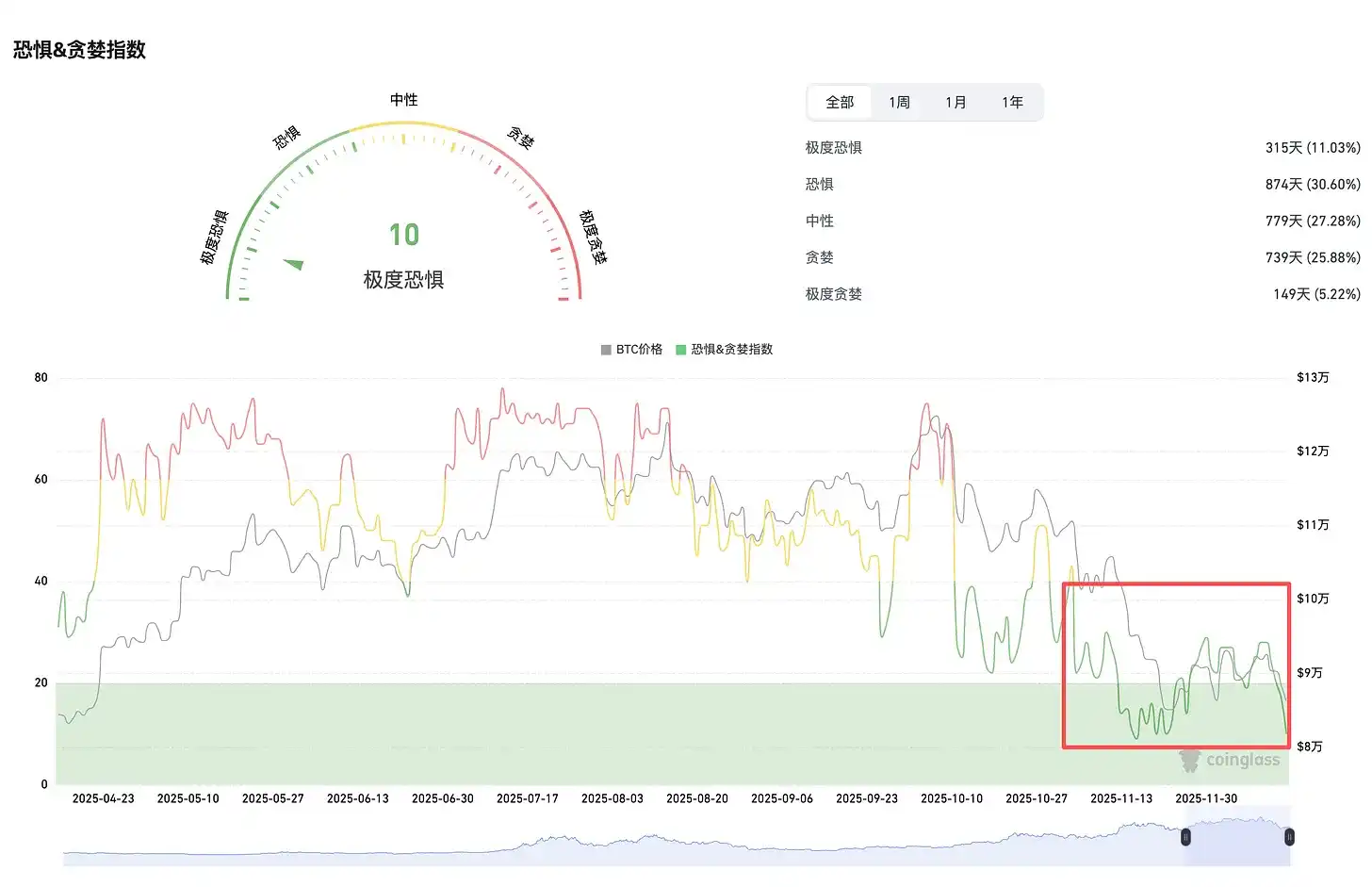
We have been continuously in a state of panic - extreme panic for over a month since early November

Thanks for reading CM's DeFi! Subscribe for free to receive new posts and support my work.

Subscribe

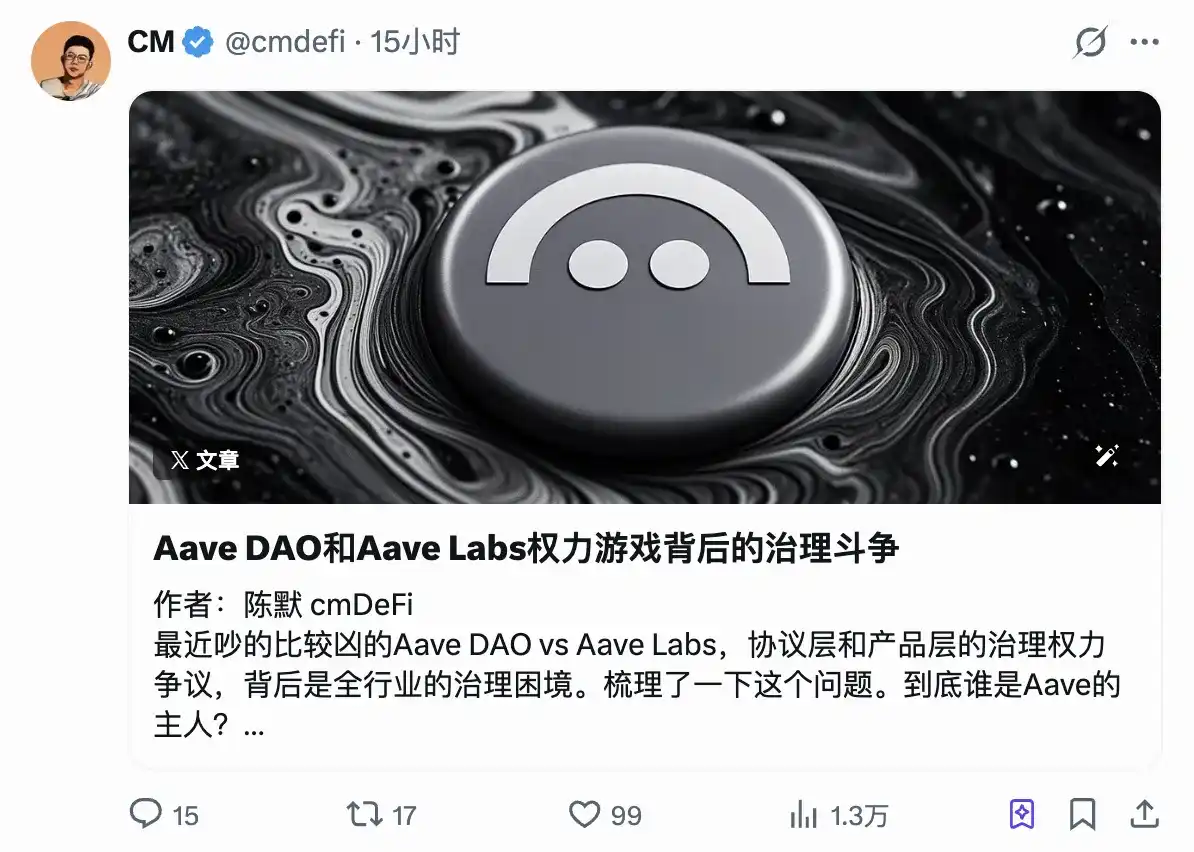
2. Aave DAO vs Aave Labs Governance Power Dispute

This has been fiercely debated recently. I wrote an article about it, recommended reading. This also reflects the governance dilemma faced by the entire industry.
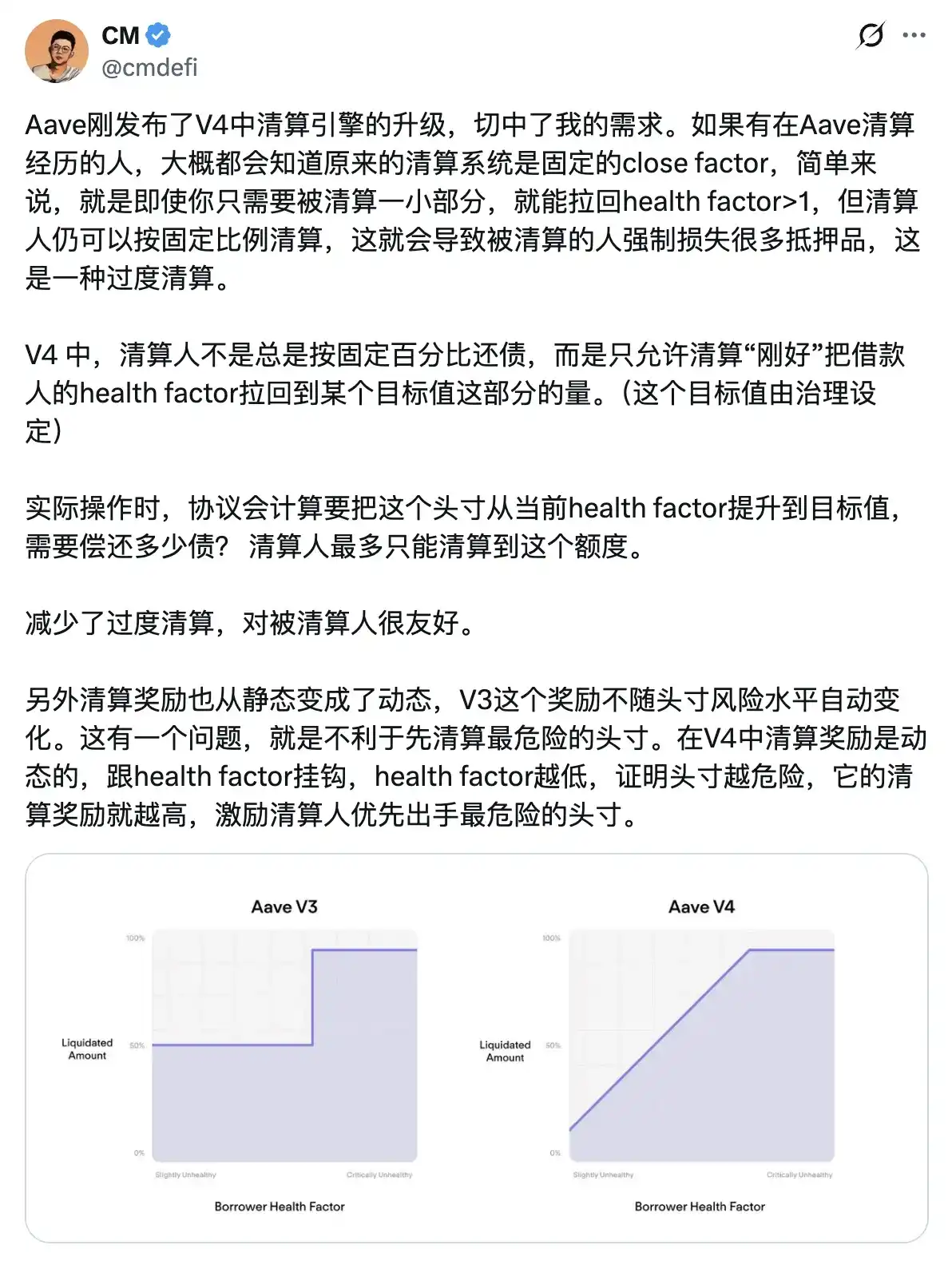
3. Aave V4 Updated Liquidation Mechanism, Reducing Over-Liquidation.
4. About the Hot Stablecoin Public Chains This Cycle

This sector is in a somewhat awkward position currently, and the market's interpretation is also problematic. When Plasma first launched, many thought it would crush other public chains and take away USDT's market share. But in reality, the impact on Ethereum and Tron has been minimal. Even with massive token rewards投放 (deployed), they haven't captured a significant market share.

The real narrative for this赛道 (sector) is to open up the stablecoin market outside the圈 (circle/crypto sphere). After all, in the context of the stablecoin compliance bill being passed this cycle, stablecoin entrepreneurship is a赛道 (sector) that occupies the right timing and conditions. However, currently, no one has been seen to successfully pull this off. Of course, the difficulty is also very high. I think this will be the key factor testing a stablecoin L1 in the future, rather than endlessly competing in the存量 (existing) stablecoin market.

5. Stock Tokenization and RWA Sector

DTCC was approved by the SEC for its asset tokenization plan. This news has once again drawn market attention to this sector. In terms of trend, the SEC is taking a very open and supportive attitude to advance this matter, with documents, details, and standards.

DTCC (Depository Trust & Clearing Corporation) is a leading global provider of financial market infrastructure, processing over 90% of U.S. stock, bond, and treasury trades globally.

First, some standards defined in the SEC's No-Action Letter for 'Qualified Blockchains': (Excerpt)

  • Reliability and Resilience: The blockchain network must demonstrate high reliability and resilience, including assessments based on availability, performance, and historical outage records, to prevent operational disruptions.

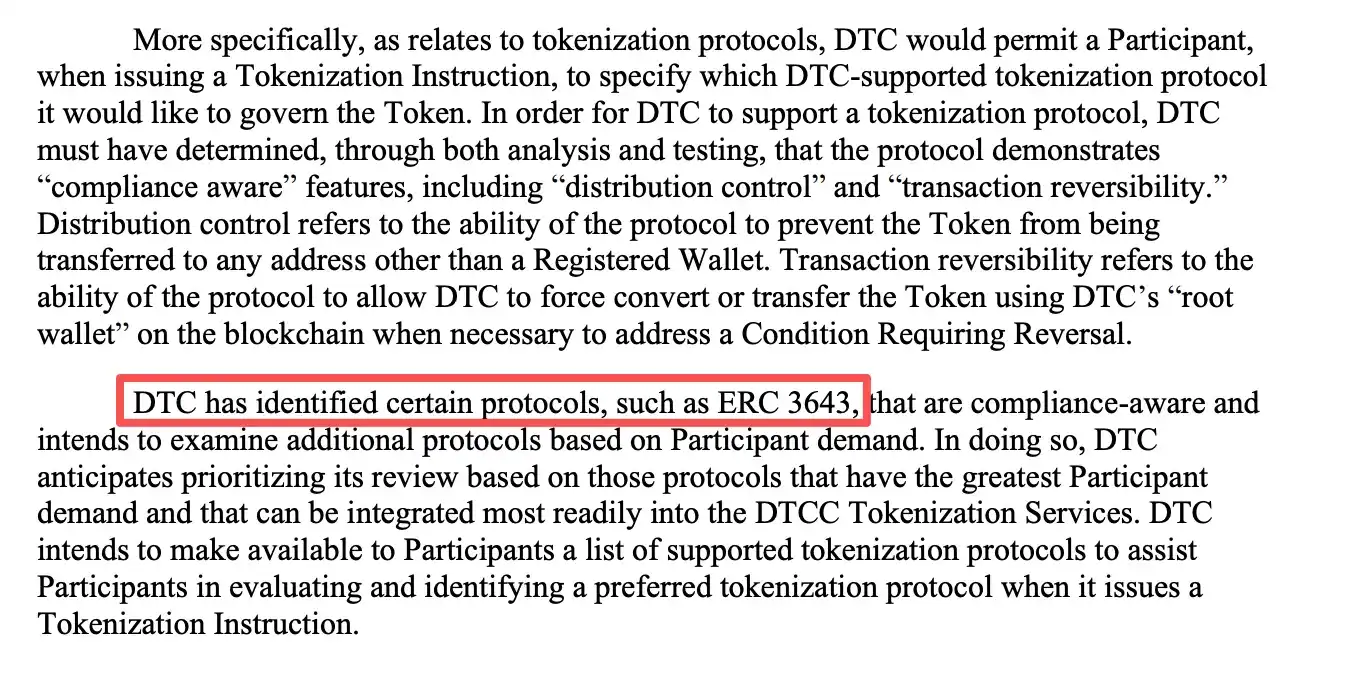
  • Compliance Function Support: Only DTCC participants can register wallets and are fully responsible for wallet activity. The network must support compliance-aware functions, including distribution controls (preventing transfers to non-registered wallets) and transaction reversibility (allowing DTCC to强制转换 (force convert) or transfer via a root wallet to handle 'reversal conditions' such as erroneous entries, lost tokens, or malicious acts).

  • Observability: Even when using privacy features (like zero-knowledge proofs), the network must allow DTCC to observe all token transfers directly or through supporting technology.

  • Wallet Screening: DTCC needs to screen registered wallets itself to confirm compliance with the Office of Foreign Assets Control (OFAC) requirements.

Source document link I've posted here →Click to read

Here, I think if choosing among existing public chains, I still believe Ethereum/L2 is the most compliant, especially since the SEC's original text mentioned ERC-3643, which was explicitly cited as an example of a compliance-aware protocol supporting distribution controls and transaction reversibility. Additionally, DTCC has previously used Ethereum for pilot projects (2020's Project Whitney).
Another point is the impact on existing RWA projects. Many market interpretations are negative, but there is a misunderstanding here. My personal interpretation is still偏向利好 (leaning positive/利好).

First, this matter serves institutional clients (primarily targeting DTC participants and their clients, who are typically financial institutions like banks, brokers, and asset managers). It has no direct relationship with retail investors. Therefore, it is not conflicting with existing stock tokenization products like Ondo (this is where the market interpretation is mistaken). For institutional clients, it offers faster settlement and improved efficiency, opens the possibility of 24/7 trading, and enables some automated management through smart contracts (reducing manual intervention).

From a retail perspective, faster and cheaper institutional settlement could lead brokers (like Robinhood or Fidelity) to reduce fees or commissions, passing the savings to retail. When trading through institutional products (like ETFs or mutual funds), retail might experience faster order execution and better price discovery. Similarly, when using products like Ondo, they could theoretically benefit because its underlying efficiency also relies on the execution efficiency of off-chain institutions.

So this relationship is微妙 (subtle/delicate). The SEC is starting to support stock tokenization in attitude and is also advancing technically. But for on-chain 'gray area' businesses like Ondo, how they will be regulated is not yet clear, while they can still benefit under current policies.估计 (I estimate) it will remain in a state of benign neglect for the short term. It might be different once the scale becomes larger; we'll see then. For now, my interpretation is利好 (positive).

(This month, the U.S. Securities and Exchange Commission (SEC) formally ended its two-year investigation into Ondo Finance and confirmed it would not bring any charges.)

6. Ondo's Stock Tokens Can Support Single Transactions of $100,000 On-Chain

There isn't that much liquidity on-chain. How is this achieved?

It uses a very clever method: it mints its own stablecoin, USDon. Then, when there is buy demand, it directly mints the stock token, using its own USDon as a bridge. This eliminates the need for external liquidity because both the stock token and USDon are under its own control – theoretically offering infinite liquidity. Conversely, when someone sells, it first burns the stock token, then converts it to USDon based on the Oracle price, and finally exchanges it for the on-chain asset the user wants.

Regarding USDon, in terms of composition, its collateral is U.S. dollars and U.S. Treasuries等高流动性资产 (highly liquid assets), held in a regulated brokerage account. On-chain, it is placed together with USDC in a Swapper contract. When a transaction occurs, USDon is used as the intermediary asset.

For example, to buy NVDAon: User inputs USDC → swapper converts to USDon → uses USDon to mint NVDAon, all completed in a single transaction.

The swapper is a smart contract pool holding liquidity for USDon and USDC. If liquidity is sufficient, the conversion can be done instantly at 1:1. For very large amounts, exceeding the liquidity threshold, one would have to wait or trade in batches. The liquidity of this contract is maintained by Ondo itself.

Theoretically, Ondo can increase the supported single transaction size by injecting more USDon (or corresponding USDC) into the Swapper. The only potential issue later is that if demand picks up, high-frequency trading might expose the Swapper's bottleneck. This would test the on-chain performance and Ondo's ability to rebalance and manage the Swapper.

For Ondo, although its current implementation seems optimal with the best liquidity, it has little to do with the ONDO token. Also, whether this project can scale up and whether it will face regulatory issues is hard to say. It is still in a 'gray area' currently. But if you want to bet on the stock tokenization narrative, then Ondo is probably unavoidable.

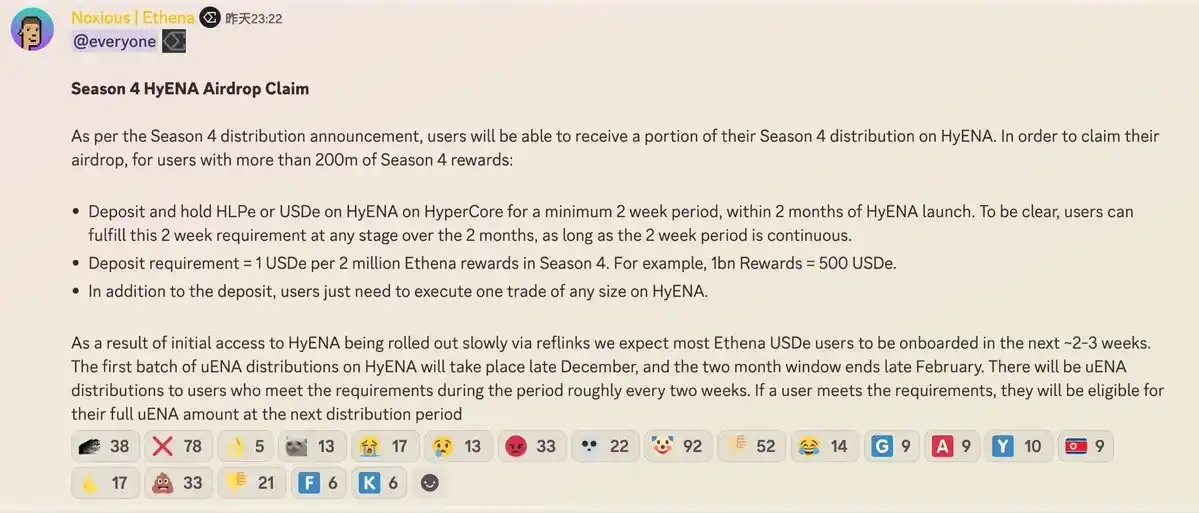
7. Ethena Updated Season 4 Airdrop, Added HyENA Related Portion

  • For users with over 200 million points, they need to deposit and hold HLPe or USDe on HyENA for at least 2 weeks, and it must be consecutive. The deposit amount required is 1 USDe for every 2 million points. Based on the minimum threshold of 200 million points, that's 100 USDe.

  • Besides depositing, users need to make a transaction of any size on HyENA. Rewards are distributed in uENA (the version of ENA on Hyper). The first batch starts in late December, with a two-month window lasting until February. This means during these 2 months, you choose any continuous 2-week period to deposit.

This is essentially forcing traffic to HyENA. Ethena places great importance on the Perps business (after all, it's very profitable).
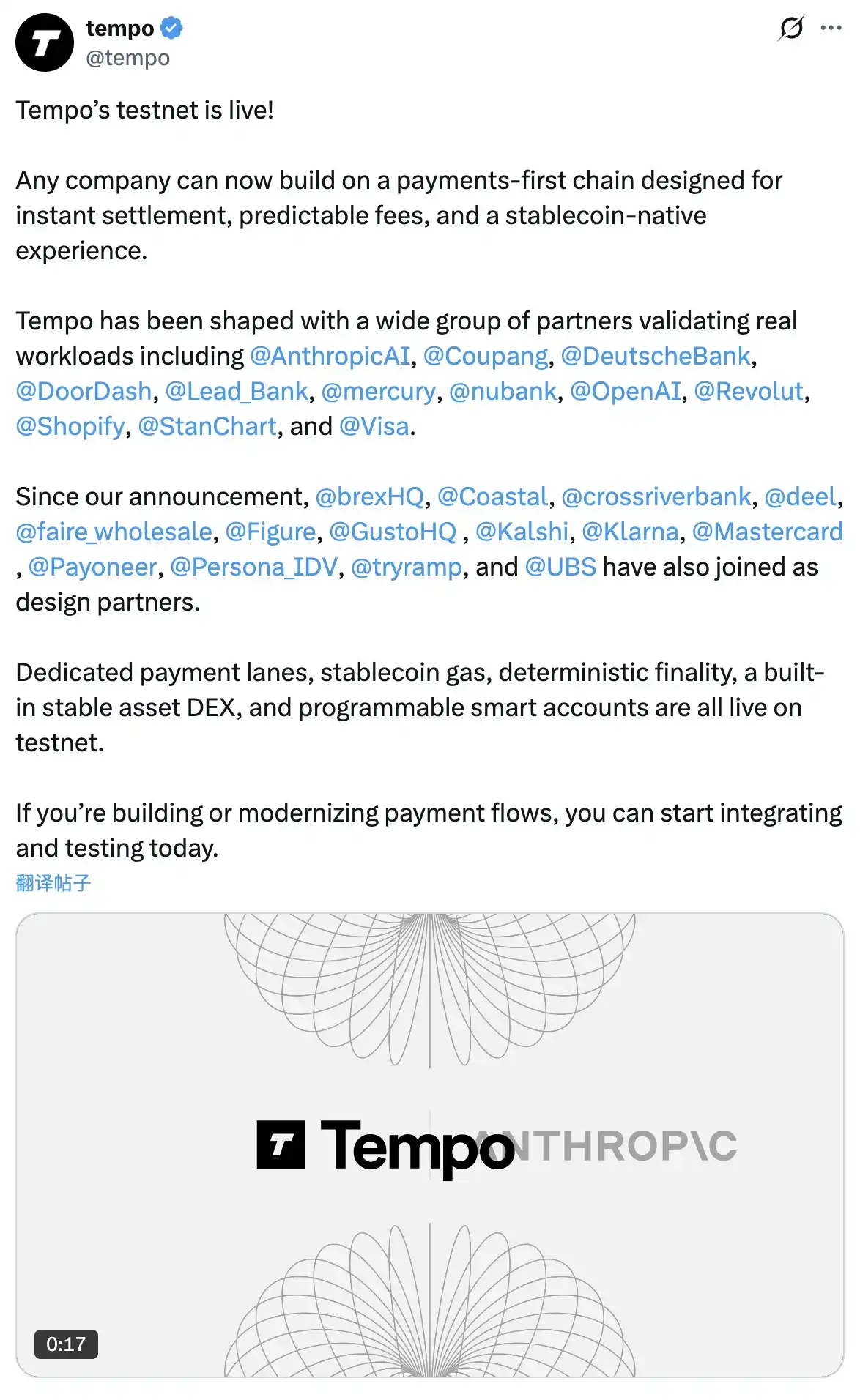
8. Tempo Launches Testnet

Co-incubated and developed by Stripe and Paradigm. Partners include Anthropic AI, Coupang, Deutsche Bank, DoorDash, Lead Bank, Mercury, NuBank, OpenAI, Revolut, Shopify, Standard Chartered, Visa.

Tempo's goal is to solve the pain points of existing blockchains in the payment field, such as high fees, latency, and uncertainty, making stablecoins a mainstream payment tool.
İlgili Sorular

QWhat is the author's current investment strategy for the crypto market, and why have they become more conservative?

AThe author's strategy is to shift from most altcoins to mainstream assets like BTC and ETH, keeping only a few altcoins with cash flow businesses such as AAVE and LINK. They have become more conservative because they believe there are fewer undervalued altcoins in this cycle, and the evaluation capabilities of the market have improved, making it harder to find bargains. Additionally, many projects lack real business models or are rebranded projects from previous funding rounds, increasing risks.

QWhat is the key challenge for stablecoin-focused Layer 1 blockchains according to the author?

AThe key challenge for stablecoin-focused Layer 1 blockchains is to expand into the off-chain stablecoin market rather than competing for the existing on-chain market share. Despite heavy token incentives, they have not significantly captured market share from established chains like Ethereum or Tron. The real opportunity lies in leveraging the regulatory environment for stablecoins to attract external users, but this remains difficult to achieve.

QHow does the SEC's approval of DTCC's tokenization plan impact the RWA and stock tokenization sector?

AThe SEC's approval is seen as a positive development, showing regulatory support for asset tokenization with clear standards. It benefits institutional clients by enabling faster settlements, 24/7 trading, and automated management via smart contracts. While it directly serves institutions, retail investors may indirectly benefit through lower fees and improved efficiency from brokers. Projects like Ondo are not directly conflicted by this but operate in a 'gray area,' potentially gaining from the overall positive momentum.

QHow does Ondo Finance facilitate large on-chain stock token trades without sufficient liquidity?

AOndo uses its own stablecoin, USDon, as an intermediary. When a user buys a stock token like NVDAon, USDC is converted to USDon via a swapper contract, and USDon is then used to mint the stock token. This allows Ondo to create 'infinite' liquidity since both USDon and the stock tokens are controlled by Ondo. The swapper contract holds liquidity in USDon and USDC, managed by Ondo, which can inject more funds to support larger trades, though high-frequency trading may expose scalability challenges.

QWhat is the purpose of Ethena's Season 4 airdrop update involving HyENA?

AEthena's Season 4 airdrop update requires users with over 200 million rewards to deposit and hold HLPe or USDe on HyENA for at least two consecutive weeks and perform any transaction on HyENA. This is designed to drive traffic to HyENA, as Ethena prioritizes its perpetuals business, which is highly profitable. Rewards are distributed in uENA over a two-month window from December to February.

İlgili Okumalar

BIT Trading Moment: BTC Still Suppressed by Weekly 200 EMA, Rejection May Restart Decline; Storage and Semiconductors that Surged Last Night Begin Falling in Evening Trading

**Crypto & Stock Market Wrap: Bitcoin Tests Resistance, Stocks Retreat After AI Surge** Bitcoin consolidates around $66,000, facing key resistance near $68,000—an area seen as a major psychological and technical hurdle where previous rallies have failed. Analysts note the cryptocurrency is caught between its 200-week moving average (~$63,333) and 200-week EMA (~$68,328). A clear break above $68k is needed to signal a stronger bullish trend, while a rejection could lead to a retest of $63k support. Market sentiment remains cautious, with low futures open interest pointing to a low-liquidity rebound rather than a full bull market. Bitcoin spot ETFs saw another $203 million inflow. US stock futures pointed lower after a strong Tuesday session led by a massive rebound in semiconductors and memory stocks. The rally was fueled by renewed optimism about AI-driven hardware demand, with Micron, SanDisk, and SK Hynix surging. However, those gains reversed in pre-market trading. Super Micro Computer (SMCI) soared over 20% after hours on strong guidance and a record backlog. Other standouts included Rocket Lab and nuclear energy plays Oklo and X-Energy. Rising oil prices (Brent above $91) and climbing Treasury yields (10-year near 4.64%), however, are reigniting inflation concerns and acting as a headwind for equities. In Asia, markets were mixed. South Korea's KOSPI pared early gains to close slightly higher as semiconductor stocks like SK Hynix gave back initial surges. Japan's Nikkei edged lower as the yen hit a fresh 38-year low against the dollar, raising fears of potential market intervention. Key events to watch include the Samsung Galaxy launch, AMD's AI event, and a slew of major tech earnings from Alphabet, Tesla, and IBM after the close on Wednesday, followed by the ECB meeting and Intel's earnings on Thursday.

marsbit9 dk önce

BIT Trading Moment: BTC Still Suppressed by Weekly 200 EMA, Rejection May Restart Decline; Storage and Semiconductors that Surged Last Night Begin Falling in Evening Trading

marsbit9 dk önce

Former CFTC Chairman, Circle President Tarbert: Preaching Long-Termism While Cashing Out $30 Million Himself

Former CFTC Chairman and Circle President Heath Tarbert has consistently advocated for a long-term vision in public, urging patience from investors as Circle’s stock price has fallen significantly from its peak. However, it has been revealed that since Circle’s IPO, Tarbert has continuously sold his CRCL shares through pre-arranged trading plans, cashing out approximately $30 million, without making any public market purchases. This contrast between his public messaging and personal actions has drawn criticism. Tarbert joined Circle in July 2023 as Chief Legal Officer, leveraging his regulatory experience to help guide the company through its IPO and expansion. Despite promoting stablecoins as long-term infrastructure, he established a 10b5-1 trading plan just before Circle went public, leading to substantial stock sales over the following year. In March 2026, he initiated another plan to sell more shares. His career trajectory highlights a pattern of moving between high-level regulatory roles and influential positions in the financial sector. After resigning as CFTC Chairman in early 2021, he joined Citadel Securities as Chief Legal Officer just 27 days later, during a period of intense regulatory scrutiny for the firm. He later joined Circle, aiding its efforts to navigate regulatory challenges for its public listing. While Tarbert's expertise in policy and compliance is valuable to companies like Circle, his actions—advocating long-term confidence while personally divesting—raise questions about the alignment between his public statements and his private financial decisions, leaving investors who followed his advice to bear the market risks.

marsbit31 dk önce

Former CFTC Chairman, Circle President Tarbert: Preaching Long-Termism While Cashing Out $30 Million Himself

marsbit31 dk önce

Gate Research Institute: The 'Wall Street-ization' Wave of Crypto Financial Products – Competition or Integration?

The article titled "Gate Research Institute: Are Crypto Financial Products Sparking a 'Wall Street' Wave—Competition or Convergence?" explores the evolving relationship between the crypto ecosystem and traditional finance (TradFi). The piece begins by reflecting on Bitcoin's original 2009 vision of decentralization, disintermediation, and moving away from banks. It then contrasts this with the 2024 landscape, where key crypto assets like Bitcoin are increasingly held through Wall Street products like ETFs issued by giants like BlackRock. The article questions whether this signifies that TradFi is systematically taking over the rights to issue, price, custody, and distribute crypto financial assets. The core argument is that this is not a zero-sum takeover but rather a bidirectional convergence where each side addresses the other's weaknesses. Crypto offers 24/7 global markets, programmable settlement, and open access but lacks compliant channels, institutional-grade custody, deep fiat liquidity, and mainstream distribution. TradFi possesses these but is constrained by legacy systems, limited operating hours, and slow settlement. Two primary convergence paths are highlighted: * **Path A (CEX to TradFi):** Exemplified by Gate, which has progressed from offering tokenized stocks and CFDs to providing direct, real stock trading (US, Hong Kong, South Korea) within its platform, using USDT. * **Path B (TradFi to Crypto):** Exemplified by Robinhood, which has integrated crypto trading, acquired exchanges like Bitstamp, and is moving traditional assets like stocks onto the blockchain via tokenization and its own Layer 2. Both paths are ultimately competing to become the next-generation, unified financial account—a "super account" where users can seamlessly trade cryptocurrencies, stocks, ETFs, RWA (Real World Assets), and tokenized treasury products in one interface. The growth of RWA and tokenized treasuries (e.g., BlackRock's BUIDL) is presented as the asset-layer fusion, providing stable, yield-bearing assets on-chain and acting as a bridge between the two worlds. In conclusion, the "Wall Street-ization" of crypto is framed as a mutual transformation. Decentralized ideals persist in the protocol layer, while at the application layer, a more efficient, global, and accessible unified capital market is emerging from this convergence. The future competition lies not between crypto exchanges and stockbrokers, but between platforms vying to offer the most comprehensive asset coverage, liquidity, and user experience within a single account.

marsbit36 dk önce

Gate Research Institute: The 'Wall Street-ization' Wave of Crypto Financial Products – Competition or Integration?

marsbit36 dk önce

İşlemler

Spot
活动图片





