Decoding KITE’s 14% jump: Is trendline support enough to keep bears at bay?

ambcrypto2026-02-23 tarihinde yayınlandı2026-02-23 tarihinde güncellendi

Özet

KITE surged nearly 14% in 24 hours, rebounding from a key rising trendline support level that has held since February 6. While the bounce improved short-term sentiment, the overall market structure remains contested rather than decisively bullish. Momentum indicators suggest easing selling pressure, with the Stochastic RSI stabilizing near oversold levels. However, derivatives data reflect caution: Open Interest fell by $32 million to $85 million, the Long/Short Ratio stayed at 0.75, and funding rates remained negative—indicating reduced speculative activity and limited bullish conviction. The price is at a technical crossroads; holding above trendline could fuel further recovery, while a breakdown may trigger renewed sell-off.

Kite [KITE] jumped nearly 14% over the past 24 hours, reversing part of yesterday’s sharp pullback.

The move shook short-term sentiment. Even so, the broader daily structure remained contested rather than decisively bullish.

Trendline support is still in play

On the daily chart, KITE’s price respected a rising trendline support in place since the 6th of February.

That trendline previously triggered multiple reactions, each followed by short-term recoveries rather than sustained breakdowns.

If that pattern holds, the latest retest could fuel another bounce, especially after the sharp daily surge.

However, a clean break below the trendline would weaken the bullish structure. Follow-through buying remained necessary to keep bulls in control.

Momentum indicators pointed to easing sell-side pressure.

The Stochastic RSI showed momentum stabilizing after dipping toward lower bounds, suggesting sellers were losing control.

That setup often preceded short-term corrective rallies, though it did not confirm a full trend reversal yet.

Derivatives paint a cautious picture

Derivatives data reflected cooling speculative activity.

Open Interest fell by roughly $32 million to about $85 million, signaling position closures during the recent decline.

That contraction suggested traders reduced exposure rather than aggressively chasing the rebound.

At the same time, the Long/Short Ratio hovered near 0.75, showing shorts still slightly outnumbered longs.

Funding data added nuance. The Aggregated Funding Rate stayed below its predicted level by roughly 0.0189 points, hinting at relatively cautious leverage positioning.

Such divergence often implied muted bullish conviction, though it sometimes preceded tactical long entries.

Bulls at a technical crossroads

KITE now sat at a pivotal technical zone.

If trendline support held and momentum continued to stabilize, short covering could amplify a rebound.

By contrast, a breakdown below support could accelerate selling and invalidate the recovery attempt.

For now, the strong reaction off trendline support kept near-term bias tilted toward the bulls, but confirmation remained pending.


Final Summary

  • KITE rebounded sharply from a rising trendline support held since 06 February, triggering dip buying and short-term momentum recovery.
  • Open Interest fell to around $85 million, the Long/Short Ratio stayed below 1, and Aggregated Funding Rates remained negative, signaling cautious leverage participation.


Trend Kriptolar

İlgili Sorular

QWhat was the key technical support level that KITE's price respected on the daily chart?

AKITE's price respected a rising trendline support that has been in place since the 6th of February.

QWhat did the previous reactions to the trendline support typically result in?

APrevious reactions to the trendline support were each followed by short-term recoveries rather than sustained breakdowns.

QWhat did the decline in Open Interest by approximately $32 million signal about trader behavior?

AThe decline in Open Interest to about $85 million signaled that traders were reducing their exposure through position closures rather than aggressively chasing the rebound.

QWhat does a Long/Short Ratio of 0.75 indicate about market positioning?

AA Long/Short Ratio of 0.75 indicates that short positions still slightly outnumber long positions in the market.

QWhat are the two potential price scenarios for KITE following its rebound from trendline support?

AIf trendline support holds, short covering could amplify a rebound. Conversely, a breakdown below the support could accelerate selling and invalidate the recovery attempt.

İlgili Okumalar

STRC's First Financial Report Post-Depegging, How is Strategy Restoring the Capital Flywheel?

On July 31, 2026, Bitcoin treasury company Strategy released its Q2 financial report. Despite a 6.9% year-over-year increase in revenue to $122 million, the company recorded a substantial net loss of $8.22 billion, primarily due to $8.32 billion in unrealized losses from Bitcoin holdings. While Strategy's core Bitcoin strategy remains intact—its holdings grew 11% to 843,775 BTC—the company is undergoing a fundamental shift in its capital model. Following the de-pegging of its key financing tool, the STRCoin (STRC), from its $100 target in May, Strategy has pivoted from a one-directional "raise funds, buy Bitcoin" cycle to a more dynamic, multi-asset capital management approach. A key part of this new framework is the "Monetization Program," through which Strategy has sold approximately $218.4 million worth of BTC to bolster liquidity. The company's top priority is repairing STRC's peg, committing not to issue discounted shares until it returns to its target range. It has initiated a $1 billion buyback program for discounted digital credit securities, having repurchased $28.9 million face value of STRC so far. Management aims to restore the peg around September 8, 2026. Strategy now actively manages a matrix of assets: Bitcoin (for accumulation or strategic sales), USD cash reserves (now at $3.75 billion), common stock (MSTR), and digital credit securities like STRC. This allows for tactical moves like repurchasing discounted debt or equity to capture value. The future success of Strategy's "capital flywheel" hinges on two factors: the short-term ability to successfully re-peg STRC to restore market confidence in its digital credit system, and the long-term price trajectory of Bitcoin, upon which its entire investment thesis ultimately depends.

Odaily星球日报7 dk önce

STRC's First Financial Report Post-Depegging, How is Strategy Restoring the Capital Flywheel?

Odaily星球日报7 dk önce

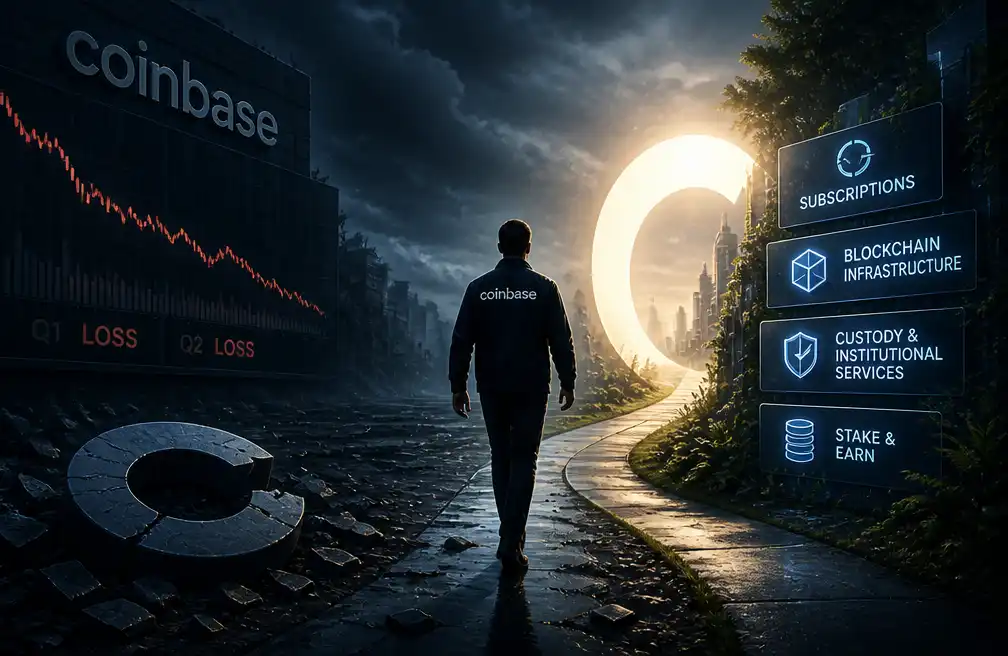
With Two Consecutive Quarters of Losses, Coinbase Must Rely on Paths Beyond Trading

Coinbase posted its second consecutive quarterly net loss of $359 million on $1.22 billion in revenue for Q2, highlighting its vulnerability to crypto market cycles where weaker prices and lower volatility reduce user trading. However, the report also reveals a strategic shift in its business model. Despite a 25% quarter-over-quarter decline in global spot trading volume, Coinbase increased its market share to a company-record 10.3%. This suggests its position as a compliant U.S. on-ramp is strengthening even in a cooler market. A key development is the diversification of revenue streams. Transaction revenue fell to $599 million, nearly equaling subscription and services revenue of $555 million. Stablecoin services, generating $292 million, are becoming a crucial revenue "floor." This income, derived from interest on the $20 billion average USDC balance held on its platform, is less tied to daily trading activity. Furthermore, while spot trading volume dropped significantly, derivatives volume held steady at $1.03 trillion. Coinbase is pushing to integrate spot, stablecoin, and derivatives liquidity to create a more interconnected and sticky ecosystem for users. The GAAP net loss includes non-cash expenses like stock-based compensation and crypto asset valuation changes. Its adjusted EBITDA remained positive at $208 million for the 14th straight quarter, indicating core operations can cover ongoing costs. The company is also reducing expenses to manage the downturn. The central question moving forward is whether Coinbase's growing market share, stablecoin revenues, and expanding product integration can sufficiently offset the inherent cyclicality of its core trading business during future market contractions.

marsbit22 dk önce

With Two Consecutive Quarters of Losses, Coinbase Must Rely on Paths Beyond Trading

marsbit22 dk önce

In the Age of Artificial Intelligence, We Need 'Magicians,' Not 'Managers'

In the AI era, leadership must shift from management to magic. As knowledge rapidly expires, value shifts from what leaders know to what they can facilitate. Traditional "inside-out" management, driven by internal experience, is giving way to "outside-in" thinking focused on external opportunities, customer needs, and disruptive change. The core challenge is fostering new ideas that may invalidate existing knowledge. While technologies like steam, electricity, and AI provide the "skeleton" for innovation, it is human vision—connecting technology to customer dreams—that creates magic. Historical figures like Richard Arkwright and Eldridge R. Johnson succeeded not by inventing core technologies, but by reimagining work and business models from the outside in. Leaders must transition from controllers to "architects of flourishing." Their role is to design environments where empowerment, creativity, and adaptive learning thrive. This involves granting autonomy, fostering partnerships, and building resilient systems that scale innovation. Critical leadership qualities now include judgment, creativity, and the ability to learn continuously rather than relying on static expertise. Therefore, cultivating future leaders requires a focus on timeless fundamentals, humanities for broader perspective, and social acuity, rather than over-specialization in quickly outdated technical skills. The future rewards those who respond to the unseen and create conditions for better answers to emerge. Leadership in the AI age is less about having all the answers and more about enabling others to discover them—creating organizations where people explore, imagine, and thrive.

marsbit57 dk önce

In the Age of Artificial Intelligence, We Need 'Magicians,' Not 'Managers'

marsbit57 dk önce

İşlemler

Spot

Popüler Makaleler

KITE Nasıl Satın Alınır

HTX.com’a hoş geldiniz! Kite AI (KITE) satın alma işlemlerini basit ve kullanışlı bir hâle getirdik. Adım adım açıkladığımız rehberimizi takip ederek kripto yolculuğunuza başlayın. 1. Adım: HTX Hesabınızı OluşturunHTX'te ücretsiz bir hesap açmak için e-posta adresinizi veya telefon numaranızı kullanın. Sorunsuzca kaydolun ve tüm özelliklerin kilidini açın. Hesabımı Aç2. Adım: Kripto Satın Al Bölümüne Gidin ve Ödeme Yönteminizi SeçinKredi/Banka Kartı: Visa veya Mastercard'ınızı kullanarak anında Kite AI (KITE) satın alın.Bakiye: Sorunsuz bir şekilde işlem yapmak için HTX hesap bakiyenizdeki fonları kullanın.Üçüncü Taraflar: Kullanımı kolaylaştırmak için Google Pay ve Apple Pay gibi popüler ödeme yöntemlerini ekledik.P2P: HTX'teki diğer kullanıcılarla doğrudan işlem yapın.Borsa Dışı (OTC): Yatırımcılar için kişiye özel hizmetler ve rekabetçi döviz kurları sunuyoruz.3. Adım: Kite AI (KITE) Varlıklarınızı SaklayınKite AI (KITE) satın aldıktan sonra HTX hesabınızda saklayın. Alternatif olarak, blok zinciri transferi yoluyla başka bir yere gönderebilir veya diğer kripto para birimlerini takas etmek için kullanabilirsiniz.4. Adım: Kite AI (KITE) Varlıklarınızla İşlem YapınHTX'in spot piyasasında Kite AI (KITE) ile kolayca işlemler yapın.Hesabınıza erişin, işlem çiftinizi seçin, işlemlerinizi gerçekleştirin ve gerçek zamanlı olarak izleyin. Hem yeni başlayanlar hem de deneyimli yatırımcılar için kullanıcı dostu bir deneyim sunuyoruz.

517 Toplam GörüntülenmeYayınlanma 2025.11.03Güncellenme 2026.06.02

KITE Nasıl Satın Alınır

Tartışmalar

HTX Topluluğuna hoş geldiniz. Burada, en son platform gelişmeleri hakkında bilgi sahibi olabilir ve profesyonel piyasa görüşlerine erişebilirsiniz. Kullanıcıların KITE (KITE) fiyatı hakkındaki görüşleri aşağıda sunulmaktadır.

活动图片