Deciphering Messari's 100,000-Word Annual Report (Part 1): Why Did Market Sentiment Collapse Completely in 2025?

深潮2025-12-22 tarihinde yayınlandı2025-12-22 tarihinde güncellendi

Özet

This article analyzes the 2025 crypto market sentiment collapse, as detailed in Messari's extensive annual report. Despite no major exchange failures, systemic collapses, or regulatory crises, the Crypto Fear & Greed Index hit a historic low of 10. The report argues this extreme pessimism stems not from industry failure, but from a structural shift in market participation and rewards. Key insights include: - Institutional investors thrived due to ETFs, regulated custody (DATs), and clearer frameworks, while retail traders suffered from vanishing alpha, ineffective narratives, and underperformance against Bitcoin. - The emotional crash reflects an identity mismatch: the market now rewards long-term holders and institutional capital, not short-term speculators. - The root cause is the failure of the traditional monetary system, where soaring global government debt forces savers to bear the cost via inflation, financial repression, or negative real rates. Crypto, especially Bitcoin, offers a predictable, non-sovereign alternative. - Bitcoin’s dominance rose to 57.3%, as it became recognized as "money" due to its stability, predictability, and institutional adoption (ETFs, corporate treasuries), not technical superiority. - Layer-1 blockchains (excluding Bitcoin) struggled, with valuations disconnected from declining revenues. They can no longer rely on "becoming money" narratives now that Bitcoin occupies that role, forcing a revaluation based on utility and cash flows, not spe...

Author: Merkle3s Capital

This article is based on the annual report The Crypto Theses 2026 released by Messari in December 2025. The full report exceeds 100,000 words, with an official estimated reading time of 401 minutes.

This content is supported by Block Analytics Ltd X Merkle 3s Capital. The information herein is for reference only and does not constitute any investment advice or offer. We are not responsible for the accuracy of the content, nor for any consequences arising therefrom.

Introduction | The Worst Year for Sentiment, But Not the Most Fragile Year for the System

If we only look at sentiment indicators, the crypto market in 2025 could almost be pronounced "dead."
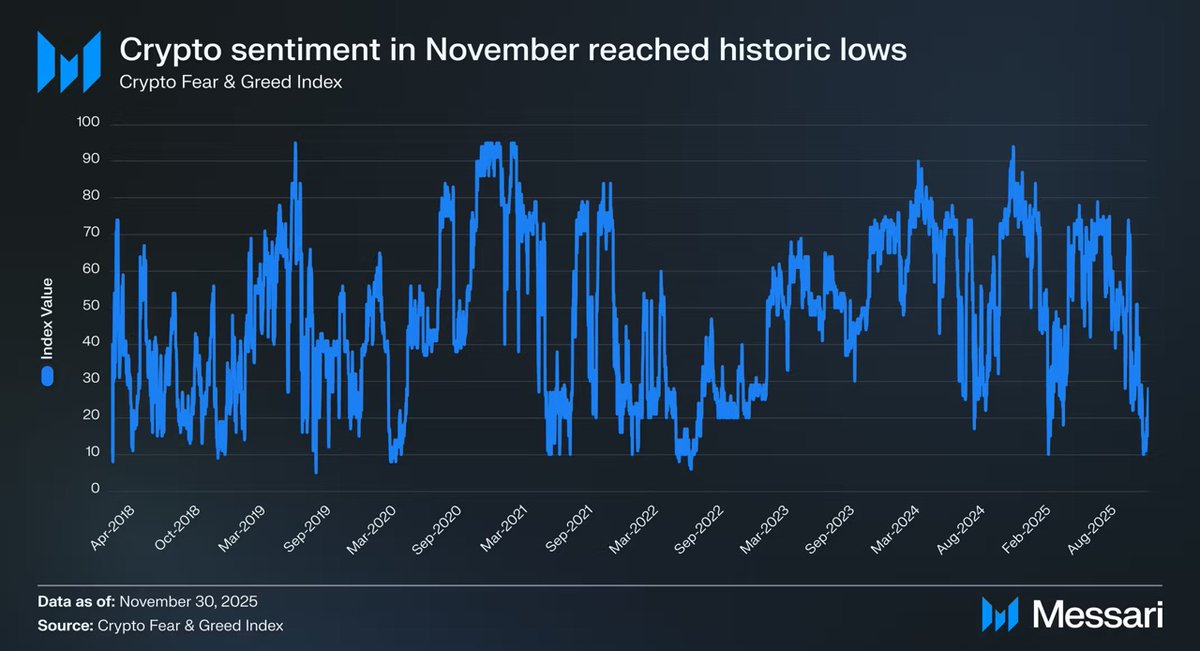
In November 2025, the Crypto Fear & Greed Index fell to 10, entering the "Extreme Fear" zone.

Historically, there have been very few moments when sentiment has fallen to this level:

March 2020: Liquidity stampede triggered by the global pandemic

May 2021: Cascading leveraged liquidations

May–June 2022: Systemic collapse of Luna and 3AC

2018–2019: Industry-wide bear market

These periods all share a commonality: the industry itself was failing, and the future was highly uncertain.

But 2025 does not fit this characteristic.

No major exchange misappropriated user assets.

No Ponzi projects with market caps of hundreds of billions of dollars dominated the narrative.

The total market capitalization did not fall below the previous cycle's high.

Stablecoin supply反而 reached a new all-time high.

Regulatory and institutionalization processes continued to advance.

At the "factual level," this is not a year of industry collapse.

However, at the "perceptual level," it might be the most painful year for many practitioners, investors, and long-time users.

Why Did Sentiment Collapse?

Messari presents a highly impactful contrast at the beginning of the report:

If you were participating in crypto asset allocation from a Wall Street office building, 2025 might have been the best year since you entered the industry. But if you were staying up late staring at charts on Telegram and Discord, searching for Alpha, this was probably the year you missed the "old days" the most.

The same market, two almost diametrically opposite experiences.

This is not a random mood swing, nor a simple bull-bear transition.

It is a deeper structural misalignment:

The market is changing its participants, but most people are still participating in the new system with their old identities.

This Is Not a Market Recap

This article does not intend to discuss short-term price movements, nor does it attempt to answer "will it go up next?".

It is more like a structural explanation:

Why did market sentiment slide to a historically low point while institutions, capital, and infrastructure were continuously strengthening?

Why did many people feel they "chose the wrong track," yet the system itself did not fail?

In this 100,000-word report, Messari chooses to start from an extremely fundamental question:

If crypto assets are ultimately a form of "money," then who deserves to be treated as money?

Understanding this is the prerequisite for understanding the complete collapse of market sentiment in 2025.

Chapter 1 | Why Was Sentiment Abnormally Low?

If we only look at the outcome, the sentiment collapse of 2025 is almost "incomprehensible."

In the absence of exchange blow-ups, systemic credit collapses, or core narrative failures, the market nonetheless provided sentiment feedback near its historical lows.

Messari's judgment is very direct: This is an extreme case of "severe decoupling between sentiment and reality."

1. Sentiment indicators have entered a "historical anomaly zone"

The Crypto Fear & Greed Index falling to 10 is not an ordinary correction signal.

In the past decade, this value has only appeared at a very few moments, and each time it appeared, it was accompanied by a real and profound industry-level crisis:

Breakdown of the funding system

Collapse of credit chains

Market doubt about "whether the future exists"

But these problems did not appear in 2025.

No core infrastructure failed.

No mainstream assets were liquidated to zero.

No systemic events occurred that could shake the industry's legitimacy.

Statistically, this sentiment reading does not match any known historical template.

2. The market did not fail; "personal experience" failed

The collapse of sentiment did not come from the market itself, but from the subjective experience of the participants.

Messari repeatedly emphasizes an overlooked fact in the report:

2025 was a year where the institutional experience was far better than the retail experience.

For institutions, this was an extremely clear, even comfortable environment:

ETFs provided low-friction, low-risk allocation channels

DATs (Digital Asset Treasuries) became stable, predictable long-term buyers

Regulatory frameworks began to clarify, and compliance boundaries became gradually visible

But for a large number of participants under the old structure, this year was exceptionally brutal:

Alpha significantly decreased

Narrative rotation failed

Most assets underperformed BTC over the long term

The relationship between "effort" and "results" was completely broken

The market did not reject people; it just changed the reward mechanism.

3. "Not making money" was misinterpreted as "the industry is failing"

The real trigger for sentiment was not the price drop, but the cognitive gap.

In past cycles, the implicit assumption of Crypto was:

As long as you are diligent enough, early enough, and aggressive enough, you can achieve超额回报 (excess returns).

But 2025 was the first time this assumption was systematically broken.

Most assets no longer gained premiums for "storytelling"

L1 ecosystem growth no longer automatically translated into token returns

High volatility no longer meant high returns

The result was that many participants began to develop an illusion:

If I didn't make money, then the entire industry must have a problem.

Messari's conclusion is恰恰相反 (precisely the opposite):

The industry is becoming more like a mature financial system, not a machine that continuously produces speculative红利 (dividends).

4. The essence of the sentiment collapse is identity misplacement

Considering all phenomena, the implicit answer given by Messari is only one:

The sentiment collapse of 2025 is essentially an identity misplacement.

The market is tilting towards "asset allocators," "long-term holders," and "institutional participants"

But a large number of participants still exist as "short-term alpha seekers"

When the system's reward logic changes, and the participation method does not adjust simultaneously, sentiment is bound to collapse first.

This is not a problem of personal ability, but the friction cost of switching roles in the era.

Summary | Sentiment did not tell you the truth

The market sentiment of 2025 truly reflected the pain of the participants, but it did not accurately reflect the state of the system.

Sentiment collapse ≠ Industry failure

Increased pain ≠ Value disappearance

It only提示 (indicated) one thing:

The old way of participating is quickly becoming obsolete.

And understanding this is the prerequisite for entering the next chapter.

Chapter 2 | The Real Root of Sentiment Collapse: The Monetary System is Failing

If we only stay at the market structure level, the sentiment collapse of 2025 is still not fully explained.

The real problem is not:

Alpha decreased

BTC is too strong

Institutions entered

These are only surface phenomena.

The deeper judgment given by Messari in the report is:

The collapse of market sentiment essentially stems from a long-ignored fact—the monetary system we are in is continuously putting pressure on savers.

A chart that must be faced: Global government debt is out of control
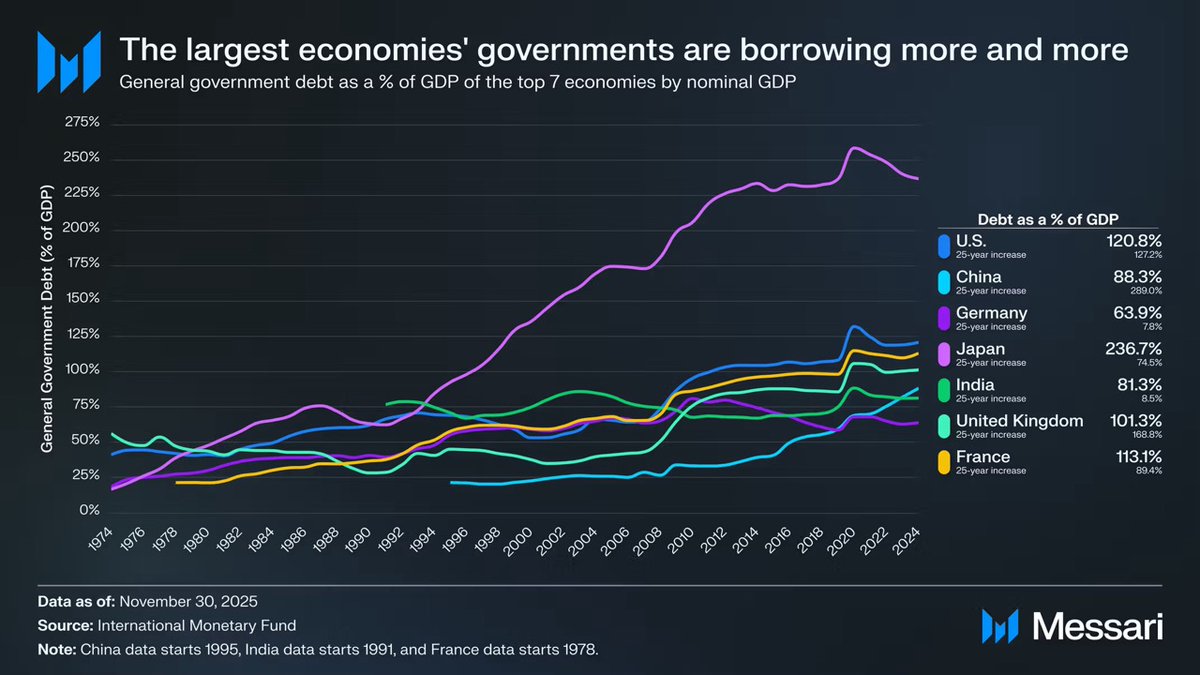
This chart is not a macroeconomic background decoration, but the logical starting point of the entire Cryptomoney argument.

Over the past 50 years, the ratio of government debt to GDP in major global economies has shown a highly consistent, almost irreversible upward trend:

🇺🇸 US: 120.8%

🇯🇵 Japan: 236.7%

🇫🇷 France: 113.1%

🇬🇧 UK: 101.3%

🇨🇳 China: 88.3%

🇮🇳 India: 81.3%

🇩🇪 Germany: 63.9%

This is not the result of governance failure in a particular country, but a common outcome spanning systems, political structures, and development stages.

Whether democratic countries, authoritarian states, developed economies, or emerging markets, government debt has consistently outpaced economic growth in the long run.

What this chart really shows is not "high debt," but "savings are being systematically sacrificed"

When government debt growth consistently outpaces economic output, the system can only maintain stability in three ways:

Inflation

Long-term low real interest rates

Financial repression (capital controls, withdrawal restrictions, regulatory intervention)

Regardless of which path is adopted, the ultimate cost will be borne by the same group:

Savers.

Messari uses an extremely restrained but weighty sentence in the report:

When debt grows faster than economic output, the costs fall most heavily on savers.

Why did sentiment collapse集中 (concentratedly) in 2025?

Because 2025 is the year when more and more participants clearly realized this for the first time.

Before this:

"Inflation is only temporary"

"Cash is always safe"

"Fiat currency is stable in the long run"

And reality is constantly否定 (negating) these assumptions.

When people发现 (discover):

>Hard work ≠ Wealth preservation

The act of saving itself is continuously shrinking in value

The difficulty of asset allocation has increased significantly

The collapse of sentiment does not come from Crypto, but from the shaken confidence in the entire financial system.

Crypto is just the place where this impact is felt first.

The significance of Cryptomoney is not "higher returns"

This is also a point that Messari repeatedly emphasizes but is极易 (extremely easy) to misinterpret.

Cryptomoney does not exist to promise higher returns.

Its core value lies in:

Predictable rules

Monetary policy not arbitrarily changed by a single entity

Assets can be self-custodied

Value can be transferred cross-border without permission

In other words, what it provides is not a "money-making tool," but:

In a world of high debt and low certainty, it重新赋予 (re-grants) individuals the right to choose their money.

The sentiment collapse is actually a form of "清醒" (clarity/awakening)

When you place this debt chart alongside the 2025 market sentiment, you find a counterintuitive conclusion:

Extreme pessimism in sentiment does not mean industry failure, but means more and more people are beginning to realize that the problems of the old system are real.

The problem with Crypto has never been that it is "useless."

The real problem is: It no longer produces easy excess returns for everyone.

Summary | From sentiment, to structure, to money itself

This chapter addresses a fundamental question:

Why, in the absence of a systemic crash, did market sentiment fall to a historical low?

The answer is not in the price charts, but in the monetary structure.

Sentiment collapse, is the表象 (surface manifestation)

Paradigm shift, is the process

Monetary system imbalance, is the root cause

And this is precisely why Messari chose to start the entire report from "money" rather than from "applications."

Chapter 3 | Why Only BTC is Treated as "Real Money"

If you have read this far, it is easy to have a question:

If the problem lies in the monetary system, then why is the answer BTC, and not something else?

Messari's judgment in the report is exceptionally clear:

BTC is no longer on the same competitive dimension as other Crypto assets.

1. Money is not a technical problem, but a consensus problem

This is the first key to understanding BTC.

Messari repeatedly emphasizes a fact easily overlooked by engineers in the original text:

Money is a social consensus, not a technical optimization problem.

In other words:

Money is not about "who is faster"

Not "who is cheaper"

Nor "who has more functions"

But who is treated as a store of value, long-term and stably.

From this perspective, Bitcoin's victory is not mysterious.

2. Three years of data have written the answer on its face
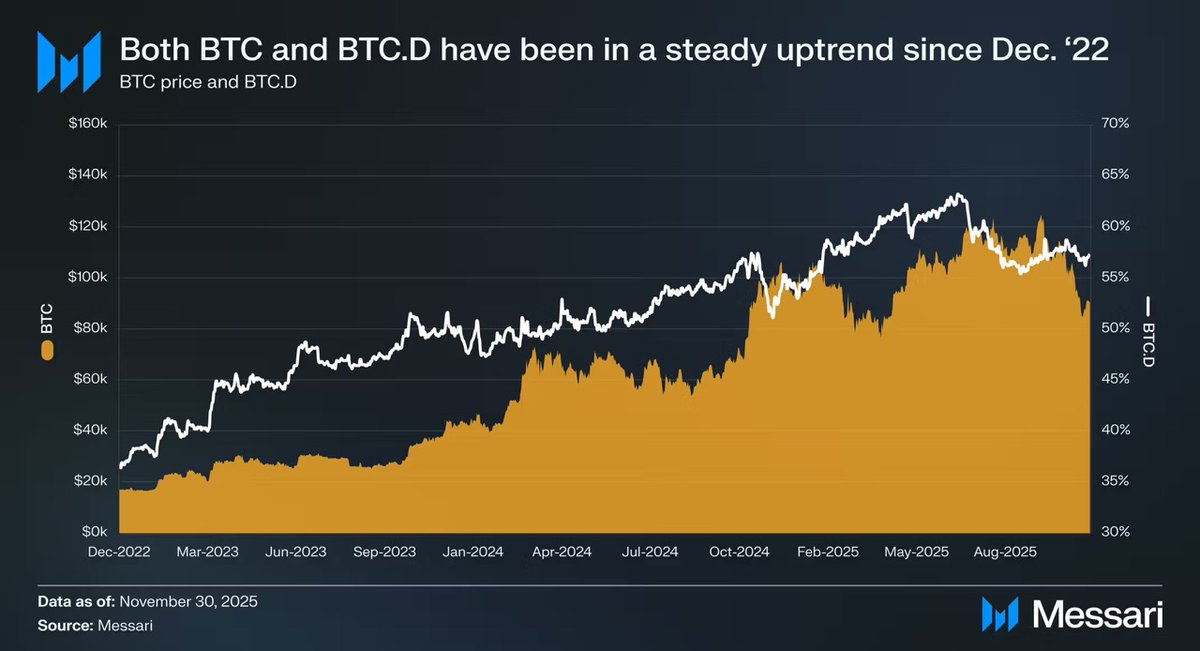
From December 1, 2022, to November 2025:

BTC rose 429%

Market cap from $318 billion → $1.81 trillion

Entered the top 10 global asset rankings

And more importantly, the relative performance:

BTC.D (Bitcoin Dominance) from 36.6% → 57.3%

In a cycle that "theoretically should have seen altcoins soar," funds instead continuously flowed back to BTC

This is not an偶然 (accidental) result of a market cycle; this is the market reclassifying assets.

3. ETFs and DATs are essentially "institutionalizing consensus"

Messari's evaluation of ETFs is very restrained, but the conclusion is extremely weighty.

The Bitcoin ETF is not simply "new buying pressure"; what it truly changes is:

Who is buying + Why they are buying + How long they can hold

ETFs made BTC a compliant asset

DATs made BTC part of corporate balance sheets

National reserves elevated BTC to a "strategic asset" level

When BTC is held by these actors, it is no longer:

"A high-volatility risky asset that can be abandoned at any time"

But rather:

A monetary asset that must be held long-term and cannot afford to make mistakes

Money, once treated this way, finds it difficult to go back.

4. Why BTC becomes more like money the more "boring" it is

This might be the most counterintuitive point of 2025.

BTC has no applications

No narrative rotation

No ecosystem stories

Not even "new things"

But precisely because of this, it meets all the characteristics of "money":

It does not rely on future promises

It does not need growth narratives

It does not require a team to deliver continuously

It only needs to not fail.

And in a world of high debt and low certainty, "not failing" is itself a scarce asset.

5. BTC's strength is not a market failure

The pain of many people comes from an illusion:

"BTC's strength indicates something is wrong with the market."

Messari's judgment is恰恰相反 (precisely the opposite):

BTC's strength is the market becoming more rational.

When the system begins to reward:

Stability

Predictability

Long-term credibility

Then all strategies relying on "high volatility for high returns" will appear increasingly painful.

This is not BTC's problem; this is a problem of participation methods.

Summary | BTC didn't win; it was selected

BTC did not "defeat" other assets.

It was just repeatedly verified by the market in an era of continuous monetary system failure as:

The asset that needs the least explanation

The asset that relies the least on trust

The asset that needs the fewest promises about the future

This is not the result of a market cycle,

But a confirmation of role.

Chapter 4 | When the Market Only Needs One Kind of "Money," the L1 Story Begins to Fail

After confirming that BTC has been selected by the market as the "primary Cryptomoney," one question is unavoidable:

If the answer for money already exists, what is left for Layer 1?

Messari does not give a direct conclusion, but after reading this section, a trend is very clear:

L1 valuations are being forced to move from "future narratives" back to "real-world constraints."

1. A harsh but true fact: 81% of the market cap is in the "money" narrative
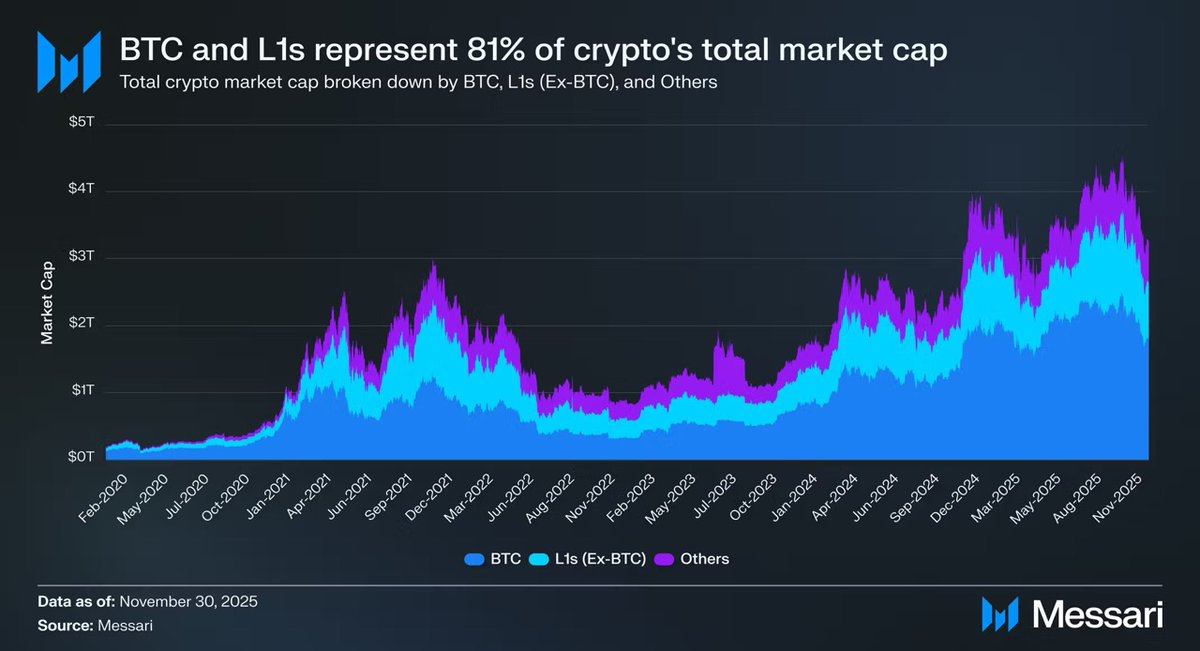
As of the end of 2025, the entire crypto market capitalization is approximately $3.26T:

BTC: $1.80T

Other L1s: approx. $0.83T

Remaining assets: less than $0.63T

Combined:

Approximately 81% of crypto asset market cap is being valued by the market as "money" or "potential money."

What does this mean?

It means L1 valuations are早已 (long) no longer based on the pricing logic of "application platforms,"

But on the pricing logic of "does it qualify to be money?"

2. The problem is: Most L1s do not qualify

The data provided by Messari is very direct and very冷酷 (cold).
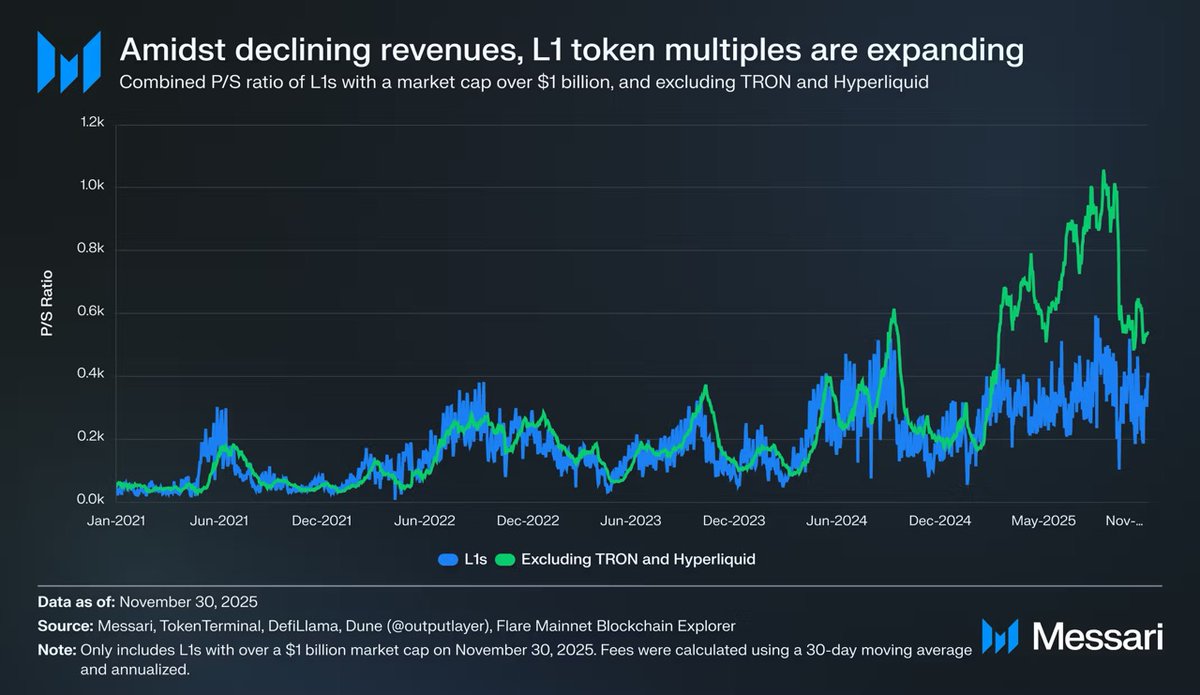
After excluding outliers with abnormally high revenue like TRON and Hyperliquid:

L1 overall revenue持续下滑 (continuously declined)

But valuation multiples却在 (instead)持续抬升 (continuously rose)

The adjusted P/S ratios are as follows:

2021: 40x

2022: 212x

2023: 137x

2024: 205x

2025: 536x

Meanwhile, total L1 revenue:

2021: $12.3B

2022: $4.9B

2023: $2.7B

2024: $3.6B

2025 (annualized): $1.7B

This is a scissors gap that cannot be reasonably explained by "future growth."

3. L1s are not "undervalued"; they are "reclassified"

The pain of many people stems from a misunderstanding:

"Were L1s wrongfully sold off by the market?"

Messari's judgment is恰恰相反 (precisely the opposite):

The market did not wrongfully sell off L1s; it is reducing their 'monetary imagination space.'

If an asset:

Cannot store value stably

Cannot be held long-term

And cannot provide certain cash flow

Then it ultimately only has one pricing method left:

High-beta risky asset.

4. The example of Solana actually explains everything

SOL was one of the few L1s that outperformed BTC in 2025.

But Messari points out a highly damaging fact:

SOL ecosystem data grew 20–30 times

The price only outperformed BTC by an additional 87%

In other words:

To achieve "significant excess returns" against BTC, an L1 needs ecosystem爆发 (explosion) on an order-of-magnitude scale.

This is not "not trying hard enough"; it's that the回报函数 (return function) has been rewritten.

5. When BTC becomes "money," the burden on L1s actually becomes heavier

This is a structural change that many people have not realized.

Before BTC's monetary status was clear:

L1s could tell the story of "becoming money in the future"

The market was willing to pay upfront for this possibility

Now:

BTC has solidified its position

The market is no longer willing to pay the same premium for a "second money"

Thus, L1s face a more difficult question:

If not money, then what exactly are you?

Summary | The problem for L1s is not competition, but positioning

L1s did not "lose to BTC."

What they lost is:

In the dimension of money

The market no longer needs more answers

And once the shelter of the "monetary narrative" is lost, all valuations must重新接受 (re-accept)现实约束 (real-world constraints).

This is the direct source of the sentiment collapse for many participants in 2025.

İlgili Sorular

QAccording to the article, why did the crypto market sentiment crash to a historical low in 2025 despite the absence of major systemic failures?

AThe sentiment crash was not due to industry failure but a structural shift where the market's reward mechanism changed, favoring institutional participants and long-term holders over short-term alpha seekers. This created a cognitive dissonance and identity mismatch for many participants who were still operating under the old paradigm.

QWhat fundamental issue does the article identify as the root cause of the 2025 market sentiment collapse?

AThe root cause is the failure of the traditional monetary system, where global government debt has grown faster than economic output for decades, systematically sacrificing savers through inflation, low real interest rates, and financial repression. This eroded confidence in the entire financial system.

QHow does the article explain Bitcoin's (BTC) dominant performance and its role in the 2025 market?

ABTC was increasingly treated as 'money' due to its predictable rules, non-discretionary monetary policy, self-custody, and permissionless cross-border transfer. It was institutionalized through ETFs and corporate treasuries, making it a long-term hold for stability and certainty in a high-debt world, rather than a high-risk, high-return asset.

QWhat does the article suggest about the valuation and narrative of Layer 1 (L1) blockchains in 2025?

AL1 valuations were forced to shift from 'future money narratives' to 'real-world constraints' as BTC solidified its role as the primary cryptomoney. Without the 'monetary narrative,' L1s faced reclassification as high-beta risk assets, requiring massive ecosystem growth to outperform BTC, which most failed to achieve.

QWhy does the article claim that 2025 was a year of 'identity mismatch' for crypto participants?

AThe market shifted towards rewarding institutional configurers, long-term holders, and regulated participants, but many individuals continued to participate as short-term alpha seekers. When the old strategies of narrative chasing and high leverage failed, their subjective experience of pain and lack of returns led to emotional collapse, despite the industry itself becoming more mature and robust.

İlgili Okumalar

Stuck Polymarket: The Real Test After Riding the Traffic Boom Has Arrived

Polymarket, a leading prediction market platform, is facing significant technical challenges as its growth outpaces its current infrastructure on Polygon. Users are experiencing laggy transactions, unresponsive orders, and delayed confirmations, severely impacting the trading experience. In response, DeFi Engineering VP Josh Stevens outlined a comprehensive engineering overhaul. The plan includes reducing on-chain data delays, fixing order cancellation issues, rebuilding the central limit order book (CLOB), improving website performance, and developing a unified SDK and API. A major revelation was the ongoing "chain migration," indicating a potential move away from Polygon. The core issue is that Polymarket has evolved from a simple prediction market into a high-frequency trading platform, making Polygon's limitations—such as block space, gas fees, and block time—a ceiling for further growth. The migration is not just a simple chain switch but a fundamental rebuild of its trading system to support more complex products like perpetual contracts (Perps). This announcement has sparked competition among chains like Solana, Sui, and Algorand, all vying to host Polymarket. For Polygon, losing this key application, which contributes significantly to its gas fee revenue, would be a major setback. The real test for Polymarket is no longer attracting users but proving it can provide a stable, reliable trading environment that retains them.

Odaily星球日报1 saat önce

Stuck Polymarket: The Real Test After Riding the Traffic Boom Has Arrived

Odaily星球日报1 saat önce

İşlemler

Spot
Futures

Popüler Makaleler

$S$ Nedir

SPERO'yu Anlamak: Kapsamlı Bir Genel Bakış SPERO'ya Giriş İnovasyonun manzarası gelişmeye devam ederken, web3 teknolojilerinin ve kripto para projelerinin ortaya çıkışı dijital geleceği şekillendirmede önemli bir rol oynamaktadır. Bu dinamik alanda dikkat çeken projelerden biri SPERO, $$s$$ olarak adlandırılmaktadır. Bu makale, SPERO hakkında ayrıntılı bilgi toplamak ve sunmak amacıyla, meraklılar ve yatırımcıların web3 ve kripto alanlarındaki temellerini, hedeflerini ve yeniliklerini anlamalarına yardımcı olmayı amaçlamaktadır. SPERO,$$s$$ Nedir? SPERO,$$s$$, kripto alanında merkeziyetsizlik ve blok zinciri teknolojisi ilkelerini kullanarak etkileşimi, faydayı ve finansal kapsayıcılığı teşvik eden bir ekosistem yaratmayı amaçlayan benzersiz bir projedir. Proje, kullanıcıların yenilikçi finansal çözümler ve hizmetler sunarak eşler arası etkileşimleri yeni yollarla kolaylaştırmayı hedeflemektedir. SPERO,$$s$$'nin temel amacı, bireyleri güçlendirmek ve kripto para alanındaki kullanıcı deneyimini artıran araçlar ve platformlar sağlamaktır. Bu, daha esnek işlem yöntemlerini mümkün kılmayı, topluluk odaklı girişimleri teşvik etmeyi ve merkeziyetsiz uygulamalar (dApp'ler) aracılığıyla finansal fırsatlar yaratmayı içermektedir. SPERO,$$s$$'nin temel vizyonu kapsayıcılık etrafında dönmekte olup, geleneksel finansal sistemlerdeki boşlukları kapatmayı ve blok zinciri teknolojisinin faydalarından yararlanmayı hedeflemektedir. SPERO,$$s$$'nin Yaratıcısı Kimdir? SPERO,$$s$$'nin yaratıcısının kimliği bir miktar belirsizdir, çünkü kurucusu(ları) hakkında ayrıntılı arka plan bilgisi sağlayan sınırlı kamuya açık kaynaklar bulunmaktadır. Bu şeffaflık eksikliği, projenin merkeziyetsizlik taahhüdünden kaynaklanabilir—birçok web3 projesinin paylaştığı bir etik anlayışı, bireysel tanınmanın yerine kolektif katkıları önceliklendirmektedir. Topluluk ve onun kolektif hedefleri etrafında tartışmaları merkezileştirerek, SPERO,$$s$$, belirli bireyleri öne çıkarmadan güçlendirme özünü taşımaktadır. Bu nedenle, SPERO'nun etik anlayışını ve misyonunu anlamak, tek bir yaratıcının kimliğini belirlemekten daha önemlidir. SPERO,$$s$$'nin Yatırımcıları Kimlerdir? SPERO,$$s$$, kripto sektöründe yeniliği teşvik etmeye adanmış girişim sermayedarlarından melek yatırımcılara kadar çeşitli yatırımcılar tarafından desteklenmektedir. Bu yatırımcıların odak noktası genellikle SPERO'nun misyonuyla uyumlu olup, toplumsal teknolojik ilerlemeyi, finansal kapsayıcılığı ve merkeziyetsiz yönetimi vaat eden projeleri önceliklendirmektedir. Bu yatırımcı temelleri, yalnızca yenilikçi ürünler sunan projelere değil, aynı zamanda blok zinciri topluluğuna ve ekosistemlerine olumlu katkılarda bulunan projelere de ilgi duymaktadır. Bu yatırımcıların desteği, SPERO,$$s$$'yi hızla gelişen kripto projeleri alanında dikkate değer bir rakip haline getirmektedir. SPERO,$$s$$ Nasıl Çalışır? SPERO,$$s$$, onu geleneksel kripto para projelerinden ayıran çok yönlü bir çerçeve kullanmaktadır. İşte benzersizliğini ve yeniliğini vurgulayan bazı temel özellikler: Merkeziyetsiz Yönetim: SPERO,$$s$$, kullanıcıların projenin geleceğiyle ilgili karar alma süreçlerine aktif olarak katılmalarını sağlayan merkeziyetsiz yönetim modellerini entegre etmektedir. Bu yaklaşım, topluluk üyeleri arasında sahiplik ve hesap verebilirlik duygusunu teşvik etmektedir. Token Kullanımı: SPERO,$$s$$, ekosistem içinde çeşitli işlevler sunmak üzere tasarlanmış kendi kripto para token'ını kullanmaktadır. Bu token'lar, işlemleri, ödülleri ve platformda sunulan hizmetlerin kolaylaştırılmasını sağlayarak genel etkileşimi ve faydayı artırmaktadır. Katmanlı Mimari: SPERO,$$s$$'nin teknik mimarisi, modülerlik ve ölçeklenebilirliği destekleyerek projenin evrimi sırasında ek özelliklerin ve uygulamaların sorunsuz bir şekilde entegrasyonuna olanak tanımaktadır. Bu uyum sağlama yeteneği, sürekli değişen kripto manzarasında geçerliliği sürdürmek için hayati öneme sahiptir. Topluluk Katılımı: Proje, işbirliği ve geri bildirim teşvik eden mekanizmalar kullanarak topluluk odaklı girişimlere vurgu yapmaktadır. Güçlü bir topluluk oluşturarak, SPERO,$$s$$, kullanıcı ihtiyaçlarını daha iyi karşılayabilir ve piyasa trendlerine uyum sağlayabilir. Kapsayıcılığa Odaklanma: Düşük işlem ücretleri ve kullanıcı dostu arayüzler sunarak, SPERO,$$s$$, daha önce kripto alanında yer almamış bireyler de dahil olmak üzere çeşitli bir kullanıcı tabanını çekmeyi hedeflemektedir. Bu kapsayıcılık taahhüdü, erişilebilirlik yoluyla güçlendirme misyonuyla uyumludur. SPERO,$$s$$ Zaman Çizelgesi Bir projenin tarihini anlamak, gelişim yolculuğu ve kilometre taşları hakkında kritik bilgiler sağlar. Aşağıda, SPERO,$$s$$'nin evriminde önemli olayları haritalayan önerilen bir zaman çizelgesi bulunmaktadır: Kavram Geliştirme ve Fikir Aşaması: SPERO,$$s$$'nin temelini oluşturan ilk fikirler, blok zinciri endüstrisindeki merkeziyetsizlik ve topluluk odaklılık ilkeleriyle yakından uyumlu olarak geliştirildi. Proje Beyaz Kağıdının Yayınlanması: Kavramsal aşamayı takiben, SPERO,$$s$$'nin vizyonunu, hedeflerini ve teknolojik altyapısını ayrıntılı bir şekilde açıklayan kapsamlı bir beyaz kağıt yayımlandı ve topluluk ilgisini ve geri bildirimini toplamak amacıyla sunuldu. Topluluk Oluşturma ve Erken Katılımlar: Projenin hedefleri etrafında tartışmalar yürüterek destek toplamak ve erken benimseyenler ile potansiyel yatırımcılar için bir topluluk oluşturmak amacıyla aktif iletişim çabaları gerçekleştirildi. Token Üretim Etkinliği: SPERO,$$s$$, yerel token'larını erken destekçilere dağıtmak ve ekosistem içinde başlangıç likiditesini sağlamak amacıyla bir token üretim etkinliği (TGE) gerçekleştirdi. İlk dApp'in Yayınlanması: SPERO,$$s$$ ile ilişkili ilk merkeziyetsiz uygulama (dApp) faaliyete geçti ve kullanıcıların platformun temel işlevleriyle etkileşimde bulunmalarını sağladı. Sürekli Gelişim ve Ortaklıklar: Projenin tekliflerine sürekli güncellemeler ve iyileştirmeler yapılmakta olup, blok zinciri alanındaki diğer oyuncularla stratejik ortaklıklar, SPERO,$$s$$'yi rekabetçi ve gelişen bir oyuncu haline getirmiştir. Sonuç SPERO,$$s$$, web3 ve kripto paranın finansal sistemleri devrim niteliğinde dönüştürme ve bireyleri güçlendirme potansiyelinin bir kanıtıdır. Merkeziyetsiz yönetime, topluluk katılımına ve yenilikçi tasarlanmış işlevselliğe olan bağlılığıyla, daha kapsayıcı bir finansal manzaraya doğru bir yol açmaktadır. Hızla gelişen kripto alanındaki herhangi bir yatırımda olduğu gibi, potansiyel yatırımcılar ve kullanıcılar, SPERO,$$s$$ içindeki devam eden gelişmelerle ilgili olarak kapsamlı bir araştırma yapmaları ve düşünceli bir şekilde katılmaları teşvik edilmektedir. Proje, kripto endüstrisinin yenilikçi ruhunu sergileyerek, sayısız olasılığını keşfetmeye davet etmektedir. SPERO,$$s$$'nin yolculuğu hala devam ederken, temel ilkeleri, teknoloji, finans ve birbirimizle etkileşim biçimimizi etkileyebilir.

89 Toplam GörüntülenmeYayınlanma 2024.12.17Güncellenme 2024.12.17

$S$ Nedir

AGENT S Nedir

Agent S: Web3'te Otonom Etkileşimin Geleceği Giriş Web3 ve kripto para dünyasında sürekli gelişen manzarada, yenilikler bireylerin dijital platformlarla etkileşim biçimlerini sürekli olarak yeniden tanımlıyor. Bu tür öncü projelerden biri olan Agent S, açık ajans çerçevesi aracılığıyla insan-bilgisayar etkileşimini devrim niteliğinde değiştirmeyi vaat ediyor. Otonom etkileşimlerin yolunu açarak, Agent S karmaşık görevleri basitleştirmeyi ve yapay zeka (AI) alanında dönüştürücü uygulamalar sunmayı hedefliyor. Bu detaylı inceleme, projenin karmaşıklıklarına, benzersiz özelliklerine ve kripto para alanındaki etkilerine dalacaktır. Agent S Nedir? Agent S, bilgisayar görevlerinin otomasyonunda üç temel zorluğu ele almak üzere özel olarak tasarlanmış çığır açıcı bir açık ajans çerçevesidir: Alan Spesifik Bilgi Edinimi: Çerçeve, çeşitli dış bilgi kaynaklarından ve iç deneyimlerden akıllıca öğrenir. Bu çift yönlü yaklaşım, alan spesifik bilgi açısından zengin bir veri havuzu oluşturmasını sağlar ve görev yürütmedeki performansını artırır. Uzun Görev Ufukları Üzerinde Planlama: Agent S, karmaşık görevlerin verimli bir şekilde parçalanmasını ve yürütülmesini kolaylaştıran deneyim artırımlı hiyerarşik planlama kullanır. Bu özellik, çoklu alt görevleri etkili ve verimli bir şekilde yönetme yeteneğini önemli ölçüde artırır. Dinamik, Homojen Olmayan Arayüzlerle Başlama: Proje, ajanlar ve kullanıcılar arasındaki etkileşimi geliştiren yenilikçi bir çözüm olan Ajan-Bilgisayar Arayüzü'ni (ACI) tanıtmaktadır. Çok Modlu Büyük Dil Modellerini (MLLM'ler) kullanarak, Agent S çeşitli grafik kullanıcı arayüzlerini sorunsuz bir şekilde gezinebilir ve manipüle edebilir. Bu öncü özellikler aracılığıyla, Agent S, makinelerle insan etkileşimini otomatikleştirmede karşılaşılan karmaşıklıkları ele alan sağlam bir çerçeve sunarak, AI ve ötesinde birçok uygulama için zemin hazırlıyor. Agent S'nin Yaratıcısı Kimdir? Agent S'nin kavramı temelde yenilikçi olsa da, yaratıcısı hakkında spesifik bilgiler belirsizliğini koruyor. Yaratıcı şu anda bilinmiyor, bu da projenin yeni aşamasını veya kurucu üyeleri gizli tutma stratejik tercihini vurguluyor. Anonimlikten bağımsız olarak, odak çerçevenin yetenekleri ve potansiyeli üzerinde kalıyor. Agent S'nin Yatırımcıları Kimlerdir? Agent S, kriptografik ekosistemde oldukça yeni olduğundan, yatırımcıları ve finansal destekçileri hakkında ayrıntılı bilgiler açıkça belgelenmemiştir. Projeyi destekleyen yatırım temelleri veya organizasyonları hakkında kamuya açık bilgilerdeki eksiklik, finansman yapısı ve gelişim yol haritası hakkında sorular doğuruyor. Destekleyicilerin anlaşılması, projenin sürdürülebilirliğini ve potansiyel pazar etkisini değerlendirmek için kritik öneme sahiptir. Agent S Nasıl Çalışır? Agent S'nin temelinde, çeşitli ortamlarda etkili bir şekilde çalışmasını sağlayan son teknoloji bir sistem yatmaktadır. İşleyiş modeli birkaç ana özellik etrafında inşa edilmiştir: İnsan Benzeri Bilgisayar Etkileşimi: Çerçeve, bilgisayarlarla etkileşimleri daha sezgisel hale getirmeyi amaçlayan gelişmiş AI planlaması sunar. Görev yürütmedeki insan davranışını taklit ederek, kullanıcı deneyimlerini yükseltmeyi vaat eder. Anlatı Belleği: Yüksek düzeyde deneyimlerden yararlanmak için kullanılan Agent S, görev geçmişlerini takip etmek amacıyla anlatı belleğini kullanarak karar verme süreçlerini geliştirir. Episodik Bellek: Bu özellik, kullanıcılara adım adım rehberlik sağlayarak, çerçevenin görevler gelişirken bağlamsal destek sunmasına olanak tanır. OpenACI Desteği: Yerel olarak çalışabilme yeteneği ile Agent S, kullanıcıların etkileşimleri ve iş akışları üzerinde kontrol sağlamasına olanak tanır ve Web3'ün merkeziyetsiz felsefesiyle uyumlu hale gelir. Dış API'lerle Kolay Entegrasyon: Çeşitli AI platformlarıyla uyumluluğu ve çok yönlülüğü, Agent S'nin mevcut teknolojik ekosistemlere sorunsuz bir şekilde entegre olmasını sağlar ve geliştiriciler ile organizasyonlar için cazip bir seçenek haline getirir. Bu işlevsellikler, Agent S'nin kripto alanındaki benzersiz konumuna katkıda bulunarak, karmaşık, çok aşamalı görevleri minimum insan müdahalesi ile otomatikleştirir. Proje geliştikçe, Web3'teki potansiyel uygulamaları dijital etkileşimlerin nasıl gelişeceğini yeniden tanımlayabilir. Agent S'nin Zaman Çizelgesi Agent S'nin gelişimi ve kilometre taşları, önemli olaylarını vurgulayan bir zaman çizelgesinde özetlenebilir: 27 Eylül 2024: Agent S'nin kavramı, “Bilgisayarları İnsan Gibi Kullanan Açık Bir Ajans Çerçevesi” başlıklı kapsamlı bir araştırma makalesi ile tanıtıldı ve projenin temelini sergiledi. 10 Ekim 2024: Araştırma makalesi arXiv'de kamuya açık olarak yayınlandı ve çerçevenin derinlemesine bir incelemesini ve OSWorld benchmark'ına dayalı performans değerlendirmesini sundu. 12 Ekim 2024: Agent S'nin yetenekleri ve özellikleri hakkında görsel bir içgörü sağlayan bir video sunumu yayımlandı ve potansiyel kullanıcılar ve yatırımcılarla daha fazla etkileşim sağlandı. Bu zaman çizelgesindeki işaretler, sadece Agent S'nin ilerlemesini değil, aynı zamanda şeffaflık ve topluluk katılımına olan bağlılığını da göstermektedir. Agent S Hakkında Ana Noktalar Agent S çerçevesi gelişmeye devam ederken, birkaç ana özellik öne çıkmakta ve yenilikçi doğasını ve potansiyelini vurgulamaktadır: Yenilikçi Çerçeve: İnsan etkileşimine benzer bir bilgisayar kullanımı sağlamak üzere tasarlanan Agent S, görev otomasyonuna yeni bir yaklaşım getiriyor. Otonom Etkileşim: GUI aracılığıyla bilgisayarlarla otonom olarak etkileşim kurabilme yeteneği, daha akıllı ve verimli hesaplama çözümlerine doğru bir sıçrama anlamına geliyor. Karmaşık Görev Otomasyonu: Sağlam metodolojisi ile karmaşık, çok aşamalı görevleri otomatikleştirerek süreçleri daha hızlı ve daha az hata payı ile gerçekleştirebilir. Sürekli İyileştirme: Öğrenme mekanizmaları, Agent S'nin geçmiş deneyimlerden öğrenmesini sağlar ve sürekli olarak performansını ve etkinliğini artırır. Çok Yönlülük: OSWorld ve WindowsAgentArena gibi farklı işletim ortamlarında uyumlu olması, geniş bir uygulama yelpazesine hizmet edebilmesini sağlar. Agent S, Web3 ve kripto alanında kendini konumlandırırken, etkileşim yeteneklerini artırma ve süreçleri otomatikleştirme potansiyeli, AI teknolojilerinde önemli bir ilerlemeyi temsil etmektedir. Yenilikçi çerçevesi aracılığıyla, Agent S dijital etkileşimlerin geleceğini örneklemekte ve çeşitli sektörlerde kullanıcılar için daha sorunsuz ve verimli bir deneyim vaat etmektedir. Sonuç Agent S, AI ve Web3'ün birleşiminde cesur bir sıçramayı temsil ediyor ve teknoloji ile etkileşim biçimimizi yeniden tanımlama kapasitesine sahip. Henüz erken aşamalarında olmasına rağmen, uygulama olanakları geniş ve çekici. Kritik zorlukları ele alan kapsamlı çerçevesi ile Agent S, otonom etkileşimleri dijital deneyimin ön plana çıkmasına taşımayı hedefliyor. Kripto para ve merkeziyetsizlik alanlarına daha derinlemesine girdikçe, Agent S gibi projelerin teknoloji ve insan-bilgisayar işbirliğinin geleceğini şekillendirmede önemli bir rol oynayacağı kesin.

440 Toplam GörüntülenmeYayınlanma 2025.01.14Güncellenme 2025.01.14

AGENT S Nedir

S Nasıl Satın Alınır

HTX.com’a hoş geldiniz! Sonic (S) satın alma işlemlerini basit ve kullanışlı bir hâle getirdik. Adım adım açıkladığımız rehberimizi takip ederek kripto yolculuğunuza başlayın. 1. Adım: HTX Hesabınızı OluşturunHTX'te ücretsiz bir hesap açmak için e-posta adresinizi veya telefon numaranızı kullanın. Sorunsuzca kaydolun ve tüm özelliklerin kilidini açın. Hesabımı Aç2. Adım: Kripto Satın Al Bölümüne Gidin ve Ödeme Yönteminizi SeçinKredi/Banka Kartı: Visa veya Mastercard'ınızı kullanarak anında Sonic (S) satın alın.Bakiye: Sorunsuz bir şekilde işlem yapmak için HTX hesap bakiyenizdeki fonları kullanın.Üçüncü Taraflar: Kullanımı kolaylaştırmak için Google Pay ve Apple Pay gibi popüler ödeme yöntemlerini ekledik.P2P: HTX'teki diğer kullanıcılarla doğrudan işlem yapın.Borsa Dışı (OTC): Yatırımcılar için kişiye özel hizmetler ve rekabetçi döviz kurları sunuyoruz.3. Adım: Sonic (S) Varlıklarınızı SaklayınSonic (S) satın aldıktan sonra HTX hesabınızda saklayın. Alternatif olarak, blok zinciri transferi yoluyla başka bir yere gönderebilir veya diğer kripto para birimlerini takas etmek için kullanabilirsiniz.4. Adım: Sonic (S) Varlıklarınızla İşlem YapınHTX'in spot piyasasında Sonic (S) ile kolayca işlemler yapın.Hesabınıza erişin, işlem çiftinizi seçin, işlemlerinizi gerçekleştirin ve gerçek zamanlı olarak izleyin. Hem yeni başlayanlar hem de deneyimli yatırımcılar için kullanıcı dostu bir deneyim sunuyoruz.

1.3k Toplam GörüntülenmeYayınlanma 2025.01.15Güncellenme 2025.03.21

S Nasıl Satın Alınır

Tartışmalar

HTX Topluluğuna hoş geldiniz. Burada, en son platform gelişmeleri hakkında bilgi sahibi olabilir ve profesyonel piyasa görüşlerine erişebilirsiniz. Kullanıcıların S (S) fiyatı hakkındaki görüşleri aşağıda sunulmaktadır.

活动图片














