Deciphering Aave V4: A Transformation from Product to "Bank"

marsbit2026-03-31 tarihinde yayınlandı2026-03-31 tarihinde güncellendi

Özet

On March 30, Aave V4 officially launched on the mainnet, introducing a major architectural redesign centered around a unified liquidity model called "Hub and Spoke." The core change replaces isolated lending markets with a centralized liquidity pool (Hub) per chain or L2, which manages global liquidity, credit limits, and system constraints. Different Hubs (Core, Prime, Plus) cater to varying risk profiles and user needs. Spokes function as independent markets with custom parameters, allowing borrowers to access assets from the shared pool under specific rules. V4 improves capital efficiency by introducing risk-based interest rates—where borrowers using volatile collateral pay higher rates—and a refined liquidation mechanism that only restores positions to a target health factor. Additionally, idle liquidity in Hubs can be automatically deployed to governance-approved yield strategies, boosting returns for suppliers and DAO revenue. While the update doesn’t radically change the lending experience for users with high-quality collateral, it transforms Aave from a product into a bank-like financial infrastructure. This sets the stage for future expansions into services like structured products, credit facilities, and investment banking operations.

On the evening of March 30th, Beijing time, the long-planned Aave V4 officially launched on the mainnet, bringing the first piece of good news since the Aave DAO governance debates began in 2024.
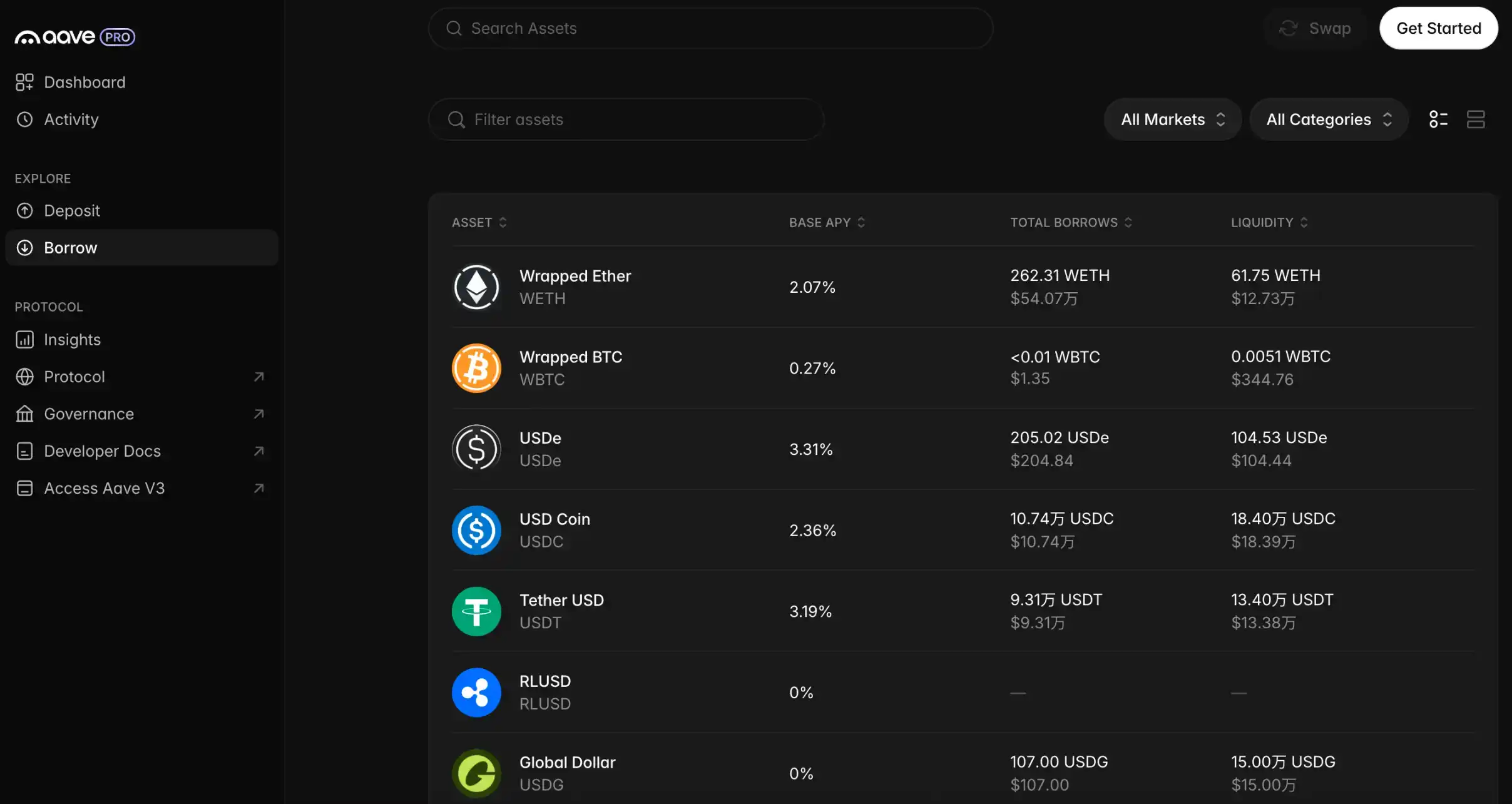
V4 can be described as a complete overhaul of Aave, with the most core change being the integration of previously independent lending markets into a unified liquidity pool architecture: the Hub and Spoke model.

In V4, each chain or L2 has a unified liquidity center (the Hub), where all assets deposited by users for lending are pooled into a single liquidity pool. The Hub is responsible for global coordination, credit limit control, system-level constraints (such as "Total Borrows ≤ Total Supply"), and emergency pauses. The Hub does not interface directly with users; it manages liquidity in the background.

It is worth noting that there is not just one Hub per chain, but different Hubs are designed based on different needs, which is essentially a form of risk isolation. For example, V4 has currently launched the Core Hub, Prime Hub, and Plus Hub. The Core Hub contains mainstream assets and is open to all users, the Prime Hub is designed for suppliers seeking more "controllable" collateral, and the Plus Hub is designed for strategic stablecoins, with its parameters needing to consider the project's scale.
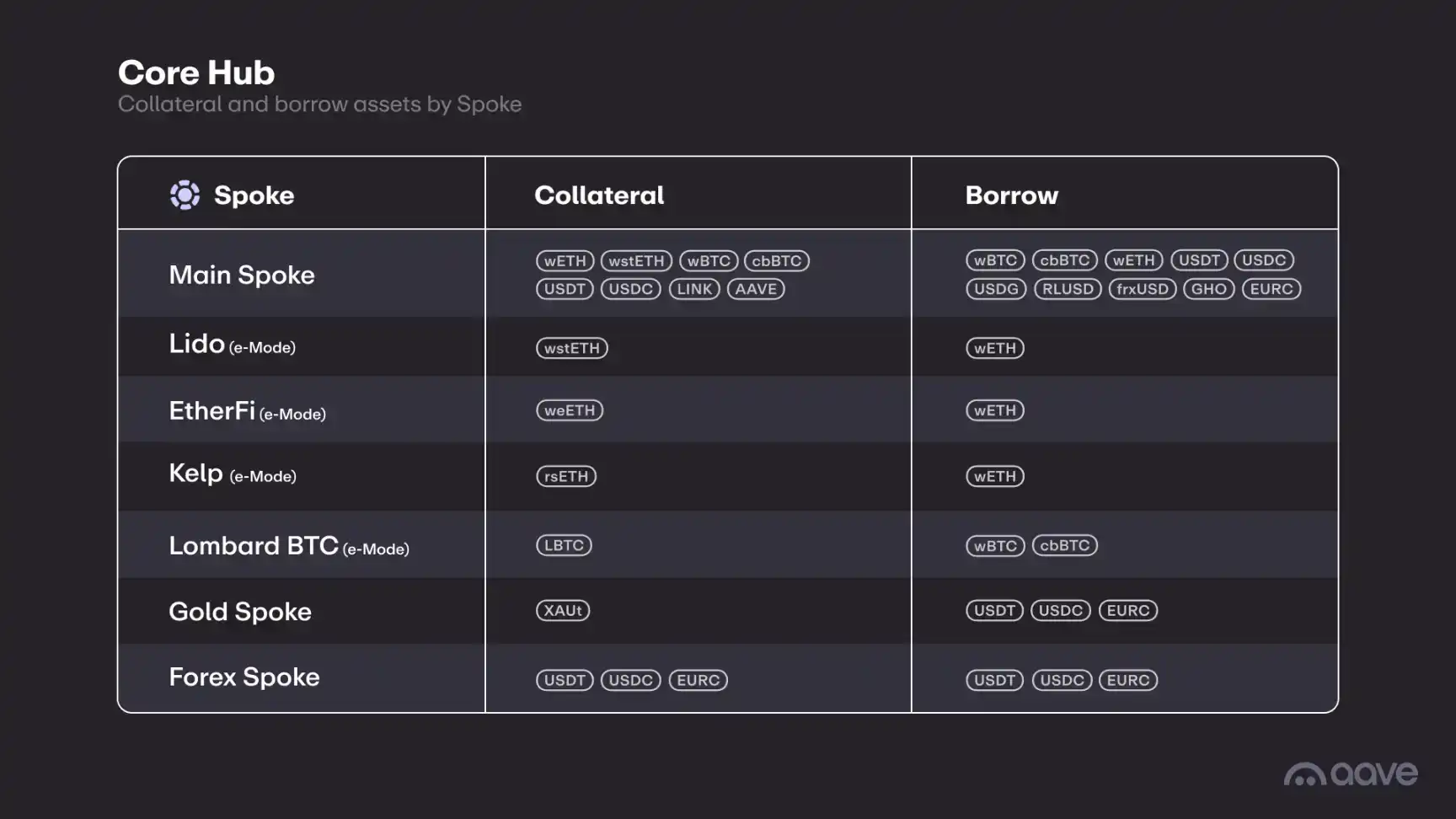
As for the Spoke, you can think of it as an independent market, each with its own lending functions, risk parameters, and collateral rules. Within a single Hub, user assets reside in the same liquidity pool, and borrowers choose different Spokes based on their needs. For example, as shown in the diagram above, a user can deposit WETH as a borrowable asset. Borrowers can borrow WETH from the first four Spokes, but only the EtherFi Spoke allows weETH to be used as collateral.

Although the official claim is that this integrates fragmented liquidity, in practice, the difference is not significant for users borrowing against high-quality collateral. For instance, if you want to抵押 ETH to borrow assets, the operation in V3 and V4 is not fundamentally different, as long as you ensure the health factor does not drop too low.

So, regarding the integration of liquidity, V4 indeed offers more精细 management than independent markets, but it's not a qualitative leap. The real differences come from the customizable parameters of the Spokes and the new liquidation engine.

In V4, a borrower's interest rate depends on the base rate and a risk premium. The base rate, like in V3, uses a utilization curve—rising slowly below optimal utilization and steeply above it. The risk premium depends on the nature of the collateral asset. If the collateral is more stable assets like USDT, ETH, or WBTC, the risk premium will be very low or even 0. However, high-risk altcoins will have a high risk premium, avoiding the situation where "good assets subsidize bad assets."

To give a simple example, in V3, the interest rate depended solely on supply and demand. When borrowing USDT, even though the loan-to-value (LTV) and liquidation threshold might differ, the interest rate for collateralizing ETH and LINK would be the same under the same supply and demand conditions, even though LINK's volatility is higher than ETH's. If the rates are the same, borrowers using LINK as collateral drive up the utilization rate, potentially causing borrowing costs for users collateralizing ETH to rise instead of fall.

V4 optimizes this flaw. Users borrowing against high-risk collateral need to pay a higher cost, while fund providers can earn higher yields. Simultaneously, the higher interest rate curbs borrowing demand, giving users borrowing against优质资产 a more明显的 cost advantage.

Regarding the liquidation mechanism, liquidators will only restore the health factor to the target value preset by the Spoke, and the lower the health factor, the higher the liquidation bonus. This design not only gives borrowers more room for maneuver but also reduces the platform's overall bad debt risk. Additionally, the new liquidation engine includes a "anti-dust mechanism," meaning if the remaining debt or collateral falls below a threshold (e.g., $1000), the liquidator must fully liquidate the position, preventing the accumulation of small残留 amounts that reduce capital efficiency.

Finally, idle liquidity in the Hub can be automatically deployed into low-risk yield strategies approved by governance (such as short-term government bonds, stablecoin LPs, money market instruments, etc.). This increases the income for fund suppliers while also boosting DAO revenue, which is perhaps one of the few advantages of "unified liquidity."

Overall, the advantages of Aave V4's unified liquidity for lending are not显著. The so-called composability—allowing borrowers to manage positions across different Spokes uniformly—is also not much more convenient than V3. But as the title suggests, V4 transforms Aave from a product into a financial infrastructure resembling a "bank."

Setting aside various complex operations, the core business of a bank is to accept deposits, retain a portion as reserves for daily user payments, transfers, etc., and earn the spread between deposits and loans through lending. As for idle funds, the bank can also allocate them to different investments within its risk tolerance.

The Bank of Saint George, established in 1407 in Genoa, Italy, is often considered the world's first bank. It not only provided deposit and loan services but also handled government debt management, currency exchange, and fund transfers, meeting the commercial needs of Genoa as a major European trade center at the time.

From the launch of ETHLend in 2017 to the mainnet release of Aave V4 in 2026, in less than 10 years, Aave has built what the earliest banks looked like. Of course, there are significant differences between Aave and a bank; this is just an analogy. Compared to P2P, the bank model, tempered by centuries of black swan events, is naturally a better choice, just as V4 is an improvement over V3.

If you look closely, you'll find that a vast amount of "innovation" in the DeFi sector has almost become历史尘埃, such as the hot DeFi 2.0 trend in the second half of 2021. Instead, projects like Aave, with simple business logic that has been成熟 in traditional finance for centuries, have survived and thrived. After years of exploration, many DeFi projects have likely discovered this truth: the ceiling for DeFi is high, but not a single step of the path taken by traditional finance can be skipped.

Aave V4's centralized liquidity opens up numerous future possibilities. For example, assets idle for a certain period (e.g., one year) could be allocated to relatively higher-risk investments, such as providing ETH/USDT liquidity on Uniswap. It could operate entirely in the mode of a commercial bank, gradually adding other commercial banking services, such as credit cards (referencing Ethfi's model of spending stablecoins borrowed against collateral), and so on.

Going a step further, Aave could expand into "investment banking." For instance, launching an ICO platform allowing users earning interest on deposited assets to borrow USDT or USDC to participate in investments, eliminating the need to withdraw and sell assets for stablecoins. This way, it could charge fees from projects on one side and collect interest on the other.

Although the Hub & Spoke mechanism doesn't bring massive innovation to lending itself, it paves the way for the next crucial steps.


Trend Kriptolar

İlgili Sorular

QWhat is the core architectural change introduced in Aave V4?

AThe core architectural change in Aave V4 is the shift to a unified liquidity pool structure called 'Hub and Spoke'. This consolidates previously isolated lending markets into a single liquidity pool per chain or L2, with a central Hub managing global liquidity, credit limits, and system constraints, while Spokes function as independent markets with their own borrowing features and risk parameters.

QHow does Aave V4's new interest rate model differ from V3?

AIn Aave V4, a borrower's interest rate is determined by a base rate and a risk premium. The base rate, similar to V3, uses a utilization curve. The key difference is the addition of a risk premium based on the collateral asset's quality. Stable assets like ETH or USDT have a low or zero risk premium, while riskier altcoins carry a higher premium, preventing 'good assets from subsidizing bad assets'.

QWhat is the purpose of the new liquidation engine in Aave V4?

AThe new liquidation engine is designed to only restore a borrower's health factor to a Spoke's preset target value, with the liquidation bonus increasing as the health factor decreases. This gives borrowers more operational flexibility and reduces the platform's bad debt risk. It also includes a 'dust prevention mechanism' that forces a full liquidation of positions if the remaining debt or collateral falls below a certain threshold.

QHow does the V4 upgrade transform Aave's business model according to the article?

AThe article posits that the V4 upgrade transforms Aave from a mere product into a 'bank-like' financial infrastructure. By centralizing liquidity, it can operate similarly to a traditional bank: taking deposits, setting aside reserves, lending to earn interest, and automatically deploying idle funds into governance-approved, low-risk yield strategies, paving the way for future banking services.

QWhat future banking-like services does the article suggest Aave could explore after V4?

AThe article suggests Aave could explore services like using long-term idle assets for higher-risk investments (e.g., providing liquidity on Uniswap), offering credit card-like products (using抵押借贷 for spending), and even expanding into investment banking activities such as launching an ICO platform where users can borrow stablecoins to participate without selling their deposited assets.

İlgili Okumalar

Dialogue with Jia Hang | Looking Back at Two Decades of Chinese Payment Going Global

**Summary: A Conversation with Jia Hang on Two Decades of China's Payment Globalization** Jia Hang, a veteran with over twenty years in payments, reflects on China's attempts to build a global payment network through three key phases: UnionPay (card networks), Alipay+ (digital wallets), and now, stablecoins. His journey began at UnionPay International, aiming to establish China's card network abroad. While successful in following Chinese tourists ("where Chinese go, UnionPay goes"), it struggled to achieve true global scale. The core lesson: card networks like Visa/Mastercard's unassailable advantage isn't just technical standards, but their deeply entrenched **governance and profit-sharing models** that create powerful network effects. Competing as the "same species" is nearly impossible. At Ant Group, he led Alipay+, a strategy to bypass card networks by interconnecting local e-wallets worldwide. While innovative, it faced a similar ceiling. Mobile QR payments and card swipes were essentially **the same species competing for the same pie**, lacking a disruptive value proposition for users or a sustainable new incentive model to replace the card networks' established flywheel. Today, at Singapore's DCS, Jia focuses on stablecoin-based payments. He argues stablecoins represent a fundamental shift. They are not competing with Visa for consumer payments but challenging the **traditional banking and account system for value movement**. Products like "U Cards" (stablecoin-linked payment cards) are transitional, leveraging existing card networks for acceptance while building new rails. The real potential lies in stablecoins enabling seamless, low-cost global value transfer, potentially reorganizing the financial infrastructure around **accounts rather than cards**. Jia believes stablecoin adoption for local retail payments, cross-border transactions, and as high-yield savings vehicles is becoming irreversible. This could gradually reduce reliance on traditional fiat channels, especially in regions with weak currencies or capital controls. The quest for the "next global payment network" continues, now centered on whether stablecoins can successfully bridge Web2 and Web3, establish new governance, and create compelling user value beyond mere cost reduction.

marsbit8 dk önce

Dialogue with Jia Hang | Looking Back at Two Decades of Chinese Payment Going Global

marsbit8 dk önce

Circle's Stock Price Plunges 76%, Hong Kong Dollar Stablecoin Set to Launch Within Two Weeks

Circle's stock price has plunged approximately 76% from its 2023 peak, reflecting a major market revaluation. Despite this, Circle President Heath Tarbert emphasized the company's focus on long-term execution and its dominant position with USDC's $73 billion circulation across 34 blockchains. The competitive landscape is intensifying. A new consortium-backed stablecoin, Open USD, is attempting to challenge incumbents by sharing reserve yields with partners. More significantly, Visa's new stablecoin platform, initially supporting Open USD while also being compatible with USDC, could erode Circle's network effects. In response, Circle is expanding into real-world payments through partnerships like the one with Japan's JCB. Separately, Tether (USDT) faces a two-year compliance window under new U.S. regulations, requiring it to adjust its reserve composition away from assets like Bitcoin and loans towards cash and U.S. Treasuries. Meanwhile, in Hong Kong, Standard Chartered-backed fintech firm Dian Dian is poised to launch a licensed HKD-pegged stablecoin (HKDAP), moving the industry into a phase where the real test is integrating licensed stablecoins into actual payment flows and corporate treasury systems. The sharp decline in Circle's stock underscores a broader shift: the stablecoin market is moving from a winner-takes-all dynamic to a multi-player competitive arena where execution, compliance, and real-world utility are becoming paramount.

marsbit9 dk önce

Circle's Stock Price Plunges 76%, Hong Kong Dollar Stablecoin Set to Launch Within Two Weeks

marsbit9 dk önce

Amidst Capital's Encirclement, Decentralization is the Sole Defense for Public Blockchains

In a landscape dominated by power and profit motives, the author argues that decentralization is not merely one desirable feature among many in blockchain design—it is the singular, non-negotiable defense against corporate and capital capture. The article adopts a Machiavellian, realist perspective on human institutions, positing that businesses will inevitably attempt to co-opt any valuable network to protect their profits and dominance. While external attacks like 51% forks are often discussed, the greater existential risk is internal capture—the gradual erosion of a protocol’s neutrality by vested interests, as seen historically with platforms like Visa and Google. The piece critiques permissioned chains, highly centralized “permissionless” layer-1s, and layer-2s without sufficient decentralization (e.g., single sequencers) as inherently vulnerable. These compromised systems, promoted by established financial players, are framed as delaying tactics to stifle truly open networks that threaten existing high-fee, inefficient business models. Real-world examples, such as closed enterprise consortiums that exclude competitors, illustrate how such systems cement oligopolies rather than foster innovation. The author concludes that while decentralized protocols like Ethereum are imperfect and costly to operate, they represent the only viable long-term equilibrium. In a market where value naturally flows to the most secure and neutral settlement layer, only maximally decentralized public blockchains can resist being subsumed by capital and powerful incumbents.

Foresight News19 dk önce

Amidst Capital's Encirclement, Decentralization is the Sole Defense for Public Blockchains

Foresight News19 dk önce

Who Decides the Rules of Bitcoin? BIP-110 Ignites Governance Debate

Bitcoin's governance is once again at the center of a heated debate, this time ignited by BIP-110, the "Reduced Data Temporary Softfork." This proposal aims to curb non-monetary data (like inscriptions and Runes) by introducing seven new consensus-layer restrictions over a year, such as limiting new output scripts to 34 bytes and restoring the OP_RETURN cap to 83 bytes. The controversy stems from BIP-110's fundamental shift: it moves the battle against "spam" from node relay and miner policies to the consensus layer, rendering currently valid transactions invalid. Supporters, arguing that default policy governance has failed (highlighted by Bitcoin Core v30's relaxation of OP_RETURN limits), see this as necessary to protect node resources and Bitcoin's monetary focus. Opponents, led by figures like Michael Saylor and Adam Back, warn it dangerously centralizes governance. Saylor listed 110 reasons against it, criticizing its low 55% miner activation threshold and potential for chain splits. Back emphasized Bitcoin's "permissionless" ethos, arguing no single group should impose value judgments via consensus rules. Further complicating matters, technical critiques suggest BIP-110 may be technically circumventable, and a "BlockSlop" vulnerability in its upgrade path poses a consensus risk. The debate has drawn in diverse stakeholders: miners (with pools like Ocean signaling support and Foundry polling clients), node operators (like Bitcoin Knots), and new players like corporate treasury holder MicroStrategy (Saylor), whose market influence adds a novel dimension. Ultimately, BIP-110 acts as a governance stress test, exposing the unresolved question: who decides Bitcoin's rules? It pits the authority of miners, node operators, developers, and capital holders against each other, with each side claiming to defend Bitcoin's core principles of neutrality and security.

marsbit36 dk önce

Who Decides the Rules of Bitcoin? BIP-110 Ignites Governance Debate

marsbit36 dk önce

İşlemler

Spot

Popüler Makaleler

$BANK Nedir

Bank AI: Bankacılıkta Devrimsel Bir Adım Giriş Teknolojideki hızlı ilerlemelerin damgasını vurduğu bir çağda, Bank AI, yapay zeka (AI) ve bankacılık hizmetleri kesişiminde yer almaktadır. Bu yenilikçi proje, finansal manzarayı yeniden tanımlamayı, operasyonel verimliliği, güvenlik önlemlerini ve müşteri deneyimlerini AI'nin gücüyle geliştirmeyi hedefliyor. Bank AI yolculuğuna çıkarken, projenin içeriğine, operasyonel dinamiklerine, tarihsel bağlamına ve önemli kilometre taşlarına dalacağız. Bank AI Nedir? Bank AI, yapay zekanın çeşitli bankacılık operasyonlarına entegrasyonunu hedefleyen dönüştürücü bir girişimi temsil etmektedir. Bu proje, süreçleri otomatikleştirmek, risk yönetimi protokollerini geliştirmek ve kişiselleştirilmiş hizmetler aracılığıyla müşteri etkileşimini artırmak için AI'nin yeteneklerinden yararlanmaktadır. Bank AI'nin temel hedefleri şunlardır: Bankacılık Fonksiyonlarının Otomasyonu: AI teknolojilerini kullanarak, Bank AI rutin görevleri otomatikleştirmeyi, insan kaynakları üzerindeki yükü azaltmayı ve verimliliği artırmayı amaçlamaktadır. Geliştirilmiş Risk Yönetimi: Proje, dolandırıcılık ve diğer tehditlere karşı güvenlik önlemlerini güçlendirerek riski tahmin edip tanımlamak için AI algoritmalarını kullanmaktadır. Bankacılık Hizmetlerinin Kişiselleştirilmesi: Bank AI, müşteri verilerini ve davranışlarını analiz ederek, özel finansal ürünler ve hizmetler sunmaya odaklanmaktadır. Müşteri Deneyimini İyileştirme: Chatbotlar ve sanal asistanlar gibi AI destekli çözümlerin uygulanması, kullanıcıların daha insana yakın etkileşimler yaşamasını sağlamayı hedeflemekte, bankalarla etkileşim biçimlerini devrim niteliğinde değiştirmektedir. Bu hedeflerle, Bank AI, bankacılığı daha verimli, güvenli ve kullanıcı odaklı hale getiren önemli bir oyuncu olarak kendini konumlandırmaktadır. Bank AI'nin Yaratıcısı Kimdir? Bank AI'nin yaratıcısı hakkında detaylar bilinmemektedir. Bu nedenle, mevcut bilgilerde belirli bir kişi veya organizasyon tanımlanmamıştır. Projenin başlangıcı etrafındaki anonimlik soruları gündeme getirse de, bunun iddialı vizyonu ve hedefleri üzerinde bir olumsuz etkisi yoktur. Bank AI'nin Yatırımcıları Kimlerdir? Proje yaratıcılarında olduğu gibi, Bank AI'nin yatırımcıları veya destekleyen organizasyonları hakkında da özel bilgiler açıklanmamıştır. Bu bilgiler olmadan, projenin ilerlemesini destekleyen finansal destek ve kurumsal destek hakkında bir çerçeve çizmek zordur. Yine de, böyle yenilikçi bir alanda gelişimi sürdürmek için sağlam bir yatırım temelinin önemi büyüktür. Bank AI Nasıl Çalışır? Bank AI, geleneksel bankacılık çerçevelerinden ayıran benzersiz faktörlere odaklanarak birden fazla yenilikçi alanda faaliyet göstermektedir. İşte temel operasyonel özellikler: Otomasyon: Makine öğrenimi algoritmalarını uygulayarak, Bank AI bankalar içindeki çeşitli manuel süreçleri otomatikleştirir. Bu, operasyonel maliyetleri azaltır ve insan çalışanların daha stratejik faaliyetlere yönelmelerini sağlar. Gelişmiş Risk Yönetimi: Risk yönetimi uygulamalarına AI entegrasyonu, bankaların dolandırıcılık gibi potansiyel tehditleri doğru bir şekilde tahmin etme araçlarıyla donatılmasını sağlar, böylece müşteri bilgileri ve varlıkları güvence altına alınır. Özelleştirilmiş Finansal Tavsiyeler: Müşteri etkileşimlerinden sürekli olarak öğrenerek, AI sistemleri kullanıcı ihtiyaçlarının daha iyi anlaşılmasını sağlar ve finansal kararlar hakkında özelleştirilmiş tavsiyeler sunar. Geliştirilmiş Müşteri Etkileşimleri: AI destekli chatbotlar ve sanal asistanlar kullanarak, Bank AI daha etkileşimli bir müşteri deneyimi sunar, kullanıcıların sorularını hızlı bir şekilde çözmelerine imkan tanır, bekleme sürelerini azaltır ve memnuniyet seviyelerini artırır. Bu operasyonel özellikler, Bank AI'yi bankacılık sektöründe bir öncü olarak konumlandırmakta ve hizmet sunumu ile operasyonel mükemmeliyet için yeni standartlar belirlemektedir. Bank AI Zaman Çizelgesi Bank AI'nin gidişatını anlamak için tarihsel bağlamına bir göz atmak gerekmektedir. Aşağıda önemli kilometre taşlarını ve gelişmeleri vurgulayan bir zaman çizelgesi bulunmaktadır: 2010'ların Başları: AI entegrasyonunun bankacılık hizmetlerine olan ilgisi arttı, bankacılık kurumları potansiyel faydalarını tanımaya başladılar. 2018: Bankaların temel müşteri hizmetleri ve geliştirilmiş güvenlik yönetimi için risk yönetim sistemlerinde chatbotlar gibi AI araçları kullanmaya başlamasıyla AI teknolojilerinin uygulanmasında belirgin bir artış yaşandı. 2023: AI'nin karmaşıklığı artmaya devam etti ve belge işleme ile gerçek zamanlı yatırım analizi gibi daha karmaşık görevler için üretken AI devreye alındı. Bu yıl, AI teknolojisi sayesinde bankaların sahip olduğu yeteneklerde önemli bir sıçrama yaşandı. 2024-Güncel Durum: Bu yıl itibarıyla, Bank AI yükselişte, devam eden araştırmalar ve geliştirmeler bankacılık operasyonlarındaki yetenekleri daha da artırmaya hazırlanıyor. AI uygulamalarının sürekli araştırılması, heyecan verici gelişmelere işaret etmektedir. Bank AI Hakkında Anahtar Noktalar Bankacılıkta AI Entegrasyonu: Bank AI, bankacılık süreçlerini kolaylaştırmak ve kullanıcı deneyimlerini geliştirmek için yapay zekanın benimsenmesine odaklanmaktadır. Otomasyon ve Risk Yönetimi Vurgusu: Proje, rutin görevlerin yükünü azaltmayı amaçlarken, tahmine dayalı analizlerle güvenlik çerçevelerini geliştirmeye büyük önem vermektedir. Kişiselleştirilmiş Bankacılık Çözümleri: Müşteri verilerinden yararlanarak, Bank AI bireysel kullanıcı ihtiyaçlarına yönelik özelleştirilmiş bankacılık hizmetleri sunar. Gelişime Bağlılık: Bank AI, teknolojinin sürekli evrimi ile uyumlu olmasını sağlamak ve güncel kalmak için sürekli araştırma ve geliştirme çabalarına bağlı kalmaktadır. Sonuç Özetle, Bank AI bankacılık endüstrisinde önemli bir adımı temsil etmekte, yapay zekayı kullanarak operasyonel paradigmaları yeniden şekillendirmekte, güvenliği artırmakta ve müşteri memnuniyetini teşvik etmektedir. Yaratıcı ve yatırımcılar hakkındaki bilgi eksikliklerine rağmen, Bank AI'nin net hedefleri ve işlevsel mekanizmaları, devam eden evrimi için güçlü bir temel sunmaktadır. AI teknolojisi gelişmeye ve bankacılık sektörüyle birleşmeye devam ettikçe, Bank AI finansal hizmetlerin geleceğini önemli ölçüde etkilemeye hazır durumda, bankacılıkla olan anlayışımızı ve etkileşim biçimlerimizi geliştirmektedir.

188 Toplam GörüntülenmeYayınlanma 2024.04.06Güncellenme 2024.12.03

$BANK Nedir

BANK Nasıl Satın Alınır

HTX.com’a hoş geldiniz! Lorenzo Protocol (BANK) satın alma işlemlerini basit ve kullanışlı bir hâle getirdik. Adım adım açıkladığımız rehberimizi takip ederek kripto yolculuğunuza başlayın. 1. Adım: HTX Hesabınızı OluşturunHTX'te ücretsiz bir hesap açmak için e-posta adresinizi veya telefon numaranızı kullanın. Sorunsuzca kaydolun ve tüm özelliklerin kilidini açın. Hesabımı Aç2. Adım: Kripto Satın Al Bölümüne Gidin ve Ödeme Yönteminizi SeçinKredi/Banka Kartı: Visa veya Mastercard'ınızı kullanarak anında Lorenzo Protocol (BANK) satın alın.Bakiye: Sorunsuz bir şekilde işlem yapmak için HTX hesap bakiyenizdeki fonları kullanın.Üçüncü Taraflar: Kullanımı kolaylaştırmak için Google Pay ve Apple Pay gibi popüler ödeme yöntemlerini ekledik.P2P: HTX'teki diğer kullanıcılarla doğrudan işlem yapın.Borsa Dışı (OTC): Yatırımcılar için kişiye özel hizmetler ve rekabetçi döviz kurları sunuyoruz.3. Adım: Lorenzo Protocol (BANK) Varlıklarınızı SaklayınLorenzo Protocol (BANK) satın aldıktan sonra HTX hesabınızda saklayın. Alternatif olarak, blok zinciri transferi yoluyla başka bir yere gönderebilir veya diğer kripto para birimlerini takas etmek için kullanabilirsiniz.4. Adım: Lorenzo Protocol (BANK) Varlıklarınızla İşlem YapınHTX'in spot piyasasında Lorenzo Protocol (BANK) ile kolayca işlemler yapın.Hesabınıza erişin, işlem çiftinizi seçin, işlemlerinizi gerçekleştirin ve gerçek zamanlı olarak izleyin. Hem yeni başlayanlar hem de deneyimli yatırımcılar için kullanıcı dostu bir deneyim sunuyoruz.

772 Toplam GörüntülenmeYayınlanma 2025.05.09Güncellenme 2026.06.02

BANK Nasıl Satın Alınır

Tartışmalar

HTX Topluluğuna hoş geldiniz. Burada, en son platform gelişmeleri hakkında bilgi sahibi olabilir ve profesyonel piyasa görüşlerine erişebilirsiniz. Kullanıcıların BANK (BANK) fiyatı hakkındaki görüşleri aşağıda sunulmaktadır.

活动图片