‘Death markets!’ U.S lawmaker slams Polymarket bets on lost U.S soldiers in Iran

ambcrypto2026-04-05 tarihinde yayınlandı2026-04-05 tarihinde güncellendi

Özet

U.S. lawmaker Seth Moulton strongly criticized the prediction market platform Polymarket for allowing users to bet on the fate of a missing American soldier in Iran-downed aircraft, calling it a "disgusting death market." He also accused former President Donald Trump, an investor in Polymarket, of potentially profiting from access to non-public intelligence. Polymarket quickly removed the market, citing integrity violations and launched an internal review. This incident is part of a broader pattern; the platform previously faced scrutiny when insiders reportedly earned over $1.2 million from contracts related to U.S. strikes in Iran and the death of its former leader. Senator Chris Murphy announced plans to introduce legislation to make such markets illegal, highlighting growing ethical and regulatory concerns around prediction platforms.

Polymarket is under scrutiny for supporting markets that speculate on deaths.

On Friday, U.S. House representative and senatorial aspirant Seth Moulton (D-MA) lashed out at the prediction site for encouraging “disgusting death markets.”

There is an ongoing search and rescue operation for a missing American service member whose plane was shot down over Iran. Their safety is unknown. They could be your neighbor, a friend, a family member. And people are betting on whether or not they’ll be saved.
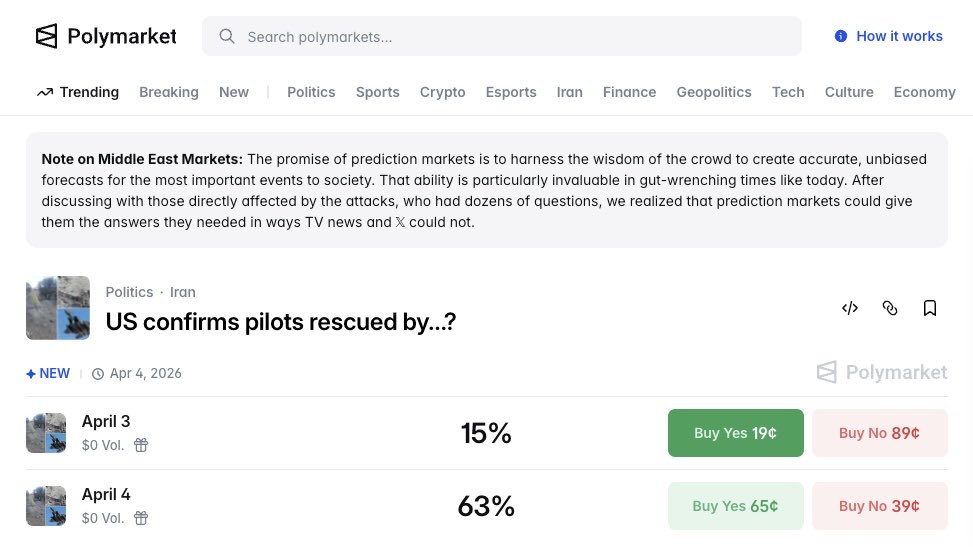
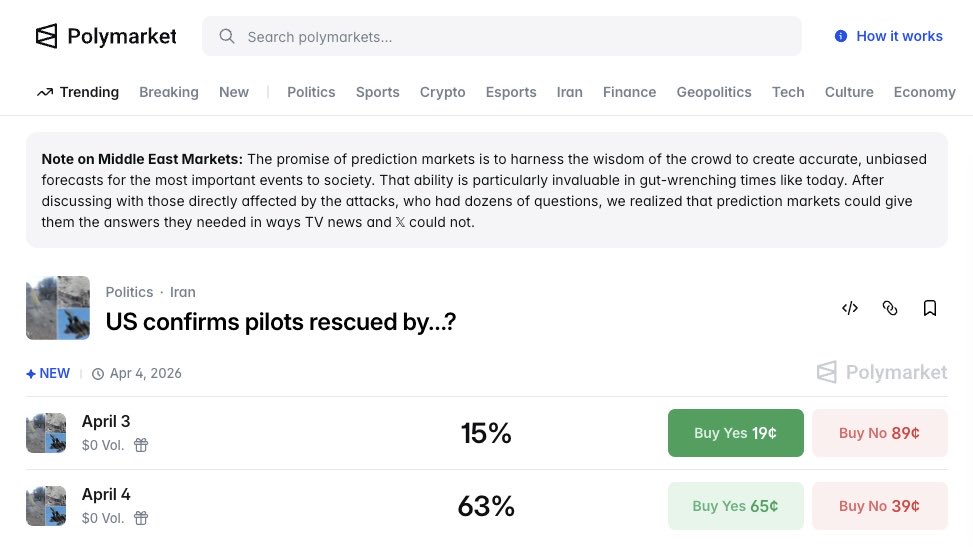
Source: Polymarket

He also criticized President Donald Trump for benefiting from the “death markets,” claiming his access to classified intelligence.

Quick reminder too that Donald Trump is an investor in this dystopian death market and may have access to intelligence that isn’t public yet.

Polymarket removes the alleged ‘death market’

Polymarket quickly archived the market, stating that it did not meet its “integrity standards.” The firm clarified that it was investigating how the market “slipped through its internal safeguards.”


Source: X/Polymarket

Well, this wasn’t the first time Polymarket or prediction markets have faced scrutiny over such markets. In fact, many traders reportedly benefited from Ali Khamenei, the former Supreme Leader of Iran, killed during U.S. and Israeli attacks.

In fact, on Polymarket, an account made over $460K in profits trading contracts related to Iran strikes and Khamenei’s ouster.
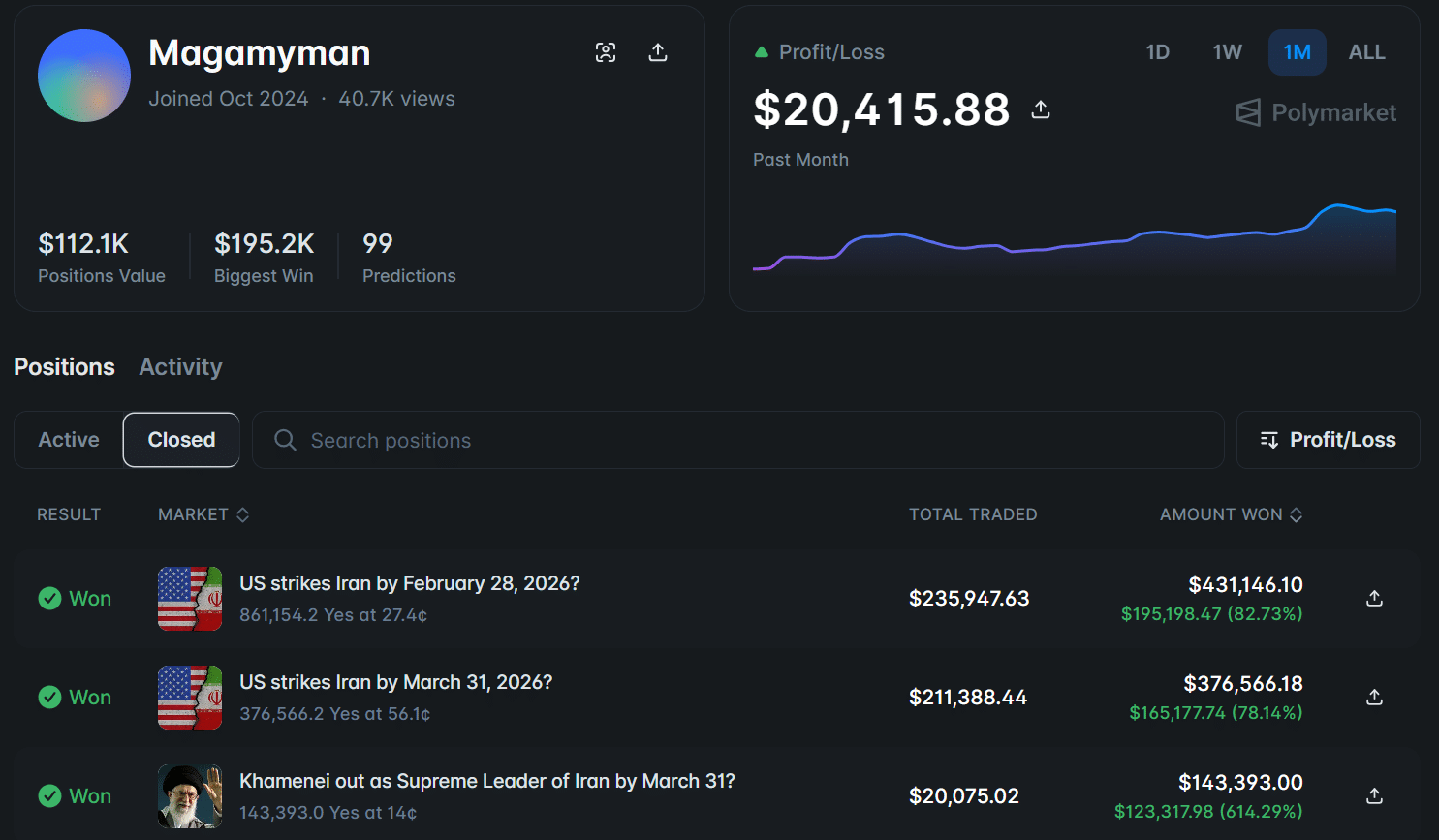
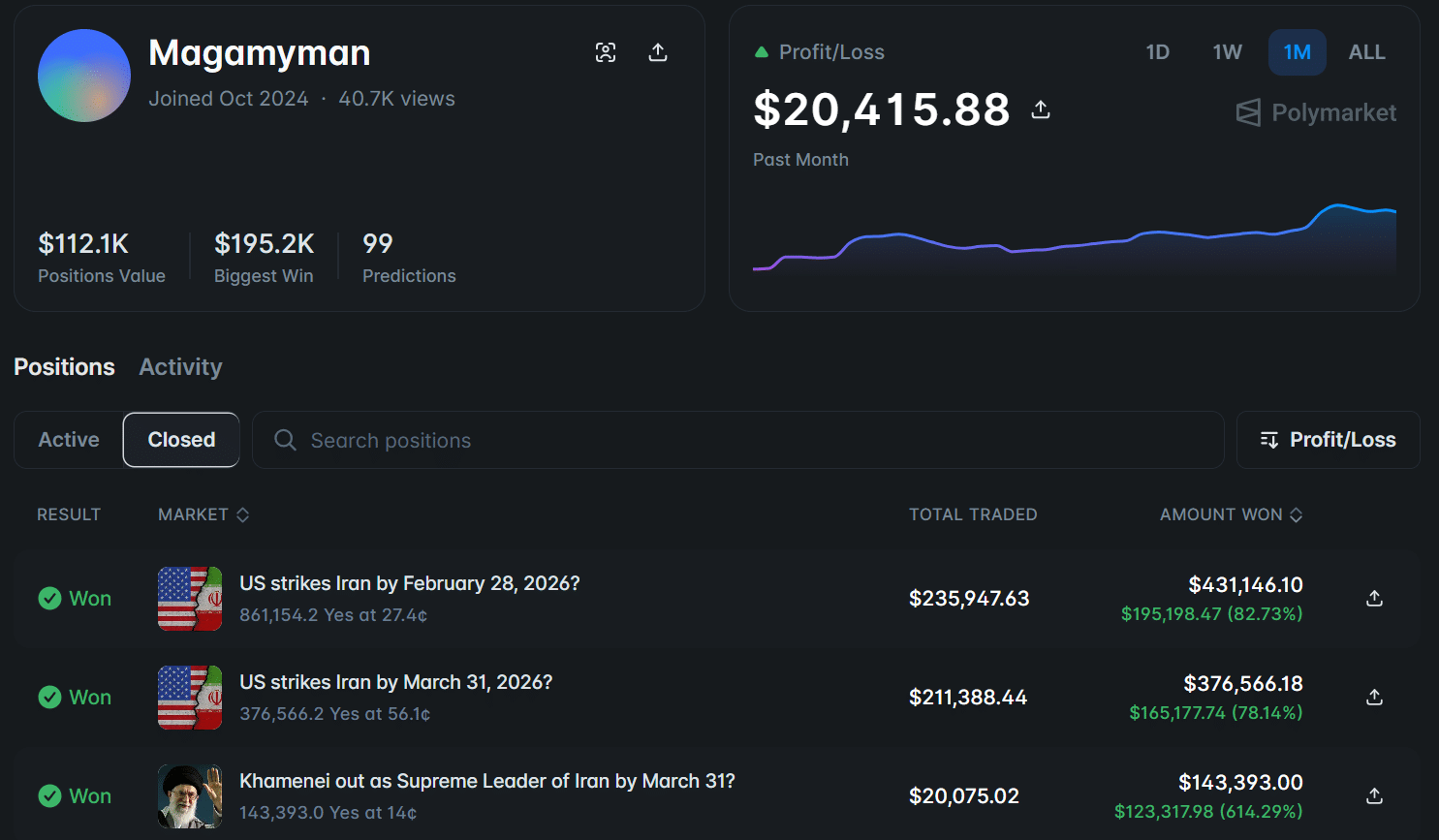
Source: Polymarket

On-chain analytics firm Bubblemaps estimated that 12 insiders made over $1.2 million from the Iran strikes and the subsequent death of its former leader. Most of the wallets were funded 24 hours before and bought the “US strikes Iran by February 28, 2026” contract hours before it happened.

Reacting to the raging ‘death markets’ and alleged insiders, Senator Chris Murphy (D-CT) slammed,

It’s insane this is legal. People around Trump are profiting off war and death. I’m introducing legislation ASAP to ban this.

Kalshi, another prediction site, also faced similar scrutiny and a class lawsuit after it failed to pay $54M to traders betting on Khamenei’s ouster.

Overall, prediction markets have become a multi-billion-dollar segment as speculation interest surges across sports, politics, and other sectors.

That said, apart from the rising ethical questions, the fight between the CFTC and states on who should oversee prediction markets could also stifle the sector’s growth in the U.S.


Final Summary

  • A U.S. lawmaker has slammed prediction site Polymarket for its ‘death markets’ targeting stranded soldiers in Iran.
  • There has been growing criticism against the prediction market amid the ongoing West Asia crisis.


İlgili Sorular

QWhy did U.S. lawmaker Seth Moulton criticize Polymarket?

AHe criticized Polymarket for encouraging 'disgusting death markets' that allowed people to bet on the fate of a missing American service member whose plane was shot down over Iran.

QWhat action did Polymarket take regarding the controversial market?

APolymarket archived the market, stating it did not meet its integrity standards, and is investigating how it slipped through internal safeguards.

QHow much profit did an account make from trading contracts related to Iran strikes and Khamenei's ouster on Polymarket?

AAn account made over $460,000 in profits from trading those contracts.

QWhat did Senator Chris Murphy announce in response to the 'death markets'?

ASenator Chris Murphy announced he is introducing legislation to ban such markets, stating it is insane that it is legal for people to profit off war and death.

QWhat broader issue is mentioned that could stifle the growth of prediction markets in the U.S.?

AThe fight between the CFTC and states over who should oversee prediction markets could stifle the sector's growth in the U.S.

İlgili Okumalar

The AI Agent Era Accelerates Its Arrival: Questflow Defines a New Paradigm of Financial Intelligence with On-Chain AI Brokerage

The AI Agent era is accelerating, with the CB Insights AI 100 list highlighting global investment confidence. The focus has shifted from whether AI works to its speed of deployment and ability to manage complex workflows, with autonomous AI Agents driving this transformation. At the forefront is Questflow, a Singapore-based startup redefining financial intelligence through its on-chain AI brokerage. Unlike tools that merely provide data dashboards, Questflow deploys AI Agents that proactively scan markets, form judgments, and execute trades via a conversational interface—operating 24/7 without requiring manual confirmation for each decision. This embodies the new AI paradigm of agents capable of executing multi-step workflows autonomously. Questflow's mission is to democratize institutional-grade trading intelligence. Historically reserved for the ultra-wealthy, this capability is now accessible starting from just $1 through Questflow's "AI Clone + Copy Trade" model. The platform charges only a 1% execution fee, aligning its incentives directly with users and eliminating traditional management or performance fees. The timing is opportune, aligning with key trends identified by CB Insights: the scalable deployment of AI Agents, accelerated AI adoption in financial services, and the maturation of on-chain infrastructure. With robust liquidity on platforms like Hyperliquid and Polymarket, alongside advancements in AI reasoning and non-custodial wallet security, Questflow is positioned to merge the roles of broker, fund, and exchange into a single, accessible platform for millions.

链捕手40 dk önce

The AI Agent Era Accelerates Its Arrival: Questflow Defines a New Paradigm of Financial Intelligence with On-Chain AI Brokerage

链捕手40 dk önce

Why Pricing Social Interactions is Doomed to Fail?

Titled "Why Putting a Price on Social Interaction Is Doomed to Fail," this article critiques attempts to monetize social networks directly through SocialFi models, arguing their inevitable failure stems from a fundamental misunderstanding of media dynamics. Using Marshall McLuhan's theory of "hot" and "cold" media, the author posits that social networks are inherently "cold" media. Their value isn't contained in individual posts but is co-created through user participation, interpretation, and fragmented, ongoing interaction (e.g., replies, shares). This ambiguity and need for user involvement are core to their function. The article asserts that SocialFi projects like Friend.tech failed because introducing real-time, tradable financial pricing (a definitive "hot" signal) into this "cold" environment doesn't add a layer—it replaces the medium's essence. The unambiguous price signal overshadows and nullifies the nuanced, participatory social signal. Users become traders, not participants, and when speculative profits vanish, the underlying social ecosystem—never genuinely cultivated—collapses entirely. This principle extends beyond crypto. The author argues platforms like Twitter have gradually "heated up" through metrics (likes, retweets counts, algorithmically defined value), shifting users from participants to performers and eroding organic engagement. The solution isn't to abandon capital but to manage its entry point. Successful models like Substack, Patreon, or Bandcamp allow capital to "condense" at specific, isolated nodes (e.g., subscriptions, one-time payments) without permeating and "heating" every social interaction. They preserve the core "cold," participatory medium while enabling monetization at designated boundaries. The NFT boom and bust serves as a stark parallel: the ancient "cold" medium of collecting (valued for story, community, gradual accumulation) was rapidly destroyed by platforms that introduced real-time floor prices, rarity scores, and trading dashboards, transforming collectors into speculators and vaporizing cultural value when prices fell. The core lesson: "Liquidity equals heat." Injecting high liquidity and definitive pricing into a "cold" participatory medium doesn't optimize it; it fundamentally alters and destroys its value-creating mechanism. The future lies not in pricing every social gesture but in finding precise, non-invasive points for capital to condense without overheating the entire ecosystem.

marsbit48 dk önce

Why Pricing Social Interactions is Doomed to Fail?

marsbit48 dk önce

İşlemler

Spot
Futures
活动图片




