‘Death markets!’ U.S lawmaker slams Polymarket bets on lost U.S soldiers in Iran

ambcrypto2026-04-05 tarihinde yayınlandı2026-04-05 tarihinde güncellendi

Özet

U.S. lawmaker Seth Moulton strongly criticized the prediction market platform Polymarket for allowing users to bet on the fate of a missing American soldier in Iran-downed aircraft, calling it a "disgusting death market." He also accused former President Donald Trump, an investor in Polymarket, of potentially profiting from access to non-public intelligence. Polymarket quickly removed the market, citing integrity violations and launched an internal review. This incident is part of a broader pattern; the platform previously faced scrutiny when insiders reportedly earned over $1.2 million from contracts related to U.S. strikes in Iran and the death of its former leader. Senator Chris Murphy announced plans to introduce legislation to make such markets illegal, highlighting growing ethical and regulatory concerns around prediction platforms.

Polymarket is under scrutiny for supporting markets that speculate on deaths.

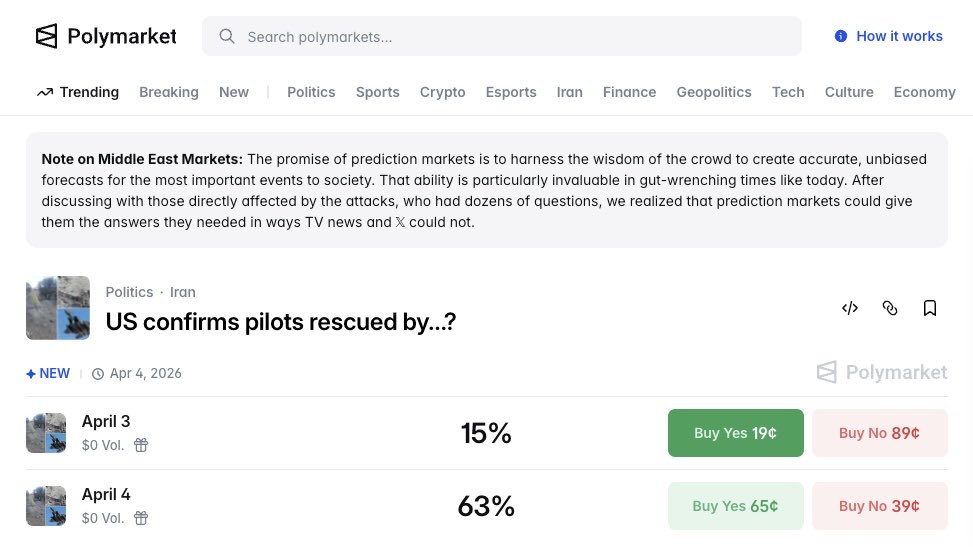
On Friday, U.S. House representative and senatorial aspirant Seth Moulton (D-MA) lashed out at the prediction site for encouraging “disgusting death markets.”

There is an ongoing search and rescue operation for a missing American service member whose plane was shot down over Iran. Their safety is unknown. They could be your neighbor, a friend, a family member. And people are betting on whether or not they’ll be saved.
AD
Source: Polymarket

He also criticized President Donald Trump for benefiting from the “death markets,” claiming his access to classified intelligence.

Quick reminder too that Donald Trump is an investor in this dystopian death market and may have access to intelligence that isn’t public yet.

Polymarket removes the alleged ‘death market’

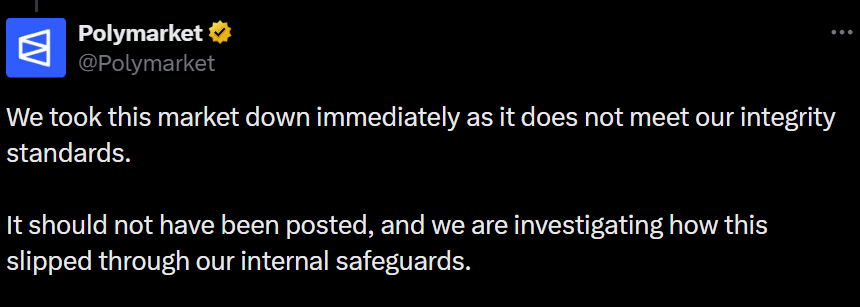
Polymarket quickly archived the market, stating that it did not meet its “integrity standards.” The firm clarified that it was investigating how the market “slipped through its internal safeguards.”
Source: X/Polymarket

Well, this wasn’t the first time Polymarket or prediction markets have faced scrutiny over such markets. In fact, many traders reportedly benefited from Ali Khamenei, the former Supreme Leader of Iran, killed during U.S. and Israeli attacks.

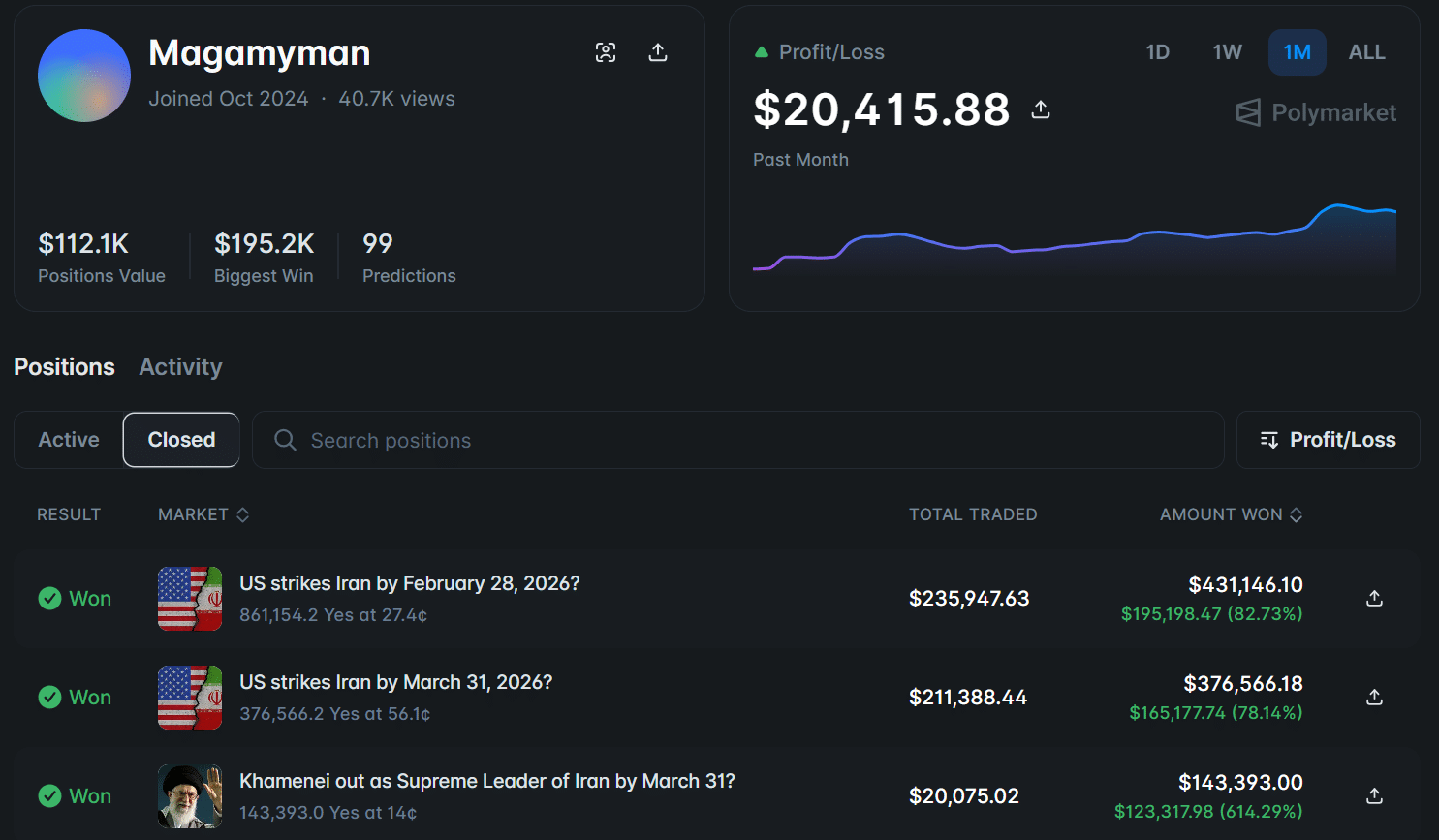
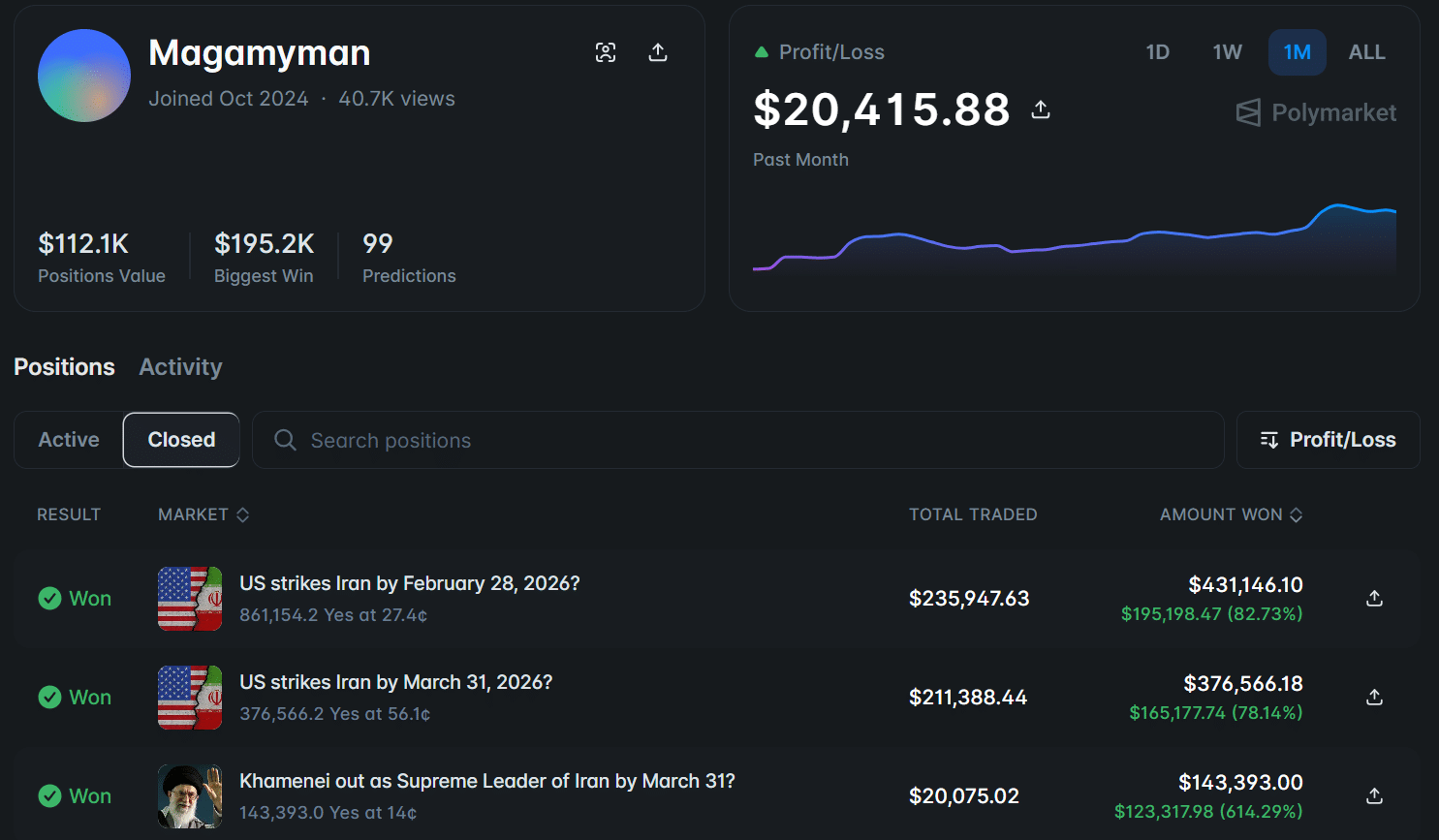
In fact, on Polymarket, an account made over $460K in profits trading contracts related to Iran strikes and Khamenei’s ouster.
Source: Polymarket

On-chain analytics firm Bubblemaps estimated that 12 insiders made over $1.2 million from the Iran strikes and the subsequent death of its former leader. Most of the wallets were funded 24 hours before and bought the “US strikes Iran by February 28, 2026” contract hours before it happened.

Reacting to the raging ‘death markets’ and alleged insiders, Senator Chris Murphy (D-CT) slammed,

It’s insane this is legal. People around Trump are profiting off war and death. I’m introducing legislation ASAP to ban this.

Kalshi, another prediction site, also faced similar scrutiny and a class lawsuit after it failed to pay $54M to traders betting on Khamenei’s ouster.

Overall, prediction markets have become a multi-billion-dollar segment as speculation interest surges across sports, politics, and other sectors.

That said, apart from the rising ethical questions, the fight between the CFTC and states on who should oversee prediction markets could also stifle the sector’s growth in the U.S.


Final Summary

  • A U.S. lawmaker has slammed prediction site Polymarket for its ‘death markets’ targeting stranded soldiers in Iran.
  • There has been growing criticism against the prediction market amid the ongoing West Asia crisis.


İlgili Sorular

QWhy did U.S. lawmaker Seth Moulton criticize Polymarket?

AHe criticized Polymarket for encouraging 'disgusting death markets' that allowed people to bet on the fate of a missing American service member whose plane was shot down over Iran.

QWhat action did Polymarket take regarding the controversial market?

APolymarket archived the market, stating it did not meet its integrity standards, and is investigating how it slipped through internal safeguards.

QHow much profit did an account make from trading contracts related to Iran strikes and Khamenei's ouster on Polymarket?

AAn account made over $460,000 in profits from trading those contracts.

QWhat did Senator Chris Murphy announce in response to the 'death markets'?

ASenator Chris Murphy announced he is introducing legislation to ban such markets, stating it is insane that it is legal for people to profit off war and death.

QWhat broader issue is mentioned that could stifle the growth of prediction markets in the U.S.?

AThe fight between the CFTC and states over who should oversee prediction markets could stifle the sector's growth in the U.S.

İlgili Okumalar

In Jinjiang, Fujian, a Storage Super Unicorn Lies Quiet

In Fujian's Jinjiang, a city known for sportswear, lies a quiet semiconductor giant: Fujian Jinhua Integrated Circuit Co. (JHICC). Once a promising domestic DRAM manufacturer alongside Yangtze Memory and ChangXin Memory Technologies (CXMT), its journey was derailed in 2018 when the U.S. placed it on an Entity List and filed criminal charges for alleged trade secret theft. This halted production for years. A turning point came in February 2024 when a U.S. federal court found JHICC not guilty. However, it had lost crucial time. While CXMT soared to become a top-valued A-share company in 2024, JHICC, with an estimated valuation of 80 billion RMB, was just restarting. Its current output is primarily customized DDR4 chips, not the advanced DDR5/HBM demanded for AI, but it still benefits from the broader memory chip upcycle. JHICC's story is tied to Chen Zhengkun, a veteran engineer who left Micron to lead the venture. Founded in 2016 with state-backed funding, JHICC partnered with Taiwan's UMC to develop DRAM technology. Rapid progress was cut short by the U.S. actions, which Micron initiated, partly due to its heavy reliance on the Chinese market. Post-sanctions, Chen's team worked to rebuild the production line with reduced reliance on U.S. technology. According to its records, JHICC achieved small-scale production and revenue growth under immense pressure. It now focuses on the stable "niche" DRAM market (e.g., TVs, routers) with a monthly capacity of ~40,000 wafers, aiming for 60,000 by 2026. It holds over 1,000 patents but remains on the Entity List. For Jinjiang, investing in JHICC was a bold industrial leap. The local government provided unwavering financial and logistical support during the crisis, helping the company survive. JHICC has become the anchor for a growing local semiconductor cluster. Though its scale lags behind domestic peers, JHICC's persistence symbolizes a hard-won foothold in a global market long dominated by Samsung, SK Hynix, and Micron. Having missed one boom, it seeks a place in the new AI-driven memory supercycle.

marsbit1 saat önce

In Jinjiang, Fujian, a Storage Super Unicorn Lies Quiet

marsbit1 saat önce

İşlemler

Spot
活动图片




