David Hoffman: Ethereum in the New World Order

marsbit2026-01-26 tarihinde yayınlandı2026-01-26 tarihinde güncellendi

Özet

David Hoffman, founder of Bankless, reflects on the 2026 Davos Forum, where crypto leaders gathered amidst a significant shift in global order. U.S. Secretary Howard declared "globalization has failed," while Canada’s Minister Mark noted the "fracturing, not transformation" of the rules-based international system. Hoffman argues that the post-WWII order, upheld by fragile institutions like the UN, is collapsing as the U.S. abandons multilateralism under Trump’s "America First" policy, reverting to a might-makes-right reality. In this fragmented landscape, Hoffman sees decentralized crypto protocols like Bitcoin and Ethereum as emerging higher-order structures that can unify a divided world. They don’t replace nation-states but provide a neutral, rules-based coordination layer for global cooperation. Bitcoin enforces accountability through its decentralized, algorithmic "if-then" logic, while Ethereum’s Turing-complete smart contracts extend this principle further. Despite current crypto market pessimism, Hoffman believes these protocols could deliver the rules-based order that traditional institutions failed to sustain—potentially making Ethereum the unexpected foundation for a new global system.

Author: David Hoffman, Founder of Bankless

Compiled by: Hu Tao, ChainCatcher

This year's Davos Forum was truly spectacular.

It brought together many heavyweight figures from the cryptocurrency industry, including Brian Armstrong, Jeremy Allaire, CZ, and Larry Fink.

Although cryptocurrency was a focal point of this forum, what truly captured attention was the Trump administration's clear statement regarding a phased shift in the global order.

Two significant speeches at the Davos Forum highlighted this point. U.S. Secretary of Commerce Howard delivered a speech titled "Globalization Has Failed," while Canadian Prime Minister Mark responded by saying, "The rules-based international order is experiencing a rupture, not a transformation."

Rules-Based International Order vs. Law of the Jungle

Since World War II, the international community has maintained a certain degree of order and cooperation. Although the United Nations has relatively little power, it is highly respected in the decision-making of various countries and plays a pivotal role.

"International law" once truly existed, but mainly because we all believed in it. We collectively赋予 it meaning.

The Trump administration decided to puncture this shared illusion.

Trump believes that this "rules-based international order" exists only because the United States allows it to exist. As the most powerful nation with the strongest military force, this means that we are the ones who truly构建 this "rules-based international order," and Trump's "America First" philosophy means he no longer wants to play nice with the rest of the world.

According to Trump, as elaborated in Lutnick's speech, this model does not serve the best interests of the United States, so we are now taking a different path.
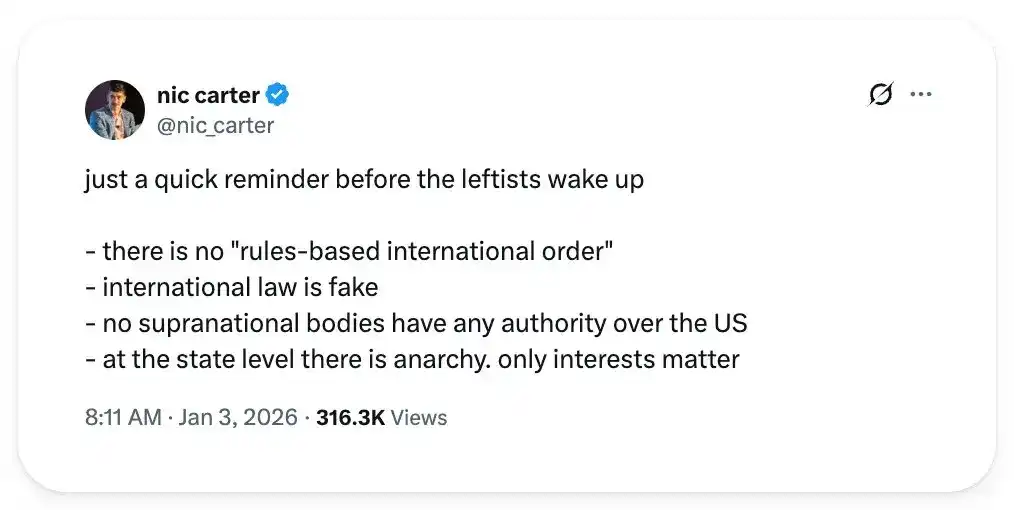
Nic Carter is right—the state is the highest level of organization that humanity has created. Before the nation-state, religion and monarchy were the highest levels of organizational structure that humans could create, and before that were feudal systems and tribes.

We attempted to build higher-level organizational structures through "common agreements" with institutions like the United Nations, but these agreements ultimately proved very fragile and had minimal impact on the world.

Therefore, our current situation is this: by 2026, the United States has abandoned the attempt to build a higher-level unified organizational structure and claims that we are better off going it alone.

It is worth mentioning that "pariah states" like Russia and Iran have恰恰 thrived by relying on a weak international order. They have always adhered to the law of the strong and exploited the weaknesses of the "rules-based international order" to expand their power, committing human rights violations that the United Nations merely condemns.

Although it is regrettable to see the attempts at global cooperation ultimately fail, at least we can finally be frank in pointing out that countries like Russia never truly followed these rules.

Bitcoin, Ethereum, and Decentralized Crypto Protocols

Decentralized crypto protocols are powerful and autonomous "higher-level organizational structures" that failed to materialize from the "rules-based international order" paradigm.

Trump's分裂 of the unified international community is precisely the situation that Ethereum aims to balance.

When the unified world falls apart and degenerates into regional powers, Ethereum reunites it in cyberspace.

These protocols do not enforce laws or protect their members. They do not replace nation-states. However, they are a ubiquitous, autonomous coordination layer for the people of the world to unite.

The conversation between Brian Armstrong and the Governor of the Bank of France exemplifies this power. The central bank governor made the mistake that all central bank governors make: misunderstanding and underestimating Bitcoin. Brian corrected him, pointing out that "Bitcoin has no issuer—it is a decentralized protocol...", and then he went on to elaborate on Bitcoin's most important role in unifying the world: "...[Bitcoin] is actually the most effective accountability mechanism for deficit spending."

No, we cannot establish a "rules-based international order" through voluntary coordination and cooperation among nations. But can we obtain a "rules-based international order" from a decentralized, cryptography-based internet protocol?

Bitcoin operates on "if...then..." statements. In my opinion, that sounds like a "rules-based international order." Doesn't Ethereum extend the same principle to Turing-complete smart contracts?

Despite the current atmosphere of despair and negativity in the cryptocurrency industry, I still firmly believe that we are far from tapping the potential of smart contracts.

So, perhaps we won't get a "rules-based international order" from the United Nations.

Perhaps we will get it from an unexpected place.

Perhaps we will get it from Ethereum.

İlgili Sorular

QWhat is the main argument David Hoffman makes about the role of Ethereum in the context of a failing international order?

ADavid Hoffman argues that as the unified global order fragments into regional powers, Ethereum serves as a decentralized, autonomous coordination layer in cyberspace that can unify the world by providing a 'rules-based international order' through its cryptographic protocols and smart contracts, unlike the failed attempts of institutions like the UN.

QAccording to the article, how did the Trump administration's stance impact the 'rules-based international order'?

AThe Trump administration rejected the 'rules-based international order' by claiming it only existed because the U.S. allowed it, and with its 'America First' policy, it no longer wanted to cooperate under this framework, effectively puncturing the collective illusion of global cooperation and international law.

QWhat example does the article provide to illustrate the power of decentralized crypto protocols like Bitcoin in holding governments accountable?

AThe article cites Brian Armstrong's conversation with the French Central Bank governor, where Armstrong corrected the governor's misunderstanding by stating that Bitcoin is a decentralized protocol without an issuer and serves as 'the most effective accountability mechanism for deficit spending,' enforcing rules through its 'if-then' operational logic.

QWhy does the author believe that decentralized crypto protocols are superior to traditional international institutions like the UN?

AThe author believes decentralized crypto protocols are superior because they are robust, autonomous higher-level organizational structures that exist ubiquitously in cyberspace, enforcing rules through code and cryptography, whereas traditional institutions like the UN rely on fragile voluntary coordination and have minimal real-world impact.

QWhat historical context does the article provide about the evolution of human organizational structures before nation-states?

AThe article references Nic Carter's view that nation-states are the highest form of organization humans have created, preceded by religions and monarchies, and before that, feudal systems and tribes, highlighting the failed attempts to create higher-level structures through agreements like the UN.

İlgili Okumalar

How Many Tokens Away Is Yang Zhilin from the 'Moon Chasing the Light'?

The article explores the intense competition between two leading Chinese AI companies, DeepSeek and Kimi (Moon Dark Side), and the mounting pressure on Yang Zhilin, the founder of Kimi. While DeepSeek re-emerged after 15 months of silence with its powerful V4 model—boasting 1.6 trillion parameters and low-cost, long-context capabilities—Kimi has been focusing on long-context processing and multi-agent systems with its K2.6 model. Yang faces a threefold challenge: technological rivalry, commercialization pressure, and investor expectations. Despite Kimi’s high valuation (reaching $18 billion), its revenue heavily relies on a single product with low paid conversion rates, while DeepSeek’s strategic silence and open-source influence have strengthened its market position and valuation prospects, now targeting over $20 billion. Both companies reflect broader trends in China’s AI ecosystem: Kimi aims for global influence through open-source contributions and agent-based advancements, while DeepSeek prioritizes foundational innovation and hardware independence, notably shifting to Huawei’s chips. Their competition is seen as vital for China’s AI progress, with the gap between top Chinese and U.S. models narrowing to just 2.7% on the Elo rating scale. Ultimately, the article argues that this rivalry, though anxiety-inducing for leaders like Zhilin, is essential for driving innovation and solidifying China’s role in the global AI landscape.

marsbit7 saat önce

How Many Tokens Away Is Yang Zhilin from the 'Moon Chasing the Light'?

marsbit7 saat önce

İşlemler

Spot
Futures

Popüler Makaleler

ORDER Nasıl Satın Alınır

HTX.com’a hoş geldiniz! Orderly (ORDER) satın alma işlemlerini basit ve kullanışlı bir hâle getirdik. Adım adım açıkladığımız rehberimizi takip ederek kripto yolculuğunuza başlayın. 1. Adım: HTX Hesabınızı OluşturunHTX'te ücretsiz bir hesap açmak için e-posta adresinizi veya telefon numaranızı kullanın. Sorunsuzca kaydolun ve tüm özelliklerin kilidini açın. Hesabımı Aç2. Adım: Kripto Satın Al Bölümüne Gidin ve Ödeme Yönteminizi SeçinKredi/Banka Kartı: Visa veya Mastercard'ınızı kullanarak anında Orderly (ORDER) satın alın.Bakiye: Sorunsuz bir şekilde işlem yapmak için HTX hesap bakiyenizdeki fonları kullanın.Üçüncü Taraflar: Kullanımı kolaylaştırmak için Google Pay ve Apple Pay gibi popüler ödeme yöntemlerini ekledik.P2P: HTX'teki diğer kullanıcılarla doğrudan işlem yapın.Borsa Dışı (OTC): Yatırımcılar için kişiye özel hizmetler ve rekabetçi döviz kurları sunuyoruz.3. Adım: Orderly (ORDER) Varlıklarınızı SaklayınOrderly (ORDER) satın aldıktan sonra HTX hesabınızda saklayın. Alternatif olarak, blok zinciri transferi yoluyla başka bir yere gönderebilir veya diğer kripto para birimlerini takas etmek için kullanabilirsiniz.4. Adım: Orderly (ORDER) Varlıklarınızla İşlem YapınHTX'in spot piyasasında Orderly (ORDER) ile kolayca işlemler yapın.Hesabınıza erişin, işlem çiftinizi seçin, işlemlerinizi gerçekleştirin ve gerçek zamanlı olarak izleyin. Hem yeni başlayanlar hem de deneyimli yatırımcılar için kullanıcı dostu bir deneyim sunuyoruz.

283 Toplam GörüntülenmeYayınlanma 2024.12.10Güncellenme 2025.03.21

ORDER Nasıl Satın Alınır

Tartışmalar

HTX Topluluğuna hoş geldiniz. Burada, en son platform gelişmeleri hakkında bilgi sahibi olabilir ve profesyonel piyasa görüşlerine erişebilirsiniz. Kullanıcıların ORDER (ORDER) fiyatı hakkındaki görüşleri aşağıda sunulmaktadır.

活动图片