Data Modeling: How to Improve the Quality of Interaction on Polymarket?

Odaily星球日报2026-02-22 tarihinde yayınlandı2026-02-22 tarihinde güncellendi

Özet

Polymarket, a leading prediction market platform, is anticipated to have one of the largest airdrops in the sector. This analysis provides a data-driven strategy to optimize user interactions for potential rewards. A critical finding is that public dashboards often double-count trading volume by including both sides of a trade. The true, single-sided figure is likely half of what is displayed, which will be the metric Polymarket uses internally. User distribution data reveals extreme concentration: only 0.51% of addresses profited over $1,000, and a mere 1.74% traded over $50,000. Crucially, 79% of traders have never earned even $1 in liquidity provider (LP) rewards, making LP activity a currently undervalued and highly capital-efficient interaction. Historical airdrop precedents suggest rewards will be based on active behavior—not profitability—to avoid favoring insiders. A multi-dimensional model is predicted, likely featuring: * 40% weight on trade volume (using a square root compression formula to limit whale dominance). * 35% weight on LP rewards. * 15% weight on market diversity (number of distinct markets traded in). * 10% weight on longevity (months active). The analysis advises users to accumulate genuine, on-chain provable volume across diverse markets, hold positions for 1-24 hours, and, most importantly, begin providing liquidity to accumulate LP rewards, which are a strong anti-Sybil signal. A hard cap per address is also expected to prevent excessive...

This article is from:arise

Compiled by | Odaily Planet Daily (@OdailyChina); Translator | Azuma (@azuma_eth)

The core content of this article is only one — how to prepare for the potential largest airdrop in the prediction market track.

Data Issues That Must Be Declared

Before building each model, we need real and reliable data. The trading volume data of Polymarket has been widely misreported.
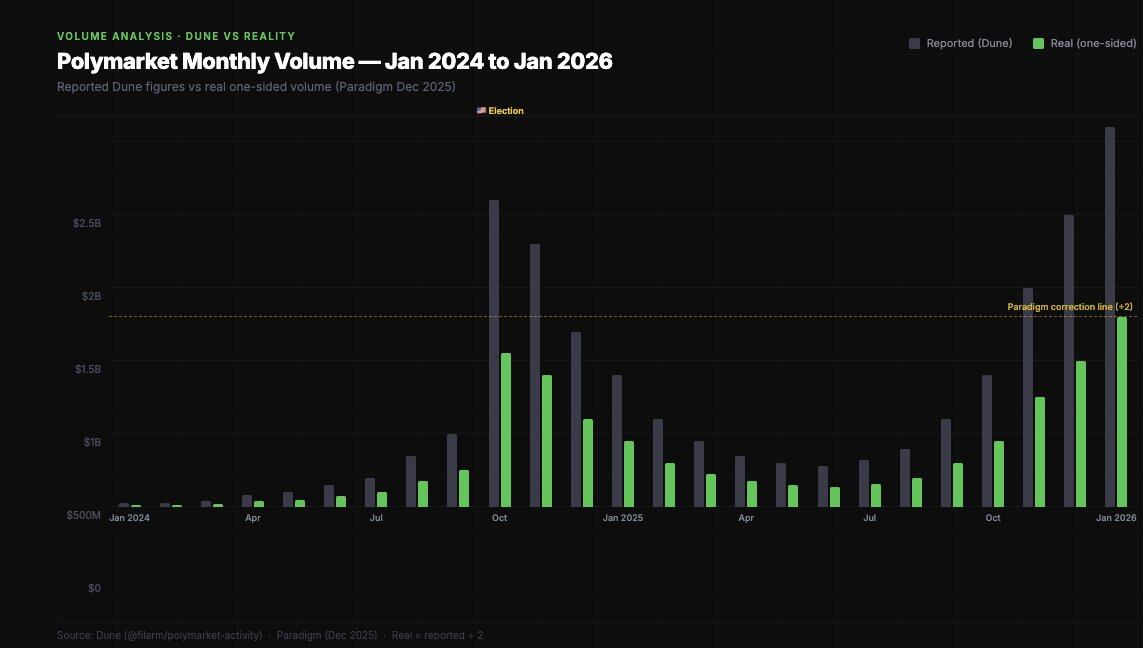
Paradigm published a key finding in a study in December 2025: Most Polymarket data dashboards count trading volume by summing all "OrderFilled" events, but this event is triggered on both the maker and taker sides of the same transaction, resulting in double counting. The actual trading volume is only about half of the number presented on the dashboards.

Dashboard volume vs. one-sided volume — the latter is the number that truly matters in airdrop modeling.
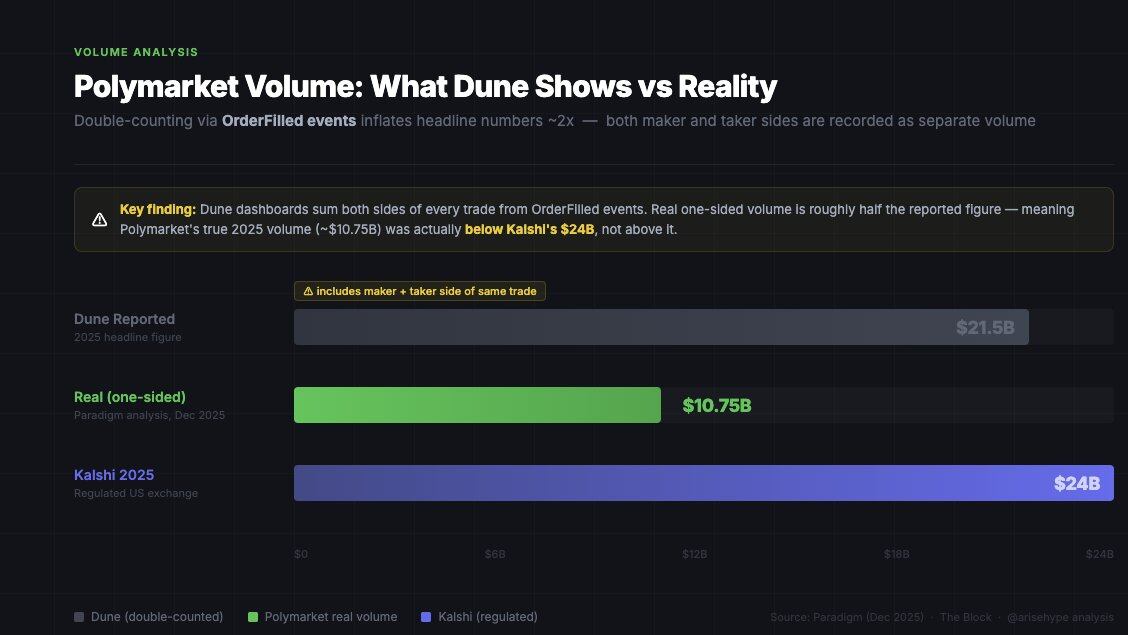
This is crucial for airdrop modeling. If Polymarket considers trading volume as a metric, they will only use internal data, not the various statistics on Dune. Your actual volume "score" is likely only half of what tools like Polycool show.

User Distribution

Regarding airdrop speculation, the most important dataset comes from a study by IMDEA Networks Institute, which covered over 86 million transactions (April 2024 – April 2025).

  • Only 0.51% of addresses achieved profits exceeding $1,000;
  • Only 1.74% of addresses (estimated) had a trading volume exceeding $50,000;
  • The top 3 arbitrage addresses alone extracted $4.2 million in "risk-free profits";
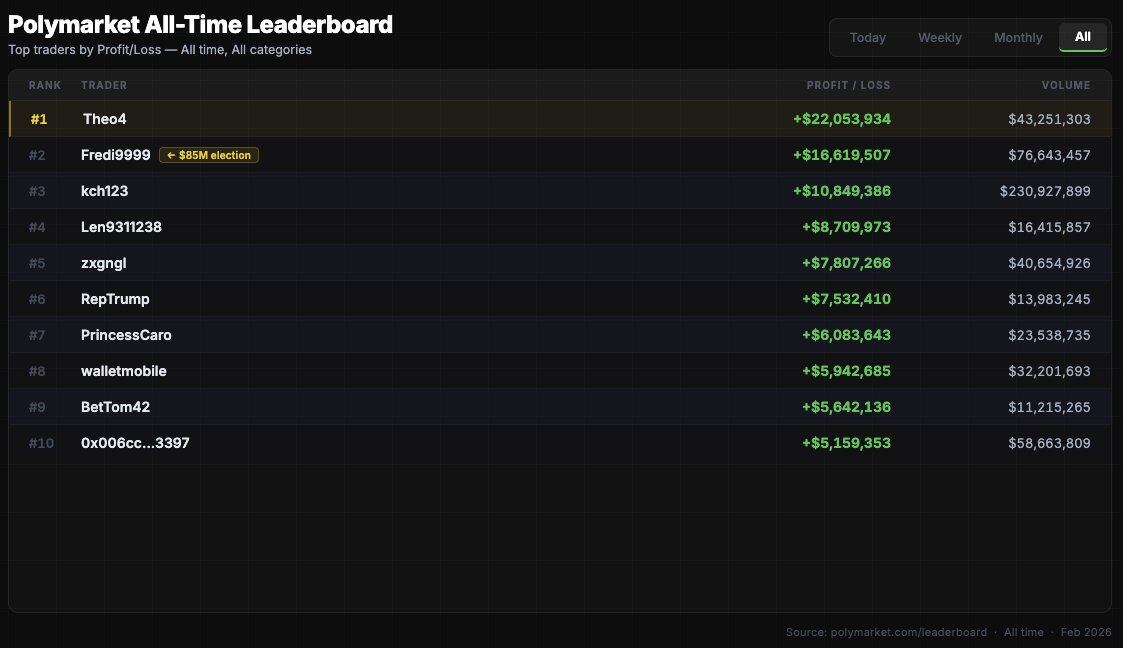
  • The top traders could profit over ten million dollars.
In terms of LP rewards, the stratification is even more pronounced.
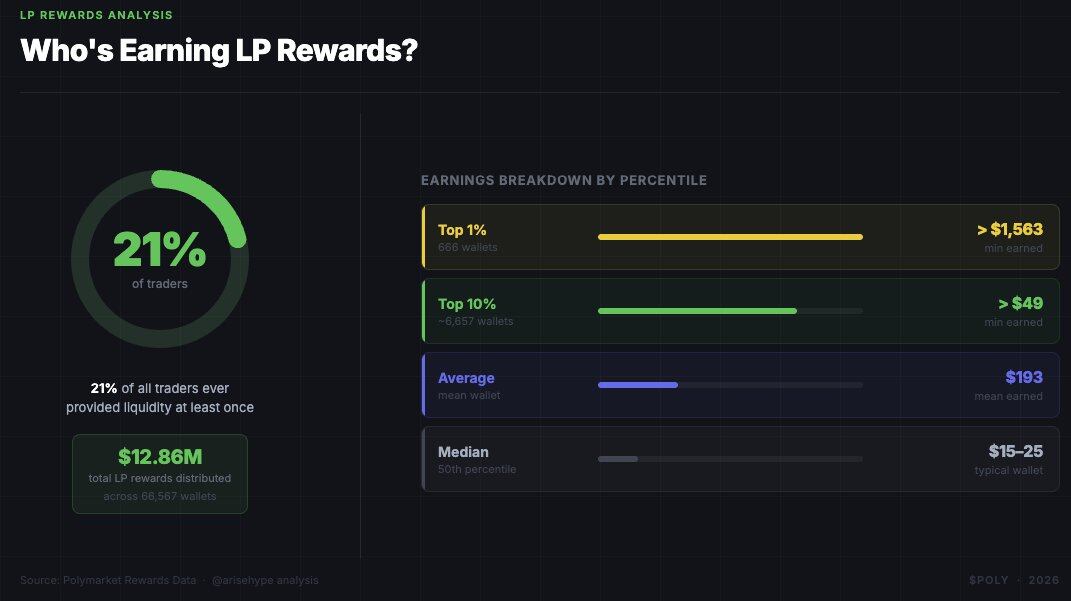
79% of traders have never earned even $1 in LP rewards — this is currently the most overlooked interactive behavior. Among 314,000 traders, only 66,567 wallets have ever received LP rewards. This means only 21% of traders have ever provided liquidity. Compared to overall participation, this reward mechanism is clearly neglected.

Lower usage is generally seen as a signal of being "undervalued" in airdrop models.

Airdrop Precedents: What Has History Told Us?
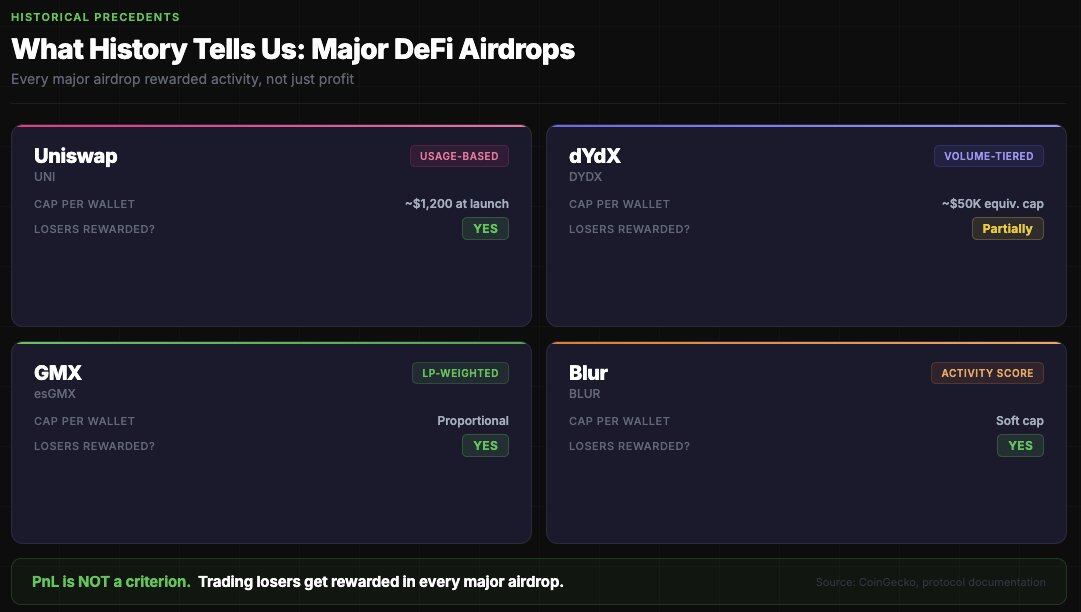
All major DeFi airdrops reward "active behavior," not "profitability." Polymarket will follow the same logic.

Commonalities of all large-scale airdrops include:

  • Purely equal distribution would be abused by Sybil attacks (Polymarket will certainly not distribute equally);
  • Purely distributing based on trading volume would overly concentrate the airdrop on whales (PR risk + SEC risk);
  • Best strategy: tiered hierarchy + reward caps + multiple dimensions (volume + LP + diversity + active duration);
  • In all major airdrops, losers are also rewarded — PnL is not a criterion.

The last point is crucial: If you traded $100,000 and lost $20,000, you are more likely to be rewarded than someone who traded $1,000 and made $500. The platform does not want to only incentivize profitable trading — that would more easily screen for insiders.

Reverse Thinking: How to Limit Whales?

Some airdrop calculators on the market use the simplest volume ratio model: Airdrop share = Individual volume / Total volume × Airdrop amount.

This is wrong because mainstream airdrops consistently use a "diminishing curve."
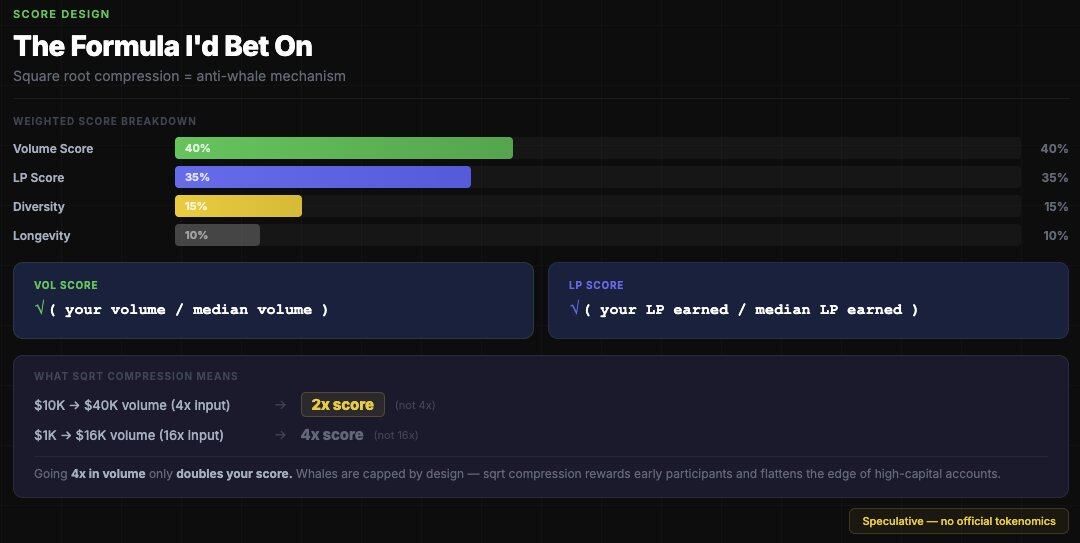
The model I'm more inclined to bet on is that Polymarket will use square root compression to limit the airdrop size for whales — for example, every 4x increase in volume only yields a 2x increase in score, which would completely change the airdrop results for the whale group.
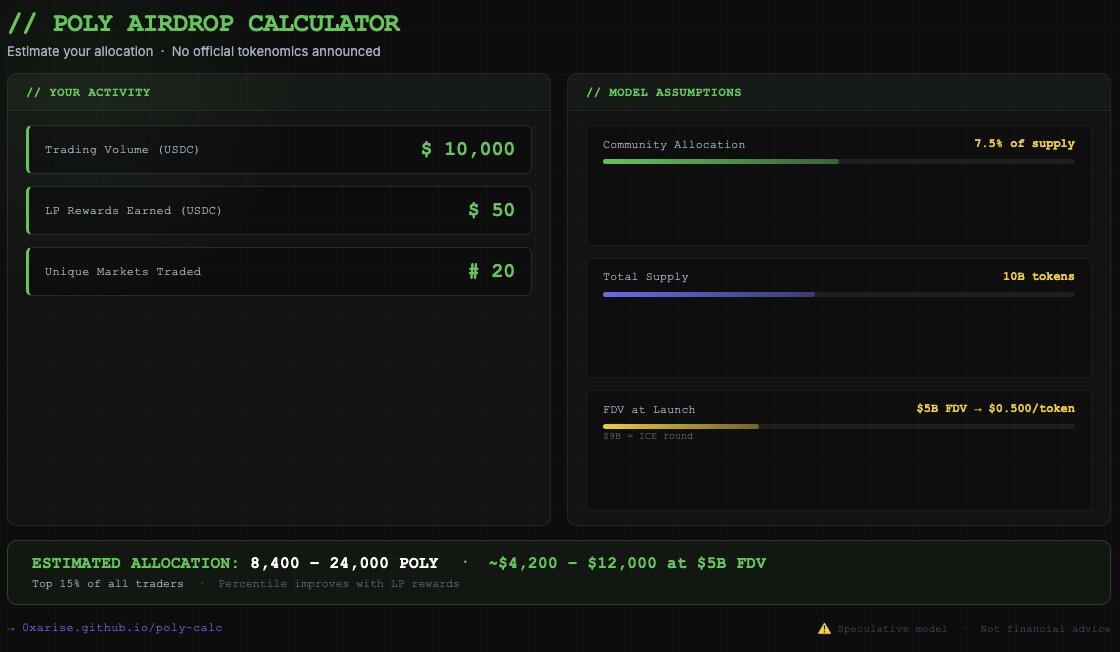
So how much would top wallets get? Assuming a total POLY supply of 10 billion, with 7.5% allocated for community airdrop (750 million POLY), and an FDV at TGE of $30–90 billion.

Without a cap on airdrop amount per address, for a volume of $85 million (taking top trader fredi999 as an example), the model estimates about 3–5 million POLY. At a $90 billion FDV, this is equivalent to $3–4.5 million. Theoretically possible, but the PR effect would be terrible.

A more realistic scenario is to cap the airdrop per address, e.g., the cap might be 500,000–2 million POLY. At a $5 billion FDV, top addresses could get about $450,000–$1 million.

"LP" vs. "Volume": Where is the Opportunity Now?

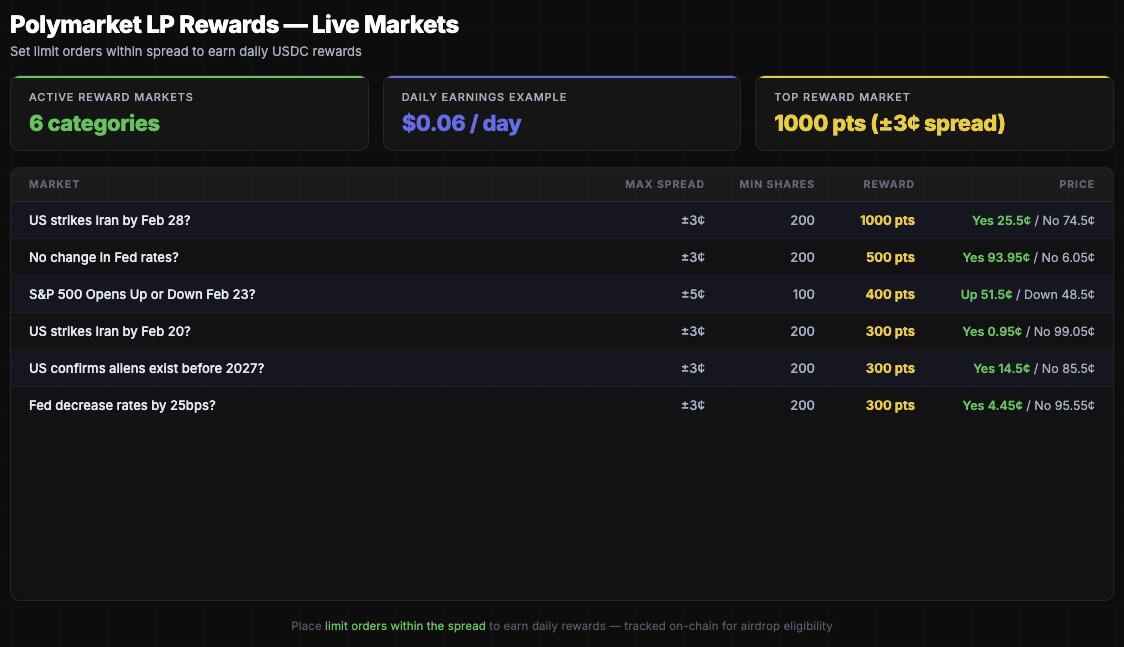
If you start interacting with Polymarket in February 2026 with a principal of $5,000, mathematically, deploying LP is a more favorable option for new participants.
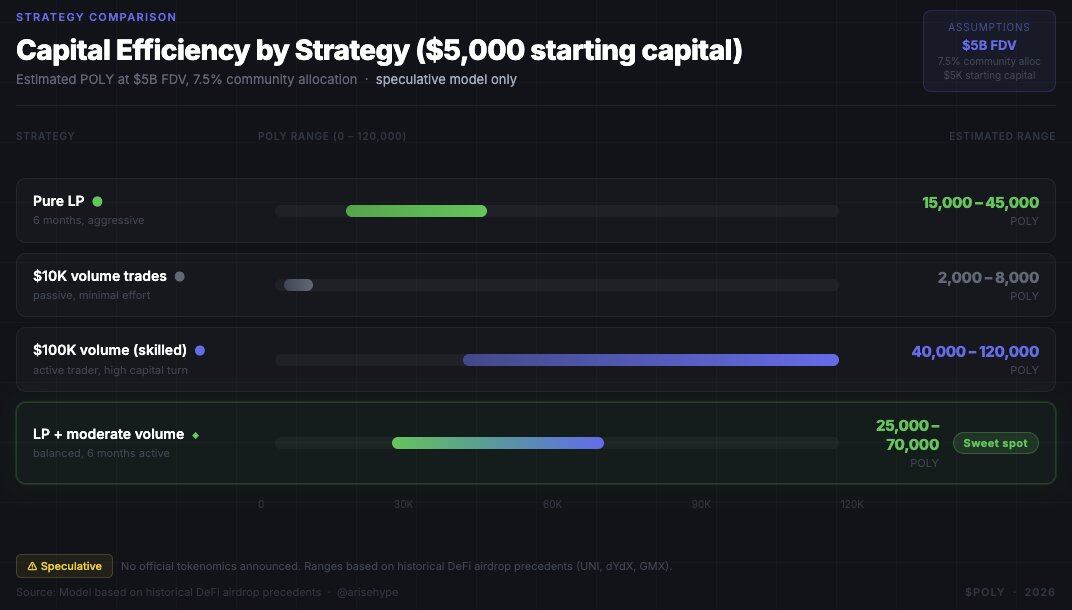
  • To earn $49 in LP rewards (top 10%), you need to consistently place limit orders in high-reward markets. This is achievable in 30–60 days using $500–$1,000 in capital.
  • To earn $1,563 in LP rewards (top 1%), higher capital or sustained high-frequency participation is required.
As for volume, you need to accumulate real volume without wash trading:

  1. Trade in 5 or more different categories of markets (politics, crypto, sports, science, culture);
  2. Hold positions for at least 1–24 hours before closing;
  3. Do not engage in wash trading the same market across different addresses;
  4. Lose money moderately — this is proof of "real participation";
  5. Target markets with volume > $500,000 (Polymarket might filter out micro markets);
  6. Single bet size: $50–$500.

Airdrop Model Speculation

The airdrop will not be as most people expect.

Most airdrop guesses are based on the simplest volume-weighted distribution, but Polymarket will do it smarter and more interestingly. They have on-chain LP data, which is clean, verifiable, and all measured in USD. They also have volume data that can filter out Sybil patterns. They also have wallet age, market diversity, and geographic distribution data.

This is my model — Polymarket has not confirmed anything, so this is just my speculation.

  • Volume weight: 40% — will use a square root compression formula, minimum threshold around $500;
  • LP reward weight: 35% — on-chain verifiable, Sybil-resistant;
  • Market diversity weight: 15% — number of unique markets participated in;
  • Active duration weight: 10% — number of active months before the snapshot.

Additionally, Polymarket will cap rewards per address (likely $500,000), otherwise the top 50 addresses would get too large a share, damaging the community narrative. Losers will receive the same reward as profiteers with equivalent volume; profitability is not a criterion — this cannot be philosophically justified and would create perverse incentives.

79% of traders have never received $1 in LP rewards. If LP weight accounts for 35% of the airdrop formula, the most capital-efficient behavior currently is to provide limit orders in high-volume markets and start accumulating on-chain verifiable proof of contribution.

In short, POLY could become the largest airdrop in the history of prediction markets. Calculated at a $9 billion FDV, the total value of the community airdrop could reach $450–$900 million. Even capturing just 0.1% of that is $450,000. This is why optimizing LP data now is more important than most people realize.


İlgili Sorular

QWhat is the key data issue highlighted in the article regarding Polymarket's volume reporting?

AThe key data issue is that most Polymarket data dashboards double-count volume by summing all 'OrderFilled' events, which fire on both the maker and taker sides of a trade. The true volume is approximately half of what is displayed on these dashboards.

QAccording to the research from IMDEA Networks Institute, what percentage of Polymarket traders have never earned even $1 in LP rewards?

AAccording to the research, 79% of Polymarket traders have never earned even $1 in LP rewards.

QWhat is a common characteristic of all major DeFi airdrops mentioned in the article?

AA common characteristic is that all major DeFi airdrops reward 'active behavior' rather than 'profitability'. Loss-making traders are also rewarded, as profitability is not a criterion.

QWhat is the proposed model for how the airdrop might be weighted across different user actions?

AThe proposed model suggests the airdrop might be weighted as follows: 40% for volume (using a square root compression formula), 35% for LP rewards, 15% for market diversity, and 10% for longevity (active months before the snapshot).

QWhy does the article suggest that providing liquidity (LP) is currently a more capital-efficient action for new participants seeking the airdrop?

AProviding liquidity is suggested as more capital-efficient because LP data is clean, on-chain, verifiable, and resistant to sybils. Furthermore, 79% of traders have never earned LP rewards, making it an underutilized activity that could carry significant weight in the airdrop formula.

İlgili Okumalar

Bitcoin Mining Farms Are Becoming AI Factories

Bitcoin mines are transforming into AI factories. This shift is driven by the convergence of three key assets from the previous crypto cycle: infrastructure, talent, and capital. Crypto mining companies like Crusoe, CoreWeave, and Bitdeer are repurposing their core competency—securing power, land, and grid connections in remote locations—to build data centers for AI clients. These firms are signing multi-billion dollar, long-term contracts with companies like Anthropic, AWS, and Microsoft, as AI's demand for reliable, high-capacity compute surpasses the profitability of Bitcoin mining. Simultaneously, crypto entrepreneurs and engineers are applying their skills to new AI ventures. Examples include OpenSea's co-founder launching OpenRouter (an AI model aggregator), and former Coinbase engineers building Fal.ai (a generative media infrastructure platform). Their experience in building scalable, global software networks translates effectively to the AI space. Furthermore, capital accumulated during the crypto boom is now fueling AI. Figures like Jed McCaleb (co-founder of Ripple) funded Voltage Park, a large-scale GPU cloud provider. Notably, some crypto investments, like FTX's early bets on Anthropic and Cursor, have generated astronomical paper returns, demonstrating how high-risk crypto capital flowed into AI before it became mainstream. The transition is not just about repurposing hardware, but about redirecting critical resources—power infrastructure, distributed systems expertise, and venture funding—to the next technological frontier: artificial intelligence.

链捕手18 dk önce

Bitcoin Mining Farms Are Becoming AI Factories

链捕手18 dk önce

Morpho Launches Fixed-Rate Product Midnight: Lenders and Borrowers Set Their Own Rates, Ending the Era of Interest Rate Models

Morpho Launches Fixed-Rate Product Midnight: Lenders and Borrowers Set Their Own Rates, Ending the Era of Algorithmic Interest Models On-chain lending has grown to $60 billion but remains minuscule compared to traditional finance's $200 trillion annual credit volume. Morpho identifies the lack of fixed rates and maturity dates as key bottlenecks. Institutions need predictability, not the passive floating rates set by algorithmic models. Midnight allows lenders and borrowers to directly quote rates, set terms, and become price makers, not takers. Fixed-rate lending is now viable due to cheaper, faster blockchains and the entry of institutions demanding control and certainty over returns, costs, and duration. Morpho Blue previously gave users control over risk; Midnight adds control over interest rates. Past attempts at on-chain fixed-rate lending failed primarily because they were built on top of floating-rate pools (creating unpredictability) or lacked sufficient active participants. Midnight avoids these pitfalls as a standalone primitive with fixed rates at its core, built upon Morpho Blue's existing large and active user base. Midnight offers distinct value: institutions gain predictable term structures and full control; fintech companies can offer tailored fixed-rate products; lenders/borrowers achieve predictability and efficiency; and curators can now differentiate by configuring both risk and interest rates. Morpho Midnight is not a replacement for Morpho Blue. The Morpho network will now feature two complementary market structures: floating-rate/open-term (Blue) for flexibility and fixed-rate/fixed-term (Midnight) for predictability. Liquidity can flow between them. The launch will be gradual, prioritizing security. Initially, it will support direct lending on Base network with one trading pair (cbBTC/USDC) and limited maturity dates. Advanced features like auto-rollovers will be introduced later.

marsbit19 dk önce

Morpho Launches Fixed-Rate Product Midnight: Lenders and Borrowers Set Their Own Rates, Ending the Era of Interest Rate Models

marsbit19 dk önce

human.tech Launches Clean SDK for Privacy-First Web3 Apps

human.tech has launched the Clean SDK, a toolkit enabling developers to build privacy-first Web3 applications with transparent accountability. Released alongside Aztec's version 5, the SDK provides components for integrating zero-knowledge identity verification, sanctions screening, and private transactions, without developers handling sensitive user data or building compliance infrastructure from scratch. It uses zero-knowledge proofs and programmable verification to allow apps to confirm user legitimacy and sanctions compliance while keeping identities confidential. The first application built on the SDK, Shield, a privacy bridge to Aztec, also launched. It allows users to transfer assets privately while proving a unique human is behind each transfer and that funds have passed sanctions checks, as verified by a May 2026 audit. The SDK offers three core verification techniques: Proof of Innocence (sanctions screening against 23 sources), Proof of Personhood (simpler verification via Human Passport), and Proof of Clean Hands (higher-assurance zero-knowledge government ID checks). This allows apps to authenticate users and transactions without exposing personal data. Designed for Aztec builders, the SDK lets developers add programmable privacy to decentralized apps, eliminating the need to create their own verification and ZK infrastructure. Shield demonstrates its practical use for private bridges, but the SDK aims to enable a wider ecosystem of private, accountable financial apps and services. The launch addresses growing demand for infrastructure that balances privacy and accountability. The SDK avoids traditional identity databases, storing encrypted data off-chain, screening at both entry and exit points, and including a gated disclosure mechanism for legal requests. human.tech's products, including the Clean SDK, focus on using zero-knowledge technology to enable verifiable personhood and privacy in digital systems.

TheNewsCrypto55 dk önce

human.tech Launches Clean SDK for Privacy-First Web3 Apps

TheNewsCrypto55 dk önce

İşlemler

Spot
活动图片