Data Modeling: How to Improve the Quality of Interaction on Polymarket?

Odaily星球日报2026-02-22 tarihinde yayınlandı2026-02-22 tarihinde güncellendi

Özet

Polymarket, a leading prediction market platform, is anticipated to have one of the largest airdrops in the sector. This analysis provides a data-driven strategy to optimize user interactions for potential rewards. A critical finding is that public dashboards often double-count trading volume by including both sides of a trade. The true, single-sided figure is likely half of what is displayed, which will be the metric Polymarket uses internally. User distribution data reveals extreme concentration: only 0.51% of addresses profited over $1,000, and a mere 1.74% traded over $50,000. Crucially, 79% of traders have never earned even $1 in liquidity provider (LP) rewards, making LP activity a currently undervalued and highly capital-efficient interaction. Historical airdrop precedents suggest rewards will be based on active behavior—not profitability—to avoid favoring insiders. A multi-dimensional model is predicted, likely featuring: * 40% weight on trade volume (using a square root compression formula to limit whale dominance). * 35% weight on LP rewards. * 15% weight on market diversity (number of distinct markets traded in). * 10% weight on longevity (months active). The analysis advises users to accumulate genuine, on-chain provable volume across diverse markets, hold positions for 1-24 hours, and, most importantly, begin providing liquidity to accumulate LP rewards, which are a strong anti-Sybil signal. A hard cap per address is also expected to prevent excessive...

This article is from:arise

Compiled by | Odaily Planet Daily (@OdailyChina); Translator | Azuma (@azuma_eth)

The core content of this article is only one — how to prepare for the potential largest airdrop in the prediction market track.

Data Issues That Must Be Declared

Before building each model, we need real and reliable data. The trading volume data of Polymarket has been widely misreported.
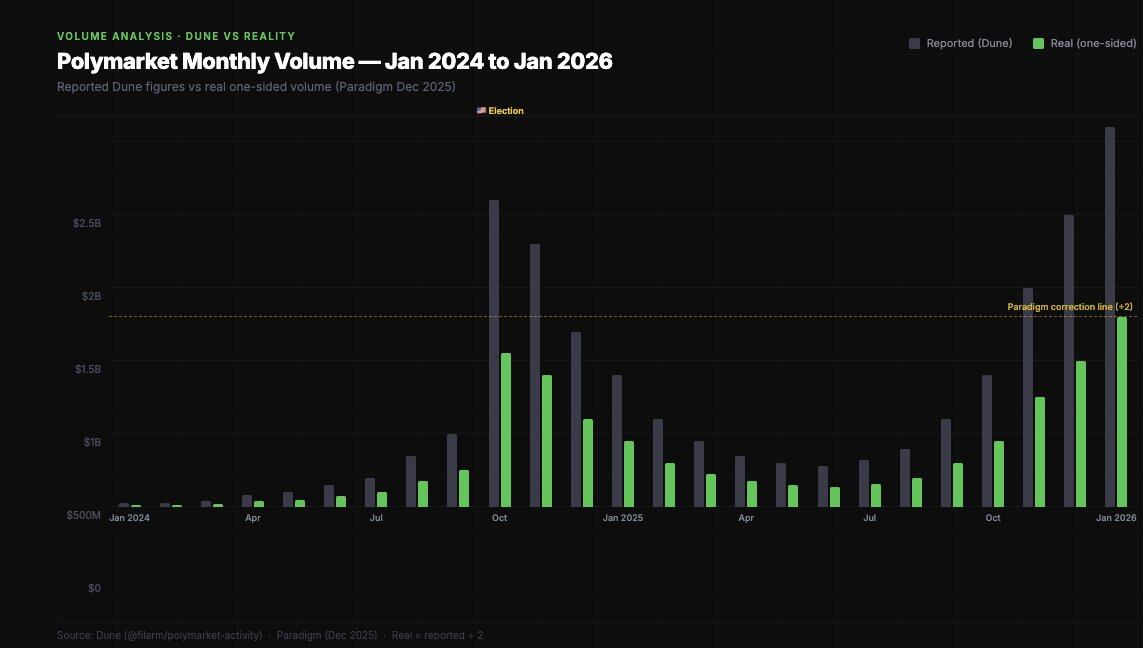
Paradigm published a key finding in a study in December 2025: Most Polymarket data dashboards count trading volume by summing all "OrderFilled" events, but this event is triggered on both the maker and taker sides of the same transaction, resulting in double counting. The actual trading volume is only about half of the number presented on the dashboards.

Dashboard volume vs. one-sided volume — the latter is the number that truly matters in airdrop modeling.
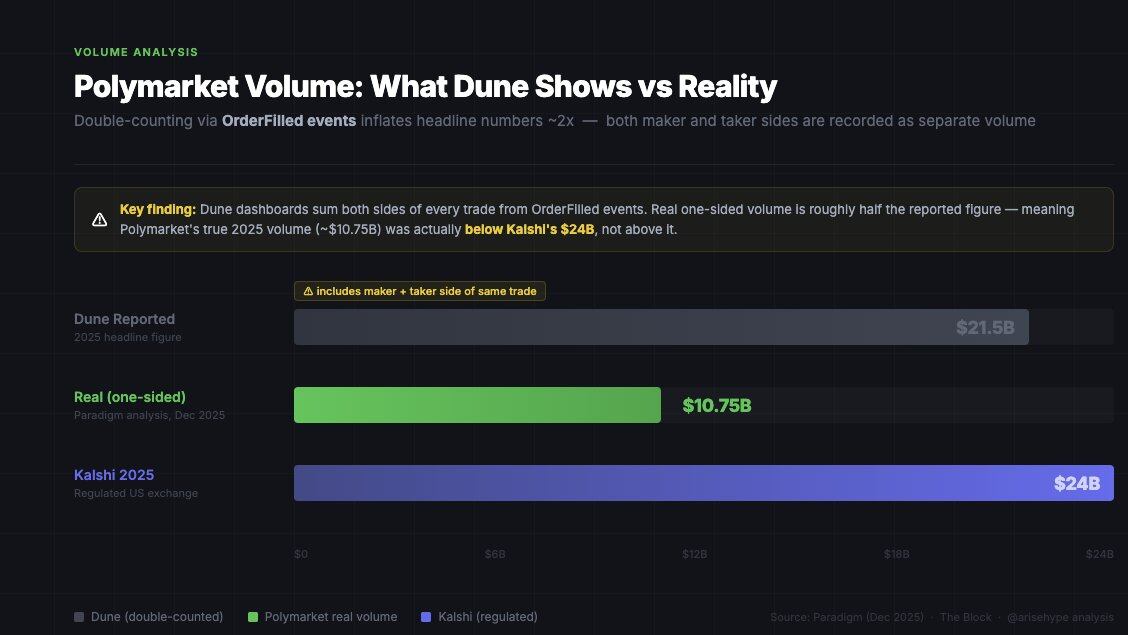
This is crucial for airdrop modeling. If Polymarket considers trading volume as a metric, they will only use internal data, not the various statistics on Dune. Your actual volume "score" is likely only half of what tools like Polycool show.

User Distribution

Regarding airdrop speculation, the most important dataset comes from a study by IMDEA Networks Institute, which covered over 86 million transactions (April 2024 – April 2025).

  • Only 0.51% of addresses achieved profits exceeding $1,000;
  • Only 1.74% of addresses (estimated) had a trading volume exceeding $50,000;
  • The top 3 arbitrage addresses alone extracted $4.2 million in "risk-free profits";
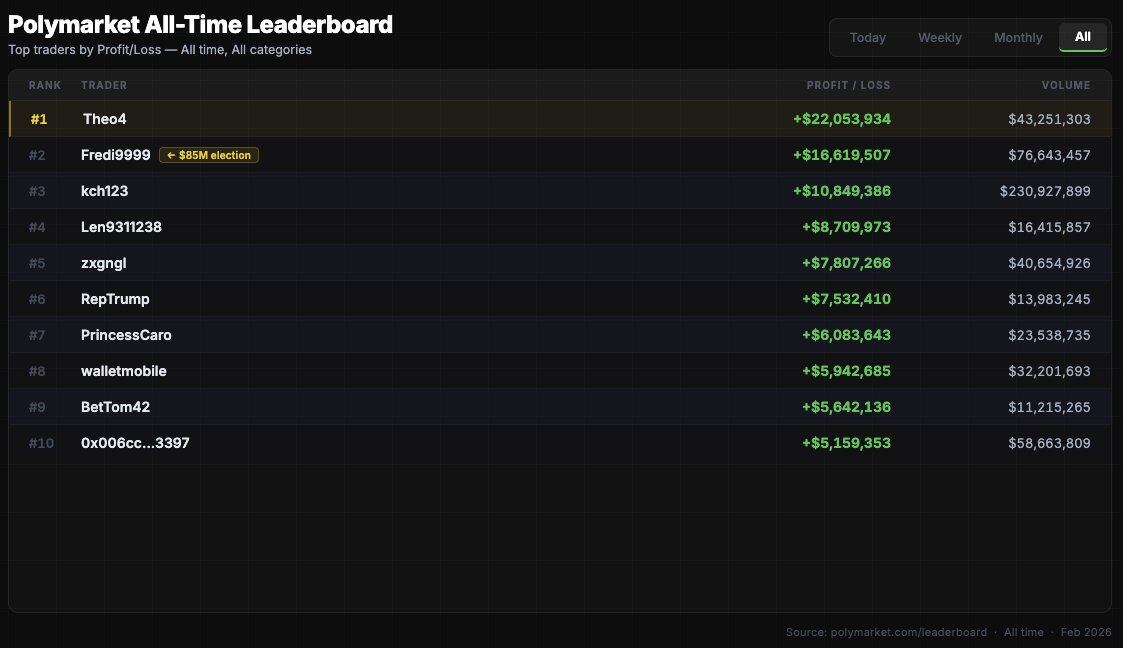
  • The top traders could profit over ten million dollars.
In terms of LP rewards, the stratification is even more pronounced.
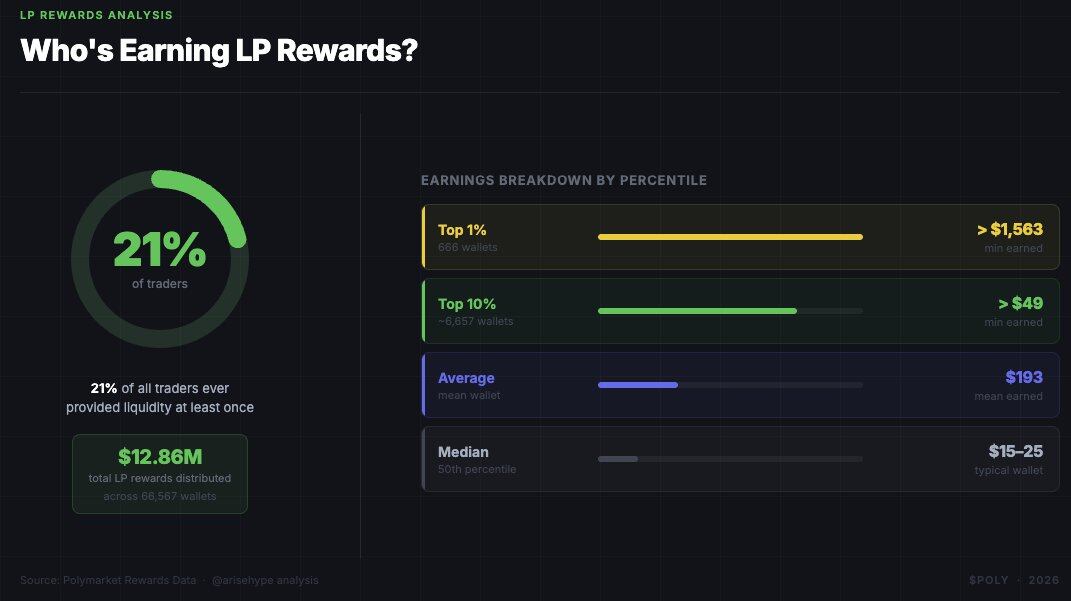
79% of traders have never earned even $1 in LP rewards — this is currently the most overlooked interactive behavior. Among 314,000 traders, only 66,567 wallets have ever received LP rewards. This means only 21% of traders have ever provided liquidity. Compared to overall participation, this reward mechanism is clearly neglected.

Lower usage is generally seen as a signal of being "undervalued" in airdrop models.

Airdrop Precedents: What Has History Told Us?
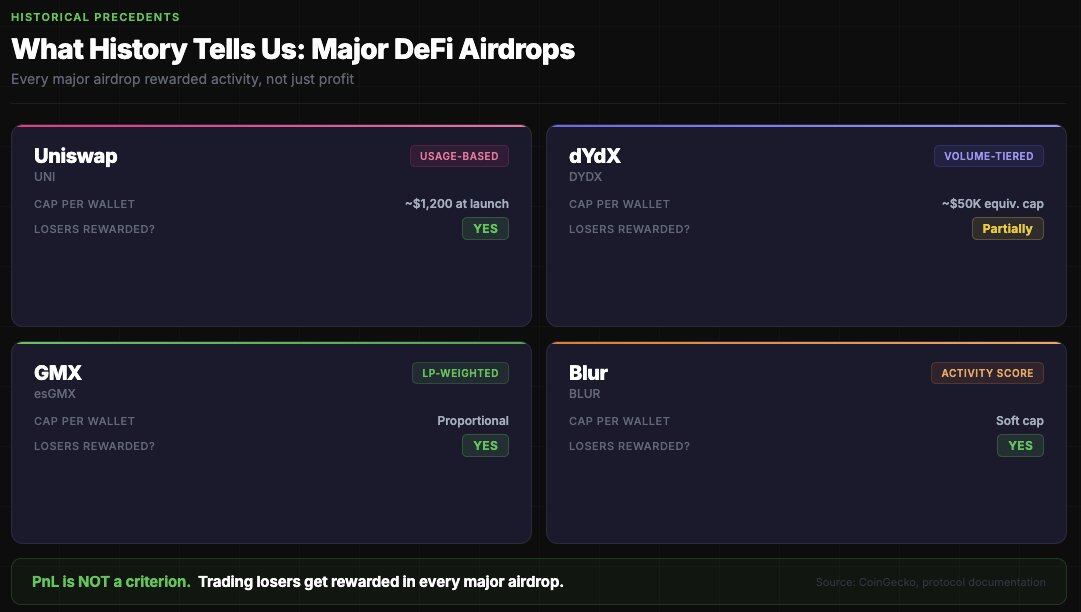
All major DeFi airdrops reward "active behavior," not "profitability." Polymarket will follow the same logic.

Commonalities of all large-scale airdrops include:

  • Purely equal distribution would be abused by Sybil attacks (Polymarket will certainly not distribute equally);
  • Purely distributing based on trading volume would overly concentrate the airdrop on whales (PR risk + SEC risk);
  • Best strategy: tiered hierarchy + reward caps + multiple dimensions (volume + LP + diversity + active duration);
  • In all major airdrops, losers are also rewarded — PnL is not a criterion.

The last point is crucial: If you traded $100,000 and lost $20,000, you are more likely to be rewarded than someone who traded $1,000 and made $500. The platform does not want to only incentivize profitable trading — that would more easily screen for insiders.

Reverse Thinking: How to Limit Whales?

Some airdrop calculators on the market use the simplest volume ratio model: Airdrop share = Individual volume / Total volume × Airdrop amount.

This is wrong because mainstream airdrops consistently use a "diminishing curve."
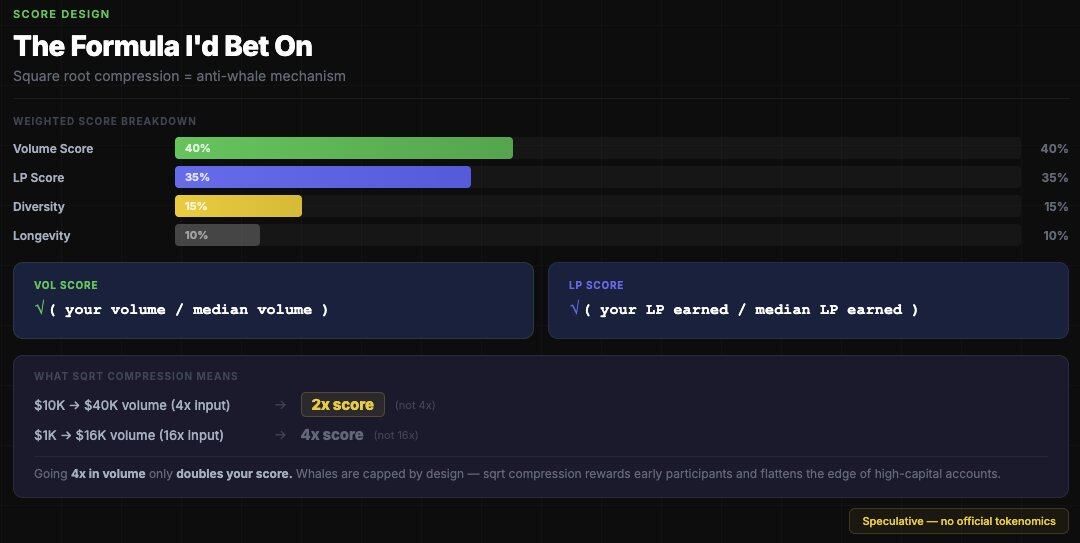
The model I'm more inclined to bet on is that Polymarket will use square root compression to limit the airdrop size for whales — for example, every 4x increase in volume only yields a 2x increase in score, which would completely change the airdrop results for the whale group.
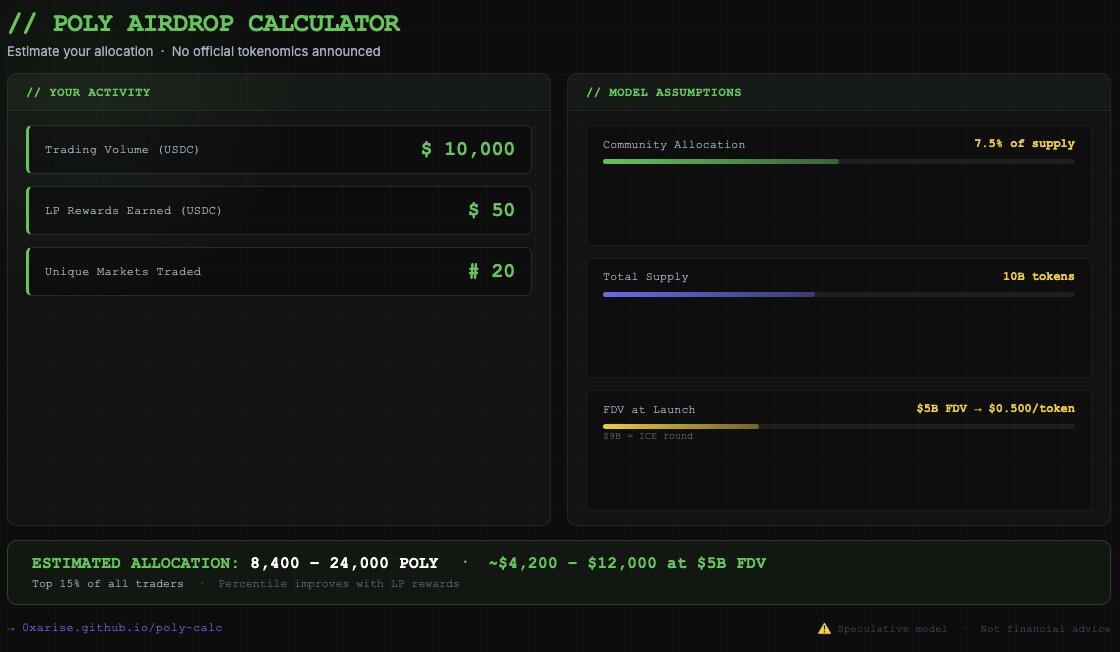
So how much would top wallets get? Assuming a total POLY supply of 10 billion, with 7.5% allocated for community airdrop (750 million POLY), and an FDV at TGE of $30–90 billion.

Without a cap on airdrop amount per address, for a volume of $85 million (taking top trader fredi999 as an example), the model estimates about 3–5 million POLY. At a $90 billion FDV, this is equivalent to $3–4.5 million. Theoretically possible, but the PR effect would be terrible.

A more realistic scenario is to cap the airdrop per address, e.g., the cap might be 500,000–2 million POLY. At a $5 billion FDV, top addresses could get about $450,000–$1 million.

"LP" vs. "Volume": Where is the Opportunity Now?

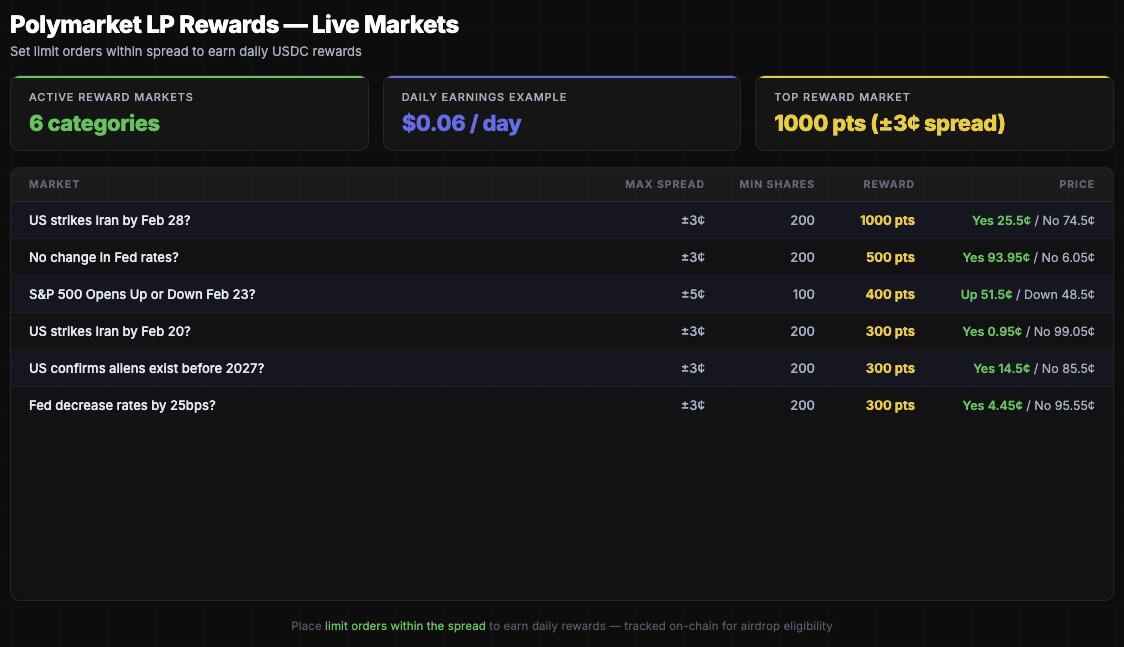
If you start interacting with Polymarket in February 2026 with a principal of $5,000, mathematically, deploying LP is a more favorable option for new participants.
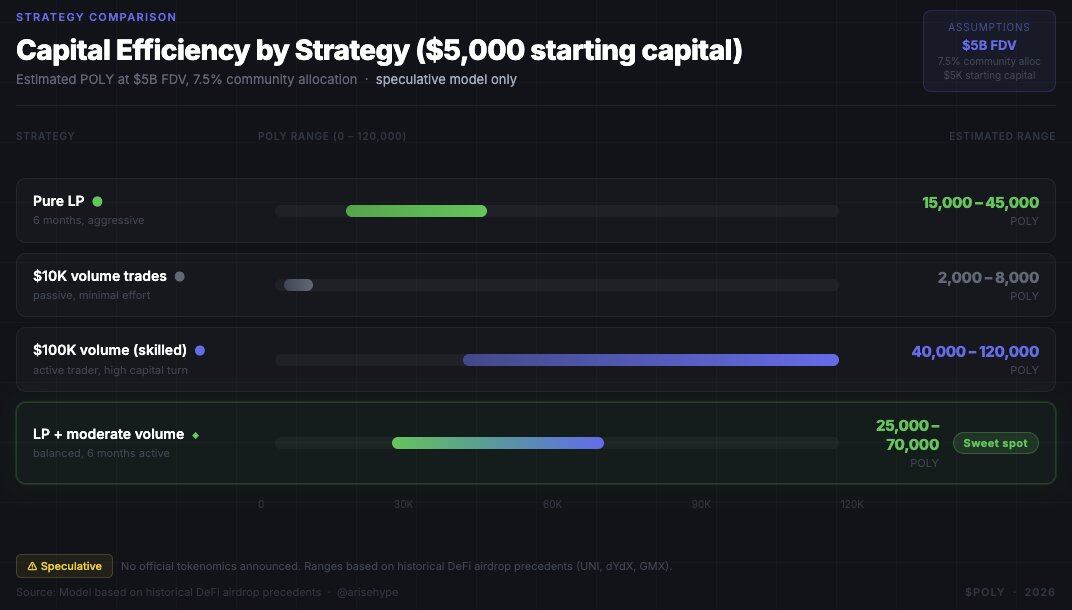
  • To earn $49 in LP rewards (top 10%), you need to consistently place limit orders in high-reward markets. This is achievable in 30–60 days using $500–$1,000 in capital.
  • To earn $1,563 in LP rewards (top 1%), higher capital or sustained high-frequency participation is required.
As for volume, you need to accumulate real volume without wash trading:

  1. Trade in 5 or more different categories of markets (politics, crypto, sports, science, culture);
  2. Hold positions for at least 1–24 hours before closing;
  3. Do not engage in wash trading the same market across different addresses;
  4. Lose money moderately — this is proof of "real participation";
  5. Target markets with volume > $500,000 (Polymarket might filter out micro markets);
  6. Single bet size: $50–$500.

Airdrop Model Speculation

The airdrop will not be as most people expect.

Most airdrop guesses are based on the simplest volume-weighted distribution, but Polymarket will do it smarter and more interestingly. They have on-chain LP data, which is clean, verifiable, and all measured in USD. They also have volume data that can filter out Sybil patterns. They also have wallet age, market diversity, and geographic distribution data.

This is my model — Polymarket has not confirmed anything, so this is just my speculation.

  • Volume weight: 40% — will use a square root compression formula, minimum threshold around $500;
  • LP reward weight: 35% — on-chain verifiable, Sybil-resistant;
  • Market diversity weight: 15% — number of unique markets participated in;
  • Active duration weight: 10% — number of active months before the snapshot.

Additionally, Polymarket will cap rewards per address (likely $500,000), otherwise the top 50 addresses would get too large a share, damaging the community narrative. Losers will receive the same reward as profiteers with equivalent volume; profitability is not a criterion — this cannot be philosophically justified and would create perverse incentives.

79% of traders have never received $1 in LP rewards. If LP weight accounts for 35% of the airdrop formula, the most capital-efficient behavior currently is to provide limit orders in high-volume markets and start accumulating on-chain verifiable proof of contribution.

In short, POLY could become the largest airdrop in the history of prediction markets. Calculated at a $9 billion FDV, the total value of the community airdrop could reach $450–$900 million. Even capturing just 0.1% of that is $450,000. This is why optimizing LP data now is more important than most people realize.


İlgili Sorular

QWhat is the key data issue highlighted in the article regarding Polymarket's volume reporting?

AThe key data issue is that most Polymarket data dashboards double-count volume by summing all 'OrderFilled' events, which fire on both the maker and taker sides of a trade. The true volume is approximately half of what is displayed on these dashboards.

QAccording to the research from IMDEA Networks Institute, what percentage of Polymarket traders have never earned even $1 in LP rewards?

AAccording to the research, 79% of Polymarket traders have never earned even $1 in LP rewards.

QWhat is a common characteristic of all major DeFi airdrops mentioned in the article?

AA common characteristic is that all major DeFi airdrops reward 'active behavior' rather than 'profitability'. Loss-making traders are also rewarded, as profitability is not a criterion.

QWhat is the proposed model for how the airdrop might be weighted across different user actions?

AThe proposed model suggests the airdrop might be weighted as follows: 40% for volume (using a square root compression formula), 35% for LP rewards, 15% for market diversity, and 10% for longevity (active months before the snapshot).

QWhy does the article suggest that providing liquidity (LP) is currently a more capital-efficient action for new participants seeking the airdrop?

AProviding liquidity is suggested as more capital-efficient because LP data is clean, on-chain, verifiable, and resistant to sybils. Furthermore, 79% of traders have never earned LP rewards, making it an underutilized activity that could carry significant weight in the airdrop formula.

İlgili Okumalar

Agent Race Ends, Super Workbench Takes Over

The era of fragmented AI agents is ending. Over the past month, China's tech giants—Tencent, Alibaba, and ByteDance—have simultaneously shifted strategy: instead of launching new, standalone AI agents, they are consolidating their various agent projects into unified "super workbenches." Tencent integrated its QClaw teams into WorkBuddy, a strategic product hailed as a potential third flagship after QQ and WeChat. Alibaba is merging its QoderWork, Wukong, and MuleRun agents into a new "Qianwen Office" platform under DingTalk's leadership. ByteDance rebranded its TRAE SOLO coding agent to TRAE Work, signaling a broader focus on workflow collaboration. This convergence marks a pivotal industry consensus. The initial exploration phase, where companies rapidly built numerous overlapping agents for different scenarios, proved costly and inefficient. With open-source tools eroding technical barriers, competition has shifted from agent creation to resource consolidation and cost control. Historically, platform wars are won not by creating more products, but by simplifying them—as seen with browsers unifying web access and super-apps consolidating services. Now, the "super workbench" aims to become the unified AI entry point for work. This reflects a deeper market realization: the primary audience for AI is no longer just programmers (a market in the tens of millions) but all knowledge workers (a market of billions). The real opportunity lies in augmenting everyday tasks—managing emails, documents, data, and meetings—across the entire workday. The core battleground is becoming control over the primary AI entry point that employees use daily. Tencent's WorkBuddy leverages WeChat and Tencent Docs; Alibaba's Qianwen Office taps into DingTalk's organizational data; ByteDance's TRAE Work integrates with Feishu's workflows. Whoever owns this "super workbench" gains strategic control over orchestrating enterprise data and APIs. This shift is redefining enterprise software. Traditional SaaS applications, valued for their user interfaces, will recede into the background. Their core functionalities will be exposed as standardized "Skills" or APIs for the super workbench's agents to invoke. Software value will shift from selling user seats to charging based on API calls and outcomes delivered. The evolution of agents is moving through clear stages: first as novel standalone products, then as consolidated primary work entry points, and finally as pervasive, invisible capabilities embedded into the digital fabric. The recent moves by major tech firms signal the transition from the first stage into the second, accelerating toward the third. In the end, the most successful agent technology may become invisible—like electricity or the HTTP protocol—a fundamental, unnamed infrastructure powering work itself.

marsbit7 dk önce

Agent Race Ends, Super Workbench Takes Over

marsbit7 dk önce

Michael Saylor: 110 Reasons to Oppose BIP-110

Michael Saylor presents 110 arguments against Bitcoin Improvement Proposal (BIP) 110, a soft fork aimed at restricting certain non-monetary data storage uses (like inscriptions) on the Bitcoin blockchain. He acknowledges the proponents' valid concerns—such as node costs, fee pressure, and preserving Bitcoin's monetary focus—but fundamentally disagrees with the proposed solution. Saylor argues that BIP 110 represents a dangerous precedent of using consensus rules to enforce value judgments on transaction validity, moving away from Bitcoin's core principles of neutrality and permissionless innovation. His key objections are organized into eleven categories: 1) It violates neutrality and hard consensus by banning currently valid transactions. 2) It fails to meet the high burden of proof required for a consensus change, lacking concrete data on the alleged crisis. 3) Its seven bundled technical restrictions are overly broad, targeting generic script functionalities and blocking future upgrade paths. 4) It sacrifices compatibility and future optionality by closing off designed upgrade hooks. 5) Its temporary rules add significant complexity (grandfathering, expiry states) without sufficient justification. 6) The economic and security impacts, particularly on miner revenue and fee markets, are uncertain and unmodeled. 7) Superior, market-based tools (fee markets, relay/mining policies) already exist to manage blockchain load. 8) It stifles innovation by creating a chilling effect for developers. 9) Its modified activation mechanism (55% threshold, forced signaling) is aggressive and risks network splits. 10) The precedent it sets—using consensus to suppress disliked but legal uses—is more dangerous than the problem it aims to solve. 11) A better path exists: improving measurements, refining resource-based policies, and allowing market forces to work. Saylor concludes that Bitcoin's strength lies in its neutral rules, open markets, and hard consensus. Changing these foundational elements to target specific use cases is an unnecessary and risky "iatrogenic" intervention. He advocates for guarding Bitcoin's neutrality rather than acting as its redeemer.

marsbit22 dk önce

Michael Saylor: 110 Reasons to Oppose BIP-110

marsbit22 dk önce

İşlemler

Spot
活动图片

