For thousands of years, to grasp even a sliver of security in the face of unpredictable fate, the Chinese have amassed an incredibly complex system of interpretation. From oracle bone divination to the I Ching's Eight Trigrams, and further to the highly systematized Four Pillars of Destiny, mysticism has always been the most covert, yet most effective, psychological defense mechanism on this land. Even a staunch Neo-Confucian scholar like Zeng Guofan secretly confessed in his diary: 'The strangest thing in my life has been fortune-telling.'
How large is the market for this interpretive system? According to industry insiders, China's metaphysical market has long surpassed one hundred billion yuan.
For reference, as early as 2018, the annual revenue of the divination industry in the United States was $2 billion; South Korea is even more exaggerated—with a population of 50 million, its divination industry reached a scale of $3.7 billion, with 150,000 registered practitioners, almost becoming a national profession, even producing a fortune-telling variety show this year. China's market size is only larger, not smaller.
Later, with the rise of modern technology, this traditional interpretive system was regarded as backward feudal superstition and was forcibly pushed to the margins of society. Technology attempted to take over the power of predicting the future entirely with rationality and data.
But the most ironic part of history is here: when technology advanced to the forefront, when AI large language models demonstrated that near-miraculous reasoning ability, it not only failed to eradicate mysticism but instead became the most handy weapon in mysticism's arsenal.
Recently, Shanghai police busted a fake Taoist group involving 50,000 people in just six months. These fake Taoists, with only a middle school education, when faced with victims' myriad questions about fate, their most熟练的动作 was to search for answers using AI large language models.紧接着, the Cece App, with 60 million users, was named and shamed by the 3·15 Gala. Its core business model is to attract traffic with free AI fortune-telling and then resell it to the more than 20,000 live-streaming hosts on the platform, charging by the minute.
You see, the most cutting-edge AI has so理所当然地 become the cheat code for the oldest superstitions. People pay for fortune-telling; what they're buying is never the cold, hard result but a process that can smooth out their anxiety. No matter how严密 AI's logic is, it can't provide that bit of spiritual essence, nor can it play the role of a medium capable of communicating with the divine.
And in China, if you're looking for the industrial base for spirit mediums, no place is larger or more mature than Northeast China.
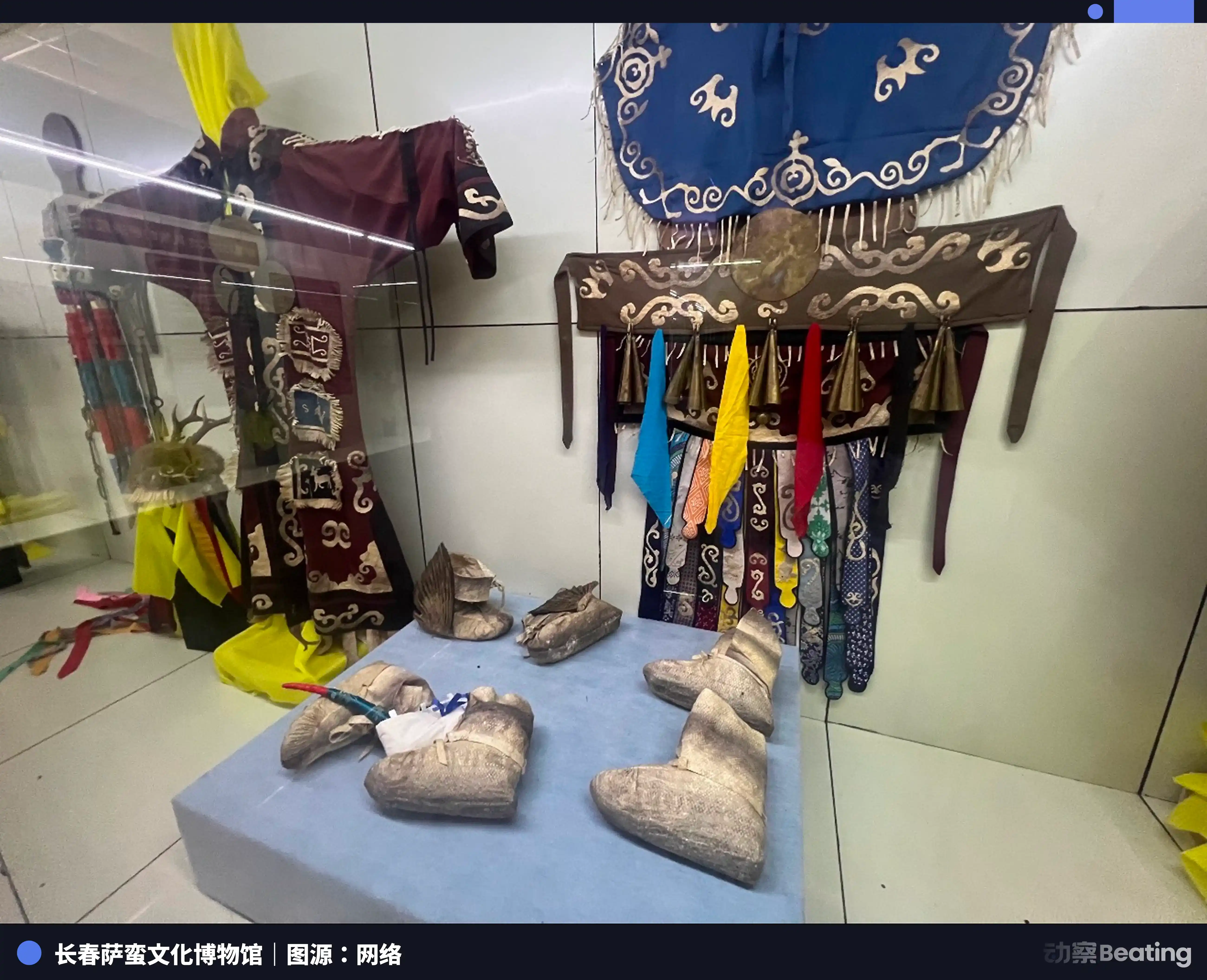
On this black soil of the Northeast, there is a deep-rooted Shamanic culture and Chumaxian tradition. Here, 'Daxian' (great immortals) are not just a folk belief but a real, sizable practicing community. When the traffic红利 of mobile internet collided head-on with the brute computing power of AI large language models, this vast community almost instinctively completed a cyber transformation.
Thus, an absurd yet tightly-knit industry chain was formed: AI provides the computing power for the 'calculation,' while the practitioners raised in the Northeast's Chumaxian culture负责给 the 'spiritual' texture. In some late-night live streams, even genuine inheritors习惯先让 AI run the命盘 first; as for those半吊子 who dare to enter the field with just superficial knowledge, they simply use AI-generated scripts to干起了 the business of comforting hearts.
Fortune-Telling: Psychological Counseling Better Suited for the Chinese Baby Constitution
The底色 of Northeast mysticism is Shamanic culture and Chumaxian.
Tencent News previously published an article titled 'One Hundred Thousand Daxian Reside in the Northeast.' Sun Shaoye, a Bilibili UP主 and member of the folk organization Chumaxian Association, once estimated that in Liaoning province alone, there are over 40,000 Daxian making a living from 'Chumaxian.' This is a highly regional folk belief where a person is possessed by an immortal spirit and suddenly gains the ability to see matters, heal illnesses, and tell fortunes.
This belief system has its own complete pantheon. Northeasterners call these five路仙家 'Hu, Huang, Bai, Liu, Hui': Hu Immortal is the fox, Huang Immortal is the weasel, Bai Immortal is the hedgehog, Liu Immortal is the snake, and Hui Immortal is the rat. These animal spirits, after cultivating for hundreds of years, will seek out people with 'spiritual energy and immortal缘分' to possess, transmitting information through the disciple's mouth. The way a disciple is chosen also has its own lore: usually, they suffer a great disaster or serious illness, then start having fevers, shivering, talking nonsense, trembling with a certain rhythm, and suddenly jolt to a stop, their voice and demeanor changing as if another person—this is the immortal possessing them.
And the opening堂口 ceremony of Chumaxian is a true spectacle. For example, having someone with ailments hold a rooster and walk around a certain area, burying a ceramic jar underground, burning paper figures at a crossroads at midnight. These practices still happen today in many parts of the Northeast; they are not distant legends, and likely your elders have亲眼见过 them.
Over a hundred years ago, during the Chuang Guandong (Braving the Northeast) migration, the pioneers faced freezing cold, wild beasts, bandits, and a completely unpredictable tomorrow; the fear in their hearts had nowhere to go. In that desperate situation of extreme insecurity, they desperately needed a powerful interpretive system like Chumaxian to bolster their courage.
From 1860 to 1911, over 20 million people flooded into the Northeast. They brought not only hoes and seeds but also the保家仙 belief and fox immortal system from Shandong. These immigrants arrived in the Northeast, encountered the local Shamanic tradition, and the two spiritual systems collided, merging into something new. The Shamanic掌坛师傅 absorbed the fox immortal narrative, developing new rituals where immortal possession required establishing a堂口. The fox packs of Changbai Mountain were endowed with the mysterious attribute of millennia of cultivation, becoming the new ancestral court of fox immortals.
Chumaxian thus took root in the Northeast. The reason this belief could embed itself so deeply here is that this land was originally a petri dish of suffering.
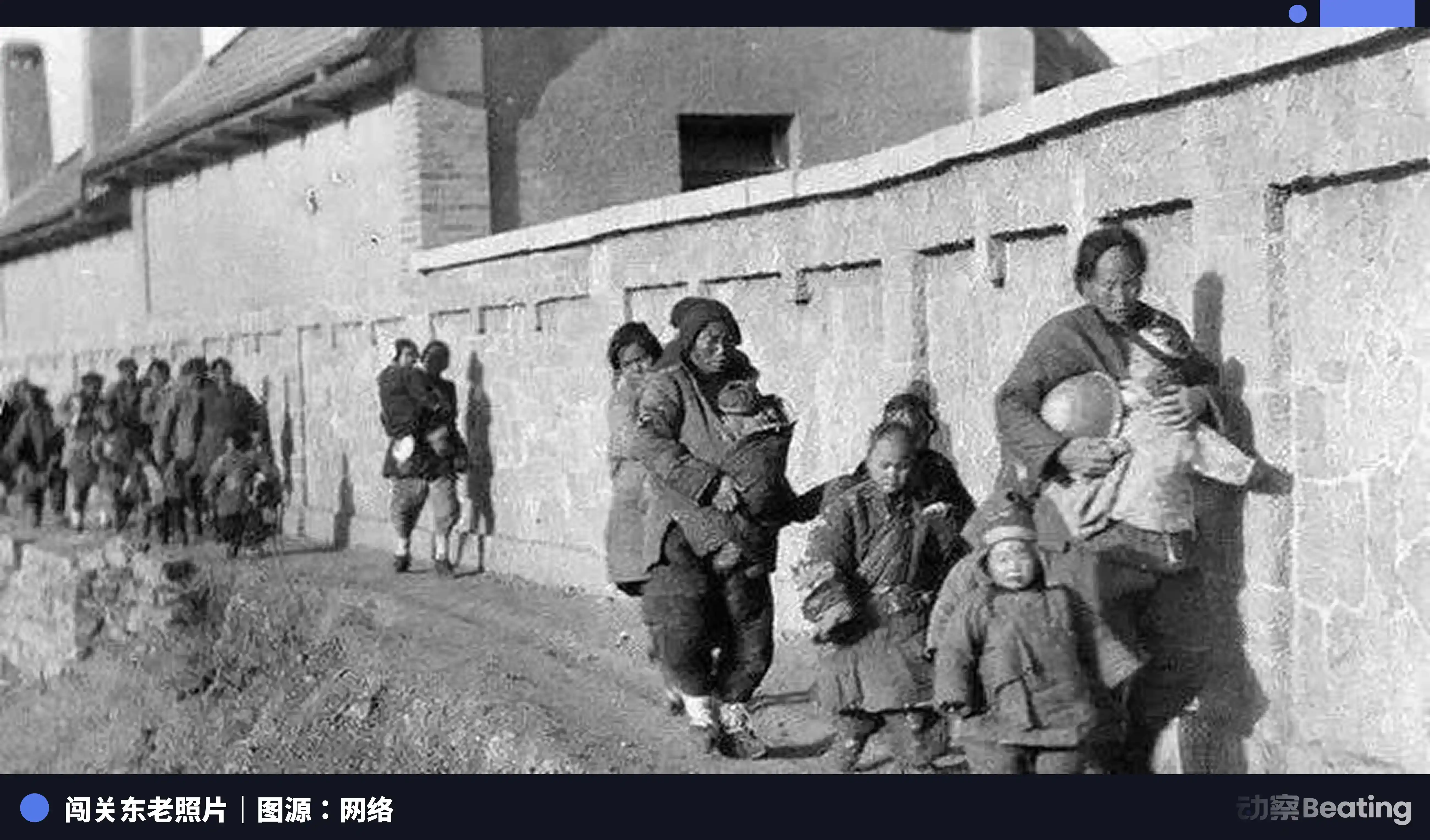
In those days, perhaps one out of every two people who braved the Northeast died on the journey or in the first few years of pioneering. The legend of the Huang Immortal's 'transportation术' reflects the collective anxiety about food shortages; the Bai Immortal's 'rolling ingot' imagery contains the wealth dreams of the Chuang Guandong migrants; the 'returning substitute' ritual existed because medical conditions were so poor, people had an inexplicable fear of illness and disaster, and could only use this to resist death.
But what truly forged this belief into its present form was not just suffering, but also several historical events that almost shattered it.
In 1934, Japan强制推行 the集团部落 policy in the Northeast,大规模 relocating and merging natural villages, destroying traditional Shamanic sacrificial spaces. In 1939, Japan introduced the粮谷出荷 policy, plundering 70% of the Northeast's grain output, leading to a great famine in the Northeast民间. In the famine years, seeking immortals for survival became the most real social demand, and堂口反而因此大量涌现. Folklorists have recorded that during the Japanese occupation, some堂口 were forced to become information channels for the Japanese side; the immortals were used as tools by political forces for the first time.
After the founding of the PRC, the state explicitly banned it; Chumaxian was denounced as feudal superstition, and practitioners went underground. They learned survival techniques, passing them down secretly within families, incorporating大量暗语 into texts to make them incomprehensible to outsiders; some learned acupuncture, using traditional Chinese medicine as a cover to continue their practice. During the subsequent特殊的历史时期, the crackdown was even more severe, but this thing didn't die; it just hid deeper into every courtyard in the Northeast countryside. According to field research by folklorists, Chumaxian practitioners in that era were 'pulling down the curtains at midnight, secretly seeing people.'
真正的松绑 had to wait until after the reform and opening-up. In the 1980s,堂口 began to resurface. In 2006, 'Shamanic Rituals' were listed as intangible cultural heritage in Jilin Province. In 2012, Changchun established a Shamanic Culture Research Association,开始吸纳 former顶香人. But what truly caused explosive growth in this industry was 1998.
That year, laid-off workers from state-owned enterprises in the Northeast reached millions,同步来袭 by the Asian financial crisis. Overnight, millions lost their jobs, their identity given by the work unit, and their grip on the future. In Shenyang's Tiexi District, the former heart of heavy industry, a fortune-telling street appeared, gathering 37堂口. Laid-off workers, unemployed female workers, and young people with no way out lined up to ask the immortals if they still had a chance to turn their lives around.
This is the底层逻辑 of Northeast mysticism, and the secret to its repeated resurrections. Every time the wheels of history rolled over it, it not only wasn't crushed but instead absorbed the deepest fears of that era, completing its own evolution.
The fear during Chuang Guandong was death. The fear during the特殊的历史时期 was being exposed. The fear during the layoff wave was loss. Today's fear is uncertainty. The shell has always been changing, but the thing that drives people to seek immortals has always been the same.
Today, the Northeast has experienced剧烈的经济转型阵痛 and population outflow. According to national census data, from 2010 to 2020, the permanent population of the three Northeastern provinces净减少了 11.01 million people, equivalent to the entire disappearance of a Harbin.
When grand historical narratives fall on specific individuals, they become layoffs, unemployment,迷茫, and a deep sense of powerlessness about the future. The more uncertain tomorrow is, the more the metaphysical market booms; this is the most typical lipstick effect in economics.
When the real world cannot provide certainty, people naturally turn to supernatural forces. This psychological demand has硬是催生出了一个庞大的玄学消费市场. In this pool, the Northeast's 'Daxian' practitioners,凭借独一份的文化背景和语言天赋, have稳稳当当地切走了一大块蛋糕.
'Fortune-telling is psychological counseling better suited for the Chinese baby constitution.'
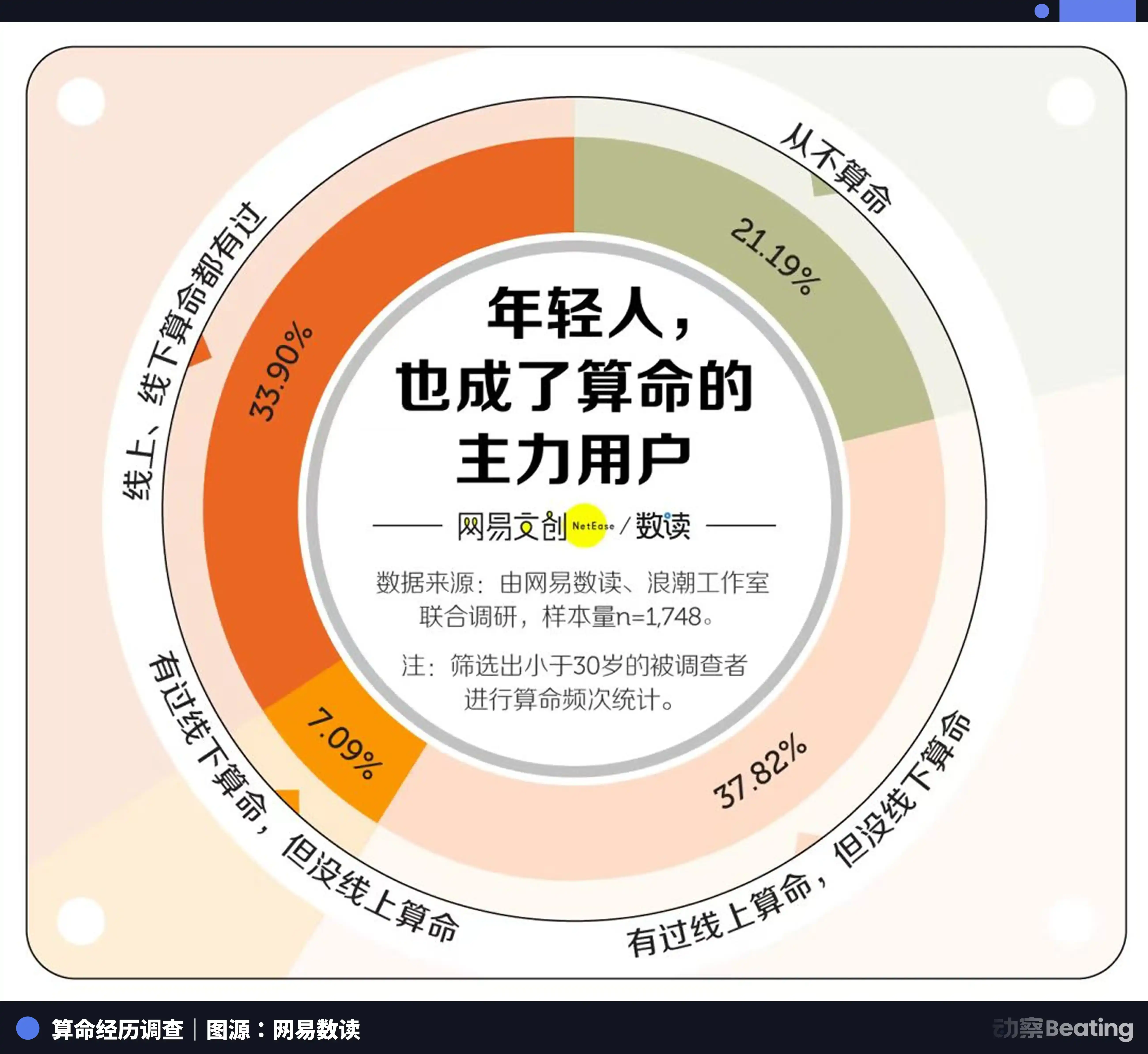
A survey by NetEase数读 showed that 78.81% of young people have experienced fortune-telling. Look at another set of data: Frost & Sullivan predicts that China's泛心理健康服务 market size will only reach 10.4 billion yuan by 2025.
The underlying logic of the Western psychological counseling system is internal attribution. You're depressed, anxious, your interpersonal skills are a mess because your family of origin has issues, your childhood has trauma; you need to analyze yourself, accept yourself, change yourself.
Placed in our East Asian society, which emphasizes collectivism and shame culture, this logic often burdens people with extremely heavy moral baggage. Many times, young people go to see a psychologist and, instead of catching their breath, end up陷入更深的自我怀疑 by repeatedly digging up inner trauma.
But fortune-telling is purely external attribution. When your job fails, your relationship fails, and even drinking cold water gets stuck in your teeth, the fortune-teller will斩钉截铁地告诉你: This is not your fault. It's that you're犯太岁 this year, your八字流年不利, you've been blocked by a小人.
Once this explanatory logic comes out, the huge rock called 'guilt' in the seeker's heart瞬间就落地了.
This psychological suggestion that 'the fault is not mine' is the highest form of spiritual massage for young people crushed by involution and anxiety today. It gives you an external target to legitimately blame, allowing you to protect that last bit of self-esteem when facing life's beatings.
But in the end, this is still a game between people. Until AI entered the field, the scale and nature of this game completely changed.
The Fortune-Telling Industry Forced to Evolve by Algorithms
生辰八字 is actually an extremely precise set of parameters and algorithms, a form of statistics. The Heavenly Stems and Earthly Branches are variables, the Five Elements' generation and restriction are functions, and the Great Cycles and Yearly Fortunes are time series. This set of native Chinese code that has been running for thousands of years unexpectedly aligns perfectly with the underlying logic of modern AI.
According to reports, a startup called MirrorAI fed real cases from the Hong Kong Master Fortune-Teller Competition as training data to a large language model.据 MirrorAI team tests, the AI's accuracy in predicting users' past experiences has approached the level of senior fortune-tellers, far exceeding the 40% baseline of native large language models.
This number means that in pure 'deduction,' AI has touched the ceiling of the industry's top tier. Those low-end fortune-tellers who rely solely on memorization and scripted忽悠 are being crushed by free AI large language models. Faced with this dimensional reduction打击 from AI, the traditional fortune-telling industry didn't die; instead, it was forced to evolve. Some institutions predict that China's AI fortune-telling market will break through 120 billion yuan by 2025; the global astrology app market is also growing from about $3 billion in 2024 at an annual rate of 20%. This speed is fiercer than most so-called 'hot sectors.'
When fortune-telling becomes a computational service with almost zero marginal cost, the power center of this industry changes hands. In the past, it was about who mastered complex metaphysical knowledge; now the core asset is who can use AI tools while still offering emotional value.
A portion of quick-witted practitioners have already transformed from fortune-tellers into fortune-telling Prompt Engineers.
They long stopped doing their own charting, instead using AI to directly generate万字命理报告, only handling the final step themselves: providing emotional comfort and rhetorical packaging. They know perfectly well that no matter how accurate AI is, it can't replace the warm, human emotional exchange.
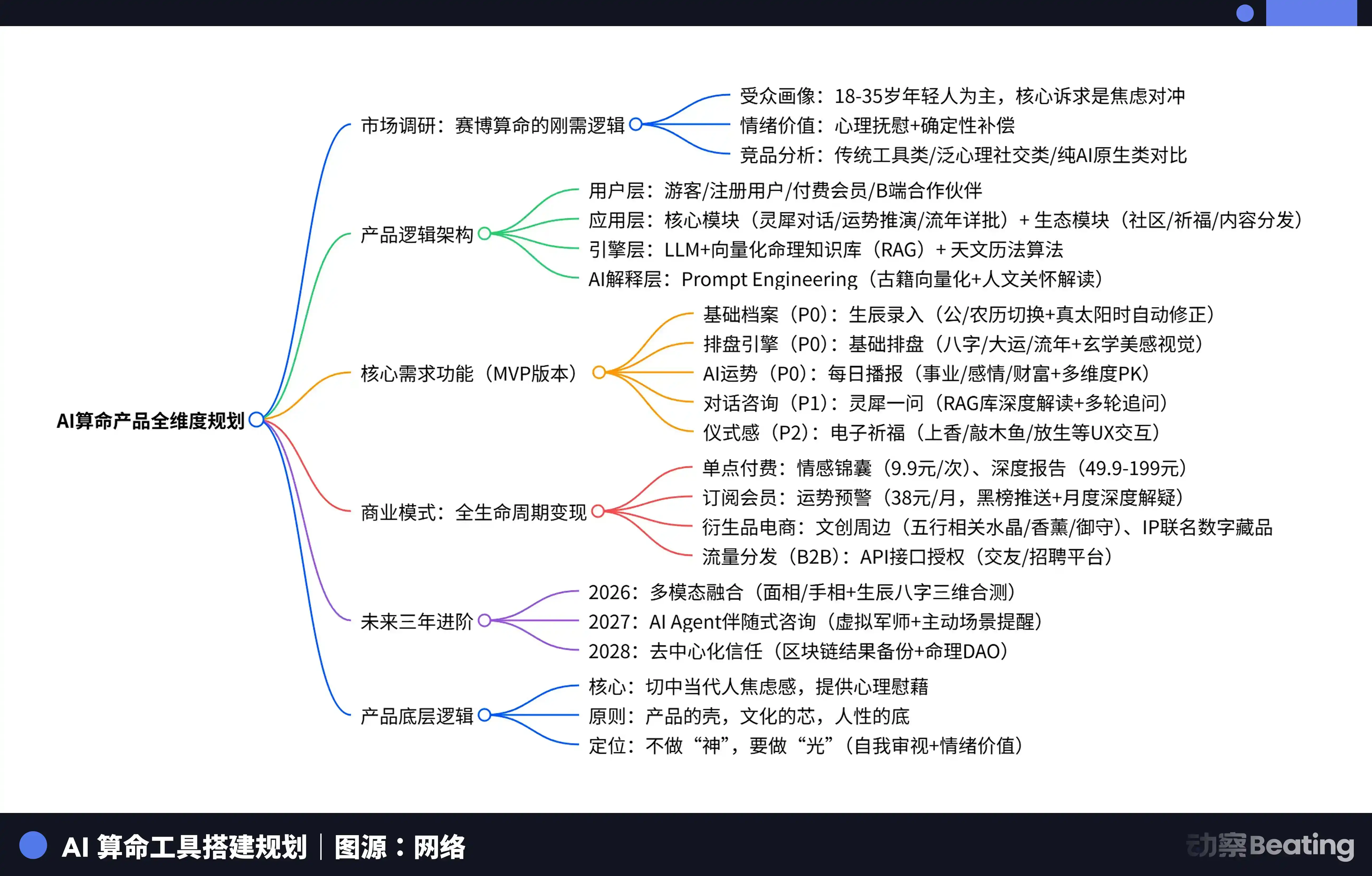
This brings us back to the aforementioned metaphysical live-streaming industry chain. Why can people with only a middle school education, or even completely ignorant of mysticism, become masters after a month of training? Because AI handles the most brain-intensive calculations and knowledge retrieval; they only need to play the shell that provides emotional value.
In the live stream room, the 'Daxian' have虔诚连麦的信徒 on this side of the screen and a疯狂运转的 AI script generator on the other. What need does Chumaxian have for real immortal possession now? The large language model is their most efficacious cyber immortal. They use the most接地气的大白话 to chew up the complex命盘 spit out by AI and feed it to the anxious young people on the other side of the screen, providing cheap but effective psychological massage.
This efficiency狂飙 brought by technological dimensional reduction hasn't just harvested young people domestically; it has even催生出了一场 digital expedition of Eastern mystical power.
When Chinese生辰八字 is translated into English by AI, will those elites sitting in Silicon Valley offices pay for this 'Eastern philosophy'?
Mystical Power from the East
They not only pay, they pay quite readily. In recent years, the global market size for spiritual products and services has reached $180.18 billion. The monthly search volume for the term 'Feng Shui' on Google is as high as 2 million, primarily searched by users in Europe and America.
According to Tencent News, a 5-person startup team in Shenzhen called FateTell wrapped Chinese生辰八字 in a shell, renamed it 'The Book of Fate,' and specifically sells it to foreigners. They use AI to generate extremely detailed English命理报告,硬是把这门古老的东方玄学做成了高客单价的数字商品. Their overseas user payment rate is as high as 4%, with a repurchase rate of 38.7%; 70% of their income comes from member subscriptions, and the project became profitable early on.
This is a cultural export full of magical realism. Fortune-telling, once pointed at and called feudal superstition, now donning the guise of AI, has transformed into Eastern philosophy, hitting the bullseye of the existential anxieties of the overseas middle class and Silicon Valley elites. Those highly paid engineers in Silicon Valley, facing layoffs and industry involution, are equally insecure and need a force beyond rationality to calm their nerves.
In this ancient arena of metaphysical consumption, people of different social strata are being served by completely different tools.
Young people at the bottom can only use free DeepSeek as a 'digital oracle,' or蹲在 Douyin and Kuaishou live streams, spending a few dozen yuan to draw a Tarot card and hear some comfort from the host. Their questions are usually specific and small, like 'Will I pass the interview tomorrow?' or 'Can I get back with my ex?'
Anxious white-collar members of the middle class are willing to spend几百上千块 on one-on-one services on apps like Cece. What they're buying isn't accuracy at all, but a tree hole willing to listen to them complain about their boss and partner. Their questions are often mixed with dissatisfaction with the status quo and迷茫 about the future, like 'When will I achieve financial freedom?' or 'Is this marriage salvageable?'
As for those at the top of the wealth pyramid, they still spend heavily to invite the top-tier offline masters to check Feng Shui and seek dragon veins. According to a report by Sanlian Life Weekly, a post-90s fortune-teller named Qing Shan charges几百块 per hour by providing deep emotional value and psychological counseling to clients.
Algorithmic Comfort
Traditional Northeast Chumaxian is, at its core, about human connection. A fortune-teller's energy has an upper limit; as a human, their capacity for empathy also has warmth. That rough-sounding comfort with a local accent has the warmth of a living person.
AI never tires, and it has a god's-eye view. It knows you were asking at 3 a.m. if your ex-boyfriend would come back; it also knows you bought two astrological analyses last month due to work anxiety. So, when you click on that连麦 interface again, the AI-generated script can always seamlessly deliver the exact words you most want to hear.
According to a 36Kr report, a girl living in a third-tier city spent over 60,000 yuan on metaphysical apps and live streams trying to win her boyfriend back. And on the Cece App exposed by Consumer Daily, a user named Ranran spent nearly 40,000 yuan waiting to hear 'he will come back.'
Behind these stories lies not human greed or foolishness, but the vulnerability of modern people facing巨大不确定性. When there are too many variables in life to keep track of, when we find we can't control our jobs, relationships, or even health, the seemingly certain answer handed over by the algorithm becomes the last lifeline.
When the ancient Chumaxian dons the armor of AI, it becomes a huge mirror, reflecting the most common anxieties of this era. Whether it's the live-stream hosts with Northeastern accents or the English命理报告 bought by Silicon Valley elites with dollars, what they sell is never the future, but that little bit of certainty used to fight uncertainty.
This is also why by 2026, the entire AI fortune-telling sector faced劈头盖脸的监管. From the cases cracked by Shanghai police to the special rectification by the Cyberspace Administration, the regulators' intervention is an attempt to draw a red line around this狂热赛博玄学.
In April 2025, the CAC specifically launched the 'Qinglang · Rectification of AI Technology Abuse' special action, explicitly listing 'misleading and deceiving netizens through AI fortune-telling, AI divination, etc., spreading superstitious ideas' as key targets. The first phase of the action处置了 over 3,500违规 AI products. Entering 2026, the CAC's Spring Festival special action again listed 'providing online fortune-telling and divination services under the banner of changing fate,转运, breaking太岁' as key整治 problems.
But behind all this, the human quest for certainty永远都在.
Over a hundred years ago, the Chuang Guandong pioneers prayed to the Shamans for safety in the snow and wind. Over a hundred years later, we ask DeepSeek about our prospects in the wee hours under our blankets. The shell has changed, but the vulnerability and loneliness people feel in the face of the unknown haven't changed one bit.
We try to use AI algorithms to smooth out life's uncertainties, turning生辰八字 into lines of code. What we don't know is that under the algorithm's gaze, all our anxieties, weaknesses, and unwillingness have long been sliced into sets of data that can be precisely calculated.
In the TV drama 'Ma Dashuai,' Fan Debiao, after living for forty years and折腾半辈子, saw his career and love life both fail. On the most desperate night, he bared his heart to Ma Dashuai: 'The best way to end sleepwalking is to lie down and sleep again. After waking up, a崭新的德彪 will重新屹立 on the land of Northern Liaoning.'
The end of the universe is Tieling; the end of metaphysics is AI. But no matter how technology evolves, in those late-night连麦 live streams, behind those生辰八字 fed to DeepSeek, stand countless specific people like Fan Debiao, repeatedly beaten down by life yet still trying to beg for a little comfort, wanting to '重新屹立'.






