Crypto’s CLARITY Act Sits At 50-50 For 2026 Passage, Galaxy Says

bitcoinist2026-04-23 tarihinde yayınlandı2026-04-23 tarihinde güncellendi

Özet

Galaxy Digital estimates a 50-50 chance that the CLARITY Act, a key U.S. crypto market structure bill, will be passed into law in 2026. The bill, which passed the House with bipartisan support, is now in the Senate Banking Committee. A planned markup was delayed until May, and Galaxy warns that if it slips past mid-May, the odds of passage drop sharply. Key unresolved issues include stablecoin rewards language, protections for software developers, and SEC commissioner vacancies. The report emphasizes that the bill is strong on policy but faces a tight legislative calendar and significant procedural steps. Failure to pass it by May could delay crypto legislation indefinitely, especially with midterm elections potentially shifting priorities.

The crypto industry’s most important US market structure bill is entering a narrowing window in Washington, with Galaxy Digital putting the odds of the CLARITY Act becoming law this year at roughly 50-50. The firm’s central argument is not that one issue alone threatens the bill, but that too many unresolved questions still need to be settled in sequence, on a calendar that is quickly tightening.

In a research note published April 22, Galaxy said the Digital Asset Market Clarity Act of 2025 is now in “endgame stage” after passing the House in July 2025 with bipartisan support and spending months in Senate negotiations. The immediate focus is the Senate Banking Committee, which had been expected to announce a markup for the last week of April. But that timeline appears to be slipping. According to Galaxy, Sen. Thom Tillis, a key negotiator on stablecoin rewards language, called on Monday for delaying the markup until May.

May Could Be The Last Chance For Crypto’s CLARITY Act

Galaxy framed the bill’s prospects in unusually blunt terms: “In our view, the odds of CLARITY being signed into law in 2026 are roughly 50-50, and possibly lower, though others at Galaxy are more optimistic. The uncertainty stems not from any single issue but from the number of unresolved questions that must be settled, in sequence, under severe time pressure.”

The report argues that a markup in early or mid-May would still leave a viable path, but not much margin for error. “If the markup slips past mid-May, the probability of enactment in 2026 drops sharply,” Galaxy wrote. “The remaining legislative calendar simply does not easily accommodate the full five-step process described above, particularly given the competing demands on floor time.” In the firm’s view, a July floor vote is still theoretically possible, but only with “extraordinary political will and coordination.”

The procedural burden is significant. From committee markup, the bill would still need to clear a 60-vote Senate floor threshold, then be reconciled with the Agriculture Committee’s version, then reconciled again with the House-passed CLARITY Act, before reaching the president’s desk. Galaxy said each step consumes time that the Senate may not have in abundance, especially with Iran military authorization debates, the unresolved DHS funding standoff, and a backlog of nominations competing for floor space.

The best-known sticking point remains stablecoin rewards language, where banks and crypto firms have been fighting over whether exchanges can offer incentives tied to stablecoin holdings and usage. Galaxy said a compromise being negotiated by Tillis and Sen. Angela Alsobrooks would still ban rewards paid “solely for holding” a stablecoin while allowing narrower, activity-based incentives tied to payments, transfers, or platform usage. But the text has not yet been released, and until it is, the committee’s 48-hour notice clock cannot start.

Galaxy also made clear that stablecoin yield is only part of the problem. The note highlighted several other live issues in Senate negotiations, including the Blockchain Regulatory Certainty Act’s protections for noncustodial software developers, ethics provisions related to government officials’ crypto holdings, concerns over Section 505’s impact on SEC exemptive relief for tokenization, and the political question of SEC commissioner vacancies. None of those is necessarily fatal on its own. Together, they create a far more fragile timeline.

Notably, US Senator Bernie Moreno is sharing a similar position like Galaxy Digital. When was asked about the timeline for crypto market structure legislation, he said: “I think we’re going to get it done by the end of May.” But the Ohio Republican also warned last month that if the Clarity Act isn’t passed by May, crypto legislation could be off the table for the foreseeable future.

The report is broadly favorable on the substance of the legislation. Galaxy called CLARITY “a strong bill both on technical terms and as a policy matter,” arguing that it would establish jurisdictional boundaries between the SEC and CFTC, define pathways for tokens to be treated as non-securities once sufficiently decentralized, and create the kind of durable legal framework that institutional capital has long lacked.

It also warned that the post-midterm outlook could be materially worse. A change in control of either chamber, Galaxy said, would likely produce different committee chairs, different priorities, and a much less hospitable path for crypto legislation.

That is why the near-term milestones now matter so much. Galaxy said the next signals to watch are the release of Tillis’s revised stablecoin text, Chairman Tim Scott’s markup announcement, the size and bipartisan character of any committee vote, and whether Senate leadership allocates floor time before the July 4 recess.

At press time, the total crypto market cap stood at $2.58 trillion.
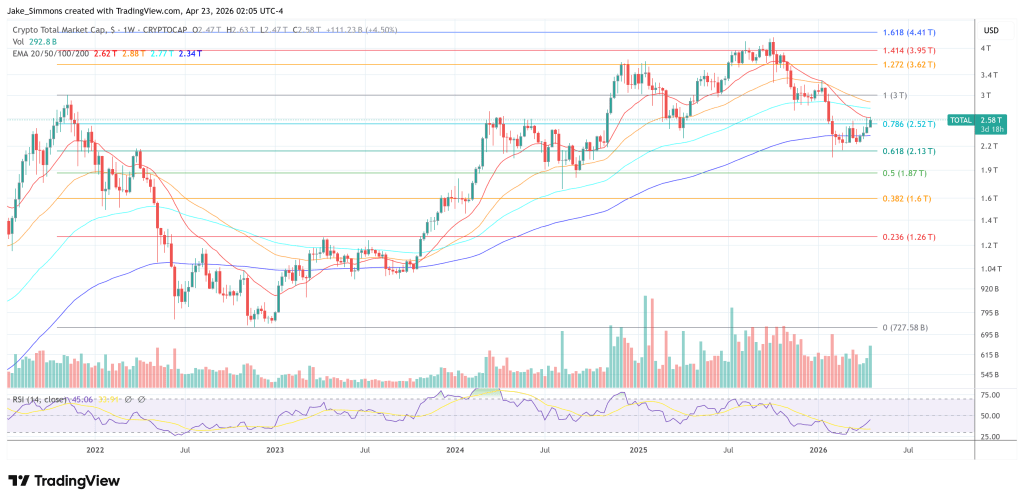
Total crypto market cap rises above the 0.786 Fib, 1-week chart | Source: TOTAL on TradingView.com

İlgili Sorular

QWhat are the odds of the CLARITY Act being signed into law in 2026 according to Galaxy Digital?

AGalaxy Digital puts the odds of the CLARITY Act becoming law in 2026 at roughly 50-50.

QWhich Senate committee is the immediate focus for the CLARITY Act's progress?

AThe immediate focus is the Senate Banking Committee.

QWhat is the key sticking point in the negotiations, as mentioned by Galaxy?

AThe key sticking point is the stablecoin rewards language, specifically whether exchanges can offer incentives tied to stablecoin holdings and usage.

QAccording to the report, what is the consequence if the committee markup slips past mid-May?

AIf the markup slips past mid-May, the probability of the CLARITY Act being enacted in 2026 drops sharply.

QWhat did Senator Bernie Moreno say about the timeline for passing the crypto market structure legislation?

ASenator Bernie Moreno said, 'I think we’re going to get it done by the end of May,' but also warned that if it isn't passed by May, crypto legislation could be off the table for the foreseeable future.

İlgili Okumalar

GitHub, Transfixed by AI

On the night of February 9th, GitHub suffered a major outage caused by a simple configuration change—reducing a cache refresh interval from 12 to 2 hours—that triggered a cascade of failures. This was not an isolated event, but part of a broader pattern. In early 2026, GitHub experienced at least 8 major incidents, failing to meet its promised 99.9% availability. These outages stemmed from structural issues: explosive growth in load, tight service coupling, and insufficient protection against abnormal traffic. This unprecedented load is driven by AI Agents. In 2025, GitHub handled ~1 billion commits. By 2026, weekly commits reached 275 million, projecting to ~14 billion for the year—a 14x increase. AI tools like Claude Code now contribute 4.5% of all public repository commits, with weekly submissions surging 25x in just three months. AI-generated pull requests jumped from 4 million to 17 million per month in half a year. Unlike human developers, AI Agents work continuously, generating commits at a scale that overwhelms infrastructure designed for human rhythms. The surge also shattered GitHub's business model. Copilot's flat-rate pricing, based on assisting human developers, became unsustainable as Agentic AI sessions consumed resources worth hundreds of dollars for a few dollars in fees. In response, GitHub imposed usage limits and, by June 1st, shifted to a pay-per-use "AI Credits" system. Facing this new reality, GitHub realized a 10x scaling plan was insufficient. It announced a need to *redesign* its architecture for 30x current scale—decoupling services, adding fault isolation, and improving change management to prevent cascading failures. Other platforms like Stripe and AWS are facing similar challenges with AI Agents. Fundamentally, GitHub is transitioning from a human collaboration platform to an "exhaust pipe" for automated AI workflows. Its detailed post-mortem reports aim to maintain trust during this turbulent rebuild. The February outage was not just a technical glitch, but a signal of the software industry's entry into a new, AI-driven era.

marsbit12 dk önce

GitHub, Transfixed by AI

marsbit12 dk önce

Both Suffer Massive Losses Exceeding $90 Billion, Which Is in Greater Peril: Strategy or Bitmine?

Facing massive paper losses exceeding $90 billion each amidst a sharp market downturn, "Digital Asset Treasury" (DAT) giants Strategy and Bitmine find themselves in a precarious position, but with different underlying risks. Strategy, heavily invested in Bitcoin (BTC), faces significant financial strain. Its strategy relies heavily on debt, including convertible notes and preferred stock (STRC) requiring substantial dividend payments. With its cash reserves dwindling and BTC offering no staking yield for cash flow, Strategy's high leverage makes it vulnerable. A continued price decline could force asset sales to meet obligations, potentially creating a negative feedback loop. Its market value has already fallen sharply. In contrast, Bitmine, an Ethereum (ETH) holder, appears on firmer financial ground. It primarily funds its purchases through equity offerings (like ATM programs), avoiding debt pressure. It also generates income by staking a large portion of its ETH holdings. While not immune to market drops and shareholder dilution concerns, Bitmine maintains more flexibility, recently announcing a new preferred share offering to raise further capital. The core divergence lies in their financing: Bitmine uses equity (investor money), while Strategy uses debt (borrowed money). Consequently, Bitmine currently faces less immediate liquidity pressure than Strategy, which must navigate the dual challenge of servicing debt/dividends and a declining core asset (BTC) price.

marsbit19 dk önce

Both Suffer Massive Losses Exceeding $90 Billion, Which Is in Greater Peril: Strategy or Bitmine?

marsbit19 dk önce

Where the AI Bubble Really Is: Which Layer of Players Are Naked

AI Bubble: Where It Really Is and Who's Swimming Naked This analysis dissects the AI industry not as a single entity but as a five-layer pyramid, arguing that bubbles are concentrated in specific tiers, not uniformly distributed. **Key Distinction from the 2000 Dot-com Bubble:** Unlike 2000, where companies had stock prices before revenue, today's leading AI players have massive, contract-backed revenue driving their valuations. Core infrastructure demand is real, with every GPU running at full capacity for paying customers. **The Five-Layer Pyramid & Bubble Assessment:** * **L0 (Fab/Manufacturing) & Top L4 (Leading AI Apps): NO BUBBLE.** Companies like TSMC, NVIDIA, major cloud providers (Microsoft, Google, Meta, Amazon), and top AI labs have real revenues and orders. Supply is tightly constrained by TSMC's disciplined capacity control and physical limits like power/land for data centers, preventing a supply glut. * **L1 (Memory): BATTLEGROUND.** Sky-high HBM margins could signal a new structural cycle or a classic "boom before bust." The oligopoly of three major players may enforce supply discipline, making this a high-stakes bet. * **L2 (Interconnect/Optical Modules): BUBBLE TERRITORY.** Companies like Lumentum and AAOI have seen stock surges (4-10x) far outpacing revenue growth. This hardware segment has lower physical barriers to expansion than fabs, allowing speculation. It mirrors the 2000 bubble's epicenter—optics. * **L3 (Infrastructure/"GPU Landlords"): VULNERABLE.** GPU leasing companies profit from the current compute shortage but own no long-term moat. Their business model relies on a temporary bottleneck that will ease as big tech expands and new tech (e.g., potential space-based data centers) emerges. * **L4 Long Tail (VC-backed Startups): STRONG BUBBLE SIGNALS.** VC funding concentration in AI is twice that of the 1999 peak. Many startups with little revenue use the valuation logic of successful giants to justify their own, creating high risk of a "valuation crunch" when funding dries up. **Critical Risks to Monitor:** 1. **GPU Depreciation & Accounting:** Companies extending the assumed useful life of GPUs artificially boost profits. The true economic life depends on future generational leaps from NVIDIA. 2. **"GPU Credit" & Off-Balance-Sheet Leverage:** Emerging structures where shell companies borrow to buy GPUs and lease them out (with chipmakers sometimes investing) move debt off major balance sheets. This echoes the "vendor financing" of 2000 and the securitization risks of 2008, though currently small-scale. 3. **TSMC Abandoning Caution:** If the primary supply bottleneck (TSMC's conservative capacity planning) breaks, runaway supply could trigger a bust. 4. **Algorithmic Efficiency Breakthrough:** A major leap in software efficiency could drastically reduce the need for raw compute hardware, undermining the investment thesis. **Conclusion:** The AI boom is expensive and has frothy areas, but its core is underpinned by real demand and physical supply constraints. The bubble risk is layered: most present in optical components, GPU leasing, and the long-tail startup ecosystem, while the foundational chip manufacturing and leading application layers remain relatively solid—for now.

marsbit31 dk önce

Where the AI Bubble Really Is: Which Layer of Players Are Naked

marsbit31 dk önce

İşlemler

Spot
Futures
活动图片





