Crypto.com and Trump Media "Break Up": $6.42 Billion Vault Plan Fails, CRO Loses Its Largest Backstop Buyer

marsbit2026-08-13 tarihinde yayınlandı2026-08-13 tarihinde güncellendi

Özet

Crypto.com, Trump Media (DJT), and Yorkville Acquisition Corp. have officially terminated their planned $64.2 billion merger to create the "Trump Media Group CRO Strategy," a publicly-listed CRO treasury company. Announced in August 2025 during the peak of Digital Asset Treasury (DAT) hype, the deal was promoted as a massive vote of confidence, with Crypto.com's CEO Kris Marszalek once stating the entity would "forever" buy CRO. The termination, citing changing market conditions and business priorities, also ends related plans for ETF services and integrating a prediction market into Truth Social. Following the news, CRO's price fell below $0.05, hitting its lowest point since October 2023. The token is down approximately 95% from its 2021 all-time high. The collapse of this high-profile deal raises critical questions about the DAT model, suggesting it creates artificial, unsustainable demand rather than being driven by genuine token utility or adoption. This sentiment is reinforced by recent reports that Strategy, the largest Bitcoin treasury company, has been selling BTC, breaking its "never sell" narrative. For CRO holders, the failed merger adds to existing concerns, including recent reductions in Crypto.com card benefits and executive departures, forcing a broader reassessment of the exchange's fundamentals beyond a single abandoned transaction.

Author: Claude, Shencha TechFlow

Shencha TechFlow Insights: Last weekend, Crypto.com, Trump Media, and Yorkville officially announced the termination of the $6.42 billion CRO vault company plan. The buyer that once promised to "buy forever" has formally exited, causing CRO to drop below $0.05, hitting a new low since October 2023. For holders of CRO or similar "vault concept tokens," this failed deal answers a crucial question: when artificial demand withdraws, what remains for the token?
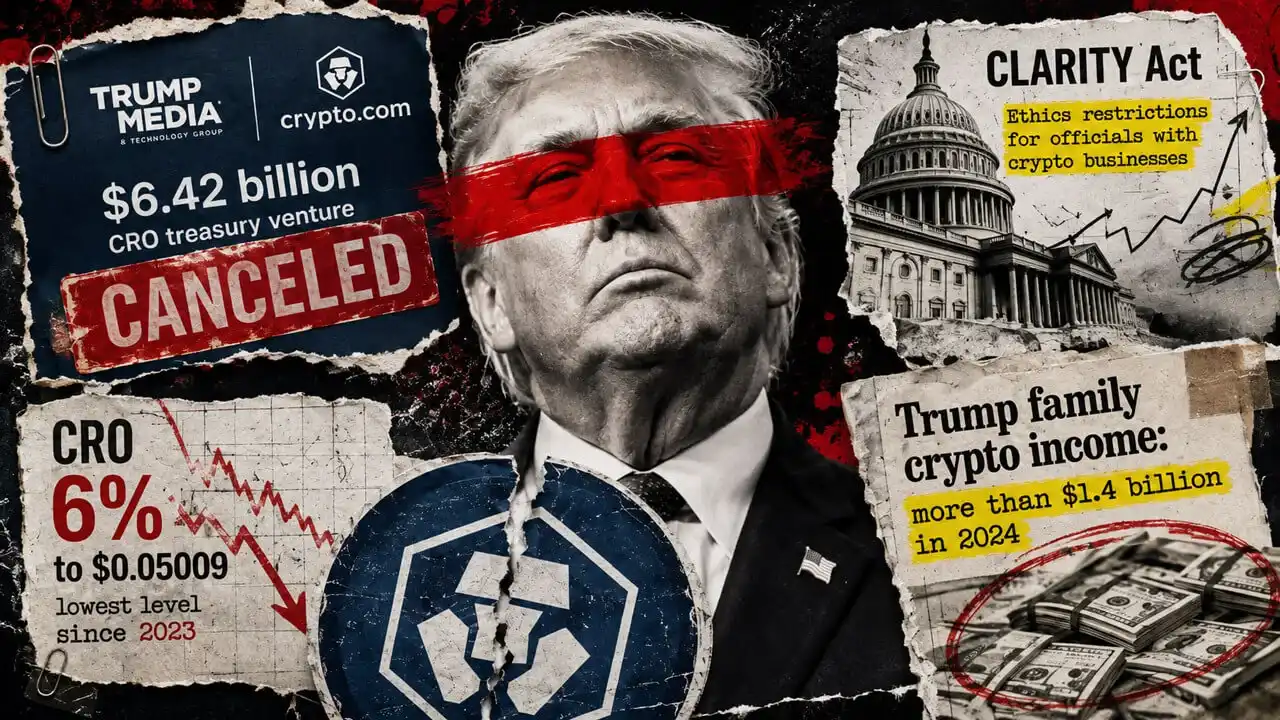
On August 7, Crypto.com, Trump Media & Technology Group (DJT), and Yorkville Acquisition Corp. filed documents with the SEC, jointly announcing the termination of the merger plan to form the "Trump Media Group CRO Strategy" vault company. The parties cited "current market conditions, as well as changes in business and stakeholder priorities" in a joint statement, marking the official end of all preliminary work regarding the merger and the digital asset vault structure.

Background: This was the most aggressive deal in the 2025 vault frenzy

This deal was officially announced in August 2025, during the peak of the "Digital Asset Treasury" (DAT) trend. The model was pioneered by the Bitcoin vault company Strategy: a publicly listed company continuously buys a certain token through financing, turning its own stock into a "proxy asset" for that token, while the premise of "having a big company to backstop the buying" was itself touted as a bullish signal for the token.

According to the initial plan, the three parties intended to form the Trump Media Group CRO Strategy through a SPAC merger, positioning it as the first and largest publicly listed CRO vault company. The funding plan included $1 billion in CRO, $200 million in cash, $220 million in mandatory exercisable warrants, plus a $5 billion equity credit line provided by Yorkville's affiliates, totaling $6.42 billion. If realized, it would have become the world's largest public holder of CRO, marketed as a "huge vote of confidence" in the token.

Looking back a year later, this vote of confidence has not materialized.

The deal wasn't locked in, but the stock ticker changed from YORK to MCGA first

The high profile of this deal is evident in the details. In anticipation of the merger, Yorkville's stock ticker was prematurely changed from YORK to MCGA, a clear nod to Trump's iconic slogan MAGA, interpreted by many as "Make CRO Great Again." Changing the ticker long before the deal was finalized appears, in hindsight, as an awkward false start.

More awkward were the initial promises. Crypto.com CEO Kris Marszalek had publicly stated that this vault company would become the world's largest holder of CRO, with a market cap potentially exceeding that of CRO itself, and would "forever" continue buying. Now, all these expectations have evaporated. Regarding the termination decision, Marszalek's statement was reduced to: "Proceeding with the transaction in the current market environment is not justified."

More than just the vault: ETF services and Truth Social prediction markets also severed

Two other collaborations were scrapped on the same day. Crypto.com will no longer provide services for Yorkville America's planned ETF products, with the latter stating its existing and future ETF business remains unaffected. Additionally, according to Axios, Trump Media also abandoned its plan to directly embed a prediction market into Truth Social (the Truth Predict initiative announced in October 2025), downgrading it to directing users to Crypto.com's prediction market product.

Trump Media's interim CEO Kevin McGurn explained the reasons to Axios: the digital asset vault sector has become saturated, and the significance of staking these assets has diminished for Crypto.com; the decision was driven by competitive dynamics, not regulatory concerns. He is refocusing the company on its media and data licensing business. Notably, Trump Media is not exiting crypto entirely: it remains the 14th largest publicly traded company holder of Bitcoin, holding over $600 million in BTC, and recently transferred 2,628 BTC to Crypto.com (the company stated it was a transfer, not a sale).

CRO's ledger after the buyer exits: Falls below $0.05, down ~95% from 2021 peak

Following the announcement, CRO broke below $0.05, touching a low of approximately $0.047, the first time since October 2023. Market data shows CRO is down nearly 40% year-to-date, around 70% over the past year, and has fallen about 95% from its all-time high of around $0.89 in November 2021, with a current market cap of approximately $2.2 billion.

These numbers illustrate one thing: the vault news once brought a pulse of "confidence premium" to CRO, but that premium required the buyer's continuous, real-money purchases to sustain. With the buyer gone, the premium vanished.

Takeaway for holders: Vault narratives create artificial demand, not real utility

On Reddit's r/CryptoCurrency, the post discussing this news raised a more pointed question: Is this DAT vault model essentially just a mechanism to create artificial demand and prop up token prices, with no real underlying utility? Every time such a deal falls through, the underlying token plummets, because the entire investment thesis was simply "a company will buy and hold," not that the token itself has utility or adoption.

This skepticism is not an isolated case. Just last week, the largest Bitcoin vault company, Strategy, was revealed to have sold Bitcoin multiple times this year, loosening its "never sell" narrative. From Strategy to MCGA, the 2025 wave of "public companies buying crypto as a bullish signal" vault mania is entering its ebb tide.

For CRO holders, there's an added layer of practical concern. Crypto.com recently also downgraded benefits for card users (Ruby card cashback reduced from 2% to 1.5%, unlimited 4% cashback for Icy White card eliminated), and several executives have departed. With the vault failure, benefit reductions, and executive exits piled together, what the market needs to reassess is not just one transaction, but the fundamentals of the exchange itself.

İlgili Sorular

QWhat was the value of the proposed 'Trump Media Group CRO Strategy' vault company plan, and which parties were involved?

AThe proposed plan was valued at $64.2 billion. The involved parties were Crypto.com, Trump Media & Technology Group (DJT), and Yorkville Acquisition Corp.

QWhat reason was given in the joint SEC filing for terminating the CRO vault company merger plan?

AThe reason given was 'current market conditions, as well as changes in business and stakeholder priorities.'

QWhat was the immediate impact on CRO's price following the announcement of the deal's termination?

AFollowing the announcement, CRO's price fell below $0.05, hitting a low of approximately $0.047, marking its lowest point since October 2023.

QAccording to the article, what fundamental problem does the collapse of this deal highlight for tokens like CRO that rely on 'vault' narratives?

AIt highlights that vault narratives create artificial, unsustainable demand based on the promise of a single buyer, rather than genuine utility or adoption of the token itself. When that buyer disappears, the price support collapses.

QBesides the vault deal, what other two collaborations between the mentioned companies were reportedly cut or downgraded?

A1. Crypto.com will no longer provide services for Yorkville America's planned ETF products. 2. Trump Media abandoned its plan to directly embed a prediction market into Truth Social (Truth Predict), downgrading it to merely redirecting users to Crypto.com's prediction market product.

İlgili Okumalar

Zcash's ETF Gilding: How a Privacy Coin Was Packaged by Wall Street into a Compliant Asset

The article traces the decade-long path of Zcash (ZEC), a privacy-focused cryptocurrency, to its potential launch as the first privacy coin spot ETF, with Grayscale's ZCSH filing in August 2026. It argues ZEC's suitability stemmed not from regulatory acceptance of its privacy technology, but from its centralized, institutional structure from inception—a commercial company (ECC) with venture capital backing and a Founder's Reward—making it easier to package than decentralized alternatives. Three key institutions, intertwined in a network, drove the process: Grayscale (owned by DCG, an early ZEC investor), which had held ZEC in a trust since 2017; Coinbase, providing custody, prime brokerage, derivatives, and venture investment; and ZODL, a new for-profit entity formed in 2026 when ECC's core development team split from the non-profit foundation. The major regulatory hurdle was SEC scrutiny (2023-2026) over ZEC's historical structure, which resembled an unregistered investment contract due to automatic block rewards to ECC and the Foundation. This was resolved through governance changes (NU6 upgrade in 2024) that ended direct funding and shifted control to community voting, coinciding with a broader shift in SEC enforcement policy. Notably, the law firm Davis Polk represented both the Zcash Foundation in its SEC defense and Grayscale in the ETF filing. The push is also driven by DCG's dire financial needs amid Genesis bankruptcy lawsuits, seeking high-fee products (the ZEC ETF charges 2.5%). Concurrently, major mining operations by entities like Cypherpunk Technologies (backed by Winklevoss Capital) and DCG's Fortitude Mining expanded, motivated by profitability and aiming to influence the network. The article concludes with irony: to become a compliant ETF asset, ZEC must shed its core privacy feature for the fund's holdings, which will be held in transparent, auditable addresses. Wall Street is not adopting privacy technology but packaging the *concept* of privacy into a tradable, fee-generating financial product. The transformation was not a single master plan but the result of a network of aligned interests capitalizing on regulatory, governance, and market shifts over ten years.

marsbit5 dk önce

Zcash's ETF Gilding: How a Privacy Coin Was Packaged by Wall Street into a Compliant Asset

marsbit5 dk önce

Bitcoin Core Developer Warns That Bitcoin Payments Are Disappearing at 'Bitcoin Beach'

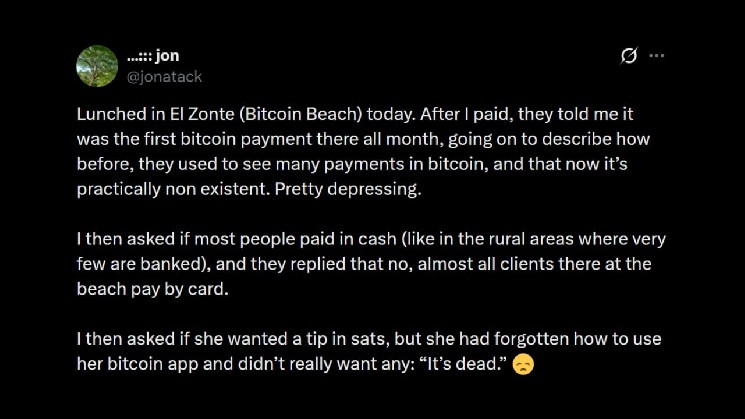
A Bitcoin Core developer, John Atack, who has lived in El Salvador since 2022, shared a concerning anecdote about Bitcoin adoption in the country. While dining at El Zonte, a region known as "Bitcoin Beach," he paid with Bitcoin and was told it was the first such payment the establishment had received in a month. Staff explained Bitcoin payments, once common, have now virtually disappeared, with nearly all customers using cards. An employee even declined a Bitcoin tip, stating she had forgotten how to use her wallet and declaring "It's already dead." Atack emphasized this was a single observation but noted the employee had witnessed the payment evolution over three years. His comments sparked mixed reactions. Some disputed his experience, with one user confirming successful Bitcoin payments in the same area. However, Bitcoin reporter Juan Galt acknowledged an underlying "economic problem," arguing that expecting price appreciation makes using Bitcoin for everyday transactions counterintuitive to economic incentives needed for a circular crypto economy. Despite the concerning report, Atack also reflected that El Salvador remains a global leader in cryptocurrency adoption and progressive legislation, sometimes causing locals to take these advancements for granted. The story highlights the ongoing challenges of mainstream Bitcoin adoption for daily commerce, even in pioneering nations.

cryptonews.ru8 dk önce

Bitcoin Core Developer Warns That Bitcoin Payments Are Disappearing at 'Bitcoin Beach'

cryptonews.ru8 dk önce

A Huge 'Sleeping' Wave of New Bitcoin Buyers Has Not Even Bought Bitcoin Yet

A recent study by the Federal Reserve Bank of Cleveland, titled "Do You Even Crypto, Bro? Cryptocurrencies in Household Finance," reveals that Bitcoin and other crypto assets are less understood than other financial assets in US households. The primary reasons for not owning crypto are a lack of knowledge and the perception that it is a poor investment. Even among owners, the main motivations are profit-seeking and portfolio diversification rather than an understanding of the underlying technology's benefits, such as independence from banks. The research found that showing respondents Bitcoin's past 12-month performance increased their desired portfolio allocation by about 47%, indicating investment decisions are driven more by recent returns than fundamental comprehension. Crypto gains are often treated like lottery winnings, leading to one-off luxury purchases rather than sustained increases in spending. While non-owners largely view crypto as high-risk, owners are somewhat less likely to do so, though they exhibit greater uncertainty about future returns compared to traditional assets like stocks or gold. This ambiguity about Bitcoin's nature and valuation contributes directly to its price volatility. The study concludes that this volatility will persist, but education efforts combined with price appreciation could convert today's uninformed non-owners into future Bitcoin holders.

cryptonews.ru10 dk önce

A Huge 'Sleeping' Wave of New Bitcoin Buyers Has Not Even Bought Bitcoin Yet

cryptonews.ru10 dk önce

Grain Prices Haven't Taken Off Yet, So Why Have Fertilizer Prices Risen First?

Fertilizer prices are rising ahead of a potential global food price surge, driven primarily by supply-side constraints rather than current agricultural demand. While a strong El Niño is forecast for late 2026, its impact is expected to be initially limited to specific crops like palm oil and rubber, not leading to immediate, broad-based grain shortages. The fertilizer market is currently propelled by its own dynamics: **Urea** faces domestic oversupply in China, with its price reliant on the potential to export to higher-priced international markets. **Phosphate fertilizers** are experiencing a rare "supply-led" cycle due to global sulfur shortages, shipping disruptions, and production cuts overseas, placing Chinese producers with integrated resources and export channels in a key position. **Potash** supply is tightening due to planned maintenance and production cuts at major global producers, underpinning its long-term resource scarcity narrative. Looking ahead to 2027, a prolonged El Niño could shift the market into a second phase of "demand-supply resonance." If extreme weather significantly impacts crop yields and global grain inventories, rising food prices and farmer income would boost fertilizer application demand. This potential demand surge, layered onto the existing supply constraints, could amplify the price cycle. The overarching theme is that **food security is redefining the strategic value of fertilizers**, particularly for resource-constrained phosphate and potash. Policy priorities balancing domestic supply guarantees with export opportunities, coupled with resource ownership and global supply chain access, are becoming critical determinants of profitability beyond short-term weather cycles.

marsbit13 dk önce

Grain Prices Haven't Taken Off Yet, So Why Have Fertilizer Prices Risen First?

marsbit13 dk önce

İşlemler

Spot
活动图片