Crypto xAI Weekly Roundup: TAO Surges 40% in a Week, Decentralized Computing Trains First Competitive-Grade Large Model

marsbit2026-03-18 tarihinde yayınlandı2026-03-18 tarihinde güncellendi

Özet

This week in crypto xAI was dominated by Bittensor subnet Templar's historic achievement: the decentralized pre-training of Covenant-72B, a 720-billion-parameter LLM, reportedly rivaling LLaMA-2-70B. Trained on 1.1 trillion tokens using consumer-grade hardware within Bittensor’s permissionless network, this milestone shifts the narrative from proving subnet viability to delivering outputs competitive with centralized alternatives. TAO surged 40% in response. The broader DeAI market cap rose 12% to $16.2B, with FET (+61%) and RENDER (+31%) also posting significant gains. The robotics sector grew 6% to $811M, led by PEAQ’s 48% rise. Nansen DEX flow data showed net inflows into sUSDAI, WTAO, and VIRTUAL, indicating smart money accumulation. x402 transaction analysis revealed a key trend: while transaction counts fell, the total transaction value spiked, signaling a shift toward higher-value, legitimate commercial use cases over low-value spam. AWS further validated the space by releasing a full technical reference architecture for x402, marking its transition from concept to infrastructure.

Author: 0xSammy

Compiled by: Deep Tide TechFlow

Deep Tide Guide: Bittensor subnet Templar has completed the largest decentralized LLM pre-training in history—Covenant-72B with 72 billion parameters. Its performance is reportedly comparable to LLaMA-2-70B, and the entire training process was based on consumer-grade internet hardware.

This is not a proof of concept but a delivered product. It elevates Bittensor's narrative from "subnets can exist" to "subnets can produce outputs that compete with centralized alternatives."

At the same time, AWS released the complete x402 technical reference architecture. These two events combined drove the DeAI sector up 12% in a single week.

Full Text Below:

Headline of the Week: TAO and Covenant-72B

On March 10, Templar (Bittensor Subnet 3) completed the largest decentralized LLM pre-training in history: Covenant-72B. 72 billion parameters. Approximately 1.1 trillion tokens. Fully trained on consumer-grade internet hardware within Bittensor's permissionless network. Anyone with a GPU can freely join or leave. Performance is reportedly comparable to LLaMA-2-70B.

This upgrades Bittensor's core thesis from "subnets can exist" to "subnets can produce outputs that compete with centralized alternatives."

A permissionless network of consumer-grade GPUs, achieving synergy on a scale previously associated only with hyperscale cloud providers. Before Covenant-72B, decentralized training was just a promise on the roadmap; now, it is a delivered product.

Within 24 hours of the announcement, TAO rose 19%, with a weekly gain of +39.8%. Templar's post on X received 1.7 million views:

Three ecosystem subnets (SN3 Templar, SN4 Targon, SN39 Basilica) ranked among the top eight gainers on CoinGecko that day. The structural dynamics between TAO and subnets amplify buying pressure: investors need TAO to acquire subnet tokens, so concentrated demand for any single subnet cascades into accumulation of the underlying asset.

The price action is now anchored to a verifiable technical milestone. Covenant-72B is a fully trained model. Grayscale's Bittensor Trust SEC filing (December 2025) is still pending approval; xTAO continues to accumulate as the largest corporate holder. Institutional access is being built in parallel.

A) DeAI Total Market Cap Analysis

This week, the total DeAI market cap increased by $1.9 billion (+12%), reaching $16.2 billion:
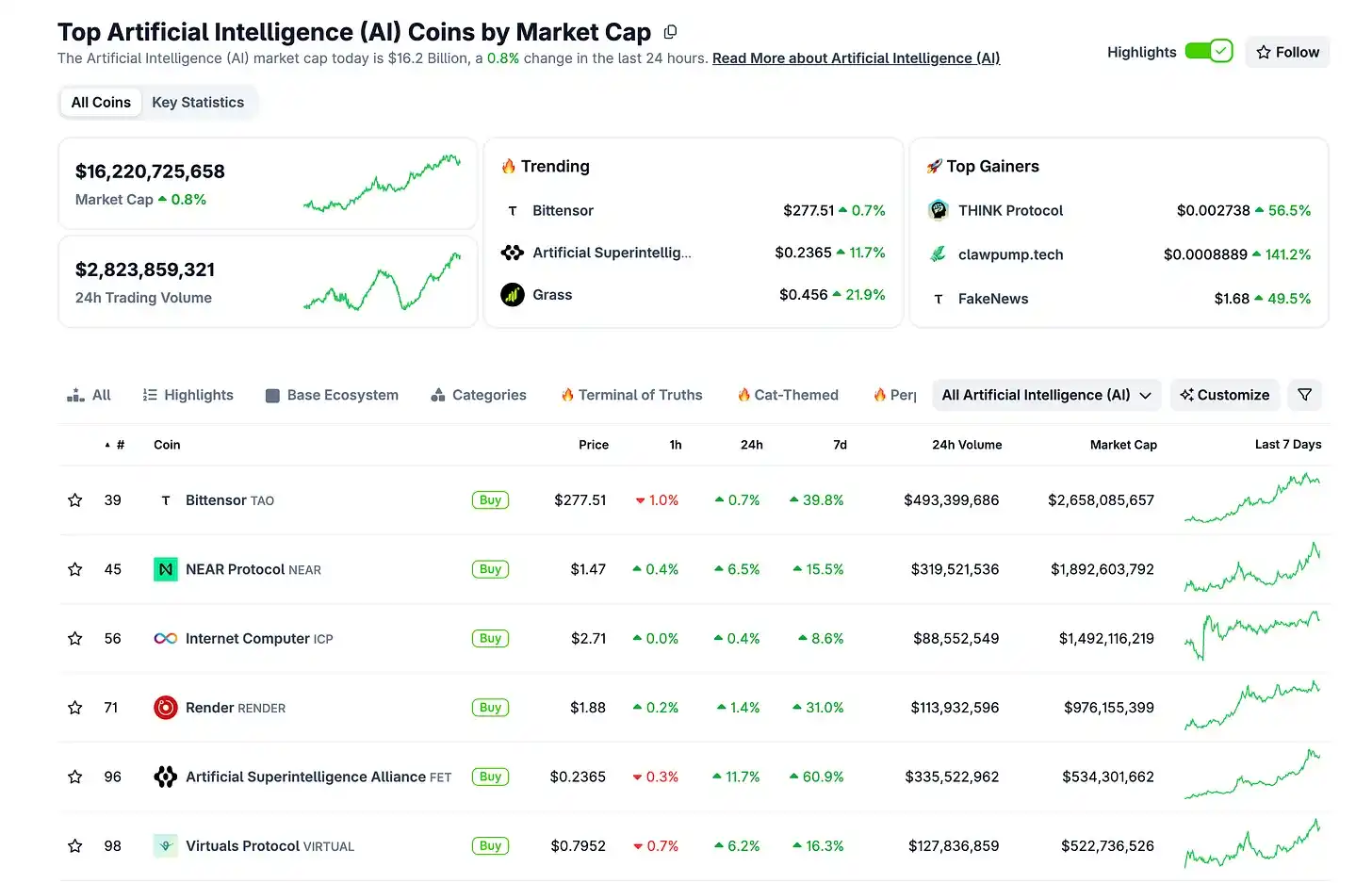
The core news this week was Templar's Covenant-72B (details above). The overall AI sector benefited from Bittensor's catalyst effect and continued institutional narrative momentum around Agent infrastructure.

TAO (7-day +40%): $277.51, market cap $2.66 billion. Catalyst: Covenant-72B; structural dynamics from subnets to TAO amplified gains.

FET (7-day +61%): $0.2365, market cap $534 million. The strongest weekly gainer among top DeAI assets. The Artificial Superintelligence Alliance benefited from sector rotation catalyzed by TAO, with capital broadly flowing into AI tokens.

RENDER (7-day +31%): $1.88, market cap $976 million. Covenant-72B proves distributed GPU networks can train competitive models, providing a tailwind for the decentralized computing narrative.

NEAR (7-day +16%): $1.47, market cap $1.89 billion. IronClaw (a security-hardened rewrite of OpenClaw in Rust, deployed on TEE) and NEARCON 2026 catalysts continue to have an effect. NEAR's positioning as enterprise-grade OpenClaw infrastructure keeps it in AI buying interest.

ICP (7-day +9%): $2.71, market cap $1.49 billion. Caffeine AI, a self-writing application platform on DFINITY's ICP platform, continues to attract developers (reportedly hundreds of thousands of monthly unique visitors according to Dominic Williams). Version V3 is upcoming, featuring Claude Code integration. The "Mission 70" tokenomics proposal aims to reduce annual inflation by 70% by the end of 2026, with Caffeine-driven compute burning as a key mechanism. Over the past 30 days, ICP ranked first in code development activity among AI/Big Data crypto projects.

VIRTUAL (7-day -16%): $0.7952, market cap $523 million. Pullback following AGDP-driven rally. But the more interesting story for VIRTUAL this week is in the x402 facilitator data: Virtuals have already ranked among the top three facilitators by transaction volume on x402 via ACP.

B) Robotics Total Market Cap Analysis

This week, the total Robotics sector market cap increased by $44 million (+6%), reaching $811 million:
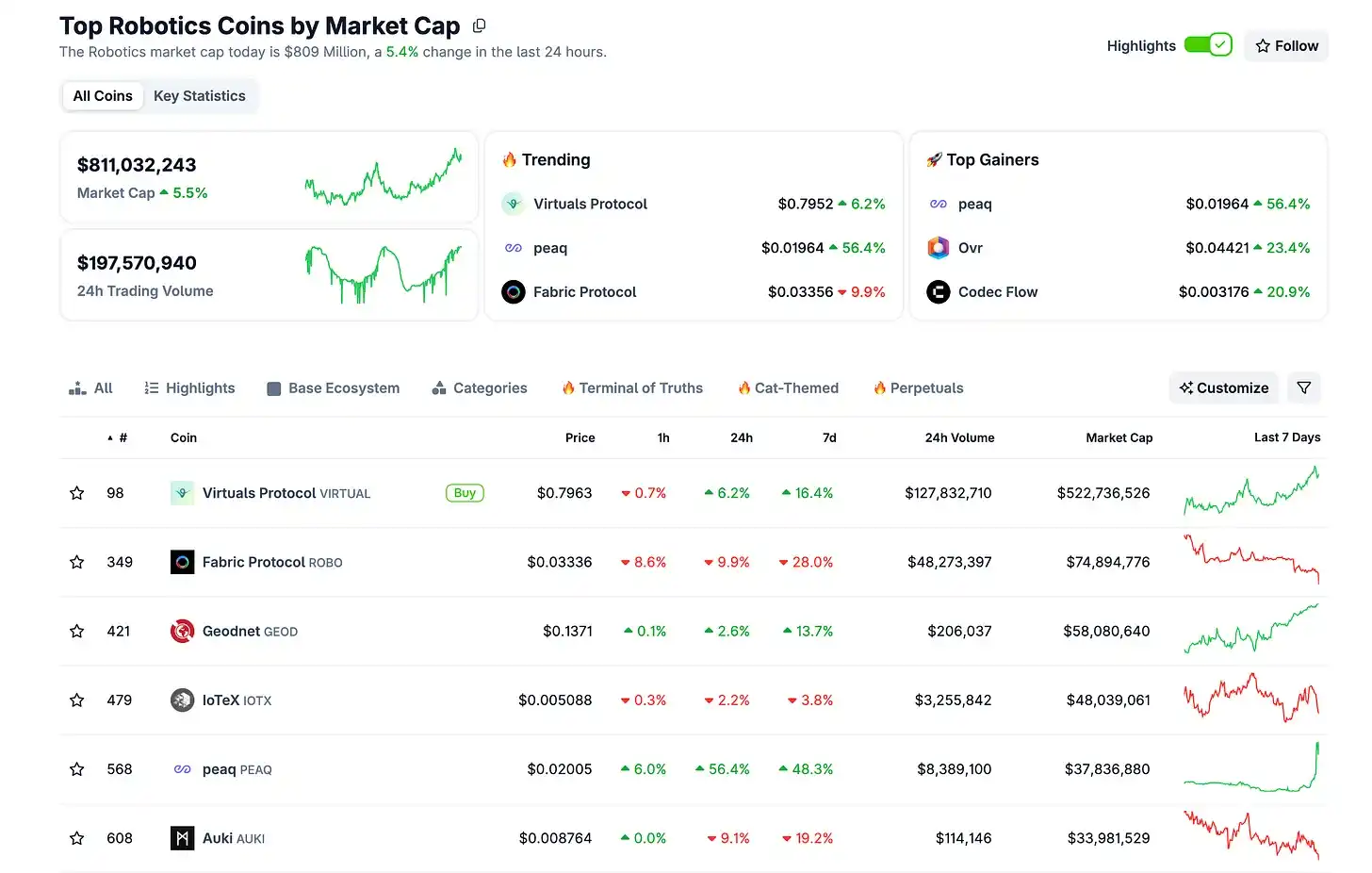
PEAQ (7-day +48%): $0.02005, market cap $37.8 million. The standout performer. peaq released a new video explaining the robotics narrative and its Robotics SDK (compatible with ROS 2, enabling any robot to obtain a peaq ID, perform on-chain payments/receipts, and data verification). Hashkey Capital's "Machine Economy" research report listed peaq as the foundational L1 for machine identity, payments, and governance. Over 60 DePIN projects across 22 industries are operational on the network; the Dubai VARA regulatory sandbox is open for on-chain robotics businesses.

ROBO (7-day -28%): $0.03336, market cap $74.9 million. Fabric Protocol (OpenMind/Fabric Foundation) is finding price equilibrium after initial listing enthusiasm. Still a relatively new player in the robotics category.

GEOD (7-day -14%): $0.1371, market cap $58.1 million. 24-hour trading volume only $206k, despite GEO-SWARM being live on Kickstarter and GEOD coverage added by Solana/Blockworks' Lightspeed institutional platform, which is expected to improve institutional visibility over time.

Crypto AI Agent Sector

a) Nansen DEX Fund Flows (All Traders, 7-Day)
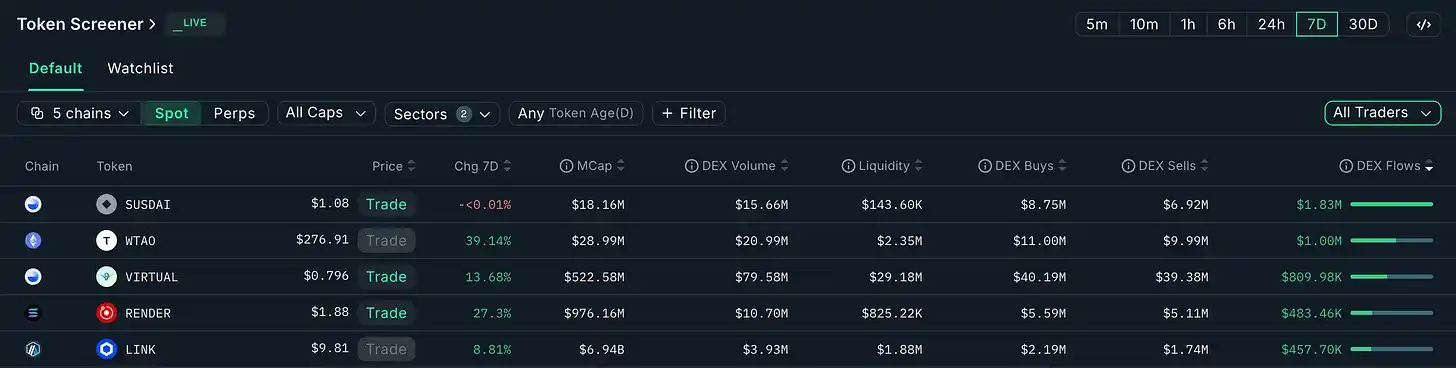
sUSDAI (+$1.83M net inflow): Largest net inflow in the AI sector. The yield layer for USDai, a GPU-collateralized stablecoin protocol (Permian Labs; backed by Dragonfly, Coinbase Ventures, YZi Labs). Lends against physical GPU infrastructure, returning yield via sUSDAI. PayPal/PYUSD integration; peak TVL $658M. CHIP governance token launched via CoinList in late February; capital is rotating into the yield layer. DeFi capital meets physical AI infrastructure financing.

WTAO (+$1.00M net inflow): $11.0M bought vs $10.0M sold. Confirms Covenant-72B drove real DEX accumulation behavior.

VIRTUAL (+$810k net inflow): Net inflow remained positive despite a 16.3% weekly price drop. $40.19M bought vs $39.38M sold. Smart money buying the dip. This group has the deepest liquidity at $29.18M.

RENDER (+$483k net inflow): Slight positive. Sector tailwinds, no specific catalyst. Render Con 2026 is upcoming.

LINK (+$458k net inflow): Noteworthy that Chainlink appears in the AI sector filter. Chainlink Runtime Engine is the connective tissue for Agent infrastructure; explicitly referenced in an AWS blog post this week regarding CRE integration.

b) Nansen Public Figure Fund Flows (7-Day)

DRV (+$264k net inflow, 7 traders): Derive, a decentralized derivatives protocol based on OP Stack. +48.84% in 7 days, market cap $111M. Institutional staking goes live on March 23; 25% of fees used for DRV buybacks.

FAI (+$187k net inflow, 4 traders): Freysa AI, a sovereign Agent stack on Base. Market cap $62M. Uses TEE and zkTLS, enabling Agents to hold their own keys. Similar to OpenClaw but approaches from a cryptographic sovereignty angle.

WTAO (+$105k net inflow, 3 traders): Corroborates the signal around Covenant-72B seen among all traders.

c) x402 Analysis

i) Transaction Count Down, Transaction Value Up
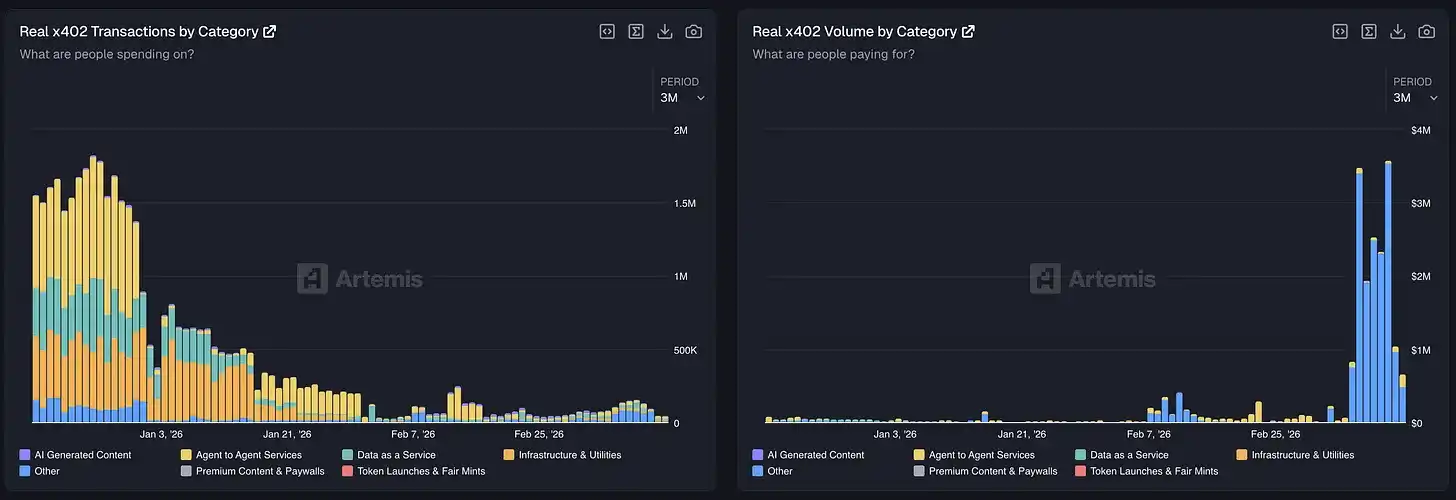
Artemis data tells two stories:

Transaction Count (Left Chart): Significant decline from Dec/Jan peaks. Daily average transactions dropped from over 1.5-2 million to the hundreds of thousands.

Transaction Value (Right Chart): Sharp uptick after a plateau in Jan/Feb, pushing daily average transaction value to $3-4 million. Concentrated in Infrastructure & Utilities and Data-as-a-Service categories, with Agent-to-Agent Services contributing secondarily.

This divergence is the most important signal for x402 currently. Decreasing transaction count with increasing transaction value means the average transaction size is growing. Fake transactions are being washed out; what remains are fewer, higher-value real commercial transactions.

Based on the current merchant landscape, the dominant categories likely represent: Agents paying for compute (cloud GPU, inference nodes, Chutes); API data source access (Firecrawl, StableEnrich, market intelligence data); browser sessions (Browserbase); and content generation (Freepik).

Agent-to-Agent Services is structurally the most interesting: autonomous Agents paying other Agents to complete subtasks.

AI-generated content and token issuance, which dominated early transaction counts, have largely been washed out.

ii) a16z and the Data Measurement Gap

a16z partner Noah Levine pointed out that "real" transaction volume is significantly lower than the inflated numbers caused by fake activity earlier this year. Bloomberg reported x402's 30-day payment volume at $24 million (data from x402.org); Allium Labs' data was around $3 million; Artemis, filtering out wash trading, estimated real volume at about $1.6 million.
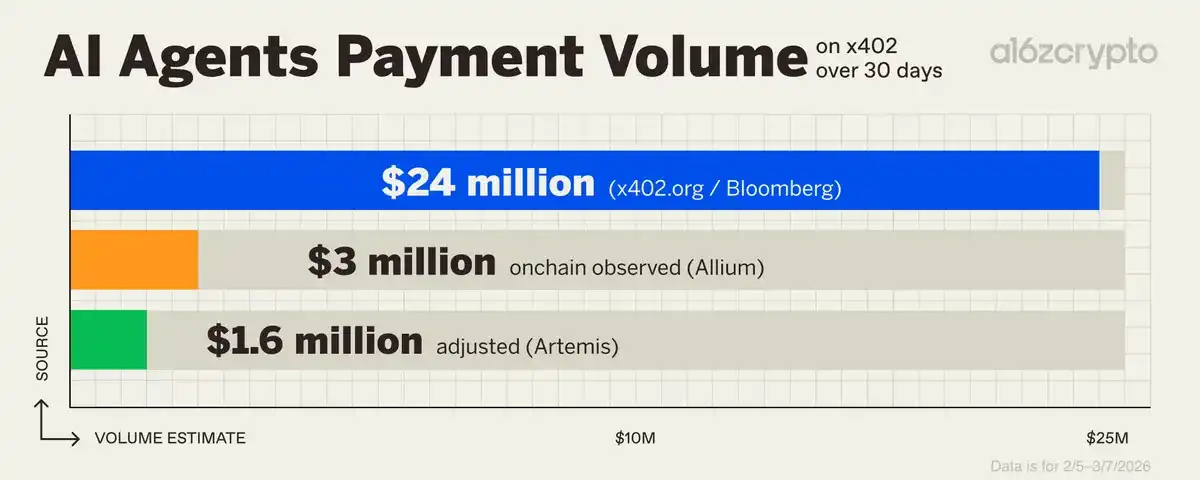
But this gap reveals how early the measurement infrastructure is—especially as more mature institutions begin adopting this open protocol: Stripe, Cloudflare, Vercel, and Google have all integrated x402.

These institutions are betting not on the current $1.6 million per month, but on what that number becomes when Agents become the default buyers.

iii) Top Facilitators Ranking (Past 7 Days)
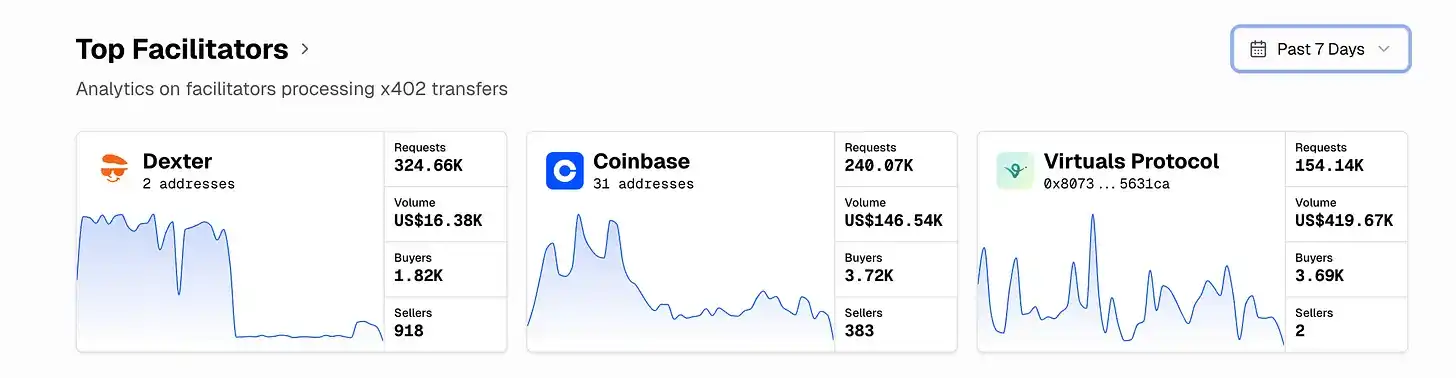
The facilitator ranking is diversifying: high-frequency micro-payments (Dexter), institutional API access (Coinbase), structured Agent commerce (Virtuals/ACP).

Virtuals Protocol (144.14k requests, $419.67k volume): Ranked third by request count, but highest by transaction value. Average price per request ~$2.72 (5x Coinbase's, 54x Dexter's). 3,690 buyers对应仅 2 sellers.

This is ACP settling structured Agent-to-Agent commercial transactions: a few service Agents completing high-value tasks for thousands of buyers.

On March 10, Virtuals and the Ethereum Foundation dAI team jointly submitted ERC-8183, formalizing the trusted Agent commercial transaction lifecycle alongside x402 (payments) and ERC-8004 (identity/reputation).

iv) AWS Releases Full x402 Reference Architecture

On March 15, AWS published "x402 and Agent Commerce: Redefining Autonomous Payments in Financial Services" on its industry blog, including a complete technical reference architecture.

When AWS releases a production-grade reference architecture with open-source code for a native crypto payment standard, the protocol moves from the conceptual stage to the infrastructure stage.

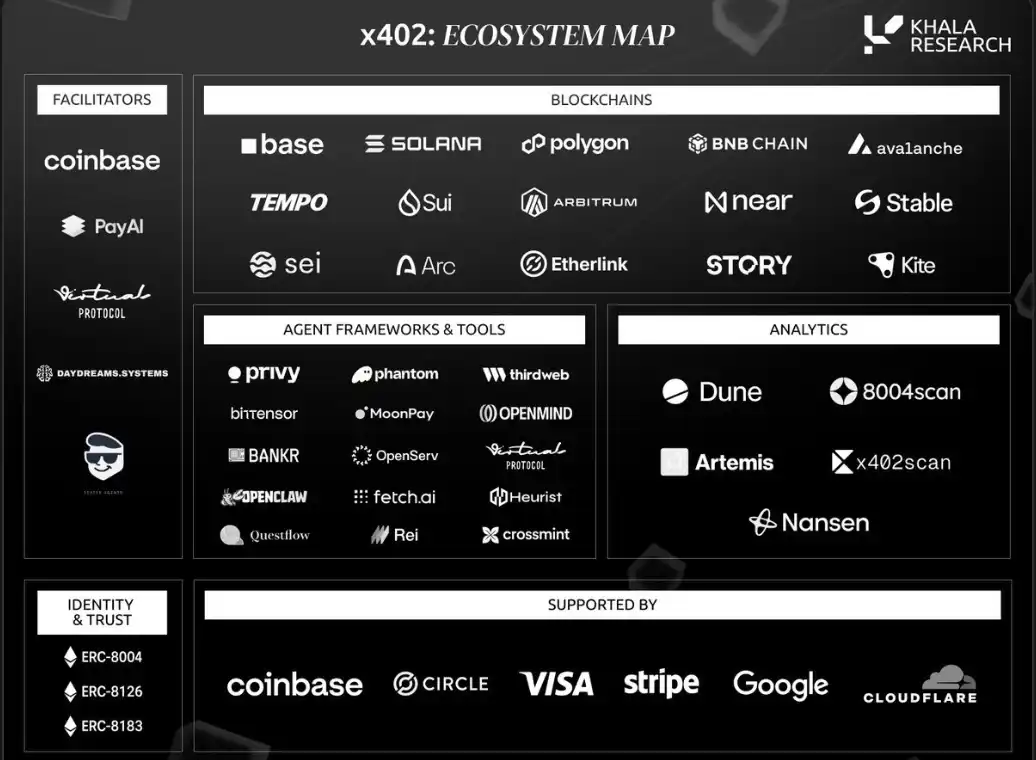
To learn more about x402's trajectory, follow Khala Research, as we will release a full report later this week. Below is the current ecosystem map:
Disclaimer: The content covered in this communication should not be considered investment or financial advice. It is for informational and educational purposes only.

Disclosure: I hold some of these assets and have cooperative relationships with certain projects mentioned in this communication.

İlgili Sorular

QWhat is the significance of the Covenant-72B model trained by Templar on the Bittensor network?

AThe Covenant-72B model is a 72-billion parameter LLM pre-trained on 1.1 trillion tokens, entirely on consumer-grade internet hardware within the Bittensor network. Its significance lies in being the largest decentralized LLM pre-training to date, with performance reportedly comparable to centralized models like LLaMA-2-70B. This upgrades Bittensor's narrative from proving subnets can exist to demonstrating they can produce outputs competitive with centralized alternatives.

QWhat was the price performance of TAO following the announcement of Covenant-72B, and what drove this performance?

AFollowing the announcement of Covenant-72B, the price of TAO increased by 19% within 24 hours and saw a weekly gain of +39.8%. This performance was driven by the technical milestone of the successful training, which validated the decentralized AI narrative. The structural dynamic between TAO and its subnets also amplified buying pressure, as investors need TAO to acquire subnet tokens.

QAccording to the article, what is the x402 protocol data showing about the nature of transactions?

AThe x402 protocol data shows a divergence: the number of transactions has decreased significantly from its peak, but the total transaction volume (in USD) has sharply increased. This indicates that the average transaction size is growing, suggesting that low-value, fake 'wash trading' is being cleaned out and replaced by fewer, but higher-value, genuine commercial transactions.

QWhich company released a full technical reference architecture for the x402 protocol, and why is this important?

AAWS released a full technical reference architecture for the x402 protocol. This is important because when a major cloud provider like AWS publishes a production-ready reference architecture with open-source code for a native crypto payment standard, it signifies the protocol's transition from a conceptual stage to an infrastructure stage, boosting its legitimacy and potential for institutional adoption.

QWhat role did the Virtuals Protocol play in the x402 ecosystem according to the merchant rankings?

AAccording to the 7-day merchant rankings, the Virtuals Protocol ranked third by number of requests but first by total transaction volume. Its high average transaction value (~$2.72 per request) and the structure of its business (3,690 buyers to just 2 sellers) indicate it is settling high-value, structured agent-to-agent commerce transactions through its ACP (Agent Commerce Protocol).

İlgili Okumalar

Programmers Worldwide Are Wasting Money on Anthropic! The Company Can't Stand It Anymore

Anthropic recently published guidelines to help developers using Claude Code reduce unnecessary token costs. The key recommendations include: 1) Clear (/clear) conversations after completing a task to avoid carrying irrelevant file reads and command outputs into the next task. 2) Set the model and reasoning effort level at the start of a session, as switching mid-session invalidates the prompt cache, requiring a full-price recalculation of the entire dialog history. 3) Attach files using @ references instead of typing paths manually to avoid extra tool calls and searches that bloat the context. 4) Add quiet flags to verbose commands (e.g., in CLAUDE.md) to minimize lengthy output in the dialog history. 5) Use /compact while the session cache is still warm (before breaks) to compress the dialog at one-tenth the cost. 6) Offload large-output tasks to a sub-agent, which runs in an isolated context and only returns conclusions, preventing intermediate outputs from polluting the main dialog. The article explains token pricing: input tokens (prefill) are processed in parallel, while output tokens (decode) are generated serially, making output tokens five times more expensive. Caching is crucial for savings—if a request's prefix (system prompt, CLAUDE.md, dialog history) matches the previous one byte-for-byte, reading it costs only 10% of the standard input price. However, cache invalidation occurs when changing models, effort levels, fast mode, compressing dialogs, after cache expiration, or when resuming old sessions. Dialog history also grows quadratically (O(n²)) as file contents and command outputs accumulate, increasing costs per round. Proactive context management—like isolating noisy tasks, using /rewind to trim unproductive turns, and task-based session clearing—is becoming an essential skill for cost-effective AI-assisted development.

marsbit58 dk önce

Programmers Worldwide Are Wasting Money on Anthropic! The Company Can't Stand It Anymore

marsbit58 dk önce

Pax Silica vs. WAICO: The US Wants to Prohibit Europe from Using Chinese Artificial Intelligence

The United States is preparing to demand that European and other partners abandon Chinese artificial intelligence initiatives, threatening exclusion from the American-led "Pax Silica" coalition, according to a leaked U.S. State Department document. This ultimatum forces signatories of the "AI Opportunity Statement" to choose between the Western technological ecosystem and alternative frameworks, with China not explicitly named but clearly targeted. Pax Silica is a U.S. strategy for AI and semiconductor hegemony, launched in late 2025. Its European presence expanded significantly in mid-2026. Concurrently, China, Russia, and 27 other nations established the World AI Cooperation Organization (WAICO) in July 2026 as an independent intergovernmental platform promoting AI governance based on UN principles. This situation creates a difficult choice, especially for European nations balancing strategic autonomy with dependence on U.S. tech and security. It also pressures Global South countries with pragmatic ties to both Washington and Beijing. The formation of competing blocks risks fragmenting the global tech landscape, forcing companies to split supply chains, increasing costs, and potentially leading to incompatible standards and protocols. The era of open globalization in AI may be ending, replaced by geopolitical confrontation where technological sovereignty trumps economic efficiency. The decisions made will shape the global digital economy for decades.

cryptonews.ru2 saat önce

Pax Silica vs. WAICO: The US Wants to Prohibit Europe from Using Chinese Artificial Intelligence

cryptonews.ru2 saat önce

Robert Kiyosaki Shares His Mentor's Predictions About the Emergence of Bitcoin and AI

American entrepreneur and author of "Rich Dad Poor Dad," Robert Kiyosaki, discussed the influence of futurist R. Buckminster Fuller on his worldview, linking Fuller's past technological predictions to the emergence of Bitcoin and the development of artificial intelligence. In an X post, Kiyosaki also reflected on personal purpose, sharing his journey from the music business—where he worked with bands like The Police and Iron Maiden—to creating the "Cashflow" board game and writing his famous book. He described feeling an inner emptiness despite his success, a turning point that came after meeting Fuller, whom he studied with for three summers. Kiyosaki described Fuller as a "friendly genius" who foresaw world-changing developments like Bitcoin and AI. However, the core of his post focused on Fuller's philosophical impact, particularly a quote about belonging to the universe and finding purpose by dedicating one's life to the maximum benefit of others. The entrepreneur remains a vocal advocate for cryptocurrencies. He regularly advises buying Bitcoin during market panics, viewing it and assets like Ethereum, gold, and silver as hedges against traditional financial system failures. Kiyosaki has predicted a major market crash by 2026, seeing it as an opportunity for prepared investors, with long-term price targets including $750,000 for Bitcoin and $95,000 for Ethereum.

cryptonews.ru4 saat önce

Robert Kiyosaki Shares His Mentor's Predictions About the Emergence of Bitcoin and AI

cryptonews.ru4 saat önce

Etherealize CEO Calls Wall Street's Private Blockchains a 'Race to the Bottom'

Etherealize co-founder and CEO Vivek Raman criticized Wall Street's growing interest in private, permissioned blockchains, calling them a "race to the bottom." In an interview with CoinDesk, Raman argued that consortium networks fragment liquidity and return the industry to the siloed systems that blockchain technology was meant to overcome. He stated that closed networks do not interoperate, undermining two key advantages of the technology: system compatibility and liquidity concentration. Etherealize promotes Ethereum as an open, foundational layer for institutional players. Raman insists that privacy and access restrictions should be built on top of public infrastructure—at the application or L2 level—rather than creating separate, closed networks. He compared Ethereum to HTTP as a base layer, with additional permissioned and private layers akin to HTTPS. Examples of this new wave of "closed" solutions mentioned include Canton Network from Digital Asset, Circle's Arc project, and Stripe's Tempo. Raman termed this trend "consortium chains 2.0," recalling earlier initiatives like the R3 interbank consortium and the Hyperledger corporate ecosystem from 2016 that failed to gain significant traction. He reiterated his firm belief that a global, open, permissionless infrastructure is necessary as a foundational base layer. Raman previously noted in June that traditional financial institutions had begun implementing Ethereum-based solutions into real business processes.

cryptonews.ru4 saat önce

Etherealize CEO Calls Wall Street's Private Blockchains a 'Race to the Bottom'

cryptonews.ru4 saat önce

İşlemler

Spot
活动图片