Crypto Whales Build A ‘Fortress Floor’ As Retail Panic Sells The Altcoin Sector

bitcoinist2026-02-20 tarihinde yayınlandı2026-02-20 tarihinde güncellendi

Özet

The crypto market is experiencing significant selling pressure, with altcoins struggling to regain momentum amid ongoing volatility and fragile sentiment. According to a CryptoQuant report, retail investors are panic-selling due to price weakness and negative headlines, amplifying short-term declines. However, underlying data reveals a more complex picture: trading volumes have surged since Ethereum’s recent bottom, suggesting repositioning rather than full capitulation. Larger market participants are systematically absorbing retail sell-offs, forming buying walls and accumulating assets while sentiment remains weak. This dynamic indicates potential accumulation or speculative positioning, though a sustained bullish reversal is not yet confirmed. Macro conditions, regulation, and Bitcoin's dominance will ultimately determine if this redistribution phase leads to a stronger altcoin cycle.

The crypto market continues to face notable selling pressure, with several leading altcoins struggling to regain upward momentum after months of volatility. Sentiment remains fragile as investors weigh macro uncertainty, liquidity conditions, and the lack of sustained bullish catalysts. While periodic rebounds have emerged, most altcoins remain well below previous cycle highs, reinforcing a cautious environment across the broader market.

A recent CryptoQuant report provides additional perspective on this dynamic. According to the analysis, retail investors appear to be under persistent pressure to sell altcoins, particularly as price weakness and negative sentiment dominate headlines. At the same time, the data suggests a more complex underlying picture. Despite ongoing pressure, certain segments of the market are forming notable buying walls, indicating that demand has not disappeared entirely.

Trading volume across altcoins has risen significantly since Ethereum established its recent bottom, reaching levels that are difficult to compare directly with the previous cycle. This increase in activity, even while prices remain depressed, may reflect repositioning rather than pure capitulation. Importantly, most altcoins have yet to stage meaningful recoveries, suggesting that current participation could represent accumulation, speculative positioning, or a mix of both as the market searches for direction.

Retail Capitulation Meets Strategic Crypto Accumulation

The CryptoQuant analysis indicates that much of the current altcoin selling pressure is being driven by retail participants reacting defensively to volatility and prolonged drawdowns. Fear-driven liquidations often emerge during uncertain phases, particularly when liquidity tightens, and price recovery lacks momentum. This behavior tends to amplify short-term weakness, especially across mid- and lower-cap crypto assets.

However, the same data suggests that a portion of this selling volume is being systematically absorbed by larger or more patient market participants. This absorption dynamic typically reflects positioning rather than speculation, as buyers accumulate exposure while sentiment remains fragile. Historically, such phases have preceded structural market transitions, although timing remains uncertain and outcomes are not guaranteed.
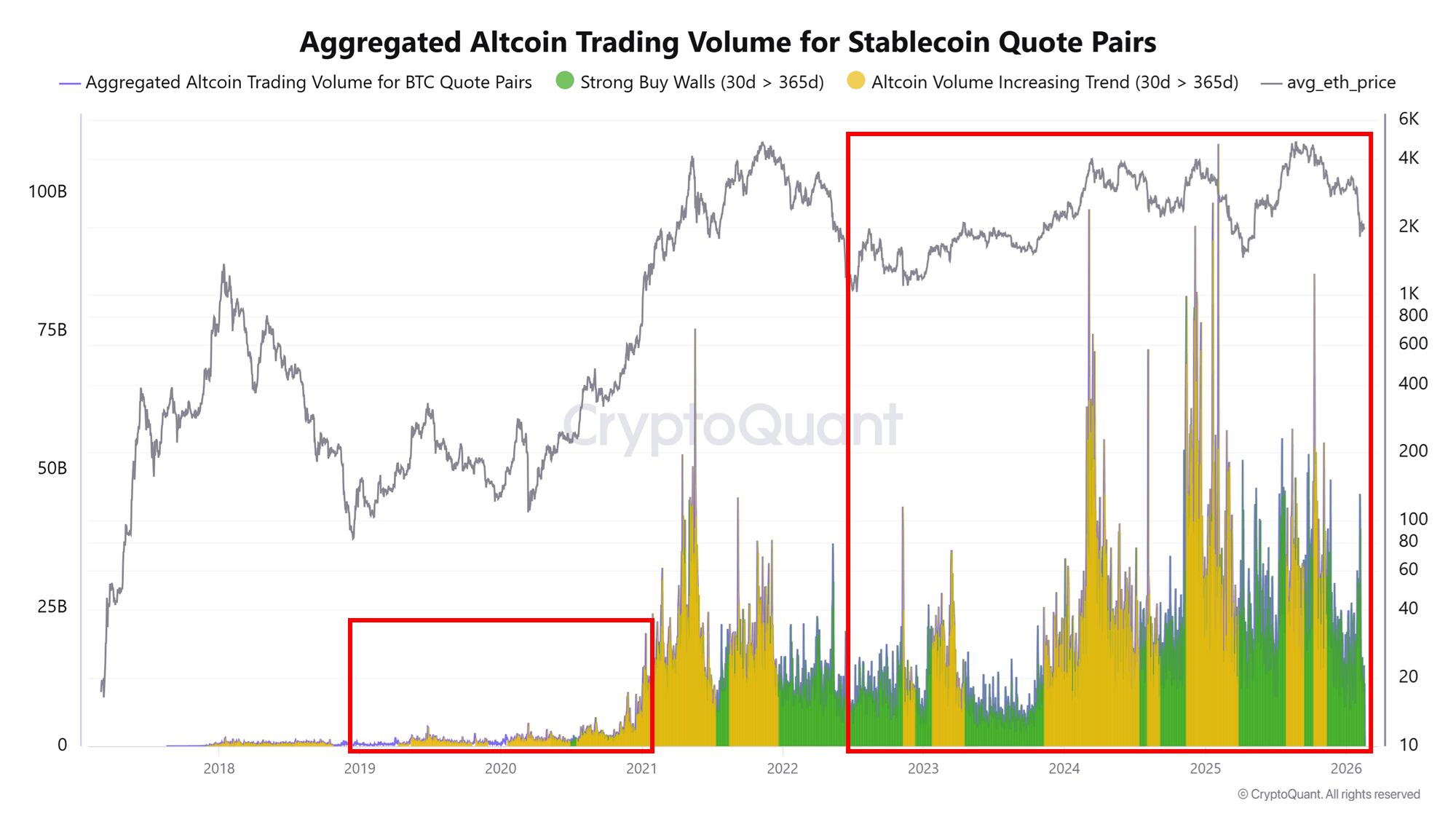
Aggregated Altcoin Trading Volume for Stablecoin Quote Pairs | Source: CryptoQuant

Some analysts argue that the current cycle may be characterized by unusually strong preparatory accumulation compared with previous market phases. Elevated spot volumes alongside persistent volatility suggest capital rotation rather than outright market exit in certain segments.

That said, projections about a future altcoin bull phase being significantly stronger than the previous cycle remain speculative. Market structure, macro liquidity conditions, regulatory developments, and Bitcoin dominance will all influence whether such expectations materialize. The data primarily supports a market undergoing redistribution rather than a confirmed bullish reversal.


İlgili Sorular

QAccording to the CryptoQuant report, who is primarily driving the current altcoin selling pressure?

ARetail investors are primarily driving the current altcoin selling pressure, reacting defensively to volatility and prolonged drawdowns.

QWhat does the data suggest is happening to the altcoins being sold by retail investors?

AThe data suggests that a portion of this selling volume is being systematically absorbed by larger or more patient market participants, indicating accumulation.

QWhat is one reason cited for the significant rise in altcoin trading volume despite depressed prices?

AThe increase in activity may reflect repositioning, accumulation, or speculative positioning rather than pure capitulation as the market searches for direction.

QWhat do some analysts argue is unusual about the current market cycle compared to previous ones?

ASome analysts argue the current cycle may be characterized by unusually strong preparatory accumulation.

QWhat factors does the article say will influence whether expectations for a strong altcoin bull phase materialize?

AMarket structure, macro liquidity conditions, regulatory developments, and Bitcoin dominance will all influence whether such expectations materialize.

İlgili Okumalar

The Storage Magnate Who Conquered a Trillion-Dollar Kingdom, Yet Ultimately Could Not Become the Richest

**Summary:** "The Memory Magnate Who Built a Trillion-Dollar Empire, Yet Never Became the Richest" explores the journey of Zhu Yiming, founder of GigaDevice (603986) and co-founder of the soon-to-IPO ChangXin Memory Technologies (CXMT). The article positions GigaDevice, a fabless chip designer now valued at ~¥340 billion, as a prequel to the massive IDM (Integrated Device Manufacturer) venture, CXMT. Starting in 2005 with minimal capital, Zhu strategically "picked up the pieces" by focusing on niche markets like NOR Flash and microcontrollers (MCUs), areas major players were exiting. This allowed GigaDevice to grow into a diversified semiconductor company, maintaining robust profitability even during industry downturns by controlling costs. However, the piece argues that in the highly cyclical and capital-intensive memory chip industry, the fabless model has limits. True resilience and scale require the ability for "counter-cyclical expansion" – investing heavily during downturns – a tactic only possible for IDMs like Samsung or SK Hynix. This insight led Zhu to partner with the Hefei city government in 2016 to establish CXMT, an IDM focused on DRAM. Zhu's symbolic moves, like forfeiting salary and diluting his equity, were crucial in securing the massive state and bank funding needed. CXMT's equipment base is now valued even higher than that of BYD's vast auto manufacturing empire. Despite the potential for CXMT to reach a market cap of ¥1-2 trillion upon its IPO, Zhu's indirect stake in both companies is estimated below 3%, placing his personal wealth far below that of China's top billionaires. The article concludes that his strategic vision built a trillion-yuan memory landscape, but the capital structure necessary to achieve it precluded a personal fortune of similar scale.

marsbit8 dk önce

The Storage Magnate Who Conquered a Trillion-Dollar Kingdom, Yet Ultimately Could Not Become the Richest

marsbit8 dk önce

XRP Ledger Daily Fees Drop Below $400 As Network Activity Question Returns

The XRP Ledger is drawing attention as daily network fees have fallen below $400. While low fees align with XRPL's design for affordable transactions and are often seen as a strength, the metric can also serve as an indicator of network demand and paid transaction volume. This data point of around $3,100 in weekly fee burn highlights the stark contrast with higher-fee chains like Ethereum and Bitcoin. The development fuels an ongoing debate. Proponents view low fees as a sign of efficiency and accessibility, while critics may question if the network is generating sufficient high-value activity relative to its market cap and payments-focused narrative. The article cautions against overstating the finding, noting a single low-fee day does not signify network failure. It instead adds context to discussions about XRPL's usage, especially alongside Ripple's broader initiatives in stablecoins (RLUSD), AI payments, and enterprise infrastructure. The report recommends monitoring for a fee rebound, checking transaction counts for a fuller picture, and confirming the trend via native explorers like Bithomp. It frames the story within a larger market shift where on-chain data, protocol updates, and infrastructure developments are becoming crucial alongside price action. The editorial stance is to present the verified data, explain its significance for assessing network activity, and avoid hype, positioning it as part of the daily crypto conversation.

bitcoinist4 saat önce

XRP Ledger Daily Fees Drop Below $400 As Network Activity Question Returns

bitcoinist4 saat önce

İşlemler

Spot
Futures
活动图片




