Crypto Watch This Week: Uniswap Fee Switch Vote Starts Today, CLARITY Act Could Face Senate Vote This Week

marsbit2026-07-20 tarihinde yayınlandı2026-07-20 tarihinde güncellendi

Özet

**Weekly Crypto Watch: Key Events & Catalysts** This week’s crypto focus is on pivotal governance votes, potential regulatory progress, and major protocol upgrades. **Uniswap** takes center stage with two crucial on-chain proposals going to vote from July 19-26. The first aims to activate protocol fees for Uniswap V2/V3 on the new Robinhood Chain and direct them to a UNI token burn mechanism. The second seeks to activate V4 fees across seven major chains, including Ethereum and Base. Robinhood Chain has already seen over $60B in Uniswap volume since its launch 18 days ago. The proposals build on last year's UNIfication plan, which transformed UNI into a fee-generating asset. On the **U.S. regulatory front**, the **CLARITY Act** could face a Senate floor vote this week. While some lawmakers are optimistic, the bill faces hurdles, needing at least 60 votes to overcome a filibuster. Prediction market Polymarket currently gives it only a 34% chance of being signed into law this year. Other notable catalysts include: * **Morpho's** fixed-rate lending protocol, **Morpho Midnight**, is set for its public launch, starting with a single market (cbBTC/USDC) on Base. * **Derive** (formerly Lyra) is preparing for its largest-ever upgrade, **V3**, which will reportedly introduce 0DTE options and a more retail-friendly UX. * **Pendle** will hold a community call on July 22 to share its roadmap, with a focus on expanding its RWA (Real World Assets) capabilities. * An undisclosed...

Author: Claude, Shenchao TechFlow

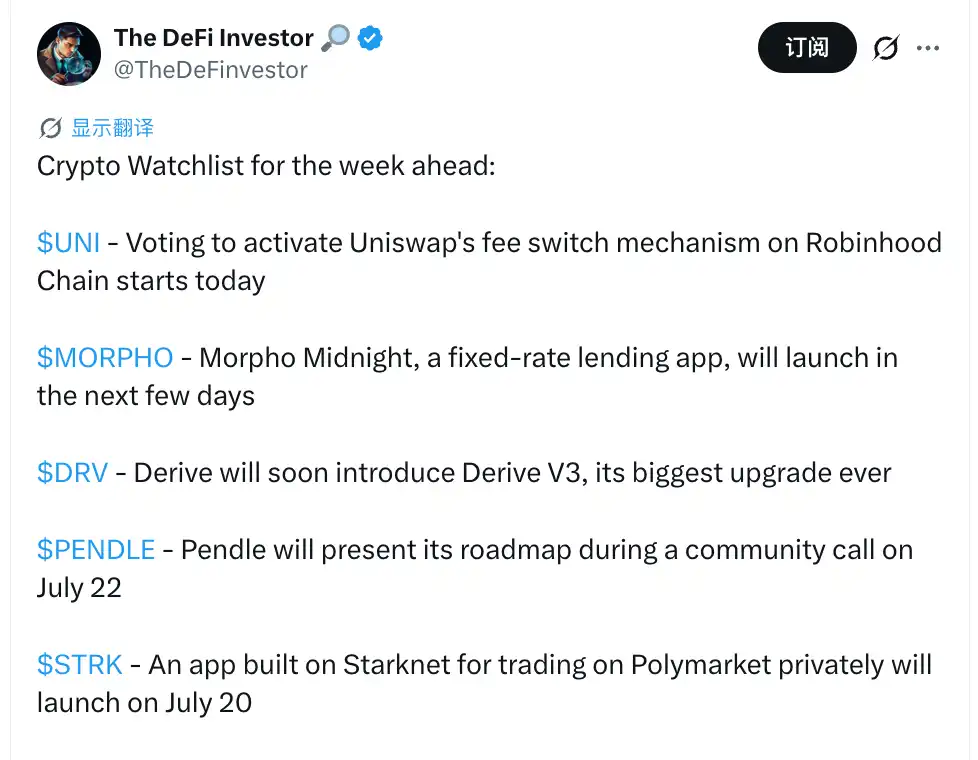
Shenchao TechFlow: Crypto KOL @TheDeFiInvestor listed this week's catalyst rundown, with 6 projects releasing positive news intensively, but the main theme of this week is regulation and revenue. Uniswap initiates on-chain voting today, proposing to channel V2/V3 protocol fees on Robinhood Chain into the UNI burn mechanism, while simultaneously activating V4 protocol fees on 7 chains. Robinhood Chain, live for only 18 days, has already seen cumulative Uniswap trading volume exceed $60 billion. On the macro front, Representative Bryan Steil expressed optimism about the CLARITY Act passing the Senate next week, but Polymarket gives it only a 34% probability of being signed into law this year. The Morpho Midnight fixed-rate lending protocol is set to go live publicly, Derive's V3 upgrade is imminent, and Pendle's community call on July 22 will disclose its roadmap.
UNI: Fee Switch Vote Starts Today, Robinhood Chain's $60B Trading Volume to Enter Burn Mechanism

The most significant catalyst this week is Uniswap.

According to Crypto News on July 19, Uniswap founder Hayden Adams submitted two governance proposals on July 17, entering the final on-chain voting phase: the first to activate V2 and V3 protocol fees on Robinhood Chain, the second to activate V4 protocol fees on 7 chains including Ethereum, Base, Arbitrum, Robinhood Chain, BNB Chain, Polygon, and Optimism. The voting window is from July 19 to July 26, requiring a quorum of 40 million UNI to pass.

According to Crypto Times, Uniswap, deployed on Robinhood Chain for only 18 days, has seen cumulative trading volume surpass $60 billion. Robinhood Chain even briefly surpassed Hyperliquid in daily DEX volume, breaking $375 million in a single day. If the proposals pass, protocol fees collected on Robinhood Chain will flow into the TokenJar contract and eventually be bridged back to the Ethereum mainnet to burn UNI.

The backdrop of these proposals is the UNIfication proposal passed in December 2025. UNIfication passed with 125 million UNI votes in favor (only 742 against), first linking protocol fees to UNI burning, transforming UNI from a pure governance token into a cash-flow asset. According to Crypto News, Adams revealed on July 12 that Uniswap's daily average fee revenue had reached $5.2 million, surpassing all crypto protocols except the top two stablecoin issuers.

Risk reminder for holders: Voting is not yet concluded; after passing, there is a 2-day timelock. V4 fee structure is more complex due to hooks mechanism, with actual rates varying significantly by pool type. UNI has rebounded about 30% from the $2.70 low in July. Standard Chartered analyst Geoff Kendrick gave a year-end 2026 target price of $6.50, but this represents a single analyst view. Short-term sentiment appears relatively fully priced.

Macro Event: CLARITY Act Could Face Full Senate Vote This Week, But Polymarket Gives Only 34% Odds

The US crypto market structure bill, the CLARITY Act, is in its final sprint.

According to Benzinga on July 18, House Financial Services Committee Digital Assets Subcommittee Chairman Bryan Steil stated at a hearing in New York's Federal Hall that he is optimistic the Senate will pass the bill next week. Senator Cynthia Lummis is also reported to expect a full Senate vote during the week of July 20. Senate Republicans released an updated bill text following talks with the Trump White House.
According to CoinDesk on July 9, the bill needs to merge versions from the Senate Banking and Agriculture Committees and secure 60 votes to overcome the filibuster threshold. Republicans currently hold 53 seats, but Senators Josh Hawley and Rand Paul are expected to vote no, meaning at least 7 to 9 Democratic votes are needed. Currently, only two Democrats, Ruben Gallego and Angela Alsobrooks, voted in favor at the committee stage. According to Yahoo Finance, Stifel's chief Washington policy strategist Brian Gardner believes the bill "likely needs to pass the Senate by the end of July," or its prospects will "materially deteriorate."

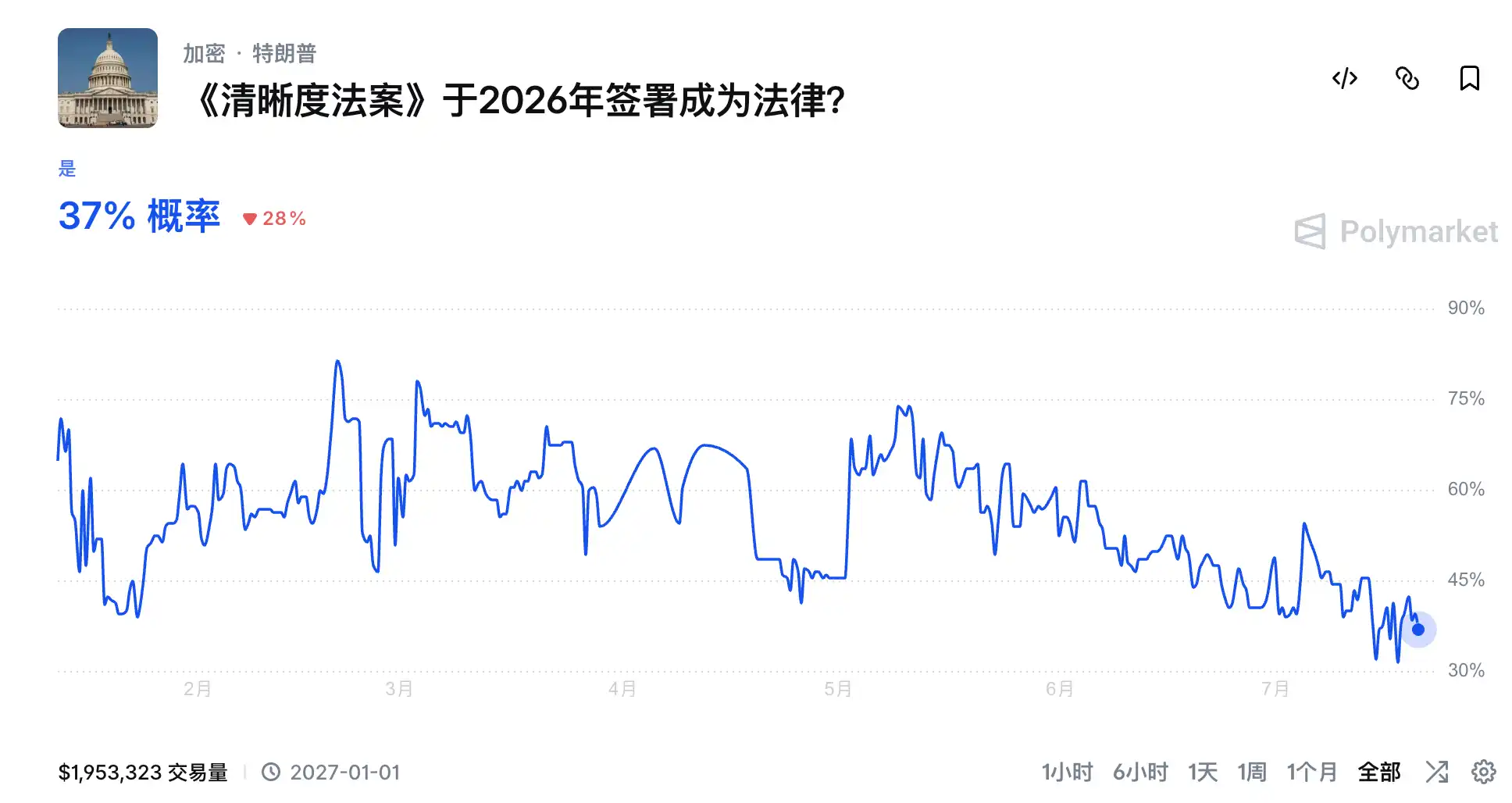
On Polymarket, the odds for the CLARITY Act being signed into law this year stand at 34%, having previously touched 44% before quickly retreating.

For the crypto market, the bill would delineate digital asset regulatory boundaries between the SEC and CFTC, the most anticipated legislation in years for the industry. However, Democratic concerns over Trump's crypto conflicts of interest remain the biggest obstacle.

MORPHO: Morpho Midnight Fixed-Rate Lending Protocol Set for Public Launch

According to Bankless on July 17, Morpho CEO Paul Frambot announced that Morpho Midnight will end its months-long testing period and officially launch publicly "in the coming days." According to CoinMarketCap, the mainnet launch date for Midnight is July 18.

Morpho Midnight is the third-generation paradigm for DeFi lending. Frambot describes it as: first-gen protocols (like Compound) set risk, rates, and maturity by the protocol; Morpho Blue delegated risk management to vault curators; Midnight further delegates rate and maturity to the market. Lenders and borrowers trade around fixed rates and real maturity dates set by the market, introducing the long-missing duration dimension to DeFi.

The initial release is deliberately restrained: launching only one market on Base chain (cbBTC/USDC, also the largest market on Morpho Blue), offering multiple maturities, no vault adapter integration, no auto-rolling, and no cross-chain functionality. The subsequent roadmap includes vault adapters (connecting tens of billions in Morpho Vaults liquidity), more chains and collateral types, compliance gating, APIs, etc.

Morpho's current TVL is approximately $7.7 billion, second only to Aave, ranking second among DeFi lending protocols. According to CoinMarketCap data, Galaxy Curator integrated with Fireblocks Earn on July 17, directly connecting Morpho vault yields to over 2,400 institutions.

Risk reminder for holders: Fixed-rate lending has been attempted multiple times in DeFi but never truly scaled. Attracting sustained liquidity is the core challenge. The initial launch features only a single market on a single chain, limiting short-term impact on protocol revenue.

DRV: Derive to Launch V3 Soon, Its Largest Upgrade Ever

@TheDeFiInvestor states that Derive will launch V3 "soon," defining it as its largest upgrade ever.

Derive (formerly Lyra) is an on-chain options and derivatives protocol built on Derive L2 (an Ethereum Rollup based on OP Stack). According to CoinMarketCap, V3 will introduce 0DTE (Zero Days to Expiry) options and a more retail-oriented user experience.

Recent developments: DRV began trading on Coinbase on May 27, its largest centralized exchange listing. On April 23, the DAO passed a proposal to increase the proportion of protocol fees used for DRV buybacks from 25% to 35%, while cutting weekly staking emissions from 250k to 100k tokens. The DAO has cumulatively repurchased over 23 million DRV.

Risk reminder for holders: DRV market cap is approximately $116 million, with daily trading volume only about $170k, indicating relatively thin liquidity. The specific launch date and full feature list for V3 have not been officially released. The phrasing "soon" is akin to Aave App's "soon"—don't treat vague expectations as definite catalysts.

PENDLE: Community Call on July 22 to Disclose Roadmap, RWA Momentum is Focus

According to an official Pendle X post (published July 16), Pendle will hold a community call on Discord on July 22 at 1 PM UTC. Pendle previewed in the post that it will share "new updates" covering the next steps for RWA momentum and the roadmap to make Pendle "the greatest yield trading platform in global finance."

According to CoinMarketCap analysis, Pendle's recent expansion directions include distributing 470k MON tokens on Monad as incentives for YT holders (starting July 23), and expanding into commodity and stock perps (WTI Crude, Brent Crude, Gold, Silver, NVDA, TSLA, etc.) via Boros. Sierra integrated with Pendle in early July, offering structured yield products.

Risk reminder for holders: Community calls are inherently informational events. If the roadmap lacks substantive content beyond known expectations, it could trigger a "buy the rumor, sell the news" reaction. PENDLE's current price is approximately $1.52, market cap around $260 million, with 7-day price change nearly flat.

STRK: Starknet-Based Polymarket Privacy Trading App to Launch Privately on July 20

Public information indicates an application built on Starknet will launch privately on July 20, enabling users to trade on Polymarket in a privacy-preserving manner.

The specific project name and detailed information for this catalyst have not been publicly disclosed; it's a single-source report. However, the context is plausible: Starknet just rolled out a suite of privacy features (Private Yield, Private Swaps, Private Transfers) on July 3, and released the STRK20 private token standard on July 15, providing native support for protected ERC-20 transfers. A Polymarket frontend leveraging Starknet's ZK privacy capabilities is technically feasible.

Risk reminder for holders: The app's name, team, and functional scope have not been confirmed by independent sources. STRK faced approximately 127 million early investor token unlocks in mid-July, presenting supply-side pressure independent of the app launch. STRK's current price is around $0.029, down about 5.5% over 7 days, trading in its historical low range.


İlgili Sorular

QWhat are the two key Uniswap governance proposals currently under on-chain voting, and what is the main purpose of them?

AThe two proposals are: 1) Activating protocol fees for V2 and V3 on Robinhood Chain. 2) Activating V4 protocol fees on Ethereum, Base, Arbitrum, Robinhood Chain, BNB Chain, Polygon, and Optimism. Their main purpose is to direct a portion of the protocol fees collected on these chains into a mechanism to buy back and burn UNI tokens, effectively turning UNI into a cash-flow generating asset.

QAccording to the article, what is the current probability for the CLARITY Act to be signed into law this year on Polymarket, and what is a major obstacle to its passage in the Senate?

AThe current probability for the CLARITY Act to be signed into law this year on Polymarket is 34%. A major obstacle to its passage in the Senate is securing enough Democratic votes, as concerns about potential crypto-related conflicts of interest for former President Trump have caused hesitation among some Democratic senators.

QWhat is Morpho Midnight, and how does it represent a 'third paradigm' for DeFi lending according to its CEO?

AMorpho Midnight is a fixed-rate lending protocol. According to Morpho CEO Paul Frambot, it represents a 'third paradigm' for DeFi lending: the first generation (e.g., Compound) had the protocol set risk, rates, and maturity; Morpho Blue delegated risk management to vault curators; Midnight further delegates both interest rates and maturity terms to the market, allowing borrowers and lenders to trade based on fixed rates and specific maturities.

QWhat major upgrade is the Derive (DRV) protocol expected to release soon, and what are two key features mentioned for this V3 upgrade?

ADerive (DRV) is expected to soon release its V3 upgrade, described as its biggest ever. Two key features mentioned for V3 are the introduction of 0DTE (Zero Days to Expiry) options and a more retail-focused user experience.

QWhat event is scheduled for Pendle on July 22nd, and what are the two main topics expected to be covered according to the announcement?

APendle has scheduled a community call on Discord for July 22nd. According to the announcement, the call is expected to cover 'new updates,' specifically focusing on the next steps for its Real World Assets (RWA) momentum and the roadmap to make Pendle 'the greatest yield trading platform in global finance.'

İlgili Okumalar

Must-Watch Events Next Week|CLARITY Act Could Face Senate Vote; SpaceX, Circle to Report Earnings (8.3-8.9)

**Summary: Key Events and Developments to Watch (August 3-9)** The upcoming week is marked by significant financial disclosures, key legislative deadlines, and notable product updates. **Major Financial Events:** Several companies are scheduled to release their Q2 2026 earnings. American Bitcoin (ABTC) will report on August 3, followed by SpaceX and Hut 8 Mining Corp. on August 4, and Circle on August 5. Notably, a significant portion of SpaceX shares (up to 12% of total shares) will be unlocked on August 6 following their earnings release. **Key Legislative Deadline:** The U.S. Senate faces an August 7 deadline to secure 60 votes for the CLARITY Act, a bipartisan bill aiming to establish a federal regulatory framework for cryptocurrencies. The Senate may hold a full vote on the bill during the week. **Economic Data:** The U.S. July Non-Farm Payrolls report will be released on August 7, providing crucial labor market data. **Technology & Product Updates:** * **Shutdowns:** DeFi portfolio tracker Zapper and wallet app Ctrl Wallet will cease operations on August 3. * **Upgrades:** LayerZero will deprecate its v1 relayers on August 3. XRP Ledger's new version 3.3.0, featuring five new functions, is expected next week. * **AI:** Elon Musk announced that the advanced Grok 4.6 AI model is set for release around August 7. * **Bitcoin:** The BIP-110 forced signaling for a potential Bitcoin network change is scheduled to begin around August 8. **Other Notable Events:** Chinese robotics firm Unitree Tech has set its preliminary price inquiry for its IPO for August 5. South Korean exchange Upbit will delist AQT and AERGO tokens on August 3.

marsbit1 saat önce

Must-Watch Events Next Week|CLARITY Act Could Face Senate Vote; SpaceX, Circle to Report Earnings (8.3-8.9)

marsbit1 saat önce

Stocks Are Plummeting More Sharply Than Cryptocurrencies. Where Has the Money Gone?

Stock Markets Plunge Deeper Than Cryptocurrencies: Where Did the Money Go? In late July, Seoul's Kospi index triggered circuit breakers for two consecutive days, plummeting over 40% from its June high. The collapse was led by heavyweight stocks like SK Hynix, whose record profits still disappointed investors, and devastating leveraged ETFs, with one major product losing over 83% of its value. This signaled a global, forced deleveraging targeting the most crowded trades. Interestingly, while stocks exhibited extreme volatility akin to crypto markets, Bitcoin rose nearly 15% in July after a prior steep drop. Analysis shows the money fleeing equities did not flow into Bitcoin. Instead, Bitcoin had already absorbed its sell-off in May-June, when U.S. spot Bitcoin ETFs saw historic outflows. The true safe-haven beneficiary was gold, whose price rose over 20% year-on-year, highlighting a decoupling between Bitcoin and gold as "digital gold." The sell-off was a targeted unwinding of leveraged positions in tech and semiconductors, accelerated by broker-dealer risk management and shifts in the AI narrative, including new competition from Chinese memory chipmakers. The retreat path was clear: from high-valuation tech stocks to cash and U.S. Treasuries, then to gold. For Bitcoin to attract sustained institutional inflows, conditions like eased global liquidity pressure, a "soft-landing" Fed rate cut, and U.S. regulatory clarity via legislation like the stalled CLARITY Act are needed. Currently, Bitcoin is not a safe haven but an already-cleared asset. Its low correlation with tech stocks, however, makes it a potential diversification play for institutional portfolios once the storm passes. The money isn't here yet, but the positioning is underway.

marsbit1 saat önce

Stocks Are Plummeting More Sharply Than Cryptocurrencies. Where Has the Money Gone?

marsbit1 saat önce

In Conversation with Ray Dalio: We Are Currently in an AI Bubble, with 1% of My Portfolio in Bitcoin

Ray Dalio, founder of Bridgewater Associates, warns in an interview that the current AI boom shows classic bubble characteristics, which could lead to significant economic downturns as seen in past cycles like 1929 or 2000. He explains that speculative enthusiasm, fueled by debt and overvaluation, often precedes a crash when rising rates or taxation force asset sales, causing widespread losses and recession. Dalio also outlines his "Big Cycle" theory, describing an approximate 80-year pattern where widening wealth gaps, massive government deficits, and shifting geopolitical power (like China's rise) create internal conflict and global instability. He emphasizes that we are in a late-cycle, transitional phase where traditional powers like the US and UK face decline. For personal wealth protection, Dalio advises diversification beyond cash into assets like stocks, bonds, real estate, and particularly gold, which he prefers over Bitcoin. While he holds about 1% of his portfolio in Bitcoin as a non-printable hard asset, he views gold as more secure from technological or governmental threats. Regarding AI's impact, Dalio believes it will disproportionately benefit capital owners, worsening inequality by replacing both physical and cognitive labor. He suggests that human intuition and emotional intelligence, combined with AI, will be key for future workers. On taxation, Dalio argues that wealth taxes are impractical and risk triggering asset sell-offs, reducing productive investment. He points to the UK as a cautionary example of debt, low productivity, and political strife. Geopolitically, Dalio foresees a more regionalized world, with the US showing weakness in prolonged conflicts like with Iran, akin to past imperial declines. The ideal outcome, he suggests, is coexisting powerful blocs (e.g., Americas, China-Asia Pacific) without major war.

marsbit5 saat önce

In Conversation with Ray Dalio: We Are Currently in an AI Bubble, with 1% of My Portfolio in Bitcoin

marsbit5 saat önce

İşlemler

Spot
活动图片




