Crypto Users Hit By 1,400% Surge In Impersonation Scams, Research Shows

bitcoinist2026-01-14 tarihinde yayınlandı2026-01-14 tarihinde güncellendi

Özet

Impersonation scams surged by 1,400% in 2025, causing billions in losses as criminals used AI tools, voice cloning, and fake customer-support schemes. The average scam amount increased by over 600%, with AI-enabled methods proving several times more profitable. Scammers impersonated exchange staff and celebrities using deepfakes and sophisticated social engineering, making operations more efficient and harder to trace. One high-profile case stole nearly $16 million. Total on-chain crypto scam losses for 2025 are estimated between $14 billion and $17 billion.

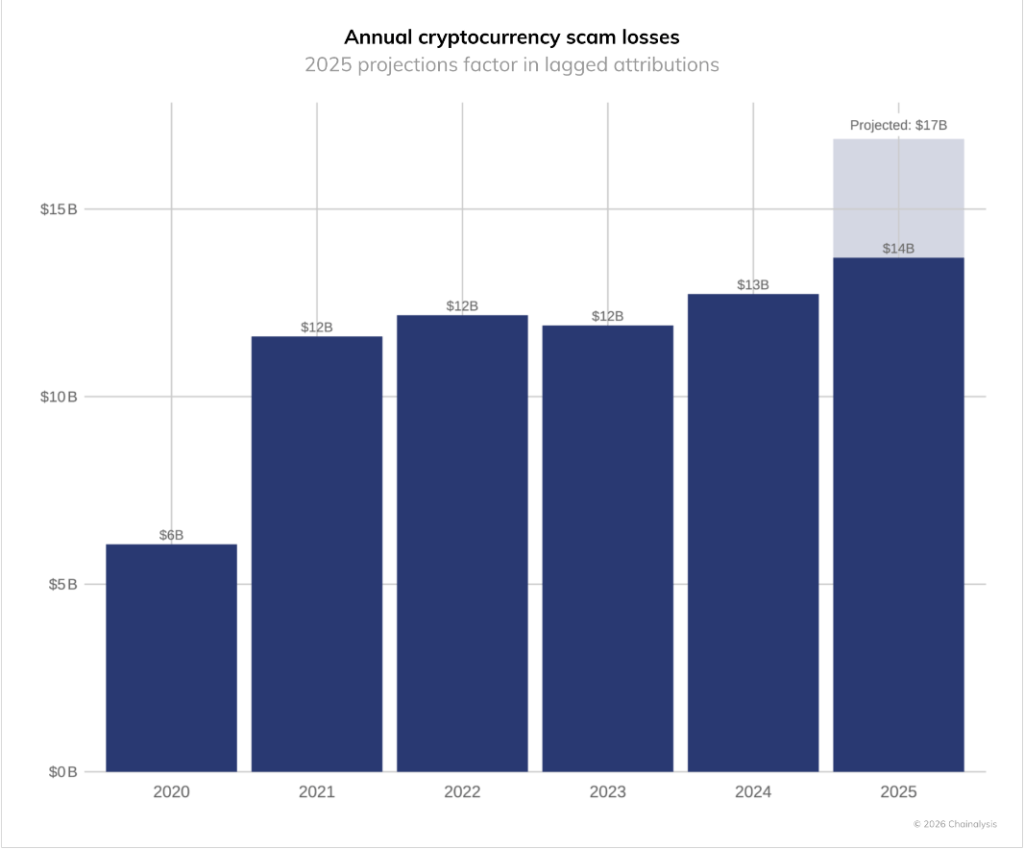
Impersonation scams exploded in 2025, growing by about 1,400% and driving some of the biggest losses seen in crypto fraud to date. According to analysis by Chainalysis, scammers used AI tools, voice cloning and fake customer-support schemes to scale up attacks, pushing total scam losses on chain into the low-double-digit billions.

Impersonation Scams Jump Dramatically

Reports have disclosed that the rise was not just in the number of cases but in how much each case cost victims. The average amount taken in impersonation schemes rose by over 600% compared with the prior year, a jump that turned many small cons into large heists. Chainalysis highlights the role of automated tooling and commercially available phishing services that let scammers run scams like factories.
Source: Chainalysis

Criminals Used AI And Deepfakes

Fraudsters leaned heavily on AI techniques in 2025. Based on reports, AI-generated voice and face clones, paired with very believable messages, helped criminals impersonate exchange staff, celebrities or close contacts. These methods increased both reach and success rates. Industry writeups and analysts show that AI-enabled scams were several times more profitable than older approaches.

BTCUSD currently trading at $94,929. Chart: TradingView

A High-Profile Example Shows The Risk

One public example involved scammers posing as a major exchange and clearing nearly $16 million from victims in a single operation. That case became a headline because it showed how quickly an impersonation scam can turn into a mass theft when it uses polished fake identities and coordinated social engineering. Financial news outlets and industry trackers used that case to illustrate the shift in tactics.

Operations Became Industrialized

Based on Chainalysis data, scam groups now resemble small businesses. They outsource parts of the fraud chain — writing scripts, buying deepfake clips, and hiring money movers. This setup made fraud more efficient and harder to disrupt. One analysis found AI-assisted schemes were about 4.5 times more profitable than traditional scams, a gap that attackers exploited to level up operations quickly.

Estimates of total crypto scam losses for 2025 vary by outlet, but multiple sources put the number well into the billions. Some trackers reported $14 billion in funds stolen on chain, while Chainalysis noted the figure could be as high as $17 billion once more data is tallied. The difference reflects how quickly new incidents were discovered and how some thefts moved off public rails.

Featured image from Unsplash, chart from TradingView

İlgili Sorular

QWhat was the percentage increase in impersonation scams in 2025 according to the research?

AImpersonation scams grew by about 1,400% in 2025.

QWhich company provided the analysis on the surge in crypto impersonation scams?

AThe analysis was provided by Chainalysis.

QWhat technologies did scammers heavily rely on to scale up their attacks in 2025?

AScammers heavily relied on AI tools, voice cloning, and fake customer-support schemes to scale up their attacks.

QHow much more profitable were AI-enabled scams compared to traditional approaches according to one analysis?

AOne analysis found that AI-assisted schemes were about 4.5 times more profitable than traditional scams.

QWhat is the estimated range of total crypto scam losses for 2025 as mentioned in the article?

AEstimates vary, with some sources reporting $14 billion and Chainalysis noting the figure could be as high as $17 billion once more data is tallied.

İlgili Okumalar

$9.4 Billion: The Largest Robotics Funding This Year Has Emerged

Munich-based humanoid robotics company Neura has completed a $1.4 billion (approximately RMB 94.9 billion) Series C funding round, valuing the company at around $7 billion and positioning it among the global leaders in the sector. The investment round is notable not just for its size—reportedly the largest in robotics this year—but also for its strategic backers, which include tech giants like NVIDIA and Amazon, alongside established industrial players such as German engineering firms Bosch and Schaeffler. This mix of investors signals a significant shift in the industry's focus from technological demonstrations and general-purpose narratives toward practical, industrial deployment and commercialization. Neura's approach centers on developing humanoid robots for defined, high-value industrial tasks rather than pursuing a general-purpose model. Its early validation comes from a partnership with BMW, where its robots are being tested on actual production lines. The involvement of Bosch and Schaeffler, companies deeply embedded in global manufacturing, underscores a growing belief that humanoid robots are transitioning from labs to viable factory-floor solutions. The article highlights two converging trends driving investment: advancements in AI and large language models, which enhance robots' perception and decision-making in unstructured environments, and mounting pressure from labor shortages and rising costs in major manufacturing regions. The funding landscape is now bifurcating between companies like Figure AI, focusing on versatile general-purpose robots, and firms like Neura, targeting specific vertical industrial applications with clearer, shorter paths to ROI. While technical hurdles remain, the core challenges for widespread adoption are increasingly seen as engineering and commercial in nature: managing the high integration and customization costs for different factory environments and establishing robust, localized maintenance and service networks. The record investment in Neura, particularly from industrial capital, indicates the industry's growing confidence in moving from proving feasibility to solving the practical problems of scalability, reliability, and building sustainable business models around humanoid robots in real-world settings like automotive manufacturing and hazardous labor environments.

marsbit5 saat önce

$9.4 Billion: The Largest Robotics Funding This Year Has Emerged

marsbit5 saat önce

İşlemler

Spot
Futures
活动图片





