Crypto User Loses $282M In Social Engineering Attack — Details

bitcoinist2026-01-18 tarihinde yayınlandı2026-01-18 tarihinde güncellendi

Özet

A crypto user suffered one of the largest social engineering attacks in history, losing over $282 million in Bitcoin and Litecoin on January 10, 2026. The victim was tricked into sharing their seed phrase, allowing the attacker to drain their hardware wallet. The exploiter quickly moved the funds across multiple networks, converting a significant portion into Monero (XMR), causing its price to surge to nearly $800. The stolen assets were also bridged via THORChain, reigniting debates on censorship-resistant cross-chain protocols. While some suspected state involvement, investigators ruled out North Korea. Security firm ZeroShadow confirmed the attacker impersonated Trezor support and managed to freeze around $700,000 in assets. The incident highlights ongoing vulnerabilities in the digital asset space.

2026 got off to a disastrous start for one crypto user, who fell victim to one of the largest social engineering attacks in digital asset history, losing over $282 million in Bitcoin and Litecoin.

How Crypto User Fell Victim To $282M Theft

According to prominent blockchain sleuth ZachXBT, the crypto theft occurred on January 10, 2026 at around 11:00 pm UTC. Around 2.05 million Litecoin (worth roughly $153 million) and 1,459 Bitcoin (equivalent to around $139 million) was drained from the victim’s hardware wallet after they were tricked into sharing their seed phrase.

The exploiter swiftly transferred the funds across multiple networks to obscure the trail after gaining full control of the crypto wallet. As revealed by ZachXBT, the attacker first began converting the stolen crypto assets into Monero’s native token, XMR, through multiple instant exchanges, leading to a surge in the price of XMR.

Furthermore, the exploiter bridged significant amounts of the stolen Bitcoin across Ethereum, Ripple, and Litecoin through THORChain, a decentralized cross-chain platform that enables users to swap crypto assets between different blockchain networks. Unsurprisingly, this move reignited the debate around the use — or abuse — of censorship-resistant cross-chain protocols, especially during security breaches.

After the news of the attack made it to social media, conversations around the entity or persons behind $282 million theft started, with many linking it to a state-sponsored hacking group. However, ZachXBT categorically stated that “it’s not North Korea,” potentially exonerating the infamous state-backed Lazarus Group.
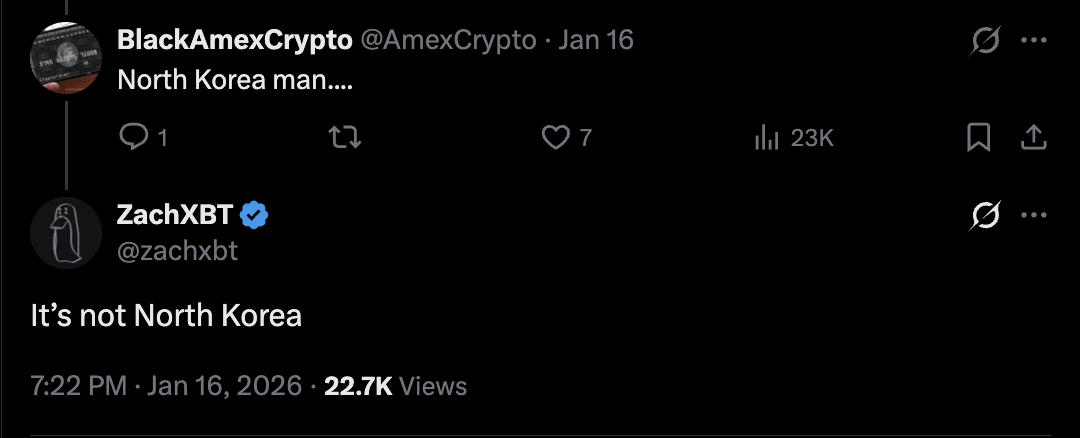
Source: @zachxbt on X

In a post on LinkedIn, security firm ZeroShadow described the victim as a Bitcoin wallet “belonging to an individual who had been tricked into sharing their seed phrase by an actor impersonating Trezor ‘Value Wallet’ support.” The firm claimed that it was able to track and flag parts of the stolen funds in real time after being alerted by blockchain monitoring teams.

According to ZeroShadow, roughly $700,000 worth of crypto assets were reportedly frozen before they could be fully swapped into privacy-focused assets. This latest incident sheds light on how the digital asset industry is still being targeted by malicious actors.

XMR Price Rallies To New High Following Security Incident

As described by ZachXBT, the attacker, after gaining control of the victim’s wallet, began converting the stolen crypto assets into Monero’s native token, XMR, through several exchanges. In the background, this activity pushed the price of the privacy-focused XMR to a new all-time high around $800 over the past week.

According to data from CoinGecko, the XMR token rallied almost 80% to $797.73 from a weekly low around $450 following the crypto theft. As of this writing, XMR is valued at around $588, reflecting a nearly 25% drop in the past few days.

The price of XMR on the daily timeframe | Source: XMRUSDT chart on TradingView


İlgili Sorular

QWhat was the crypto user tricked into sharing that led to the loss of $282 million?

AThe crypto user was tricked into sharing their seed phrase by an actor impersonating Trezor 'Value Wallet' support.

QAccording to ZachXBT, which privacy-focused cryptocurrency did the attacker convert the stolen funds into, causing its price to rally?

AThe attacker converted the stolen funds into Monero's native token, XMR.

QWhat decentralized cross-chain platform did the exploiter use to bridge the stolen Bitcoin across different blockchain networks?

AThe exploiter used THORChain, a decentralized cross-chain platform, to bridge the stolen Bitcoin.

QHow much of the stolen crypto assets were reportedly frozen before they could be fully swapped into privacy-focused assets?

ARoughly $700,000 worth of crypto assets were reportedly frozen.

QWhat was the new all-time high price that XMR reached following the security incident, according to the article?

AXMR reached a new all-time high of around $800 following the security incident.

İlgili Okumalar

U.S. Government Bans Foreign Nationals from Using Fable 5, Anthropic Issues Rebuttal

U.S. Government Bans Foreign Access to Fable 5, Anthropic Issues Rebuttal On June 12th, the U.S. government ordered AI company Anthropic to immediately suspend all foreign access—including foreign nationals within the U.S. and Anthropic's own foreign employees—to its newly released Fable 5 and Mythos 5 AI models, citing national security concerns. This forced Anthropic to temporarily disable access to both models for all users globally, as it cannot technically differentiate user nationality at scale. The models, released just three days prior, represent Anthropic's highest public capability tier. Fable 5 is the first publicly available model from the advanced "Mythos" family, while Mythos 5 is a less-restricted version for approved cybersecurity and critical infrastructure partners. The government's directive was reportedly triggered by claims from another company that it could "jailbreak" Mythos 5, raising alarm within the Trump administration. Anthropic, in a detailed public statement, strongly challenged this rationale. The company argues the demonstrated "jailbreak" is a narrow, non-generalized technique that merely involves identifying minor, known software vulnerabilities—a capability common to other publicly available models like OpenAI's GPT-5.5 and routinely used by cybersecurity defenders. Anthropic stated it has complied with the order but disagrees with the government's standard, warning that applying it industry-wide would halt all new frontier model deployments. The company criticized the lack of a transparent, fact-based legal process and expressed confidence the situation stems from a misunderstanding. It is working to restore access and will release more technical details within 24 hours. Other Anthropic models remain unaffected.

链捕手13 dk önce

U.S. Government Bans Foreign Nationals from Using Fable 5, Anthropic Issues Rebuttal

链捕手13 dk önce

The Revelation from the Raydium Theft Incident: New DeFi Vulnerabilities Lurking in Forgotten Old Contracts

**Raydium Exploit Reveals DeFi's Hidden Risk: Forgotten "Zombie" Contracts** A recent attack on Raydium's deprecated V3 AMM pools resulted in a loss of approximately $1.34 million. The hacker exploited pools that were no longer supported by Raydium's current UI or SDK but remained fully functional and accessible on-chain. This incident highlights a critical, often overlooked category of risk in DeFi: inactive or legacy smart contracts that projects fail to properly decommission. Since March 2025, there have been at least 8 publicly reported attacks targeting such abandoned contracts, with total losses around $10.8 million. Including older pools and deprecated features, the count rises to 10 incidents with roughly $22.5 million in losses. These "zombie contracts" represent a lifecycle management failure rather than a code vulnerability, yet they are typically misclassified under general "code bug" categories in security reports, masking the true scale of the problem. The root cause is that projects often merely document a contract as "deprecated" without taking essential technical steps to secure it: withdrawing remaining assets, disabling external call functions, and implementing ongoing monitoring. These forgotten, under-monitored components become prime targets for attackers. To address this, the industry needs to recognize "zombie contracts" as a distinct risk category and establish standardized decommissioning protocols. Essential steps should include: 1) a formal retirement announcement, 2) removal of all front-end integrations, 3) withdrawal of locked assets, 4) disabling key contract functions, 5) ongoing security monitoring, 6) clear user communication, and 7) a post-mortem analysis. The value of a DeFi project lies not only in its current TVL but also in the security of its historical codebase, which has now become a new attack surface.

Foresight News2 saat önce

The Revelation from the Raydium Theft Incident: New DeFi Vulnerabilities Lurking in Forgotten Old Contracts

Foresight News2 saat önce

Robots Begin to 'Consume Data': The Hidden Production Chain from Indian Data Factories to Billion-Dollar Humanoid Robots

Robots have started to 'consume data,' driving the formation of a new industrial supply chain focused on producing training data for embodied AI. Unlike large language models, which are trained on vast internet text corpora, embodied AI models face a 'data desert' in the physical world. This has created a massive demand for first-person perspective video data (Ego Data), captured by workers wearing cameras in places like Indian garment factories. Companies like Neocambrian AI are establishing 'data factories' where workers perform standardized tasks (e.g., sorting clothes, kitchen organization) to generate thousands of hours of video. Research, such as NVIDIA's EgoScale, demonstrates that scaling this human demonstration data predictably improves robot performance, particularly for dexterous manipulation. This has validated a training path combining large-scale human data for pre-training with smaller amounts of robot-specific data for fine-tuning. The value of different data types varies significantly, forming a 'data pyramid.' The base consists of low-cost, large-scale internet and Ego Data. Higher layers include more expensive motion-capture data (e.g., from data gloves), simulation/synthetic data, and the most costly and scarce layer: real robot teleoperation data. This demand has spawned a layered ecosystem of data suppliers: low-cost data factories, motion capture and alignment specialists, robot-native teleoperation service providers, simulation data companies, and platforms aiming for data standardization. Robot companies themselves are adopting a 'layered procurement' strategy: outsourcing generic Ego Data while building in-house capabilities for robot-specific adaptation data and the critical deployment/failure data generated in real-world applications. The industry is shifting focus from hardware and basic mobility to the data pipelines required for general-purpose capability. While parallels exist to data labeling companies like Scale AI in the LLM boom, the physical complexity of robot data—involving action success ambiguity and sim-to-real gaps—requires more integrated solutions for data collection, annotation, and a continuous feedback loop. The race is on to build the data engines that will teach robots to operate reliably in the unstructured real world.

marsbit4 saat önce

Robots Begin to 'Consume Data': The Hidden Production Chain from Indian Data Factories to Billion-Dollar Humanoid Robots

marsbit4 saat önce

İşlemler

Spot
Futures

Popüler Makaleler

ONE Nasıl Satın Alınır

HTX.com’a hoş geldiniz! Harmony (ONE) satın alma işlemlerini basit ve kullanışlı bir hâle getirdik. Adım adım açıkladığımız rehberimizi takip ederek kripto yolculuğunuza başlayın. 1. Adım: HTX Hesabınızı OluşturunHTX'te ücretsiz bir hesap açmak için e-posta adresinizi veya telefon numaranızı kullanın. Sorunsuzca kaydolun ve tüm özelliklerin kilidini açın. Hesabımı Aç2. Adım: Kripto Satın Al Bölümüne Gidin ve Ödeme Yönteminizi SeçinKredi/Banka Kartı: Visa veya Mastercard'ınızı kullanarak anında Harmony (ONE) satın alın.Bakiye: Sorunsuz bir şekilde işlem yapmak için HTX hesap bakiyenizdeki fonları kullanın.Üçüncü Taraflar: Kullanımı kolaylaştırmak için Google Pay ve Apple Pay gibi popüler ödeme yöntemlerini ekledik.P2P: HTX'teki diğer kullanıcılarla doğrudan işlem yapın.Borsa Dışı (OTC): Yatırımcılar için kişiye özel hizmetler ve rekabetçi döviz kurları sunuyoruz.3. Adım: Harmony (ONE) Varlıklarınızı SaklayınHarmony (ONE) satın aldıktan sonra HTX hesabınızda saklayın. Alternatif olarak, blok zinciri transferi yoluyla başka bir yere gönderebilir veya diğer kripto para birimlerini takas etmek için kullanabilirsiniz.4. Adım: Harmony (ONE) Varlıklarınızla İşlem YapınHTX'in spot piyasasında Harmony (ONE) ile kolayca işlemler yapın.Hesabınıza erişin, işlem çiftinizi seçin, işlemlerinizi gerçekleştirin ve gerçek zamanlı olarak izleyin. Hem yeni başlayanlar hem de deneyimli yatırımcılar için kullanıcı dostu bir deneyim sunuyoruz.

377 Toplam GörüntülenmeYayınlanma 2024.12.12Güncellenme 2026.06.02

ONE Nasıl Satın Alınır

Tartışmalar

HTX Topluluğuna hoş geldiniz. Burada, en son platform gelişmeleri hakkında bilgi sahibi olabilir ve profesyonel piyasa görüşlerine erişebilirsiniz. Kullanıcıların ONE (ONE) fiyatı hakkındaki görüşleri aşağıda sunulmaktadır.

活动图片