The National Policy Committee of Korea pushed the “second‐phase” crypto act debate until after the June 3 local elections.
Crypto Framework Postponed In A Time Of Need
The Korean outlet Maeil Business Newspaper reported uncertainty in the crypto industry deepening after the National Policy Committee excluded the Framework Act on Digital Assets from the 31st of March agenda.
Lawmakers sent five finance-related bills to the subcommittee that day: the Framework Act on Administrative Regulation, the Credit Information Protection Act, the Microfinance Support Act, the Insurance Business Act, and the Capital Markets Act. Not a single bill related to crypto was included, but the Political Affairs Committee’s plenary session received Representative Kim Nam-geun’s “Partial Amendment to the Act on the Protection of Virtual Asset Users, etc.” and forwarded it to the Bill Review Subcommittee.
Lawmakers opted to park the second‐phase bill during a sensitive election window rather than ram through divisive provisions on banks and exchange tycoons, which have become “core landmines” in the legislative process. Speculation in Korean political coverage suggest that the presidential office and the Financial Services Commission (FSC) are not fully aligned on how far to push ownership caps and how tightly to ring‐fence stablecoin issuance, adding to the deadlock narrative.
The proposed crypto framework comes at a time of major importance, as the aforementioned political disagreements also happen to be the two key fights occurring between major players in the Korean cryptocurrency and financial industry.
The Stablecoins Fight
South Korea has recently seen a tug‐of‐war between The Bank of Korea and the FSC over who gets to issue won‐denominated stablecoins.
The BOK is pushing for a bank‐led consortium model where commercial banks must hold at least 51% of any issuer of won‐denominated stablecoins. Bitcoinist reported this on October last year.
The FSC, however, accepts that stablecoins need strict safeguards but opposes a hard 51% bank‐ownership rule, warning it would lock out tech platforms, fintechs and exchanges that actually build the user‐facing products.
These stablecoin-issuers rules are to be hard‐wired under the Digital Asset Basic Act, so every month of delay leaves existing and would‐be KRW stablecoin issuers operating in a gray zone or stuck on the sidelines. According to local outlet Aju Economy, this is a real and concerning issue for the industry. They reported on and industry insider lament:
We need the bill to be finalized quickly to determine our business direction, but currently, we are keeping all possibilities open, which is only increasing the cost burden.
The Equity-Cap Fight
The FSC has been backing proposals to treat big crypto exchanges more like securities or ATS‐style markets, where no single “same person” can own beyond roughly 15–20% in principle. After heavy pushback, regulators and the ruling party have coalesced around a 20% ceiling for “major shareholders”, with a narrow exception that allows stakes up to 34% for new entrants, mirroring the 33.3% veto line in Korea’s Commercial Act. Bitcoinist covered the story at the beginning of the past month.
For existing giants like Upbit and Bithumb, this is a post‐facto rule. Founders and early backers already hold stakes well above 20%, so a hard cap would force them to sell down significant portions of their equity over a three‐year transition (six years for some smaller exchanges). This could potentially disrupt ongoing M&A and reshape control of the local market.
What This Means For The Market
South Korea seems ready to move from ad‐hoc crackdowns to a comprehensive crypto regime. This delay comes on top of recent moves from Seoul to step up oversight with strategies such as AI surveillance, manipulation probes and tax tracking, and to loosen some restrictions, like easing earlier exchange‐stake proposals and reconsidering corporate crypto trading.
Near term, rule uncertainty around KRW stablecoins and exchange ownership could keep Korean venues’ risk premia high and make local listing or market‐making plans harder to model. Post‐election, a bank‐heavy stablecoin framework plus tighter governance rules could favor well‐capitalized incumbents and banks over smaller, high‐beta platforms. This could reshape liquidity and altcoin listings.
Lawmakers watering down ownership caps or opening up stablecoin issuance beyond banks would be a clear risk‐on signal for KRW‐denominated products and for global firms eyeing Korea’s retail base.
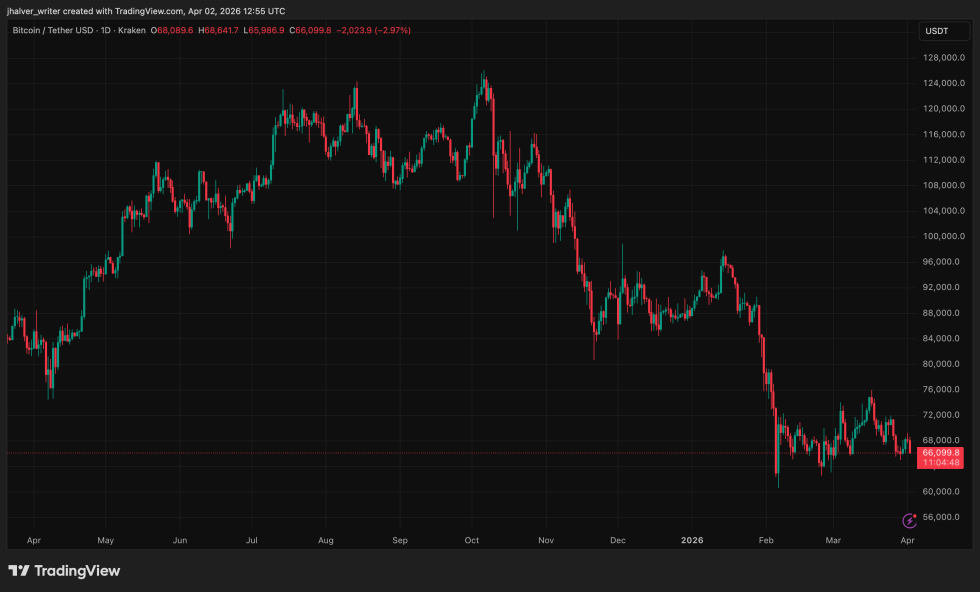
At the moment of writing, BTC trades for exactly $66k on the daily chart. Source: BTCUSDT on Tradingview.
Cover image from Perplexity. BTCUSDT chart from Tradingview.