Crypto Traders On Edge As Korea Stalls Key Law — Is The “Kimchi Premium” At Risk Next?

bitcoinist2026-04-03 tarihinde yayınlandı2026-04-03 tarihinde güncellendi

Özet

The National Policy Committee of Korea has delayed the debate on the "second-phase" crypto framework until after the June local elections, creating uncertainty in the industry. The proposed Digital Asset Basic Act was excluded from the legislative agenda, despite its importance in regulating stablecoins and exchange ownership. Two major conflicts are stalling progress: first, a dispute between the Bank of Korea and the Financial Services Commission (FSC) over whether banks must hold a 51% stake in won-denominated stablecoin issuers. The FSC opposes this, arguing it would exclude tech firms and exchanges. Second, there is disagreement over equity caps for crypto exchanges, with proposals to limit major shareholders to 20%, affecting giants like Upbit and Bithumb. The delay leaves KRW stablecoin issuers in a gray zone and increases operational costs. Post-election, a bank-heavy stablecoin framework and tighter rules could favor large incumbents, reshaping market liquidity and altcoin listings. Weakening these rules could signal greater openness for crypto in Korea.

The National Policy Committee of Korea pushed the “second‐phase” crypto act debate until after the June 3 local elections.

Crypto Framework Postponed In A Time Of Need

The Korean outlet Maeil Business Newspaper reported uncertainty in the crypto industry deepening after the National Policy Committee excluded the Framework Act on Digital Assets from the 31st of March agenda.

Lawmakers sent five finance-related bills to the subcommittee that day: the Framework Act on Administrative Regulation, the Credit Information Protection Act, the Microfinance Support Act, the Insurance Business Act, and the Capital Markets Act. Not a single bill related to crypto was included, but the Political Affairs Committee’s plenary session received Representative Kim Nam-geun’s “Partial Amendment to the Act on the Protection of Virtual Asset Users, etc.” and forwarded it to the Bill Review Subcommittee.

Lawmakers opted to park the second‐phase bill during a sensitive election window rather than ram through divisive provisions on banks and exchange tycoons, which have become “core landmines” in the legislative process. Speculation in Korean political coverage suggest that the presidential office and the Financial Services Commission (FSC) are not fully aligned on how far to push ownership caps and how tightly to ring‐fence stablecoin issuance, adding to the deadlock narrative.

The proposed crypto framework comes at a time of major importance, as the aforementioned political disagreements also happen to be the two key fights occurring between major players in the Korean cryptocurrency and financial industry.

The Stablecoins Fight

South Korea has recently seen a tug‐of‐war between The Bank of Korea and the FSC over who gets to issue won‐denominated stablecoins.

The BOK is pushing for a bank‐led consortium model where commercial banks must hold at least 51% of any issuer of won‐denominated stablecoins. Bitcoinist reported this on October last year.

The FSC, however, accepts that stablecoins need strict safeguards but opposes a hard 51% bank‐ownership rule, warning it would lock out tech platforms, fintechs and exchanges that actually build the user‐facing products.

These stablecoin-issuers rules are to be hard‐wired under the Digital Asset Basic Act, so every month of delay leaves existing and would‐be KRW stablecoin issuers operating in a gray zone or stuck on the sidelines. According to local outlet Aju Economy, this is a real and concerning issue for the industry. They reported on and industry insider lament:

We need the bill to be finalized quickly to determine our business direction, but currently, we are keeping all possibilities open, which is only increasing the cost burden.

The Equity-Cap Fight

The FSC has been backing proposals to treat big crypto exchanges more like securities or ATS‐style markets, where no single “same person” can own beyond roughly 15–20% in principle. After heavy pushback, regulators and the ruling party have coalesced around a 20% ceiling for “major shareholders”, with a narrow exception that allows stakes up to 34% for new entrants, mirroring the 33.3% veto line in Korea’s Commercial Act. Bitcoinist covered the story at the beginning of the past month.

For existing giants like Upbit and Bithumb, this is a post‐facto rule. Founders and early backers already hold stakes well above 20%, so a hard cap would force them to sell down significant portions of their equity over a three‐year transition (six years for some smaller exchanges). This could potentially disrupt ongoing M&A and reshape control of the local market.

What This Means For The Market

South Korea seems ready to move from ad‐hoc crackdowns to a comprehensive crypto regime. This delay comes on top of recent moves from Seoul to step up oversight with strategies such as AI surveillance, manipulation probes and tax tracking, and to loosen some restrictions, like easing earlier exchange‐stake proposals and reconsidering corporate crypto trading.

Near term, rule uncertainty around KRW stablecoins and exchange ownership could keep Korean venues’ risk premia high and make local listing or market‐making plans harder to model. Post‐election, a bank‐heavy stablecoin framework plus tighter governance rules could favor well‐capitalized incumbents and banks over smaller, high‐beta platforms. This could reshape liquidity and altcoin listings.

Lawmakers watering down ownership caps or opening up stablecoin issuance beyond banks would be a clear risk‐on signal for KRW‐denominated products and for global firms eyeing Korea’s retail base.
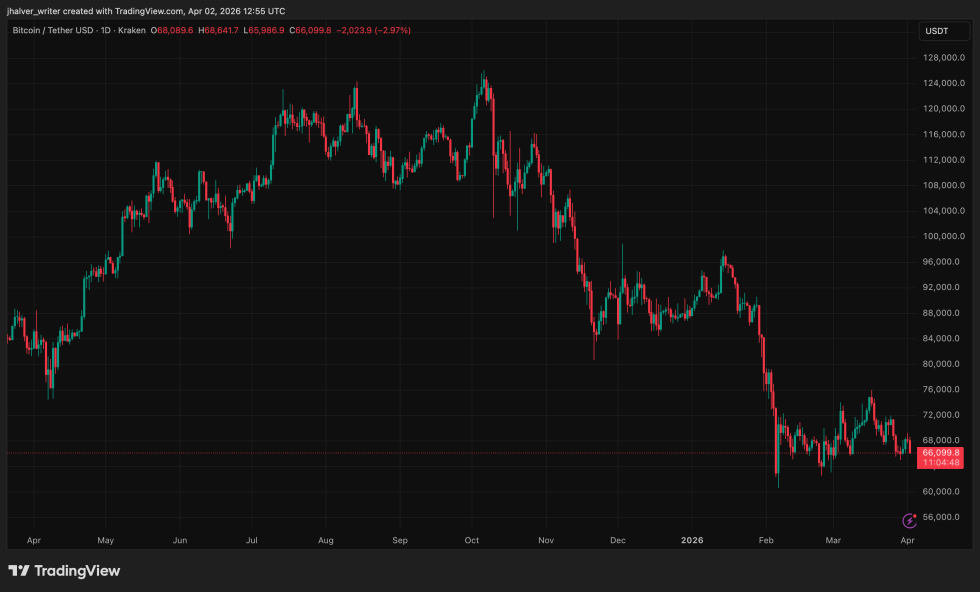
At the moment of writing, BTC trades for exactly $66k on the daily chart. Source: BTCUSDT on Tradingview.

Cover image from Perplexity. BTCUSDT chart from Tradingview.

İlgili Sorular

QWhy was the debate on the 'second-phase' crypto act in Korea postponed?

AThe National Policy Committee of Korea postponed the debate until after the June 3 local elections to avoid pushing through divisive provisions on banks and exchange tycoons during a sensitive election window.

QWhat are the two key disagreements causing a deadlock in the Korean crypto framework legislation?

AThe two key disagreements are over ownership caps for major shareholders of crypto exchanges and the regulatory approach for won-denominated stablecoin issuance, particularly between the Bank of Korea and the Financial Services Commission (FSC).

QHow does the Bank of Korea propose to regulate won-denominated stablecoin issuance?

AThe Bank of Korea is pushing for a bank-led consortium model where commercial banks must hold at least 51% of any issuer of won-denominated stablecoins.

QWhat ownership cap is being proposed for major shareholders of crypto exchanges in Korea?

ARegulators and the ruling party have coalesced around a 20% ceiling for major shareholders, with a narrow exception allowing stakes up to 34% for new entrants.

QWhat are the potential market implications of the delayed crypto legislation in Korea?

AThe delay could keep risk premia high for Korean venues, make local listing or market-making plans harder to model, and potentially reshape liquidity and altcoin listings depending on the final rules for stablecoins and exchange ownership.

İlgili Okumalar

BIP-110 Controversy Intensifies: Bitcoin May Face Its Most Divisive Hard Fork Battle in Years

Bitcoin is approaching a critical block height of 961,632, which could activate the controversial BIP-110 proposal. This proposal aims to restrict the amount of non-financial data, such as inscriptions and other large data payloads, within Bitcoin transactions. Supporters, including some node operators and Bitcoin purists, argue that BIP-110 is necessary to preserve Bitcoin's core function as a monetary settlement layer by reducing network congestion and node operational burdens caused by non-essential data. They frame it as a correction to keep the network true to its original purpose. However, critics, including prominent figures like Blockstream's Adam Back and developer Jameson Lopp, warn that the proposal's implementation mechanism is dangerously flawed. They highlight that its low 55% miner signaling threshold, coupled with a contentious enforcement mechanism allowing nodes to unilaterally reject non-compliant blocks, significantly increases the risk of a chain split. Opponents argue this sets a dangerous precedent for transaction censorship, undermines Bitcoin's protocol neutrality, and creates excessive uncertainty for developers and businesses, especially since the rule is proposed as a temporary one-year measure. Market analysts, such as those from Bitfinex, suggest a full-scale network split is unlikely due to a lack of broad economic consensus. Major mining pools remain neutral, and adoption of the new rules is minimal. They view the situation more as a governance stress test. The primary risk is operational disruption: if a minority chain persists, major exchanges and custodians may need to temporarily suspend Bitcoin deposits and withdrawals to manage security and liquidity, potentially unsettling newer institutional investors. While BIP-110 is not expected to succeed in overtaking the main chain, its approach has ignited a significant debate about Bitcoin's governance, core values, and resilience.

Foresight News3 dk önce

BIP-110 Controversy Intensifies: Bitcoin May Face Its Most Divisive Hard Fork Battle in Years

Foresight News3 dk önce

NEAR to Airdrop 330,000 Tokens, Betting on TVL Reaching $70 Million

On June 11th, NEAR Protocol launched the Near@3.33 Milestone Incentive Program, targeting users of its Confidential Intents privacy cross-chain execution feature. The program will distribute 333,333 milestone tokens when the Confidential Intents Total Value Locked (TVL) reaches $70 million. Users must have conducted Confidential transactions on near.com and maintain a Confidential balance above $100 in any asset to qualify, with a single wallet capped at 2% of the current airdrop pool. The milestone tokens will be locked upon receipt and cannot be sold or transferred. They can only be converted 1:1 to NEAR tokens once NEAR's Volume Weighted Average Price (VWAP) maintains $3.33 or higher for three consecutive trading days. As of the report, Confidential Intents TVL exceeds $20.69 million, needing roughly a 3x increase to trigger the airdrop. Confidential Intents, launched in February 2026, is NEAR's privacy execution layer designed to prevent MEV, front-running, and strategy leaks by building confidentiality directly into the execution environment. Its TVL has grown from zero to approximately $15 million in about three months. NEAR token price, which surged from around $1 in April to a peak of $3.08, currently trades near $2. The program aims to boost user activity for Confidential Intents, with future incentive rounds planned as community engagement increases.

Foresight News1 saat önce

NEAR to Airdrop 330,000 Tokens, Betting on TVL Reaching $70 Million

Foresight News1 saat önce

Crypto Market Makers Are Collectively Seeking Change as Money Becomes Harder to Earn

**Summary: Crypto Market Makers Adapt as Margins Shrink** Leading crypto market maker GSR exemplifies a broader industry shift, moving beyond traditional market-making to become a full-service "Web3 investment bank." Its recent strategic acquisitions—including an SEC-registered broker-dealer, rebranded as GSR Securities—and purchases of token advisory firms aim to create an integrated platform covering token design, fundraising, listing, liquidity provision, and asset management. This includes launching an ETF and investing in tokenization platforms like Libeara, backed by a strategic investment from Standard Chartered's SC Ventures. This transformation is not unique to GSR. Other major players like Keyrock, B2C2, Wintermute, and DWF Labs are also expanding geographically, pursuing regulatory licenses (especially under frameworks like MiCA in the EU), and diversifying into over-the-counter (OTC) trading, asset management, and real-world asset tokenization. The driving force behind this collective pivot is a rapidly changing market. Profits from traditional altcoin market-making are declining due to fewer viable projects, reduced client budgets, increased competition, and smarter, more demanding clients. Simultaneously, regulatory pressures are mounting, making compliance a baseline cost. Extreme market events further expose teams lacking robust risk controls. Consequently, the crypto market-making business model is evolving from one reliant on information asymmetry and volatility to a more institutionalized, regulated, and service-diverse industry. Survival now depends on building systemic capabilities beyond mere liquidity provision.

marsbit1 saat önce

Crypto Market Makers Are Collectively Seeking Change as Money Becomes Harder to Earn

marsbit1 saat önce

Market Adjusts Following Google's $84.7 Billion Fundraising, AI Valuations Now Focus on Payback Speed

After Alphabet's announcement of an $84.75 billion equity financing round, market focus for AI investment is shifting from pure growth narratives to capital efficiency and payback periods. The core argument is that AI is being re-priced from a software-like growth story into a heavy-asset infrastructure cycle, requiring massive capital expenditure (CapEx) on chips, data centers, and power grids. While Alphabet's financing itself is not a distress signal—part of it is for administrative purposes like tax obligations on stock compensation—it highlights the enormous capital demands of AI infrastructure. This demand extends beyond tech giants to pure-play AI model companies (like OpenAI, Anthropic), data center REITs, and utilities. Major tech firms are projected to spend heavily on AI data centers in 2026, signaling a broad-based capital cycle the market must absorb. Consequently, valuation logic is changing. Investors are moving away from questions about who has the strongest AI narrative and are now prioritizing clear visibility into orders, stable cash flows, and the cost of capital. This has led to recent pressure on high-multiple AI software and semiconductor stocks, while "picks-and-shovels" hardware, data center, and power assets with firmer near-term demand may see relative support. The key going forward will be monitoring whether rising CapEx guidance across companies is matched by a timely monetization of AI investments into revenue and cash flow. The market's tolerance for high spending depends on demonstrable returns. While the long-term AI thesis remains intact, the valuation framework has fundamentally shifted to emphasize capital discipline and payback speed.

marsbit1 saat önce

Market Adjusts Following Google's $84.7 Billion Fundraising, AI Valuations Now Focus on Payback Speed

marsbit1 saat önce

İşlemler

Spot
Futures

Popüler Makaleler

EDGE Nasıl Satın Alınır

HTX.com’a hoş geldiniz! edgeX (EDGE) satın alma işlemlerini basit ve kullanışlı bir hâle getirdik. Adım adım açıkladığımız rehberimizi takip ederek kripto yolculuğunuza başlayın. 1. Adım: HTX Hesabınızı OluşturunHTX'te ücretsiz bir hesap açmak için e-posta adresinizi veya telefon numaranızı kullanın. Sorunsuzca kaydolun ve tüm özelliklerin kilidini açın. Hesabımı Aç2. Adım: Kripto Satın Al Bölümüne Gidin ve Ödeme Yönteminizi SeçinKredi/Banka Kartı: Visa veya Mastercard'ınızı kullanarak anında edgeX (EDGE) satın alın.Bakiye: Sorunsuz bir şekilde işlem yapmak için HTX hesap bakiyenizdeki fonları kullanın.Üçüncü Taraflar: Kullanımı kolaylaştırmak için Google Pay ve Apple Pay gibi popüler ödeme yöntemlerini ekledik.P2P: HTX'teki diğer kullanıcılarla doğrudan işlem yapın.Borsa Dışı (OTC): Yatırımcılar için kişiye özel hizmetler ve rekabetçi döviz kurları sunuyoruz.3. Adım: edgeX (EDGE) Varlıklarınızı SaklayınedgeX (EDGE) satın aldıktan sonra HTX hesabınızda saklayın. Alternatif olarak, blok zinciri transferi yoluyla başka bir yere gönderebilir veya diğer kripto para birimlerini takas etmek için kullanabilirsiniz.4. Adım: edgeX (EDGE) Varlıklarınızla İşlem YapınHTX'in spot piyasasında edgeX (EDGE) ile kolayca işlemler yapın.Hesabınıza erişin, işlem çiftinizi seçin, işlemlerinizi gerçekleştirin ve gerçek zamanlı olarak izleyin. Hem yeni başlayanlar hem de deneyimli yatırımcılar için kullanıcı dostu bir deneyim sunuyoruz.

418 Toplam GörüntülenmeYayınlanma 2026.03.31Güncellenme 2026.06.02

EDGE Nasıl Satın Alınır

Tartışmalar

HTX Topluluğuna hoş geldiniz. Burada, en son platform gelişmeleri hakkında bilgi sahibi olabilir ve profesyonel piyasa görüşlerine erişebilirsiniz. Kullanıcıların EDGE (EDGE) fiyatı hakkındaki görüşleri aşağıda sunulmaktadır.

活动图片













