Crypto traders alert! Why Trump’s weekend post could trigger liquidations on Monday

ambcrypto2026-04-04 tarihinde yayınlandı2026-04-04 tarihinde güncellendi

Özet

Crypto traders are on high alert as former President Trump's weekend social media post regarding a potential escalation with Iran could trigger significant market liquidations on Monday. The crypto market, already vulnerable, closed Q1 with a nearly 21% loss, extending a severe downturn. This decline has moved in lockstep with soaring oil prices, which surged nearly 70% in Q1 due to Middle East tensions. Trump's post, warning of a severe attack on Iran's infrastructure, adds a critical layer of uncertainty. With U.S. stock markets closed over the weekend, the full market reaction has been delayed. Analysts now anticipate a highly volatile session when markets reopen, with oil potentially surging toward $200 per barrel. This could spark a sharp sell-off in equities, which would severely impact the crypto market. Bitcoin's positioning index has already turned negative, indicating traders are betting on further downside. The market is trapped in a liquidity crunch, making it extremely sensitive to any catalyst. A major, liquidation-driven downturn is now likely as Monday's session begins.

Is the worst still yet to come for crypto?

From a technical standpoint, the market is officially rolling into Q2. However, to see where it’s headed, we need to check where it’s been. Q1 closed with the total crypto market cap down nearly 21%, extending losses from Q4 2025 when it fell by about 24%.

In just six months, crypto has technically lost over $1.5 trillion. Bitcoin [BTC] hasn’t been spared either, making up 60% of those outflows – A sign that it’s lagging compared to other volatile assets. Backing this, the XAU/BTC ratio closed Q1 up almost 40%, underlining BTC’s relative weakness versus gold.
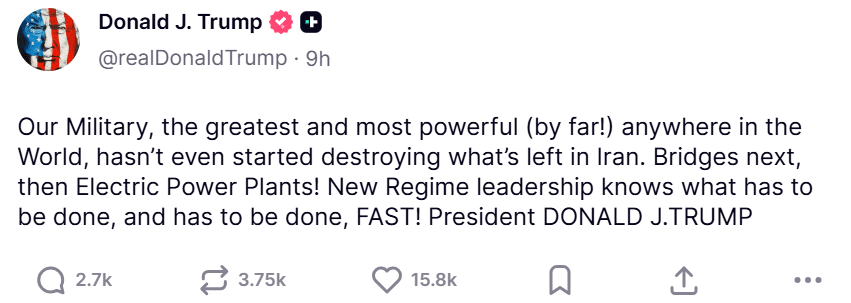
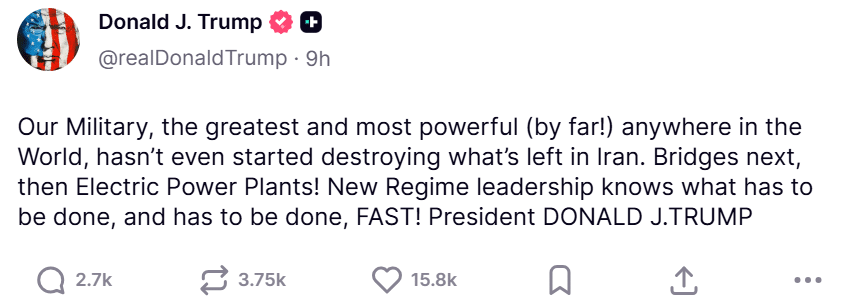
Source: TruthSocial

In short, despite recent optimism around Bitcoin’s “relative” resilience, Q1 revealed crypto was still the weakest performer across asset classes. Against this backdrop, a recent post by U.S President Donald Trump couldn’t have come at a more critical time.

In it, President Trump sounded a warning about a potentially severe attack on Iran’s infrastructure, putting ceasefire expectations on hold. However, more than the content, it’s the “timing” of the post that’s sparked a full-blown market frenzy. Notably, the U.S stock market will remain closed over the weekend, which means the post has temporarily prevented a liquidation cascade.

The real momentum shift, however, is in oil prices. Even before the post, oil had been rattling global markets. Now, the added geopolitical risk layers in more uncertainty. Traders and investors are likely to react as soon as the market reopens, making Monday a highly volatile session for equities. The spotlight, however, falls on crypto – Is a massive bloodbath looming?

Crypto locked in a liquidity trap as weekend market risk spikes

The crypto market’s nearly 21% drop in Q1 has moved almost in lockstep with oil prices.

Notably, this trend is set to shape Monday’s market, especially with equities likely to react. Take the NASDAQ (NDX), for example – It closed Q1 down nearly 6%, marking its worst quarterly performance since Q1 2025.

Here, the culprit is the ongoing Middle East conflict, which has created a massive oil supply squeeze. The Strait of Hormuz, responsible for roughly 20% of global oil exports, remains under serious threat. The impact is clear – Oil closed Q1 up nearly 70%, sending ripples across risk assets, including crypto.
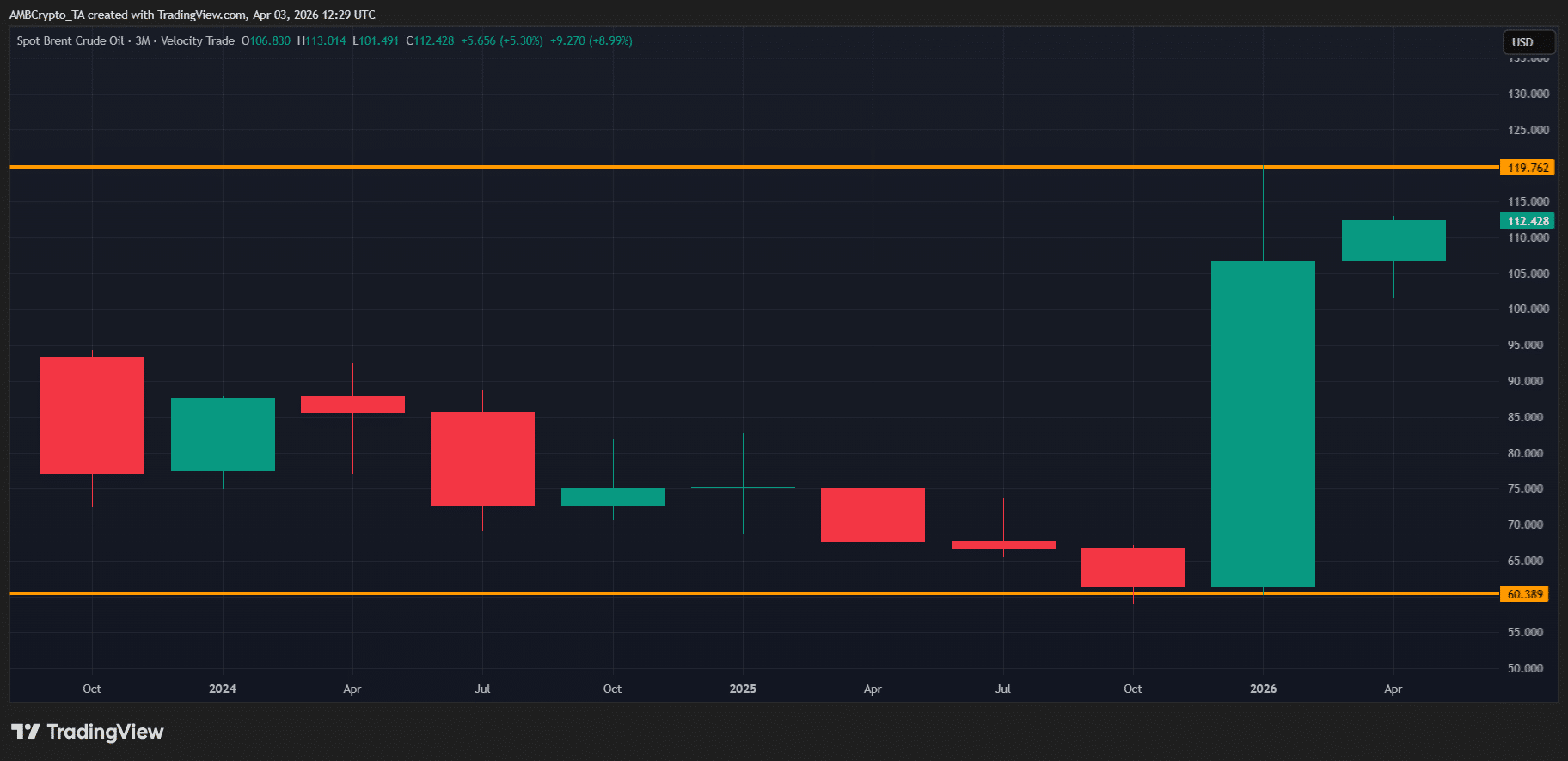
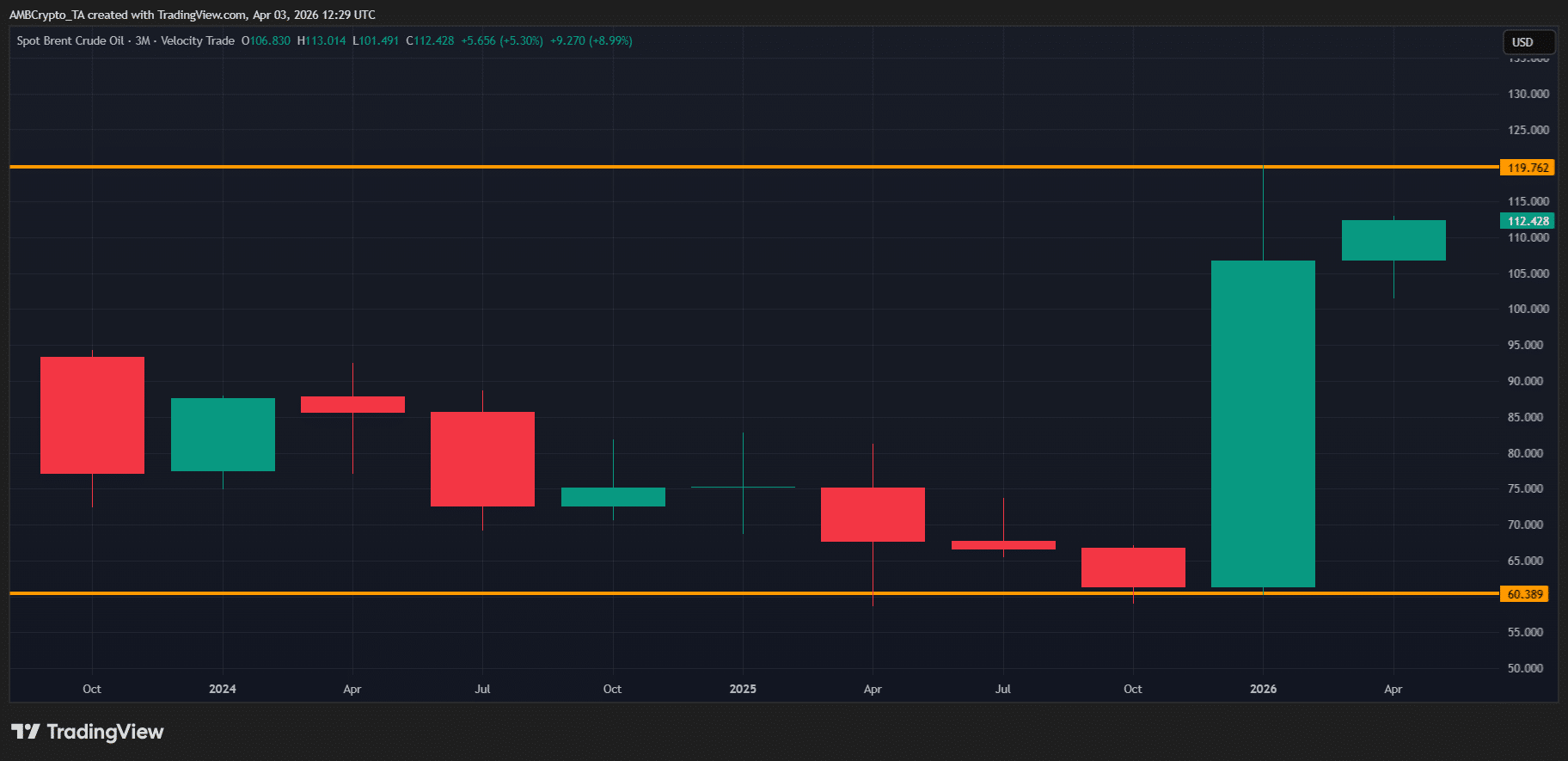
Source: TradingView (BRENT/USD)

According to AMBCrypto, that’s where President Trump’s recent post comes into play. With the escalation now official, analysts are expecting oil prices to surge towards $200 per barrel. In this context, Monday’s market reaction could be critical, with the odds of a sharp sell-off looking high.

Meanwhile, Bitcoin’s positioning index flipped negative, signaling that shorts are returning. This isn’t random. Instead, it’s a strategic move by traders, positioning for a potential downside in crypto once Monday’s session kicks off. With crypto heavily locked in a liquidity trap, even a small move could trigger sharp price swings, making the market extra sensitive to any catalyst.

Against this backdrop, President Trump’s post is now a key bearish trigger. Once Monday’s session begins, equities are set to react, putting crypto at high risk of a liquidation-driven bloodbath.


Final Summary

  • Q1 losses, negative positioning, and a liquidity trap are setting the stage for sharp downside moves.
  • President Trump’s post and surging oil prices could trigger a major market reaction on Monday.

İlgili Sorular

QWhat was the overall performance of the crypto market in Q1, and how does it compare to Q4 2025?

AThe total crypto market cap was down nearly 21% in Q1, which extended the losses from Q4 2025 when it fell by about 24%.

QAccording to the article, what is the significance of the XAU/BTC ratio closing Q1 up almost 40%?

AThe XAU/BTC ratio's significant increase underlines Bitcoin's relative weakness as an asset compared to gold.

QWhy is the timing of President Trump's post considered so critical for the markets?

AThe timing is critical because the U.S. stock market was closed over the weekend, temporarily preventing an immediate liquidation cascade. The post is expected to trigger a major market reaction when trading resumes on Monday.

QWhat key factor, besides Trump's post, is identified as a major driver of risk asset performance and a threat to crypto?

ASurging oil prices, driven by the ongoing Middle East conflict and a potential supply squeeze from the Strait of Hormuz, are a major driver putting pressure on risk assets like crypto.

QWhat does the shift in Bitcoin's positioning index to negative signal, according to the analysis?

AThe shift to a negative positioning index signals that traders are opening short positions, strategically preparing for a potential downside move in the crypto market once Monday's trading session begins.

İlgili Okumalar

CPU, Quietly Returning to the Center of the AI Computing Power Stage

Over the past three years, AI computing power narratives have been dominated by GPUs. However, starting in 2026, this story began to shift. While training large models remains GPU-intensive, the rapid growth of inference and AI agent workloads, which require high levels of task orchestration, concurrency, and data flow management, has highlighted a renewed critical role for CPUs. These are tasks GPUs are not designed to handle. Intel's recent launch of the Xeon 6+ processor, built on its Intel 18A process and featuring up to 288 efficiency cores (E-cores), exemplifies this strategic pivot. It is positioned not as a mere companion to GPUs but as the essential "control plane" for AI infrastructure, optimized for high-density, energy-efficient, and high-throughput workloads characteristic of AI agents and inference. This "CPU resurgence" is not about CPUs outperforming GPUs in raw computation. It reflects a systemic bottleneck: as AI scales from training single models to deploying countless intelligent agents, the demand for coordination and data handling surges. Major cloud providers are also developing their own high-density ARM-based server CPUs for similar workloads. However, Intel's success with this strategy faces significant challenges. Competition includes NVIDIA's integrated CPU-GPU solutions, the expanding adoption of cloud vendors' in-house ARM CPUs, and the crucial market test of Intel's 18A manufacturing process against rivals like TSMC's N2. In conclusion, CPUs are indeed reclaiming a central, though redefined, role in AI compute—managing the complex orchestration that enables massive-scale AI deployment. While the trend is clear, which company will ultimately lead this CPU resurgence remains an open question to be decided in the data centers of 2027 and beyond.

marsbit19 dk önce

CPU, Quietly Returning to the Center of the AI Computing Power Stage

marsbit19 dk önce

After Collaborating with 35+ DeFi Projects, Pink Brains Discovers the New 2026 KOL Marketing Rules

After collaborating with over 35 leading DeFi projects on marketing over three years, Pink Brains identifies a key shift for effective marketing in 2026: prioritizing the user journey over traditional campaign tactics. The most effective marketing mirrors how users actually behave—starting with discovery on social platforms like X (formerly Twitter), followed by data-driven verification on sites like DefiLlama, and finally, participation with small test funds. Success hinges on genuine, verifiable mechanisms, not just marketing hype. Current user interest centers on several key themes: new DeFi trends (RWA, perps, crypto x AI), meaningful airdrops requiring real contributions, real yield from protocol revenue, and tokens with value capture mechanisms directly tied to product usage. Case studies like Hyperliquid's HYPE (with its aggressive buyback program) and Venice's VVV (linking demand to AI compute) exemplify how strong tokenomics foster user retention. New trading venues like prediction markets, collectibles platforms, and GambleFi are also gaining traction, driven by verifiable activity. The article outlines common mistakes in DeFi KOL marketing, such as using creators unfamiliar with the product, generic messaging, or relying on a few top-tier KOLs. Instead, effective strategies align with different KOL types—educators, content creators, airdrop hunters, and niche experts—for various stages of the user journey. Ultimately, long-term user retention depends on a combination of a genuinely useful product, responsive support, community-aligned tokenomics, and strategic community building. The core takeaway is that sustainable growth stems from products whose value is validated by data and real-world utility, not just promotional efforts.

marsbit38 dk önce

After Collaborating with 35+ DeFi Projects, Pink Brains Discovers the New 2026 KOL Marketing Rules

marsbit38 dk önce

İşlemler

Spot
Futures
活动图片





