Crypto Push In Korea: Hana Financial And Standard Chartered Unveil New Deal

bitcoinist2026-03-16 tarihinde yayınlandı2026-03-16 tarihinde güncellendi

Özet

One of South Korea's largest financial groups, Hana Financial, has partnered with UK-based Standard Chartered to strengthen cooperation in global finance and crypto assets. The two institutions signed a memorandum of understanding (MOU) on March 15, aiming to develop stablecoins and digital assets as new growth drivers alongside their traditional banking operations. The agreement covers areas including stablecoins, deposit tokens, and tokenized financial instruments. Hana’s Chairman, Ham Young-joo, emphasized the importance of building a comprehensive ecosystem for won-denominated stablecoins, from issuance to circulation. Standard Chartered’s CEO, Bill Winters highlighted South Korea’s key role in Asian financial markets. This partnership reflects a broader trend among major Korean banks to develop regulated digital asset infrastructure—such as stablecoins and tokenized bonds—rather than focusing on retail crypto speculation. Both institutions have prior experience in the digital asset space, with Hana having established a crypto custody venture and Standard Chartered actively involved in tokenization projects and stablecoin initiatives in Asia.

One of the largest South Korean financial conglomerates has partenerd up with a major UK-based global bank to deepen cooperation in global finance and crypto assets.

A Transnational Crypto Deal

Incumbents are keen not to be left behind on the crypto curve, so much so that some of them are now joining forces. That seems to be the case for Hana Financial Group and Standard Chartered Group as on March 15th they announced the signing of a MOU (memorandum of understanding). By teaming up, the two lenders aim to turn stablecoins and other digital assets into a new growth engine alongside their existing international banking business.
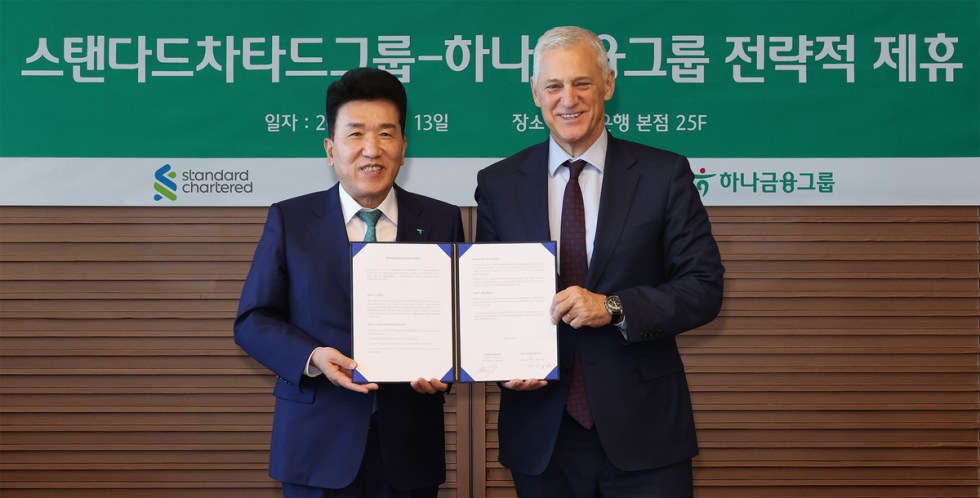
Chairman Ham of Han Financial Group and Bill Winters, CEO of Standard Chartered Group, at the signing ceremony in Seoul. Source: Seoul Economic Daily.

According to The Korea Times, the signing ceremony took place at Hana’s Bank’s headquarters on March 13th. It was attended by Ham Young-joo, Chairman of Hana Financial Group, and Bill Winters, CEO of Standard Chartered Group. Seoul Economic Daily reports that Ham and Winters exchanged views on cooperation in global and digital assets. Chairman Ham stated that:

The partnership between Hana Financial Group and Standard Chartered Group, leveraging their extensive global networks and diverse financial know-how, will serve as a strong competitive edge in the global financial sector. We will create new growth opportunities by generating synergies in future financial domains, including digital assets.

Winters emphasized on the capital importance that South Korea has in Asian financial markets, regarding the country as a “key hub”.

Shared Goals

The MOU covers stablecoins, deposit-token experiments, and future tokenized instruments, tying in Hana’s domestic stablecoin plans and pilots.

The Seoul Economic Daily contextualizes this move with Chairman Ham views of stablecoins as “core future business”. His goal with Hana Financial points to the building of an “ecosystem encompassing the issuance, distribution, use and circulation of (won-denominated stable) coins”, as he stated in his New Year’s address in January. In 2024, Hana Bank, BitGo, and SK Telecom set up BitGo Korea as the local arm focused on institutional crypto custody. In 2025, the Korean lender had an all-time high net profit of ₩4 trillion.
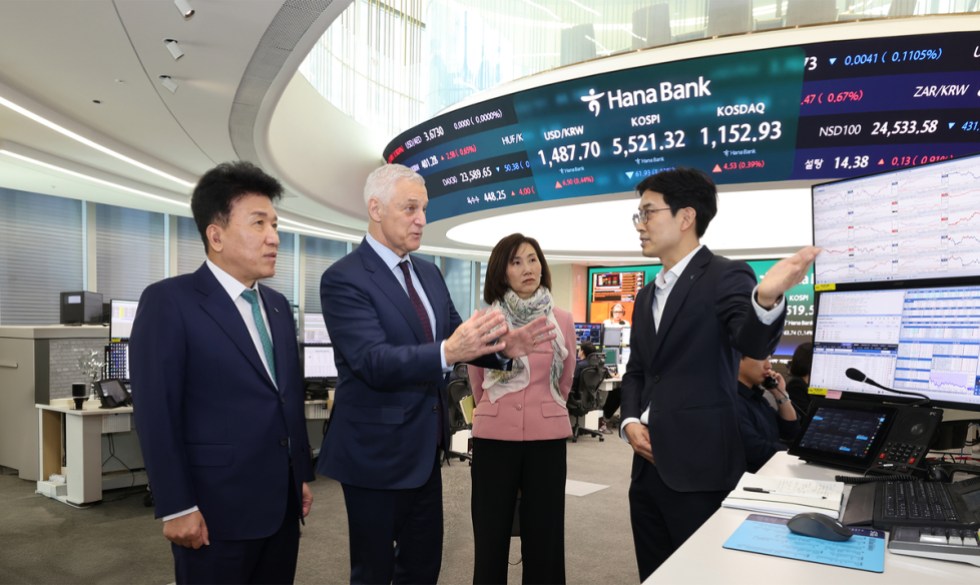
Chairman Ham and Bill Winters at Hana’s Bank’s headquarters, Source: Seoul Economic Daily.

Standard Chartered already has a growing crypto footprint, from institutional custody services to pilots with tokenized bonds and other blockchain-based assets. The bank has also backed several stablecoin ventures in markets like Hong Kong.

This is not the first time Hana Bank and Standard Chartered team up. In December 2025, the UK-based global bank announced that it was facilitating Hana Securities first venture with digital assets.

A Crypto Race

Instead of chasing pure spot exposure, the South Korea’s big banks are now racing to build compliant rails around stablecoins, tokenized notes, and digital bonds that can plug directly into the regulated financial system, nudging the market away from retail speculation toward more structured corporate and banking participation.

This new deal marks another milestone in the latest wave of efforts by TradFi institutions to keep up with a rapidly evolving digital financial system.
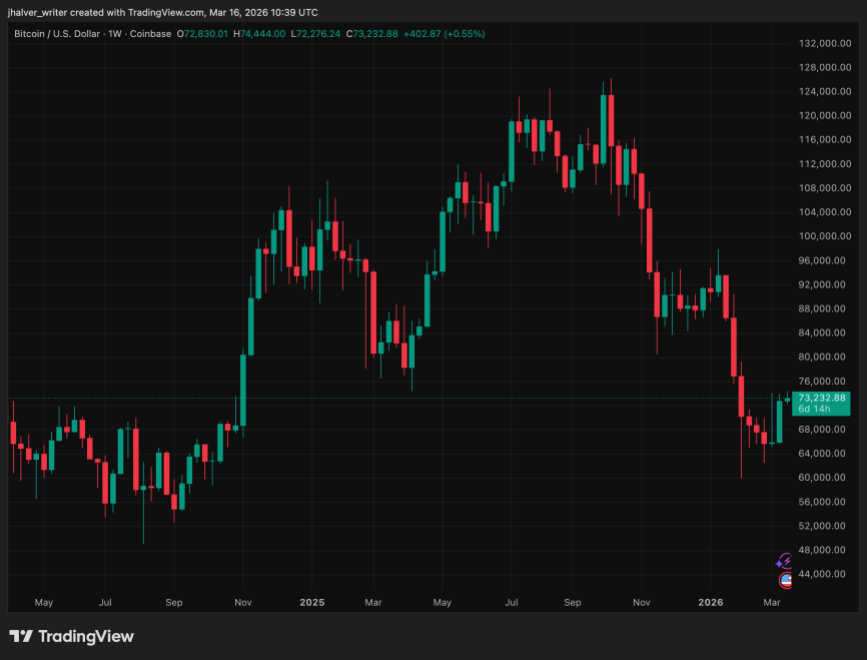
BTC’s price trends to the upside on the daily chart, reaching the $73K. Source: BTCUSD on Tradingview

Cover image from Perplexity, BTCUSD chart from Tradingview

Trend Kriptolar

İlgili Sorular

QWhat is the main purpose of the partnership between Hana Financial Group and Standard Chartered Group?

AThe partnership aims to deepen cooperation in global finance and crypto assets, turning stablecoins and other digital assets into a new growth engine alongside their existing international banking business.

QWhen and where did the signing ceremony of the MOU between Hana Financial Group and Standard Chartered take place?

AThe signing ceremony took place on March 13th at Hana Bank's headquarters in Seoul.

QWhat specific areas does the MOU between the two financial institutions cover?

AThe MOU covers stablecoins, deposit-token experiments, and future tokenized instruments, tying in Hana's domestic stablecoin plans and pilots.

QWhat did Chairman Ham of Hana Financial Group identify as a 'core future business' in his New Year's address?

AChairman Ham identified stablecoins as a 'core future business' and expressed his goal to build an ecosystem encompassing the issuance, distribution, use, and circulation of won-denominated stablecoins.

QHow is Standard Chartered Bank involved in the crypto space, according to the article?

AStandard Chartered has a growing crypto footprint, including institutional custody services, pilots with tokenized bonds and other blockchain-based assets, and backing several stablecoin ventures in markets like Hong Kong.

İlgili Okumalar

From South Korea to the United States: Blue-Collar Jobs Are Becoming Increasingly Popular, Thanks to AI

AI is reshaping the labor market's value proposition. The traditional four-year college degree is losing its appeal as a guaranteed career path, while skilled blue-collar trades like electricians, welders, and plumbers are experiencing historic demand and wage premiums. This shift is driven by dual pressures: AI's displacement of certain white-collar roles and a booming need for physical infrastructure and data center construction. Data confirms the trend. In the U.S., vocational school revenue surged, and a significant portion of recent layoffs are AI-related. Surveys show a majority of Gen Z adults plan to pursue blue-collar work, citing better job security against AI automation. Vocational education interest has exploded recently. Experts cite a psychological shift as younger generations seek tangible, AI-resistant careers and avoid high student debt. In many cases, salaries for skilled trades now match or exceed those requiring a bachelor's degree. In South Korea, semiconductor vocational high schools boast near-total employment, with graduates securing high-paying roles at companies like Samsung. The shortage is structural, exacerbated by a retiring baby boomer workforce and massive infrastructure projects. Companies like JPMorgan Chase, Meta, and Lowe's are investing heavily in training programs. However, overcoming historical stigma and a "perception gap" around trade careers remains a key challenge to closing the talent gap.

marsbit1 saat önce

From South Korea to the United States: Blue-Collar Jobs Are Becoming Increasingly Popular, Thanks to AI

marsbit1 saat önce

Qualcomm: AI Hype Subsides, When Will Smartphones Emerge from the Gloom?

Qualcomm reported its Q3 FY2026 results (ending June 2026), with revenue of $9.95B, down 4% YoY but above expectations. Gross margin declined to 53.1%, pressured by rising costs across manufacturing and memory. Key business segments showed mixed performance: Handset revenue fell 19.6% YoY to $5.09B, dragged by an 11% decline in non-Apple Android shipments and weaker high-end mix. Conversely, Automotive revenue surged 61% to $1.59B, and IoT grew 9% to $1.83B. Core operating profit dropped 41% YoY due to margin compression and higher expenses. Management's Q4 FY2026 guidance projects revenue of $9.7B-$10.5B, in line with consensus, but Non-GAAP EPS guidance of $2.05-$2.25 fell short of expectations. Amidst persistent weakness in its core handset market, Qualcomm is pursuing growth in AI, focusing on Edge AI (smartphones, PCs, automotive) and Data Center AI. Its data center strategy includes four pillars: AI accelerators (e.g., AI200), commercial CPUs (Dragonfly C1000), custom silicon, and connectivity solutions. While these initiatives initially boosted its stock, concerns over AI capital expenditure sustainability have since erased those gains. The company targets $5B in data center revenue for FY2027 and $15B for FY2029. The report concludes that with the traditional handset business still under pressure, the data center opportunity is currently viewed as a longer-term option, and a more conservative valuation based on core operations may be warranted until AI contributions materialize.

marsbit1 saat önce

Qualcomm: AI Hype Subsides, When Will Smartphones Emerge from the Gloom?

marsbit1 saat önce

From TPU to Self-Evolving Agents: How Jeff Dean Predicts the Next Step in AI

At the 2026 YC Startup School, Jeff Dean outlined his vision for AI's next phase, shifting focus from simply scaling models to building intelligent, autonomous systems. He believes AI's progress is no longer just about creating smarter models, but about integrating them into systems capable of long-term, iterative work, automated experimentation, and continuous learning. This evolution moves the competition from "who has the bigger model" to "who can best organize intelligence." Dean suggests AI capabilities are now comparable to a junior engineer, enabling the automation of complex workflows. However, the true challenge and opportunity lie in managing these AI "workers" at scale. He emphasizes the importance of **context engineering**—structuring tools, memory, and feedback loops—over raw model power. For startups, this means building deep expertise in niche domains where general models currently fail (near 0-1% success rates), leveraging proprietary data, specialized tools, and domain-specific evaluators. A recurring theme is re-examining fundamental constraints. Dean's past work, like moving Google's search index to memory or creating the TPU, stemmed from questioning outdated assumptions about hardware and cost. He sees similar inflection points today, particularly in **specialized inference hardware** to drastically reduce latency and energy consumption for real-time Agent operation. Notably, he points out that in modern AI systems, the dominant cost is often not computation but **data movement**. Reliable, long-running Agents require robust system design, borrowing concepts from distributed computing like checkpointing, state management, and parallel exploration to handle failures and maintain progress over days or weeks. As AI automates execution, the scarcest human skills will shift to **defining clear specifications**, **judging what problems are worth solving** (taste), and designing effective feedback loops. Ultimately, Dean's framework prioritizes understanding the problem deeply, identifying the true bottlenecks, and systematically building closed-loop systems where AI can not only perform tasks but also improve AI itself.

marsbit1 saat önce

From TPU to Self-Evolving Agents: How Jeff Dean Predicts the Next Step in AI

marsbit1 saat önce

İşlemler

Spot

Popüler Makaleler

PUSH Nasıl Satın Alınır

HTX.com’a hoş geldiniz! Push Protocol (PUSH) satın alma işlemlerini basit ve kullanışlı bir hâle getirdik. Adım adım açıkladığımız rehberimizi takip ederek kripto yolculuğunuza başlayın. 1. Adım: HTX Hesabınızı OluşturunHTX'te ücretsiz bir hesap açmak için e-posta adresinizi veya telefon numaranızı kullanın. Sorunsuzca kaydolun ve tüm özelliklerin kilidini açın. Hesabımı Aç2. Adım: Kripto Satın Al Bölümüne Gidin ve Ödeme Yönteminizi SeçinKredi/Banka Kartı: Visa veya Mastercard'ınızı kullanarak anında Push Protocol (PUSH) satın alın.Bakiye: Sorunsuz bir şekilde işlem yapmak için HTX hesap bakiyenizdeki fonları kullanın.Üçüncü Taraflar: Kullanımı kolaylaştırmak için Google Pay ve Apple Pay gibi popüler ödeme yöntemlerini ekledik.P2P: HTX'teki diğer kullanıcılarla doğrudan işlem yapın.Borsa Dışı (OTC): Yatırımcılar için kişiye özel hizmetler ve rekabetçi döviz kurları sunuyoruz.3. Adım: Push Protocol (PUSH) Varlıklarınızı SaklayınPush Protocol (PUSH) satın aldıktan sonra HTX hesabınızda saklayın. Alternatif olarak, blok zinciri transferi yoluyla başka bir yere gönderebilir veya diğer kripto para birimlerini takas etmek için kullanabilirsiniz.4. Adım: Push Protocol (PUSH) Varlıklarınızla İşlem YapınHTX'in spot piyasasında Push Protocol (PUSH) ile kolayca işlemler yapın.Hesabınıza erişin, işlem çiftinizi seçin, işlemlerinizi gerçekleştirin ve gerçek zamanlı olarak izleyin. Hem yeni başlayanlar hem de deneyimli yatırımcılar için kullanıcı dostu bir deneyim sunuyoruz.

715 Toplam GörüntülenmeYayınlanma 2024.12.13Güncellenme 2026.06.02

PUSH Nasıl Satın Alınır

Tartışmalar

HTX Topluluğuna hoş geldiniz. Burada, en son platform gelişmeleri hakkında bilgi sahibi olabilir ve profesyonel piyasa görüşlerine erişebilirsiniz. Kullanıcıların PUSH (PUSH) fiyatı hakkındaki görüşleri aşağıda sunulmaktadır.

活动图片













