Crypto Prediction Markets Face Existential Threat — 3 States Move To Shut Traders Out

bitcoinist2026-04-03 tarihinde yayınlandı2026-04-03 tarihinde güncellendi

Özet

The U.S. federal government, through the CFTC and DOJ, is suing Illinois, Arizona, and Connecticut to block their attempts to shut down crypto prediction markets like Polymarket and Kalshi. The federal agencies argue they have exclusive jurisdiction to regulate these markets as derivatives, while the states classify them as illegal gambling. This legal clash represents a significant existential threat to the industry. A federal victory would centralize oversight under the CFTC, creating a single regulatory framework. If the states prevail, platforms would face a fragmented landscape of state gambling laws, potentially pushing markets offshore and increasing costs for traders.

Illinois, Arizona and Connecticut are trying to regulate crypto predictions markets, such as Polymarket and Kalshi. The Commodity Futures Trading Commission and the Justice Department are coming to the rescue.

For The First Time, The Scale Moves In Crypto Prediction Markets’ Favor

As contradictory as it may sound, the Trump administration is trying to save crypto prediction markets from the State itself. The coordinated lawsuits the CFTC and the DOJ have filed against the three states argue that only the federal derivatives regulator can police prediction markets.

The lawsuits go as far as to claim the three states are bypassing the CFTC’s authority by trying to shut down “federally regulated DCMs” (designated contract markets). Regarding Illinois, the federal regulator said the state spent the past year issuing cease‐and‐desist letters to Kalshi, Crypto.com, and Polymarket, which the complaint argues are all under CFTC authority:

Illinois’s attempt to shut down federally regulated DCMs intrudes on the exclusive federal scheme Congress designed to oversee national swaps markets.

Related Reading: Crypto Traders On Edge As Korea Stalls Key Law — Is The “Kimchi Premium” At Risk Next?

Put simply, Washington says prediction markets are federally regulated derivatives. States insist, however, that prediction markets are just unlicensed gambling products harming local consumers.

CFTC Chairman Michael Selig explained that this is not the first time states “have tried to impose consistent and contrary obligations on market participants”. Just this past month, a bipartisan Senate bill targeting sports‐style bets on platforms like Polymarket and Kalshi was introduced by Senators Adam Schiff (D-CA) and John Curtis (R-UT).

Also on March, democratic representative Seth Moulton of Massachusetts (MA-06) formally banned all his staff from participating in prediction markets. That same day, Congressman Adrian Smith (R-NE-03) and Congresswoman Nikki Budzinski (D-IL-13) from Nebraska introduced the PREDICT Act, banning members of Congress from trading on political and policy outcome markets.

These are the first lawsuits by the CFTC to block state gaming regulators ​from policing operators of prediction markets, according to Reuters. The outlet also highlighted the fact that all the defendants are Democrats.

Market Implications

The CFTC’s lawsuits build on its recent push to assert “exclusive jurisdiction” over event contracts, including sports and politics, reversing the Biden‐era move that tried to ban broad categories of prediction markets.

Prediction markets are morphing into an information layer and hedging tool for traders, with liquidity increasingly coming from crypto‐native capital and exchange integrations.

A federal win would likely centralize rule‐making at the CFTC, potentially clearing a single regulatory path for crypto prediction platforms, but also tightening surveillance and enforcement. Conversely, if states prevail, platforms may face a patchwork of gambling rules that fracture liquidity, push some markets offshore, and raise operational risk premia for traders.
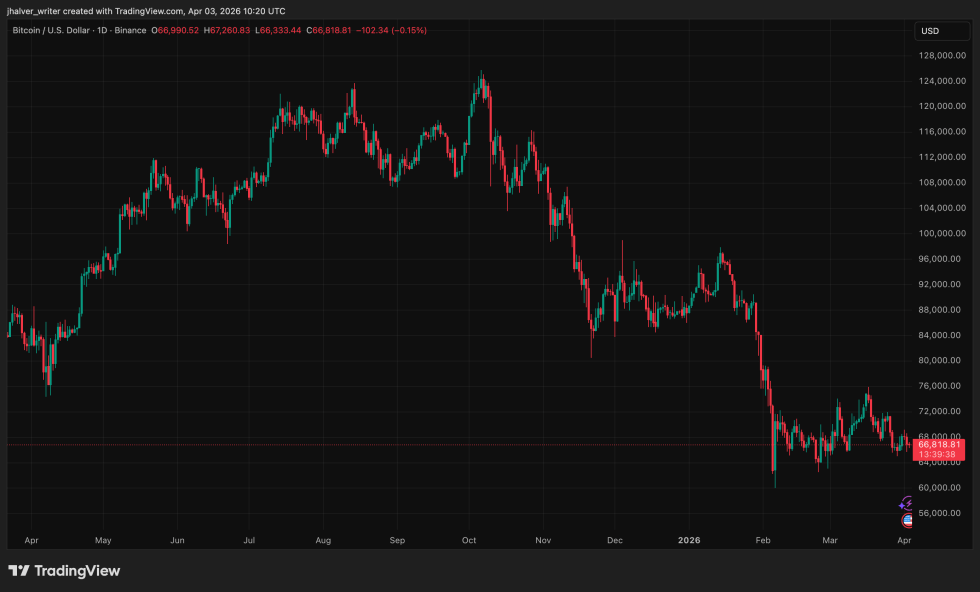
At the moment of writing, BTC trades for almost $67k on the daily chart. Source: BTCUSD on Tradingview.

Cover image from Perplexity. BTCUSD chart from Tradingview.

İlgili Sorular

QWhich three states are mentioned as trying to regulate crypto prediction markets in the article?

AIllinois, Arizona, and Connecticut.

QWhat federal agencies are taking legal action against these states to protect crypto prediction markets?

AThe Commodity Futures Trading Commission (CFTC) and the Department of Justice (DOJ).

QAccording to the CFTC, what is the core legal argument against the states' actions?

AThe CFTC argues that it has exclusive federal jurisdiction to regulate prediction markets as derivatives, and the states are intruding on this federal regulatory scheme.

QWhat is the name of the bipartisan Senate bill mentioned that targets sports-style bets on platforms like Polymarket?

AThe article mentions a bipartisan Senate bill but does not provide its specific name. It was introduced by Senators Adam Schiff and John Curtis.

QWhat are the two potential outcomes for crypto prediction markets discussed, depending on who wins the legal battle?

AA federal win would centralize rule-making at the CFTC, creating a single regulatory path. If states prevail, platforms would face a patchwork of state gambling rules, fracturing liquidity and pushing some markets offshore.

İlgili Okumalar

In Jinjiang, Fujian, a Storage Super Unicorn Lies Quiet

In Fujian's Jinjiang, a city known for sportswear, lies a quiet semiconductor giant: Fujian Jinhua Integrated Circuit Co. (JHICC). Once a promising domestic DRAM manufacturer alongside Yangtze Memory and ChangXin Memory Technologies (CXMT), its journey was derailed in 2018 when the U.S. placed it on an Entity List and filed criminal charges for alleged trade secret theft. This halted production for years. A turning point came in February 2024 when a U.S. federal court found JHICC not guilty. However, it had lost crucial time. While CXMT soared to become a top-valued A-share company in 2024, JHICC, with an estimated valuation of 80 billion RMB, was just restarting. Its current output is primarily customized DDR4 chips, not the advanced DDR5/HBM demanded for AI, but it still benefits from the broader memory chip upcycle. JHICC's story is tied to Chen Zhengkun, a veteran engineer who left Micron to lead the venture. Founded in 2016 with state-backed funding, JHICC partnered with Taiwan's UMC to develop DRAM technology. Rapid progress was cut short by the U.S. actions, which Micron initiated, partly due to its heavy reliance on the Chinese market. Post-sanctions, Chen's team worked to rebuild the production line with reduced reliance on U.S. technology. According to its records, JHICC achieved small-scale production and revenue growth under immense pressure. It now focuses on the stable "niche" DRAM market (e.g., TVs, routers) with a monthly capacity of ~40,000 wafers, aiming for 60,000 by 2026. It holds over 1,000 patents but remains on the Entity List. For Jinjiang, investing in JHICC was a bold industrial leap. The local government provided unwavering financial and logistical support during the crisis, helping the company survive. JHICC has become the anchor for a growing local semiconductor cluster. Though its scale lags behind domestic peers, JHICC's persistence symbolizes a hard-won foothold in a global market long dominated by Samsung, SK Hynix, and Micron. Having missed one boom, it seeks a place in the new AI-driven memory supercycle.

marsbit42 dk önce

In Jinjiang, Fujian, a Storage Super Unicorn Lies Quiet

marsbit42 dk önce

Must-Watch Events Next Week|CLARITY Act Could Face Senate Vote; SpaceX, Circle to Report Earnings (8.3-8.9)

**Summary: Key Events and Developments to Watch (August 3-9)** The upcoming week is marked by significant financial disclosures, key legislative deadlines, and notable product updates. **Major Financial Events:** Several companies are scheduled to release their Q2 2026 earnings. American Bitcoin (ABTC) will report on August 3, followed by SpaceX and Hut 8 Mining Corp. on August 4, and Circle on August 5. Notably, a significant portion of SpaceX shares (up to 12% of total shares) will be unlocked on August 6 following their earnings release. **Key Legislative Deadline:** The U.S. Senate faces an August 7 deadline to secure 60 votes for the CLARITY Act, a bipartisan bill aiming to establish a federal regulatory framework for cryptocurrencies. The Senate may hold a full vote on the bill during the week. **Economic Data:** The U.S. July Non-Farm Payrolls report will be released on August 7, providing crucial labor market data. **Technology & Product Updates:** * **Shutdowns:** DeFi portfolio tracker Zapper and wallet app Ctrl Wallet will cease operations on August 3. * **Upgrades:** LayerZero will deprecate its v1 relayers on August 3. XRP Ledger's new version 3.3.0, featuring five new functions, is expected next week. * **AI:** Elon Musk announced that the advanced Grok 4.6 AI model is set for release around August 7. * **Bitcoin:** The BIP-110 forced signaling for a potential Bitcoin network change is scheduled to begin around August 8. **Other Notable Events:** Chinese robotics firm Unitree Tech has set its preliminary price inquiry for its IPO for August 5. South Korean exchange Upbit will delist AQT and AERGO tokens on August 3.

marsbit2 saat önce

Must-Watch Events Next Week|CLARITY Act Could Face Senate Vote; SpaceX, Circle to Report Earnings (8.3-8.9)

marsbit2 saat önce

İşlemler

Spot
活动图片





