Crypto Prediction Markets Continue To Be Under Siege — Are Traders Now Fair Game For Prosecutors?

bitcoinist2026-04-09 tarihinde yayınlandı2026-04-09 tarihinde güncellendi

Özet

U.S. federal regulators, including the CFTC and DOJ, are seeking a court order to prevent Arizona from enforcing its gambling laws against crypto prediction-market platform Kalshi. They argue that contracts tied to sports, elections, and real-world events qualify as financial derivatives ("swaps") under federal law, not state-regulated gambling. This legal action is part of a broader conflict between federal and state authorities over jurisdiction on prediction markets. Arizona and other states contend these platforms constitute illegal gambling and have initiated criminal charges. Similar legal pressures are affecting Kalshi’s rival, Polymarket, which faces lawsuits and investigations in multiple states. The outcome could either legitimize and boost U.S. prediction markets or fragment them into riskier offshore operations.

U.S. regulators are urging a court to stop Arizona from enforcing its gambling laws against crypto prediction‐market platform Kalshi.

Another Battle Over Crypto Prediction Markets

In a filing from yesterday, the Commodity Futures Trading Commission (CFTC) and the Justice Department (DOJ) commended a federal court to stop Arizona from using its gambling laws against crypto prediction‐market platform Kalshi.

The agencies are asking for a temporary restraining order and preliminary injunction to halt Arizona’s criminal case and gambling‐law enforcement.

Related Reading: Bitcoin Creator Exposed? New Investigation Points At The Real Identity Of Satoshi Nakamoto

CFTC argues that these contracts tied to sports, elections and other real‐world events qualify as swaps (financial derivatives) under U.S. law, rather than falling under state gambling statutes. The federal regulators based their arguments on the fact that since the contracts are settled on future events with economic impact, they are governed by the Commodity Exchange Act and fall under federal law rather than state authority.

Such interpretation curbs how far individual states can go in blocking or constraining these platforms, which regulators say would otherwise splinter the market into a patchwork of state‐by‐state rules.

The Arizona Lawsuit Explained

Arizona charged Kalshi with illegal gambling over sports and election markets. Arizona, along with an expanding list of other states, argue that contracts tied to sports results operate like ordinary bets and must be treated as gambling, subject to licensing rules, age limits, and consumer safeguards.

According to the court filing, Arizona first sent a cease‐and‐desist order to KalshiEx LLC and Kalshi Trading LLC in May 2025, alleging they were taking unlawful bets in breach of state law. The state then brought criminal charges against both entities for “betting and wagering” under several Arizona statutes, with an arraignment set for April 13.

On Monday, a Third Circuit (one of the 13 U.S. federal courts of appeals) ruling stated that sports event contracts on designated contract markets (DCMs) are “swaps” preempting state gambling laws. However, one judge disagreed, blasting Kalshi’s stance as a “performative sleight” designed to hide the fact that its offerings are, in substance, sports betting.

Crypto Prediction Markets Under A Coordinated State Pushback

This move follows a broader CFTC and DOJ litigation against Arizona, Connecticut, and Illinois over prediction‐market jurisdiction. Bitcoinist reported on it last week. This past month, a bipartisan Senate bill targeting sports‐style bets on platforms like Polymarket and Kalshi was introduced by Senators Adam Schiff (D-CA) and John Curtis (R-UT).

Also on March, democratic representative Seth Moulton of Massachusetts (MA-06) formally banned all his staff from participating in prediction markets. That same day, Congressman Adrian Smith (R-NE-03) and Congresswoman Nikki Budzinski (D-IL-13) from Nebraska introduced the PREDICT Act, banning members of Congress from trading on political and policy outcome markets.

Related Reading: SEC Admits Flaws In Crypto Enforment, What Went Wrong?

Kalshi’s main rival, Polymarket, is also under mounting legal fire, with a New York class action filed in February alleging it runs an unlicensed sports‐betting operation. Regulators in Nevada have launched a civil case against its parent company, and authorities in Ohio, Utah, and Iowa have likewise begun probing the platform.

Not too long ago, Argentinian authorities ordered a full national ban of Polymarket after it “predicted” inflation data back in February. On top of that, the platform faced terrible backlash recently after bettors sent death threats to Times of Israel military reporter Emanuel Fabian, following his report of an Iranian ballistic missile on March 10.

Both Kalshi and Polymarket updated their rules at the end of March to preemptively block politicians, candidates and sports insiders from trading on related markets

If the federal preemption is upheld, it will de‐risks U.S. prediction venues, potentially boosting liquidity and making them more attractive as macro and sports‐beta tools for crypto‐savvy traders. However, if states carve out sports and politics as gambling, markets may fragment offshore or into on‐chain, harder‐to‐police venues, raising operational and legal risk premia for anyone treating these contracts as serious hedging instruments.
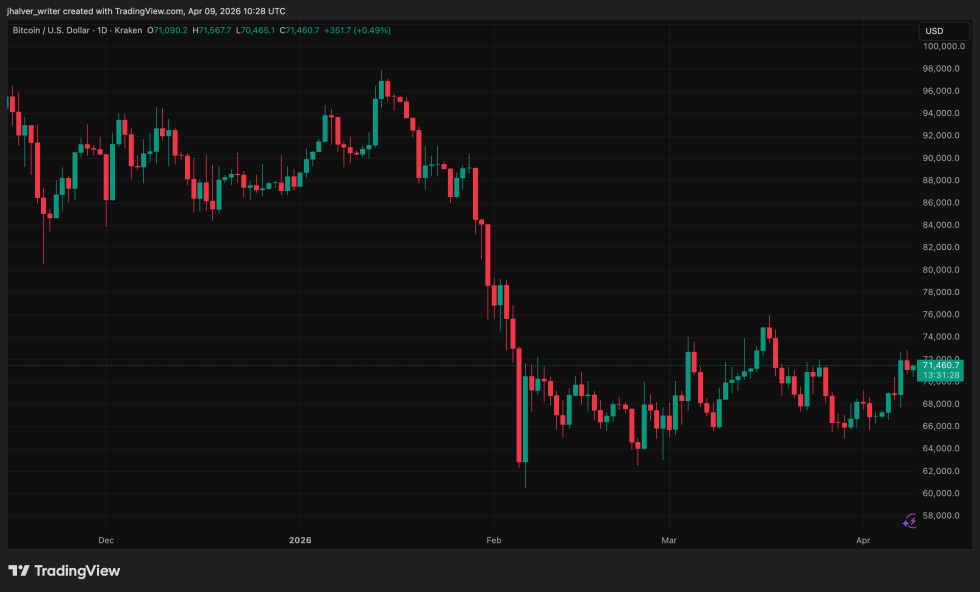
Yesterday, Bitcoin bounced back and reclaimed $72k. At the moment of writing, BTC trades for around $71k on the daily chart. Source: BTCUSD on Tradingview.

Cover image from Perplexity. BTCUSD chart from Tradingview.

İlgili Sorular

QWhat is the main argument of the U.S. regulators (CFTC and DOJ) against Arizona's enforcement of its gambling laws on Kalshi?

AThe CFTC and DOJ argue that the contracts offered by Kalshi, which are tied to sports, elections, and other real-world events, qualify as financial derivatives (swaps) under U.S. federal law, specifically the Commodity Exchange Act. They contend that these contracts, because they are settled on future events with economic impact, fall under federal jurisdiction and preempt state gambling statutes.

QWhat specific legal measures are the federal agencies requesting from the court regarding Arizona's case against Kalshi?

AThe Commodity Futures Trading Commission (CFTC) and the Justice Department (DOJ) are asking the court for a temporary restraining order and a preliminary injunction to halt Arizona's criminal case and its enforcement of gambling laws against Kalshi.

QAccording to the article, what was the recent ruling by the Third Circuit court regarding sports event contracts on designated contract markets (DCMs)?

AA recent Third Circuit ruling stated that sports event contracts on designated contract markets (DCMs) are considered 'swaps,' which preempts state gambling laws. However, one judge dissented, calling Kalshi's stance a 'performative sleight' designed to disguise what is essentially sports betting.

QBesides Kalshi, which other major prediction market platform is facing significant legal challenges, and what are some examples?

AKalshi's main rival, Polymarket, is also under significant legal pressure. A New York class action lawsuit was filed in February alleging it runs an unlicensed sports-betting operation. Regulators in Nevada have launched a civil case against its parent company, and authorities in Ohio, Utah, and Iowa are probing the platform. It was also completely banned in Argentina.

QWhat are the two potential future scenarios for U.S. prediction markets outlined at the end of the article, depending on the legal outcome?

AIf federal preemption is upheld, it would de-risk U.S. prediction venues, potentially boosting their liquidity and attractiveness as trading tools. Conversely, if states successfully classify these markets as gambling, the markets may fragment and move offshore or into on-chain venues that are harder to police, thereby raising operational and legal risks for traders.

İlgili Okumalar

Annual Salary of Millions Competing for Electricians, Meta Rushes to Open Its Own Technical School

The AI boom is facing an unexpected bottleneck: a severe shortage of skilled construction workers and electricians. As tech giants like Meta, OpenAI, and Alphabet race to build massive data centers—such as OpenAI's $16 billion "Stargate" project—they are hitting a critical labor wall. The U.S. needs an estimated 130,000 more electricians, 240,000 construction workers, and 150,000 supervisors by 2030 for AI infrastructure alone, but tens of thousands of electrician jobs go unfilled each year. While AI companies offer high premiums, with electricians earning up to $280,000 annually, worker scarcity still causes massive losses—delays on a single project can cost $14.2 million per month. The complexity of building AI data centers, which require immense power (equivalent to powering hundreds of thousands of homes), sophisticated electrical systems, and advanced liquid cooling solutions, demands highly skilled technicians who are in short supply. To combat this, companies are investing heavily in training. Meta has committed $115 million to a free training school offering tuition, housing, and stipends, targeting 5,000 new workers. OpenAI is partnering with unions to secure skilled labor. These efforts are paying off, with a significant rise in Gen Z interest in trade schools over college. However, the power demands are staggering. AI data centers are driving a rapid surge in electricity consumption, projected to account for up to 12% of U.S. power use by 2028 and raising costs for consumers. Furthermore, the construction boom is project-based, leading to a potential future glut of trained workers once building peaks, which could depress wages industry-wide. The race for AI supremacy now depends as much on skilled hands as on advanced chips.

marsbit53 dk önce

Annual Salary of Millions Competing for Electricians, Meta Rushes to Open Its Own Technical School

marsbit53 dk önce

OpenAI No Longer Sells Its Most Expensive Model for Profit

OpenAI is shifting its business strategy away from promoting its most expensive, flagship models for every task. Recent price cuts—80% for GPT-5.6 Luna and 20% for Terra—signal a deeper change: the company now actively advises users that many tasks don't require the most powerful model. Instead, OpenAI recommends a tiered approach: use the high-end GPT-5.6 Sol for complex planning and analysis, then delegate execution to cheaper models like Luna. This mirrors moves by Anthropic, which recently launched Claude Opus 5 at half the price of its top model, Fable 5. Both companies are de-emphasizing flagship models as primary revenue drivers, using them instead for brand prestige and technological showcases. The industry is entering a "mass-market" phase, similar to automotive, where high-volume, cost-effective models handle daily operations and drive scale. OpenAI's price reductions are partly enabled by AI models themselves optimizing underlying code and infrastructure, creating a self-reinforcing cycle of efficiency gains and cost reduction. Competition is shifting from "who is smartest" to "who offers the best value." The goal is no longer selling individual models but fostering widespread API adoption and ecosystem lock-in. By making AI calls cheap and ubiquitous, companies like OpenAI aim to become the indispensable, utility-like infrastructure powering automated workflows—the "water and electricity" of software, quietly embedded everywhere.

marsbit53 dk önce

OpenAI No Longer Sells Its Most Expensive Model for Profit

marsbit53 dk önce

Will the Fed Definitely Raise Interest Rates in September? How Will Crypto and U.S. Stocks Withstand the Pressure?

The market's expectation for a September Fed rate hike surged dramatically in early August, jumping from under 50% to over 80% within a week. This shift followed a contentious July FOMC meeting, where a 9-3 vote to hold rates revealed growing dissent from hawkish members advocating for an immediate hike to combat persistent inflation. The primary catalyst for this repricing is rising oil prices, driven by renewed geopolitical tensions around the Strait of Hormuz, which threaten global supply. Energy costs directly influence inflation metrics, making the upcoming July CPI report (due August 12th) a critical data point. If it shows inflation reaccelerating, the probability of a September hike will solidify. For Bitcoin and crypto assets, this is typically bearish news. Bitcoin continues to behave as a high-beta, liquidity-sensitive risk asset. A rate hike raises the opportunity cost of holding non-yielding assets and could drive capital toward money markets, pressuring crypto prices in the short term. However, historical patterns suggest that if a hike is perceived as the end of a tightening cycle rather than the start, any negative price impact may be brief. U.S. stocks, particularly crypto-linked equities like Coinbase and growth-oriented tech stocks, are also vulnerable. Higher rates increase discount rates in valuation models, putting pressure on high-multiple companies. This coincides with a pivotal tech earnings season where investor focus has shifted from massive AI capital expenditure to tangible revenue and cash flow generation. Companies with negative cash flow and weak growth narratives could face heightened volatility if borrowing costs rise in September. In summary, a September Fed hike has evolved into a mainstream market scenario. Key factors to watch are oil prices, the July CPI report, and Fed communications, which will determine the final decision and its impact on volatile crypto and equity markets.

marsbit1 saat önce

Will the Fed Definitely Raise Interest Rates in September? How Will Crypto and U.S. Stocks Withstand the Pressure?

marsbit1 saat önce

İşlemler

Spot
活动图片





