Crypto payments for gray-market peptides up by 700% in a year – Details

ambcrypto2026-07-22 tarihinde yayınlandı2026-07-22 tarihinde güncellendi

Özet

The use of cryptocurrency payments, primarily Bitcoin and stablecoins, for gray-market peptides in the United States surged by 700% in a year, according to a recent report. These peptides, often sold as wellness or anti-aging aids, exist in a regulatory gray area. Facing tighter restrictions from traditional banks, vendors increasingly accept crypto, with some Chinese suppliers accepting only Bitcoin. This has attracted mainstream consumers seeking cheaper access, even those new to cryptocurrency. Data from Chainalysis shows gray-market peptide vendors received $32 million in crypto in Q1 2026, projecting an annual run rate over $100 million. TRM Labs noted a similar trend, estimating $41.4 million in crypto inflows to Chinese peptide sellers in 2025. Analysts highlight this involves many first-time crypto users, distinct from historical darknet market activity, and underscores crypto's role in facilitating cross-border value transfer. This growth occurred alongside a broader downturn in general retail crypto transaction volumes in early 2026.

According to a recent disclosure, the United States is using cryptocurrency, mainly Bitcoin [BTC] and stablecoins, to buy gray-market peptides.

The latter are compounds or research chemicals that frequently fall into a gray area of law and regulation. For further context, peptides are short chains of amino acids that are sold as anti-aging, muscle-building, weight-loss, and longevity aids.

Due to concerns about compliance and risk, banks and card networks have tightened restrictions on transactions involving certain peptide sellers. As a result, many vendors have started to accept cryptocurrencies. In fact, some suppliers in China now only accept Bitcoin.

Why is this surge important?

Now, this does not necessarily mean that the products are legal or acceptable for consumer use. However, it does highlight the increasing role that cryptocurrency is playing in enabling cross-border commerce for goods.

In fact, Bloomberg, in its recent report, cited the case of people who never owned Bitcoin, but still created a Coinbase account. Specifically to purchase a year’s worth of an experimental weight-loss peptide from China.

Such people had long rejected Bitcoin as being too speculative. According to one of them,

The cost difference is so drastic that it seemed kind of worth that risk.

Surge in gray-market peptide vendors

According to Chainalysis, in Q1 2026, gray-market peptide vendors received $32 million in cryptocurrencies. This marked a 700% increase from the previous year and was sufficient to put the market on a run rate of more than $100 million annually.
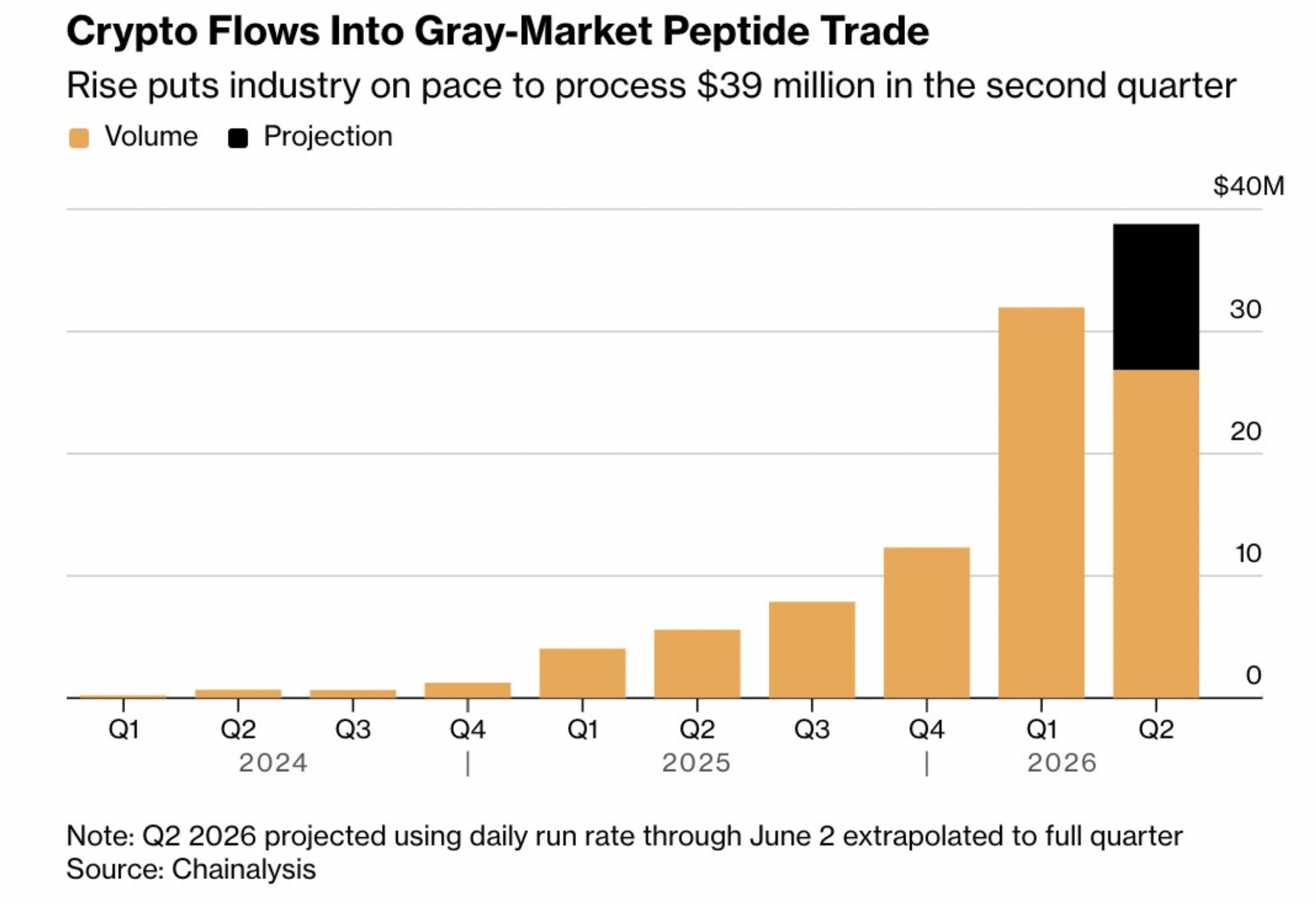
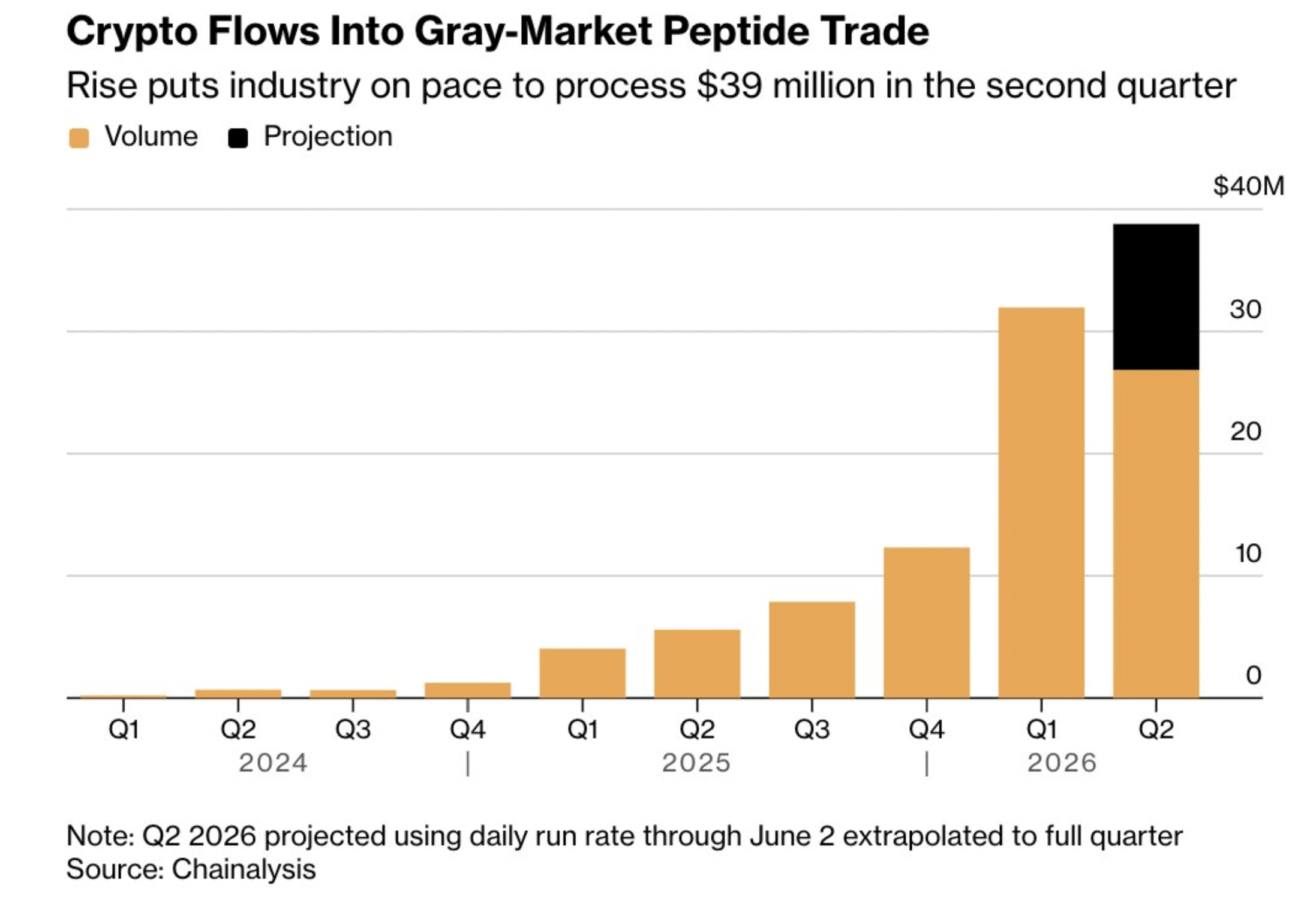
Source: Chainalysis

Despite a hike in law enforcement scrutiny, TRM Labs discovered a similar trend, estimating that cryptocurrency inflows to Chinese chemical manufacturers selling peptides reached $41.4 million in 2025.

However, unlike in the Silk Road era, modern buyers are frequently mainstream wellness consumers attracted by easier access and cheaper costs rather than illegal marketplaces.

Industry leaders weigh in

Remarking on the same, Sara Graham, Senior Intelligence Analyst at Chainalysis, said,

This is a market with buyers who are using crypto for the first time, and they may have not purchased drugs on the Silk Road or other dark net markets.

Echoing similar sentiments, Ari Redbord, Global Head of Policy at TRM Labs, added,

One of the earliest use cases of crypto was in the dark market. The promise of crypto is cross-border value transfer. Bad actors can now send larger amounts of funds than ever before.

Crypto adoption in Q1 2026

Here, it’s worth noting that this uptick in crypto use for gray-market peptides came on the back of AMBCryto revealing that retail participation plunged to its lowest level since the bear market of 2022 in Q1 2026.

Following a two-quarter trend of net capital outflows, the total volume of cryptocurrency transactions fell to $979 billion — down 23% from the previous quarter and 11% YoY.

In April, however, sentiment started to improve as the total market capitalization recovered from $2.05 trillion to about $2.63 trillion.


Final Summary

  • United States is seeing a surge in the use of cryptocurrencies, including Bitcoin and stablecoins, to purchase gray-market peptides.
  • In Q1 2026, gray-market peptide vendors received $32 million in crypto, a 700% increase from 2025.


İlgili Sorular

QWhat is the reported percentage increase in cryptocurrency payments for gray-market peptides from the previous year, according to the article?

AAccording to the article, cryptocurrency payments for gray-market peptides increased by 700% from the previous year.

QWhich two types of cryptocurrencies are primarily mentioned as being used to buy these peptides?

AThe cryptocurrencies primarily mentioned are Bitcoin (BTC) and stablecoins.

QWhat is one major reason peptide vendors have started to accept cryptocurrencies, as stated in the article?

AOne major reason is that due to compliance and risk concerns, traditional banks and card networks have tightened restrictions on transactions involving certain peptide sellers, leading vendors to accept cryptocurrencies.

QWhat trend did TRM Labs discover regarding cryptocurrency inflows to Chinese chemical manufacturers selling peptides in 2025?

ATRM Labs discovered that cryptocurrency inflows to Chinese chemical manufacturers selling peptides reached an estimated $41.4 million in 2025.

QHow does the article describe the typical modern buyer of these gray-market peptides, contrasting them with buyers from the Silk Road era?

AThe article describes the typical modern buyer as frequently being a mainstream wellness consumer attracted by easier access and cheaper costs, rather than a participant in illegal dark net marketplaces like the Silk Road.

İlgili Okumalar

Bitcoin Withdrawals Continue: 8 Years of Storage in a Coldcard Cold Wallet Ended in Zero

Coldcard Hardware Wallet Hacked: Losses Mount Due to Vulnerable Seed Generation A critical vulnerability in Coldcard hardware wallets has led to a continued wave of fund thefts. According to Galaxy Research, the total stolen has reached 1,367.05 BTC (approx. $88.6 million) from 4,585 addresses, a significant increase from the initial 594.5 BTC reported on July 30, 2026. Most of the stolen funds remain on the attackers' addresses. The issue is not with the current firmware, which Coinkite has updated, but with seed phrases generated on vulnerable devices between March 2021 and the release of fixed firmware versions. Due to a programmer error, devices switched from using a hardware random number generator to the software-based Yasmarang generator, which was initialized with publicly accessible data like the chip's serial number. This made the seed phrases predictable through offline brute-force attacks, meaning wallets remain at risk until funds are moved to a new wallet generated with the patched firmware. Affected devices include Mk2/Mk3 with firmware 4.0.1–4.1.9 (and up to 5.0.3), Mk4/Mk5 up to version 5.6.0, and Q models up to 1.5.0Q. The only exceptions are seeds created with a high-entropy method like at least 50 independent dice rolls or a strong unique BIP-39 passphrase. All other owners must generate a new seed on the fixed firmware and transfer their assets. A case highlighting the human impact involves a 39-year-old long-term investor who lost 2 BTC (approx. $130,000) in minutes. He had accumulated the Bitcoin over eight years through physical labor, viewing it as a financial lifeline and a retirement plan in a country suffering from hyperinflation. His story underscores that even conservative "buy and hold in cold storage" strategies can be compromised by such underlying technical flaws. From a technical perspective, this incident echoes historical failures where weak random number generators undermined cryptographic security, challenging the assumption that offline storage is automatically foolproof.

cryptonews.ru17 dk önce

Bitcoin Withdrawals Continue: 8 Years of Storage in a Coldcard Cold Wallet Ended in Zero

cryptonews.ru17 dk önce

İşlemler

Spot
活动图片




