Crypto Morning Report: U.S. Stocks Plunge Across the Board, HyperLend Unveils HPL Tokenomics

marsbit2026-01-21 tarihinde yayınlandı2026-01-21 tarihinde güncellendi

Özet

Crypto Morning Brief: U.S. stocks fell sharply across the board, with the Nasdaq and S&P 500 dropping over 2%. Chip stocks and major tech companies like Nvidia and Tesla declined 3-4%. Gold and silver hit new highs. In regulatory news, CFTC Chair announced the "Future Proof" initiative to modernize digital asset oversight. Trump Media set February 2, 2026, as the record date for its digital token distribution to shareholders. Hong Kong’s Securities and Futures Professionals Association urged a shift toward commercial application of virtual assets, following the establishment of regulatory infrastructure. HyperLend revealed its HPL tokenomics: 30.14% for ecosystem growth, 25% for genesis allocation, 22.5% to core contributors, 17.36% to strategic investors, and 5% for liquidity. Pendle introduced sPENDLE, a liquid staking token that reduces withdrawal time from years to 14 days. Ethereum’s recent network activity surge may be linked to address poisoning attacks, exploiting lower gas fees post-Dencun upgrade. Chainlink launched 24/5 U.S. stock data feeds for blockchain applications. Trend Research purchased 6,656 ETH, now holding $1.91 billion worth. Bitmine approved increasing its share issuance limit for future financing flexibility. Pump.fun established an investment division and a $3 million public hackathon. Recommended reads include discussions on AI’s impact, X’s algorithm changes, NYSE’s move to 24/7 tokenized trading, Wintermute’s market outlook...

Author: Deep Tide TechFlow

Yesterday's Market Dynamics

U.S. stock indices plummet across the board, chip stocks and gold/silver hit new highs

U.S. stock indices fell sharply, with the Nasdaq Composite dropping over 2%, the S&P 500 down about 2%+, and the Dow Jones Industrial Average declining approximately 1.7%–1.8%. Market panic sentiment rose, with the VIX fear index climbing to recent highs.

Tech/chip stocks fell broadly, with heavyweight stocks like Nvidia, Tesla, Apple, and Amazon generally under pressure, down 3%–4%+.

U.S. Treasury yields rose to multi-month highs, with significant selling pressure on U.S. bonds; the U.S. dollar index weakened.

Gold and silver prices reached new highs, with spot gold briefly surging to around $4750-4763 per ounce, and silver breaking through the $90 per ounce range.

U.S. Supreme Court issues no ruling on challenge to legality of Trump's global tariffs

The U.S. Supreme Court did not issue a ruling on the challenge to the legality of Trump's global tariffs.

CFTC Chairman launches "Future Proof" plan to upgrade cryptocurrency regulation

According to The Block, the new Chairman of the U.S. Commodity Futures Trading Commission (CFTC), Michael Selig, announced the "Future Proof" plan on January 20, aimed at modernizing the CFTC's approach to digital asset regulation. Selig wrote in a Washington Post op-ed, emphasizing that the existing regulatory framework is no longer suitable for the emerging digital asset market and calling for a "minimum effective dose" regulatory strategy.

Selig stated that if Congress passes legislation expanding the CFTC's regulatory authority, the agency is ready to take over the supervision of the digital asset market.

Trump Media announces record date for digital token program as February 2

Trump Media & Technology Group (Nasdaq, NYSE Texas: DJT) today announced that the record date for its digital token program is set for February 2, 2026. Ultimate beneficial owners and registered holders of at least one share of DJT stock as of this date will be eligible to receive tokens and related rewards. The company will partner with Crypto.com to mint and custody these digital assets.

Hong Kong Securities and Futures Professional Association: Hong Kong has completed initial virtual asset regulatory infrastructure, next step should shift focus to commercialization and application implementation

The Hong Kong government plans to announce the 2026/2027 Fiscal Budget on February 25, focusing on virtual assets and investor protection, among other areas. The Hong Kong Securities and Futures Professional Association stated that Hong Kong has completed the initial regulatory infrastructure for virtual assets, and the next step should shift focus to commercialization and application implementation. By unlocking RWA secondary market liquidity, accelerating product approvals, introducing international liquidity, and strengthening practitioner training, Hong Kong can upgrade from a market with clear regulations to a global virtual asset center with ample liquidity and widespread application, aligning with the national "15th Five-Year Plan" for financial openness and digital economy strategy.

HyperLend unveils HPL tokenomics model: Genesis allocation accounts for 25%, ecosystem growth and incentives account for 30.14%

According to a message from the official X account of digital asset lending platform HyperLend, the protocol has released its HPL token distribution plan:

Ecosystem growth and incentives account for 30.14%;

Genesis allocation accounts for 25%;

Core contributors account for 22.5%;

Strategic investors account for 17.36%;

Liquidity accounts for 5%.

Pendle launches sPENDLE liquid staking token: shortens lock-up period from years to 14 days

According to The Block, DeFi project Pendle announced the launch of the sPENDLE liquid staking token, officially replacing the previous vePENDLE multi-year locking mechanism. The new system reduces the withdrawal period from years to 14 days, while introducing transferable, composable token features to simplify user participation. Pendle revealed that the original vePENDLE system attracted only about 20% of the token supply, the lowest among similar models. The new mechanism will utilize up to 80% of protocol revenue for PENDLE buybacks and introduce an algorithmic emissions model, expected to reduce overall emissions by approximately 30%. Existing vePENDLE holders will receive a maximum 4x reward multiplier based on remaining lock-up time, which will decay linearly over two years.

Analysis: Recent surge in Ethereum network activity may be related to address poisoning attacks

According to Cointelegraph, security researcher Andrey Sergeenkov stated that Ethereum's recent record network activity may be related to a wave of address poisoning attacks exploiting low gas fees.

Since the Ethereum Fusaka network upgrade in December, transaction fees have dropped by over 60%, making such attacks more economically viable. Data shows that in the week starting January 12, the number of new Ethereum addresses reached 2.7 million, with daily transaction volume surging to over 2.5 million.

Address poisoning attacks involve scammers sending small transactions from wallets with addresses similar to legitimate ones, tricking users into copying the wrong address when transacting. Research indicates that some top "poisoners" have sent transactions to over 400,000 recipients, with 116 victims having lost over $740,000 through this method so far.

Chainlink launches 24/5 U.S. stock data service, connecting traditional stock market with blockchain

According to an official announcement, Chainlink recently launched a 24/5 U.S. stock data stream service, providing U.S. stock and ETF market data for blockchain applications, covering standard trading hours and non-standard hours. The service is already live on multiple blockchain platforms, aiming to bridge the gap between traditional stock market trading hours and blockchain operation mechanisms, creating blockchain application scenarios for the U.S. stock market.

Several trading platforms, including Lighter and BitMEX, have adopted this service for applications such as stock perpetual contracts and prediction markets. Beyond price information, this data service also includes bid/ask quotes, trading volume, and market status data, which can be used for pricing and risk management of on-chain financial products. This service represents a technological advancement in blockchain financial infrastructure.

Trend Research purchases another 6,656 Ethereum, currently holds approximately $1.91 billion worth of Ethereum

According to monitoring by Onchain Lens(@OnchainLens), Trend Research borrowed 20 million USDT and purchased 6,656 Ethereum (ETH), then deposited these Ethereum into the Aave V3 protocol.

Currently, Trend Research holds 651,310 Ethereum, worth approximately $1.91 billion.

Bitmine approved to increase cap on issuable shares to enhance future financing flexibility

According to CoinDesk, Bitmine Immersion Technologies received shareholder approval to increase the cap on the number of shares the company can issue, enhancing future financing flexibility. The company currently holds 4.203 million ETH, 193 BTC, a $22 million stake in Eightco Holdings, and nearly $1 billion in cash.

A news release from the company on Tuesday disclosed that Proposal No. 2 was passed with 81% approval at the annual shareholders' meeting on January 15, authorizing the company to increase the number of shares it can issue. This proposal does not mean the company will immediately issue more shares but raises the上限 for future issuances, providing room for subsequent financing, M&A, or supporting continued Ethereum accumulation.

Pump.fun announces establishment of investment division Pump Fund, launches $3 million "Build in Public Hackathon"

According to a disclosure on Pump.fun's official Twitter, the platform announced the establishment of the Pump.fun investment division and launched a $3 million Build in Public Hackathon. This hackathon will fund 12 projects, with each receiving a $250,000 investment at a $10 million valuation, along with guidance from Pump.fun founders.

Participating projects must issue tokens, build publicly, and hold at least 10% of the token supply. Unlike traditional hackathons, this event uses a tokenized model, letting the market rather than judges determine project value. The application deadline is February 18, 2026, with the first winners announced within 30 days.

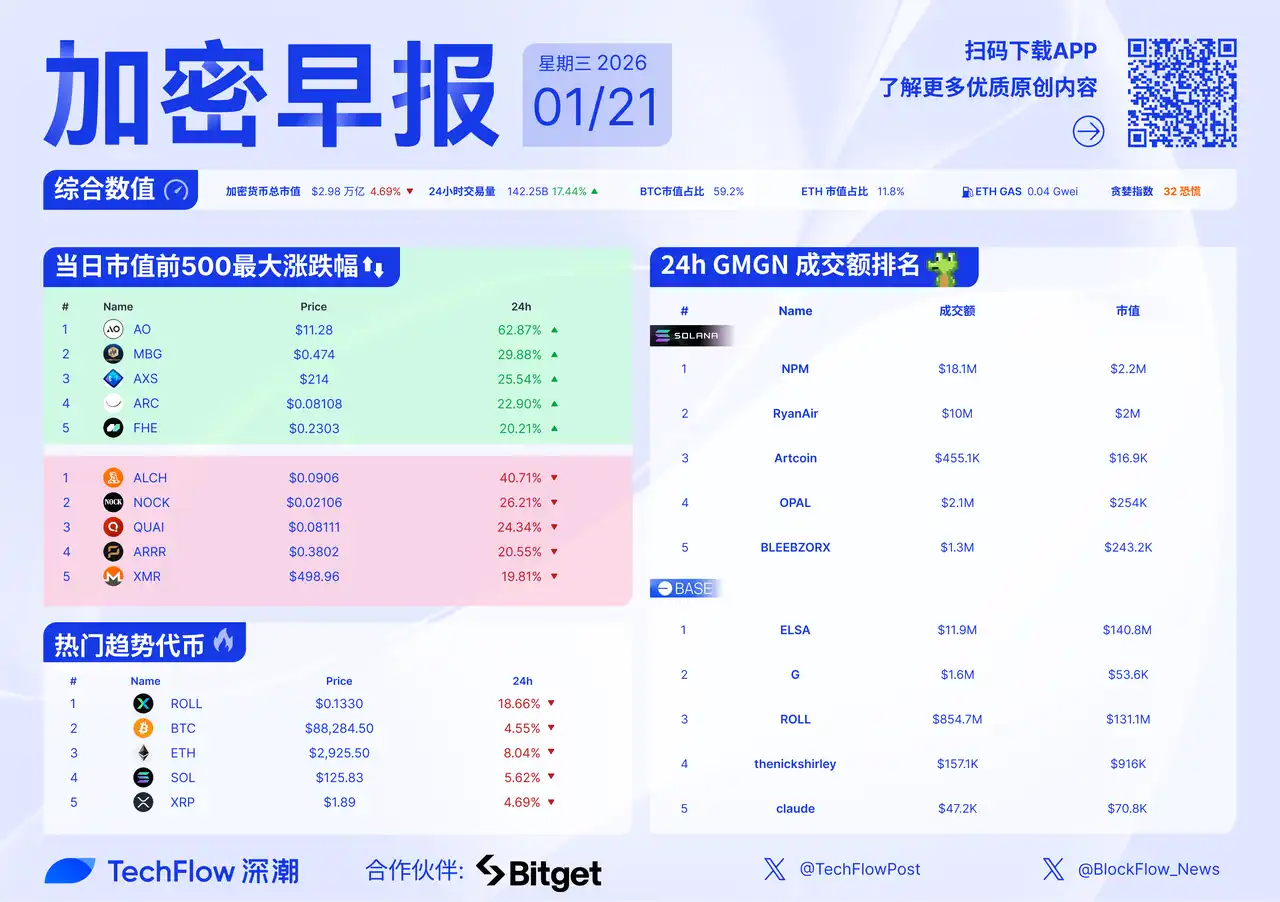
Market Dynamics
Recommended Reading

Conversation with Wang Qiao: Crypto tokens have little appeal to me currently, went all-in on Google in 2026

This article is a transcript of an interview with Qiao Wang on a podcast, discussing 2026 investment trends, the impact of AI on startups, current market sentiment, and topics like health and time management. Qiao shares his portfolio construction, insights on AI tools, and predictions for future technology and market developments.

Deconstructing X's open-source recommendation algorithm: What content should we write to be more attractive?

This article analyzes the architecture and logic changes in X platform's latest open-source recommendation algorithm, Phoenix, covering the shift from traditional manual features to AI models and the algorithm's impact on content creators. Additionally, the article provides practical advice for creators and discusses the limitations and value of open-sourcing.

NYSE aims for 7x24 stock trading: The world is one big exchange

This article discusses the NYSE's announced plan to launch a tokenized securities platform for 24/7 trading of U.S. stocks and ETFs, with instant settlement via stablecoins. This marks further integration of traditional finance with crypto infrastructure, removing barriers of time, space, and门槛, and推动 seamless global market trading. Although crypto's technical infrastructure is being adopted, its practical application still needs further expansion.

Wintermute: Three necessary conditions for the crypto market to warm up in 2026

This article analyzes how the crypto market failed to achieve the expected broad rebound in 2025, showing extreme polarization. Top market maker Wintermute believes the traditional four-year halving cycle is失效, with market logic shifting from "seasonal rotation" to "liquidity lock-up." Although Bitcoin and Ethereum are becoming institutionalized through ETFs, altcoin lifecycles are shortening, putting overall market pressure. Market recovery in 2026 requires attention to three core variables: expansion of institutional investment scope, wealth effect from mainstream assets, and the return of retail attention from the stock market. Future market performance depends on the diffusion of liquidity and structural changes.

Stop grinding mindlessly, the best airdrops often come "unexpectedly"

This article explores how to obtain high-quality cryptocurrency airdrops through genuine on-chain interaction rather than mechanical operations. It emphasizes the importance of building on-chain reputation and contributing value, citing multiple successful retrospective airdrop cases to reveal their core logic. The article also suggests strategies to avoid "volume fatigue" and encourages users to focus on protocols they like and interact genuinely.

İlgili Sorular

QWhat was the overall performance of the U.S. stock market as reported in the article?

AThe U.S. stock market saw a significant downturn, with the Nasdaq Composite Index falling over 2%, the S&P 500 dropping about 2%+, and the Dow Jones Industrial Average declining approximately 1.7%–1.8%.

QWhat is the 'Future Proof' plan announced by the CFTC Chairman, and what is its goal?

AThe 'Future Proof' plan, announced by CFTC Chairman Michael Selig, aims to modernize the CFTC's approach to regulating digital assets. It calls for a 'minimum effective dose' regulatory strategy, as the existing framework is no longer suitable for the emerging digital asset market.

QWhat is the new tokenomics model for HPL as announced by HyperLend?

AHyperLend's HPL token allocation is as follows: 30.14% for Ecosystem Growth and Incentives, 25% for Genesis Allocation, 22.5% for Core Contributors, 17.36% for Strategic Investors, and 5% for Liquidity.

QWhat significant change did Pendle make to its staking mechanism with the introduction of sPENDLE?

APendle replaced its vePENDLE multi-year locking mechanism with the new sPENDLE liquid staking token, which shortens the withdrawal period from several years to just 14 days and introduces a transferable, composable token to simplify user participation.

QAccording to the analysis in the article, what is a potential reason for the recent surge in Ethereum network activity?

AThe surge in Ethereum network activity may be related to a wave of 'address poisoning' attacks, which became more economically feasible after the Dencun upgrade reduced transaction fees by over 60%.

İlgili Okumalar

SemiAnalysis Dissects Huawei's Kirin 9030: Process Technology Halted, So They Folded the Chip

SemiAnalysis has published a detailed teardown report on the HiSilicon Kirin 9030 Pro chipset found in Huawei's Mate 80 Pro. Fabricated using SMIC's most advanced N+3 node without EUV lithography, the analysis reveals significant technical achievements and strategic shifts. The report indicates SMIC's N+3 has achieved transistor density comparable to TSMC's N6 (113.4 vs 107.7 MTr/mm²), primarily through aggressive use of Self-Aligned Quadruple Patterning (SAQP) for its metal layers. This results in a notably small 32.5nm M0 metal pitch. However, SemiAnalysis notes this achievement comes with significantly higher process complexity, cost, and potential yield challenges compared to competitors using more advanced tools. The Kirin 9030 design maximizes this constrained density. While its GPU performance has improved ~70% and matches Qualcomm's 2022 flagship level, the CPU core's IPC lags behind current top-tier designs from Apple and Qualcomm, a gap attributed to the underlying manufacturing technology rather than design capability. Facing long-term restrictions on advanced tools, Huawei is charting a new path. The report highlights the company's "LogicFolding" roadmap, a 3D stacking technique aimed at shortening signal paths to boost performance and efficiency. The goal is to reach 5GHz frequency and a projected density of 295 MTr/mm² by 2031. SemiAnalysis concludes that export controls have not halted China's chip progress but have fundamentally altered its trajectory, making it more expensive and complex. This has spurred innovation in alternative areas like 3D stacking and domestic EDA tool development, with Huawei's supply chain also beginning to integrate Chinese memory from CXMT.

marsbit26 dk önce

SemiAnalysis Dissects Huawei's Kirin 9030: Process Technology Halted, So They Folded the Chip

marsbit26 dk önce

How Will the Price Move Before SpaceX's Next Share Unlock?

TL;DR Investors buying SPCX after SpaceX's IPO are not simply investing in a typical tech stock. It’s a high-valuation asset driven by Musk's narrative, Starlink, and space transport potential, but with a key twist: a very small initial float of ~4% has led to significant post-listing price appreciation. The current price action reflects a timing gap. Before the first lock-up expiration (estimated around August, subject to official confirmation), scarcity and high demand could continue to push prices up. Short-term bulls focus on low float, FOMO, and potential index inclusion. However, bears point to the supply dynamics that will change post-lockup. Existing shareholders still hold over 95% of shares, which will be released in stages starting from the first unlock window. This introduces future selling pressure from low-cost holders. The upcoming Q2 earnings report is a critical catalyst before the unlock. It will test whether the company's fundamentals can justify the current ~$2.1T valuation. Strong results could support the pre-unlock momentum, while weak figures could amplify concerns about future supply. The trading thesis is shifting from immediate scarcity ("can't buy enough") to evaluating future absorption capacity ("who will buy when more supply hits"). The path ahead hinges on the specifics of the unlock schedule, Q2 earnings performance, and whether anticipated passive index buying materializes.

marsbit47 dk önce

How Will the Price Move Before SpaceX's Next Share Unlock?

marsbit47 dk önce

Bitcoin Short-Term Bullish Structure Validated, HYPE Low-Entry Window Opens | Guest Analysis

**Market Analysis Summary (Week of June 2026)** **Overall Market Context:** The market environment is exceptionally complex, with the unexpected US-Iran agreement and the reopening of the Strait of Hormuz triggering a global asset repricing and significant volatility. This heightened noise underscores the importance of a structured analytical framework. **Bitcoin (BTC) Analysis & Strategy:** * **Current Status:** The price has climbed above $65,000, currently in a rebound phase (segment 38-39) following a complex 12-segment correction from the May high of $82,850. * **Key Levels:** * **Primary Resistance:** $69,500–$70,500. A successful breakout above $65,000 targets this zone. * **Primary Support:** $65,000 (immediate), followed by $59,000–$60,000 and $55,000. * **Weekly Outlook & Strategy:** The focus is on the confirmation of the $65,000 level. * **Bullish Scenario (Hold $65K):** A move toward the $69.5K–$70.5K resistance zone is anticipated, which is a potential area for initiating medium-term short positions. * **Bearish Scenario (Break below $65K):** A retest of the $60,000–$62,000 support range is likely. * **Medium-Term Strategy:** Currently neutral. Plan to establish short positions (up to 60% allocation) either in the $69.5K–$70.5K resistance zone upon signs of rejection, or on a confirmed breakdown below $65,000 and further below $59K–$60K. * **Short-Term Strategy:** Utilize 30% capital for scalping opportunities based on support/resistance levels, using 30/60-minute charts. **HYPE Analysis & Strategy:** * **Current Status:** The price has stabilized around $52 after a four-segment decline from the June high of $75.87 and is now in a rebound (segment 50-51). * **Key Levels:** * **Primary Resistance:** $62.50–$64.57. Watch for potential rejection here to form a lower high. * **Primary Support:** $52–$55.50, followed by $47–$49. * **Weekly Outlook & Strategy:** Adopt a "buy on dips, avoid chasing rallies" approach. * **Core View:** Monitor the price action and potential formation of a lower high ("endpoint 51") in the $62.50–$64.57 resistance zone. * **Short-Term Strategy:** Consider light long positions (max 30% allocation) if the price finds support and shows reversal signals in the $52–$54.50 or deeper $47–$49 support zones, confirmed by proprietary quantitative bottom signals. **Trade Review:** Last week's HYPE short-term long trade, executed based on proprietary "Price Difference" and "Momentum" model signals, yielded a profit of approximately 11.88%. The entry was near $54.39 and exit near $60.85. **Risk Management Reminder:** Always set an initial stop-loss upon entry. Move stop-loss to breakeven at +1% profit, then trail it upwards to lock in gains as the trade progresses. *Disclaimer: All analysis, models, and strategies are based on personal technical analysis for educational purposes only, not investment advice. The market carries inherent risk.*

Odaily星球日报51 dk önce

Bitcoin Short-Term Bullish Structure Validated, HYPE Low-Entry Window Opens | Guest Analysis

Odaily星球日报51 dk önce

Bitcoin Short-Term Bullish Structure Validated, HYPE Accumulation Window Opens | Guest Analysis

**Bitcoin and HYPE Market Analysis: Short-Term Outlook and Trading Strategies** This market analysis examines Bitcoin (BTC) and HYPE amid volatile conditions, providing short-term outlooks and specific trading strategies. **Key Outlooks:** * **Bitcoin (BTC):** Focus is on whether BTC's recent move above $65,000 holds. A successful breakout could lead to a test of the $69,500-$70,500 resistance zone, where medium-term short positions are considered. A failure, breaking below $65,000, may trigger a decline towards the $59,000-$60,000 support area. * **HYPE:** The token completed a four-wave correction and is now rebounding. The key resistance zone is $62.5-$64.57. The trading strategy is "buy on dips," looking for entry opportunities near the $52-$54.5 or deeper $47-$49 support zones, pending confirmation from proprietary models. **BTC Trading Strategy:** * **Medium-term:** Primarily looking to establish short positions (up to 60% allocated capital) if price rallies to the $69,500-$70,500 resistance area and shows signs of reversal. Alternative plans involve initiating shorts on a breakdown below $65,000. * **Short-term:** Allocate up to 30% capital for intraday "spread" trades based on support/resistance levels on 30/60-minute charts. **HYPE Trading Strategy:** * **Short-term:** Adopt a dip-buying approach. Consider light long positions (under 30% capital) when price tests key support levels ($52-$54.5 or $47-$49) and shows stabilization, confirmed by proprietary "Price Spread" and "Momentum Quant" models. **Trade Recap:** The analysis reviews a successful HYPE long trade from the previous week, executed at ~$54.39 and closed at ~$60.85 for an ~11.88% gain, based on signals from the aforementioned models. **Risk Management Emphasis:** The article stresses strict capital allocation (under 30-60%), immediate initial stop-loss placement, and a trailing stop-loss protocol to lock in profits as trades move favorably. ***Disclaimer:** All analysis, models, and strategies are for educational purposes based on technical analysis, not investment advice. Markets are volatile; trade with caution.*

marsbit54 dk önce

Bitcoin Short-Term Bullish Structure Validated, HYPE Accumulation Window Opens | Guest Analysis

marsbit54 dk önce

İşlemler

Spot
Futures
活动图片