Crypto Morning Report: Crypto Market Bloodbath, Strategy Releases Q4 Earnings

marsbit2026-02-06 tarihinde yayınlandı2026-02-06 tarihinde güncellendi

Özet

Crypto Market Bloodbath: Key Updates & Strategy's Q4 Report The crypto market experienced significant turmoil, with Bitcoin dropping below $73,000. Major developments include: U.S. economic data showed higher-than-expected weekly jobless claims. The CFTC withdrew a proposal to ban political prediction markets. Treasury Secretary Scott Bessent testified that the U.S. will not "bail out" Bitcoin or direct banks to buy crypto, though the government holds over $15B in seized BTC. Policy moves included Virginia proposing a bill to create a state cryptocurrency reserve fund. The House launched an investigation into a $500M deal between a Trump-linked crypto project and an UAE entity. Company news featured Espresso releasing its ESP tokenomics with a 10% airdrop. Binance denied sending legal threats to a user who alleged insolvency. A wallet labeled Trend Research moved 8,000 ETH to Binance. Strategy Inc. reported a massive Q4 net loss of $12.4B, citing digital asset depreciation. It holds 713,502 BTC at an average cost of ~$76,052. Tether announced a $100M strategic investment in Anchorage Digital. The report also covered broader themes like AI's need for crypto-based trust systems and crypto's evolving role as a settlement layer for the internet economy.

Author: Deep Tide TechFlow

Yesterday's Market Dynamics

US Initial Jobless Claims for the Week Ending Jan 31: 231K, Expected 212K

US Initial Jobless Claims for the week ending January 31 were 231,000, compared to an expectation of 212,000 and a previous reading of 209,000.

US CFTC Withdraws Biden-Era Proposal to Ban Political Prediction Markets

According to The Block, the US Commodity Futures Trading Commission (CFTC) has formally withdrawn a 2024 proposed rule on "event contracts" that would have banned political prediction market contracts. CFTC Chairman Michael S. Selig called the initial proposal "policy overreach" and announced the Commission will develop a new framework to support "legitimate innovation".

Bessent: US Will Not "Bail Out" Bitcoin, Has No Authority to Direct Private Banks to Buy Bitcoin or TRUMP Coin

According to Cointelegraph, US Treasury Secretary Scott Bessent testified before Congress on Wednesday, stating that the US will retain Bitcoin obtained through asset forfeiture but will not direct private banks to buy more Bitcoin during a market downturn.

In an exchange with California Representative Brad Sherman, Bessent made clear that he, as Treasury Secretary and Chairman of the Financial Stability Oversight Council (FSOC), does not have the authority to direct private banks to buy more Bitcoin or "TRUMP coin" by altering bank reserve requirements.

Bessent added that the value of Bitcoin seized and held by the US government has grown to over $15 billion. According to an executive order signed by Trump in March 2025, the US can only acquire more Bitcoin through asset forfeiture cases or budget-neutral strategies, not through open market operations.

Virginia Proposes SB557 Bill to Establish State-Level Cryptocurrency Reserve Fund

According to Virginia Senate Bill No. 557, submitted on January 14, 2026, the state plans to amend the Code of Virginia by adding Article 6 to Chapter 18 of Title 2.2, establishing the "Commonwealth Strategic Cryptocurrency Reserve Fund".

The bill was introduced by Senator Reeves and has been referred to the Committee on General Laws and Technology for consideration.

US House Launches Investigation into $500M Deal Between Trump-Linked Crypto Project and UAE

According to The Block, Senior Democrat Rep. Ro Khanna of the House Select Committee on the Strategic Competition Between the United States and the Chinese Communist Party has launched an investigation into the Trump-linked crypto project World Liberty Financial (WLFI) over its reported acceptance of a $500 million investment from Aryam Investment 1, an entity linked to the UAE royal family. The investigation letter notes that the deal was signed four days before Trump's inauguration, with an initial payment of $250 million, of which $187 million flowed to Trump family entities.

Rep. Khanna questioned whether this investment may have influenced US policy on advanced AI chip exports to the UAE and whether there is a temporal correlation with Binance founder Changpeng Zhao receiving a presidential pardon. The representative requested that World Liberty Financial respond to 16 specific questions and submit relevant documents by March 1, 2026.

Previous market news: A member of the UAE royal family secretly acquired a 49% stake in World Liberty Financial for $500 million.

Espresso Reveals ESP Tokenomics Model, Initial Supply of 3.59 Billion Tokens, Airdrop Allocation 10%

Blockchain infrastructure Espresso has revealed the economics model for its ESP token. ESP is an Ethereum ERC-20 token with an initial total supply of 3.59 billion tokens and no fixed maximum supply.

The ESP token allocation includes:

Contributors: 27.36%;

Investors: 14.32%;

Airdrop: 10%;

Community Launchpad: 1%;

Staking Rewards: 3.01%;

Future Airdrops & Incentives: 24.81%;

Foundation Operations: 15%;

Liquidity Provision: 4.5%.

ESP tokens will be used to support the network's Proof-of-Stake consensus. Holders can participate in network operation by running validator nodes or delegating tokens. Espresso uses a staking reward formula similar to Ethereum's, providing higher incentives when the staking ratio is low and gradually decreasing the reward rate as staking participation increases to ensure network security and stable operation.

Previous news: Espresso completed a $28 million Series B funding round led by a16z in 2024.

Binance Denies Sending Legal Threat Letter to User Who Alleged Insolvency

According to The Block, cryptocurrency exchange Binance has clarified that a cease-and-desist notice widely circulated online is a forgery. The notice was purportedly issued against an individual alleging the exchange was insolvent.

Social media user Lewsiphur claimed on platform X on Wednesday that Binance was insolvent, warning it would have a "catastrophic" impact on the market. The user later claimed to have received a cease-and-desist from Binance, attaching an image of a document. The official Binance Customer Support account responded: "This letter is not from Binance, it is an imaginative forgery."

Rumors about Binance's insolvency have been circulating in recent weeks, often linked to the cryptocurrency market crash in October 2025. Binance co-founder He Yi stated that despite user-initiated withdrawal campaigns, assets on Binance addresses have actually increased.

Trend Research Transfers Another 8,000 ETH to Binance, Worth Approximately $14.8 Million

According to on-chain analyst EmberCN (@EmberCN) monitoring, Trend Research transferred another 8,000 ETH to Binance, worth approximately $14.8 million.

Strategy Releases Q4 Earnings Early This Morning: Average Bitcoin Holding ~$76,052, Q4 Net Loss $12.4 Billion

According to an official announcement, Bitcoin treasury company Strategy Inc. released financial data for the fourth quarter and full year 2025. As of February 1, 2026, it holds 713,502 BTC with a total cost of $54.26 billion, averaging approximately $76,052 per bitcoin. The company raised $25.3 billion in financing for the full fiscal year 2025.

Fourth-quarter financial data shows the company had a loss of $17.4 billion and a net loss of $12.4 billion, primarily affected by the decline in digital assets. As of December 31, 2025, the company held $2.3 billion in cash and cash equivalents. Strategy has built a $2.25 billion US dollar reserve, which can cover approximately 2.5 years of dividend and interest expenses.

Market News: Polymarket Parent Company Blockratize Files $POLY Trademark Application

According to market news, prediction market platform Polymarket's parent company, Blockratize, has filed a trademark application for $POLY.

Tether Announces $100 Million Strategic Investment in Anchorage Digital

According to an official Tether message, Tether Investments announced on February 5, 2026, a $100 million strategic equity investment in Anchorage Digital, the first federally chartered digital asset bank in the US. Anchorage Digital provides staking, custody, governance, settlement, and stablecoin issuance services for global institutions and innovators.

Market Trends
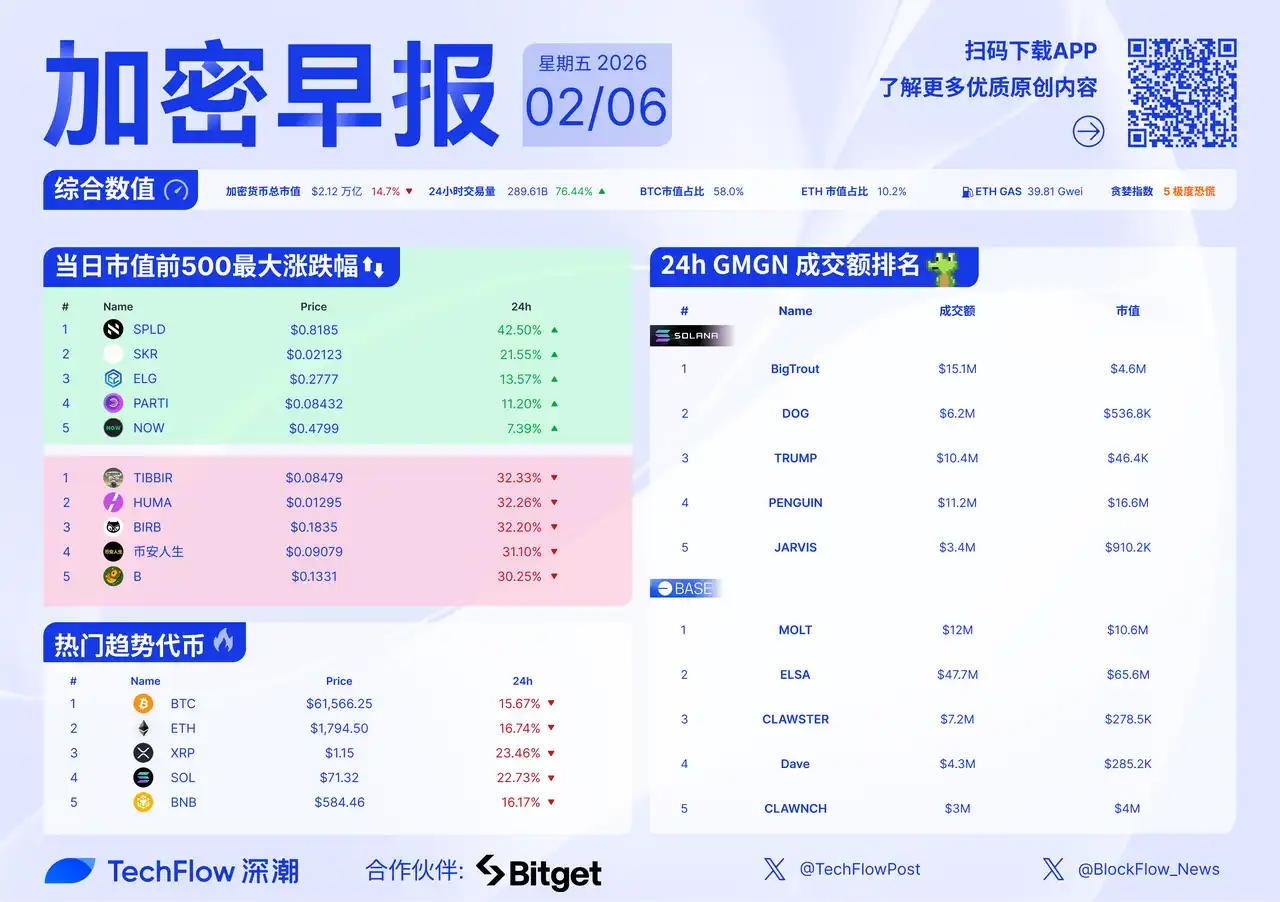
Recommended Reading

Using Claude to Scrape 260,000 Records, I Uncovered Epstein's Crypto Connections

This article analyzes Epstein's connections to the crypto industry, revealing his behavioral patterns in the field, including funding academic research, direct communication with crypto technology developers, and attempts to influence industry development. Through database records and auxiliary analysis, the article shows Epstein's deep penetration into the crypto space and offers speculation about his actions.

Kyle Left the Crypto Industry, and I'm a Bit Sad

This article discusses知名VC Kyle Samani's announcement of leaving the crypto industry to focus on AI, longevity technology, and robotics. His departure is seen as a shake in confidence in the crypto industry. Nonetheless, the author remains hopeful about the prospects of Crypto's financial applications, believing it still holds value in areas like stablecoins and DeFi, and expresses willingness to continue exploring the industry's possibilities. The crypto industry may be undergoing a transition from "faith" to "rationality," which might be a necessary path in its development.

February 5 Market Summary: AMD Plunge Triggers Chip Stock Crash, Bitcoin Falls Below $73K

This article analyzes recent market dynamics, including the performance of tech stocks, cryptocurrencies, and precious metals markets, revealing concerns about the AI bubble bursting and the impact of cost失控 on tech company profitability. Additionally, the article mentions the strong rebound in gold prices and the reasons behind it.

Wintermute Ventures: In 2026, Crypto Gradually Becomes the Clearing Layer for the Internet Economy

This article explores the trend of crypto technology gradually becoming a clearing and settlement layer for the internet economy and analyzes the future development directions in related fields. The article focuses on five themes: everything becomes tradable, stablecoin interoperability, tokenomics returning to fundamentals, DeFi and TradFi convergence, and privacy becoming a regulatory driver.

a16z: Why Does AI Urgently Need Crypto Technology?

This article analyzes how artificial intelligence lowers the cost of large-scale operations but makes trust difficult to establish, while blockchain technology can重塑 the trust system. AI systems can forge identities on a large scale at low cost; blockchain can effectively limit forgery through decentralized proof-of-humanity systems. Blockchain serves as the infrastructure for an AI-native internet, restoring trust and protecting human-scale interaction.


İlgili Sorular

QWhat was the main reason for Strategy Inc.'s $12.4 billion net loss in Q4 2025?

AThe net loss was primarily due to the decline in the value of its digital asset holdings.

QWhat action did the U.S. CFTC take regarding political prediction markets, and what was the reason given by its chairman?

AThe CFTC withdrew a 2024 rule proposal that would have banned political prediction market contracts. Chairman Michael S. Selig called the initial proposal 'policy overreach' and announced the committee would develop a new framework to support 'legitimate innovation'.

QWhat is the purpose of Virginia's proposed Senate Bill No. 557?

AThe bill proposes to establish a 'Commonwealth Strategic Cryptocurrency Reserve Fund' to create a state-level cryptocurrency reserve.

QWhat was the significant transaction involving Trump-associated crypto project World Liberty Financial that prompted a U.S. House committee investigation?

AThe investigation was prompted by a reported $500 million investment from the UAE王室-related entity Aryam Investment 1. The deal was signed four days before Trump's inauguration, with an initial payment of $250 million, of which $187 million flowed to Trump family entities.

QWhat is the total initial supply of Espresso's ESP token and what percentage is allocated for the airdrop?

AThe initial total supply of ESP tokens is 3.59 billion, and 10% of that supply is allocated for the airdrop.

İlgili Okumalar

Understanding CPO (Co-Packaged Optics) in One Article: Why Nvidia Is Willing to Spend $3.2 Billion on a Fiber?

NVIDIA and Corning announced a multi-year strategic partnership on May 6, 2026, with NVIDIA committing up to $3.2 billion to support Corning's U.S. expansion. This investment will triple Corning's manufacturing plants and significantly boost its optical fiber and communications production capacity. The core driver behind this massive investment is the fundamental shift from copper to optical interconnect technology within AI data centers. As GPU clusters scale, copper wires face critical limitations: severe signal attenuation over distance, high energy consumption for signal integrity, and excessive heat generation. Optical fiber, transmitting light instead of electrical signals, solves these issues with minimal loss, near-light speed, and lower power needs. The article outlines a three-stage evolution of data center interconnect: 1. **Traditional Copper Interconnects:** The mainstream solution of the 2010s, now being phased out due to scaling bottlenecks. 2. **Pluggable Optical Modules:** The current mainstream, where modules convert electrical signals to light externally. This process still introduces energy loss and latency. 3. **CPO (Co-Packaged Optics):** The next-generation technology where the optical engine is integrated directly with the GPU chip package. This drastically reduces the electrical signal travel distance to mere millimeters, slashing power consumption and latency while boosting data density. NVIDIA CEO Jensen Huang has identified CPO as an essential core technology for AI infrastructure. NVIDIA's investment signifies a strategic shift from being a buyer to actively controlling its supply chain for critical components. With demand for specialized optical fiber far outstripping supply—evidenced by soaring prices—securing long-term manufacturing capacity has become a competitive necessity. While Corning's expansion may pressure some suppliers, a projected global fiber supply gap of 5-15% over the next few years creates a significant opportunity window, particularly for Chinese manufacturers competitive in optical preforms, chips, and modules. Ultimately, NVIDIA's move is not about chasing a trend but an engineering imperative. The transition to light-based interconnects like CPO is driven by the physical limits of copper, marking a definitive step in the ongoing AI computing revolution.

marsbit7 dk önce

Understanding CPO (Co-Packaged Optics) in One Article: Why Nvidia Is Willing to Spend $3.2 Billion on a Fiber?

marsbit7 dk önce

KOL's Perspective: Why Is SOL Set to Rise from This Point?

**Summary: Why SOL is Positioned for Growth at This Level** The article argues that SOL is poised for an upward move from its current price point, citing several key factors. Primarily, SOL has just broken out of a 4-month consolidation phase. This breakout signals a return of risk appetite to the broader crypto market, as SOL is seen as a key indicator of overall crypto health. The token's ownership has reportedly shifted from short-term traders and tourists to long-term accumulators, leading to low volume. Any meaningful increase in trading activity could thus trigger significant upward momentum. Fundamental strengths include strong institutional adoption, integration with DeFi and RWAs (Real-World Assets), and the potential benefits from the Clarity Act. Despite its high volatility—having dropped 70% from its all-time high but still up 12x from its bear market low—SOL is highlighted as one of the few tokens from the last cycle to reach new highs. It boasts a robust ecosystem of applications, users, and protocols. Future catalysts include the expected influx of AI developers following the Miami Accelerate conference, which focused on AI on Solana. Furthermore, Solana is positioned as the premier chain for memecoin activity, a trend expected to continue and drive network usage and fees. The article concludes that recent price action reflects a healthy transfer to long-term holders, setting the stage for growth.

marsbit57 dk önce

KOL's Perspective: Why Is SOL Set to Rise from This Point?

marsbit57 dk önce

Those Pre-Bitcoin PoW Protocols Have Recently Been Reimplemented

This article details a recent surge in replicating pre-Bitcoin Proof-of-Work (PoW) protocols, specifically focusing on Hal Finney's 2004 RPOW (Reusable Proofs of Work). Within five days in May 2026, multiple independent builders in the Bitcoin/cypherpunk community launched projects inspired by this early electronic cash proposal. The initiative began with Fred Krueger's `rpow2.com`, a centralized but auditable system that replaced RPOW's original IBM 4758 hardware with Ed25519 signatures. Initially a faithful replica, it later adopted Bitcoin-like features (21M supply cap, difficulty adjustment) and a controversial 5.24% founder allocation. This sparked rapid forks, including `rpow4.com` which incorporated full Bitcoin parameters, a prediction market (`rpowmarket.com`), and a DEX (`rpow2swap.com`). Concurrently, Mike In Space created a prototype of Wei Dai's 1998 b-money proposal (`b-money.replit.app`), pushing the historical exploration even further back. The article contrasts these centralized, server-dependent experiments with Bitcoin's core innovation of decentralized, trustless consensus. It also highlights a parallel development: the `HASH` project on Ethereum, which uses smart contract hooks to enable a purely fair-launch, browser-mineable PoW token with 0% allocations to team or VCs. The collective activity is framed as a meme-driven, educational exploration of cypherpunk history rather than a serious financial movement, with all projects heavily disclaiming any investment value.

marsbit1 saat önce

Those Pre-Bitcoin PoW Protocols Have Recently Been Reimplemented

marsbit1 saat önce

South Korean Exchanges 'Battle' Regulators, Challenging the Boundaries of Enforcement and Legislation

South Korea's cryptocurrency industry is engaged in a rare, direct confrontation with regulators. The Financial Intelligence Unit (FIU), the primary anti-money laundering (AML) watchdog, has recently imposed heavy penalties on major exchanges like Upbit and Bithumb for alleged violations involving unregistered overseas VASPs and AML procedures. However, exchanges are now actively challenging these actions in court and through industry associations. In a significant shift, the Seoul Administrative Court ruled in favor of Upbit's operator, Dunamu, overturning part of an FIU-ordered business suspension. The court found the FIU's penalty criteria and justification insufficiently clear. Similarly, the court suspended the enforcement of a six-month business suspension against Bithumb pending a final ruling, citing potential irreversible harm to the exchange. Beyond legal battles, the industry is contesting proposed legislative amendments. The Digital Asset eXchange Alliance (DAXA) strongly opposes a draft rule that would mandate Suspicious Transaction Reports (STRs) for all crypto transfers over 10 million KRW (~$6,800). DAXA argues this "poison pill" clause violates legal principles and would overwhelm the STR system, increasing reports from 63,000 to an estimated 5.45 million annually for major exchanges, thereby crippling effective AML monitoring. This conflict highlights a structural tension in South Korea's crypto governance: comprehensive digital asset laws are still developing, while regulators rely heavily on AML enforcement. The industry's move from passive compliance to active legal and legislative challenges signifies a new phase, pressing for clearer rules and more proportionate enforcement. While short-term disputes may intensify, this clash could ultimately lead to a more mature and sustainable regulatory framework for South Korea's vibrant crypto market.

marsbit1 saat önce

South Korean Exchanges 'Battle' Regulators, Challenging the Boundaries of Enforcement and Legislation

marsbit1 saat önce

İşlemler

Spot
Futures
活动图片




