Crypto Morning Brief: U.S. Government Shutdown Ends, MetaMask Integrates Ondo Finance to Launch Tokenized U.S. Stock Trading Feature

marsbit2026-02-04 tarihinde yayınlandı2026-02-04 tarihinde güncellendi

Özet

This crypto market digest covers key developments from February 3, 2026. The U.S. government ended its partial shutdown after President Trump signed a funding bill. Regulatory progress continues as Senate Democrats plan another closed-door meeting on the CLARITY Act, while the Avalanche Policy Alliance established an advisory committee to push for global regulatory coordination. In product updates, MetaMask integrated with Ondo Finance, enabling non-U.S. users to trade over 200 tokenized U.S. stocks and ETFs directly using USDC. BNB Chain introduced new application-layer standards (BAPs) and a non-fungible agent (NFA) token standard. Tether launched MiningOS, an open-source Bitcoin mining operating system. On the security front, Step Finance confirmed a $40 million treasury exploit due to a team device breach but has recovered approximately $4.7 million so far. Market sentiment was impacted by a triple threat: poor earnings from major tech companies, uncertainty around the new Fed chair nomination, and a sharp correction in precious metals. Bitcoin fell below $80,000, triggering a record $2.55 billion in liquidations. Despite the bearish trend, analysts from Wintermute anticipate a potential market recovery in the second half of 2026, citing solid industry infrastructure. Other notable news includes Tria's tokenomics reveal for its 10 billion TRIA token supply and a court filing suggesting Jeffrey Epstein may have indirectly invested $3.25 million in Coinbase's 2014 Serie...

Author: Deep Tide TechFlow

Yesterday's Market Dynamics

Trump Signs Funding Bill Early This Morning, Ending Partial Government Shutdown

According to Jinshi Data, on February 3 local time, U.S. President Trump signed the government funding bill in the Oval Office of the White House, ending the partial government shutdown. Earlier that day, the U.S. House of Representatives voted to pass the funding bill for several federal departments for the remainder of the fiscal year, resolving the partial government shutdown that began on January 31. The bill will provide funding for several federal departments until September 30, the end of the fiscal year, and provide two weeks of funding for the Department of Homeland Security, which has recently faced controversy and protests over immigration enforcement actions, to allow all parties to continue negotiations on improving the department's operations.

Crypto Journalist: U.S. Senate Democrats Plan Another Closed-Door Meeting on the CLARITY Act Tomorrow

According to cryptocurrency journalist Eleanor Terrett early this morning, U.S. Senate Democrats plan to convene another closed-door meeting tomorrow to discuss the CLARITY Act (Cryptocurrency Market Structure Act). Two informed sources revealed that this will be the first meeting of Democratic members since the Senate Banking Committee postponed the bill's review last month.

Avalanche Policy Alliance Forms Advisory Committee, Calls for Global Crypto Regulatory Coordination

According to The Block, the Avalanche Policy Alliance announced the formation of an advisory committee on February 3, led by Ava Labs General Counsel Lee Schneider, with UK House of Lords member Chris Holmes and several Avalanche ecosystem executives joining. The committee will focus on three core priorities in 2026: token classification, definition of intermediaries, and protecting internet access rights.

The committee's formation comes as the U.S. is working to pass comprehensive crypto regulation, the EU has begun implementing MiCA regulations, the UK plans to introduce a new regulatory framework by 2027, and Japan continues to lead in rule-making.

BNB Chain Releases Application Layer Standard BAPs and NFA Token Standard BAP-578

According to an official announcement, BNB Chain has released a new application layer standard, BAPs, and a Non-Fungible Agent (NFA) token standard, BAP-578.

The BAPs standard aims to make the application layer more consistent, interoperable, and easier to build, enabling faster development, clearer integration methods, and a better developer experience. It focuses on standardizing the application layer, covering application interfaces, wallet and identity conventions, token and NFT utility standards, and interoperability between applications.

BAP-578 is a Non-Fungible Agent (NFA) token standard. NFA is an AI-driven asset that can operate autonomously on-chain.

Step Finance Confirms Theft Amount Reached $40 Million, Advises Users to Temporarily Avoid Interaction

According to an official statement from Step Finance, the security incident on January 31 resulted in approximately $40 million being stolen from its treasury due to the compromise of an executive team device. Step Finance is currently collaborating with cybersecurity researchers and relevant departments to investigate the matter and has notified law enforcement agencies.

During the enhanced security measures, Step Finance has suspended multiple operational activities. Through the built-in security protection of Token22 and rapid coordination with partners, Step Finance has successfully recovered approximately $3.7 million in Remora assets and $1 million in other assets.

The official advice is for users to temporarily avoid interacting with the STEP token until the investigation is complete. The project will take a snapshot from before the attack and is seeking solutions for STEP token holders. Remora Markets was not affected by this incident, and all rTokens remain 1:1 backed by custodial collateral.

Tether Launches Open-Source Bitcoin Mining Operating System MiningOS

According to The Block, Tether has released an open-source Bitcoin mining operating system called MiningOS (MOS), providing miners with a new alternative to proprietary, vendor-controlled software. The system is designed with a modular, peer-to-peer architecture, capable of managing mining activities without relying on centralized services, suitable for setups ranging from small home operations to large industrial sites. MOS is released under the Apache 2.0 open-source license, is hardware-agnostic, and can coordinate hardware, energy usage, device health status, and site-level infrastructure.

Tether CEO Paolo Ardoino stated that MiningOS aims to make Bitcoin mining infrastructure more open, modular, and accessible.

Additionally, Tether announced that it will release and develop the Mining SDK in collaboration with the open-source community in the coming months. This move is part of Tether's ongoing business expansion. The company reported a net profit of over $10 billion in 2025, and its business has expanded from core stablecoins to mining, payments, and infrastructure.

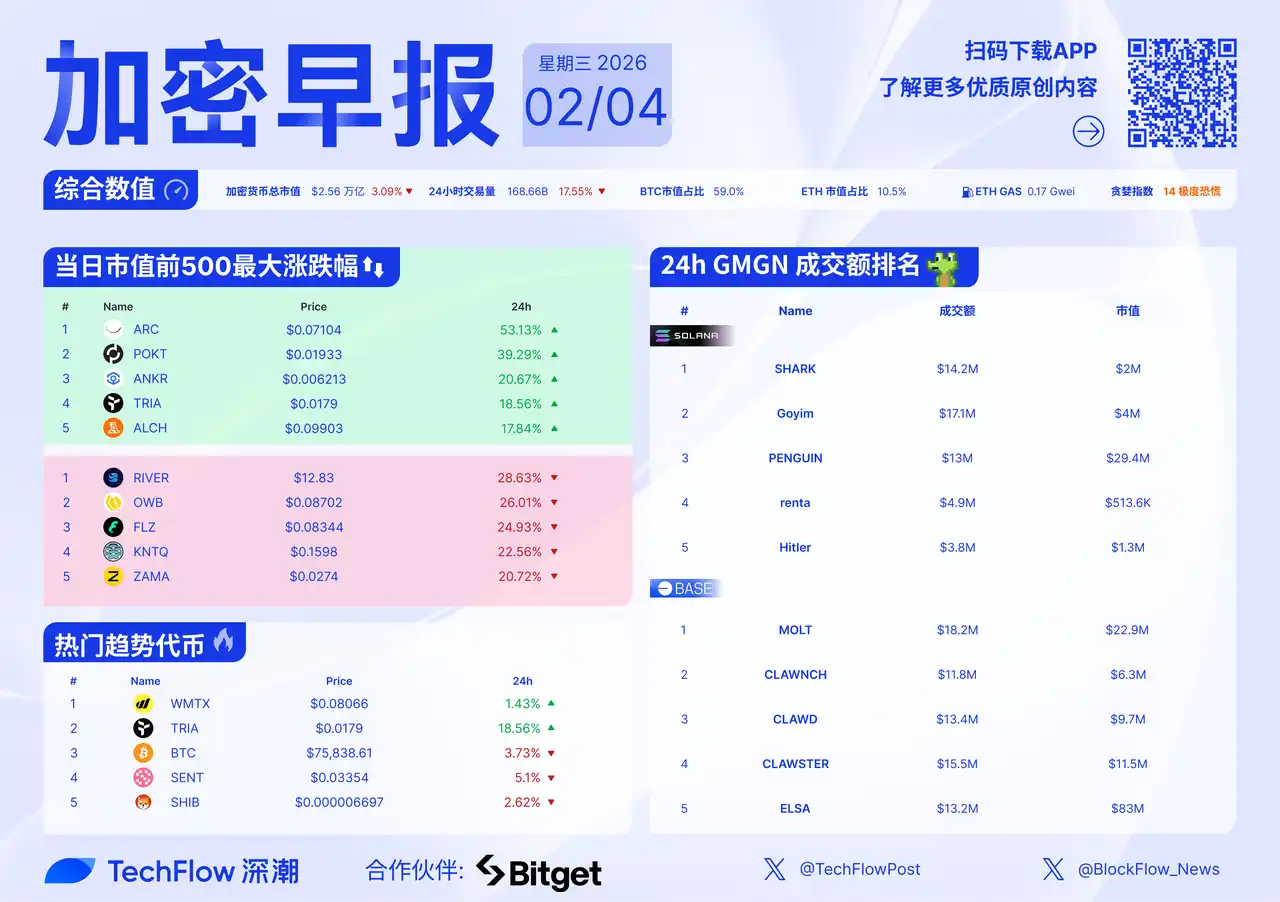
Tria Reveals Tokenomics: Total Supply 10 Billion, Community Allocation 41.04%

According to official news, the self-custody digital bank Tria has unveiled the TRIA tokenomics model. The total supply is 10 billion tokens, adopting a fixed supply, hard cap model with no inflation design.

The TRIA token has five core functions within the system: BestPath settlement, staking and routing access, gas and fee subsidies, governance, and membership benefits. In the token allocation, the community receives 41.04%, the foundation 18%, ecosystem and liquidity 15%, investors 13.96%, and core contributors 12%. The genesis circulating supply is 2.189 billion tokens, accounting for 21.89% of the total.

Previous news reported that the self-custody digital bank Tria completed a $12 million funding round with participation from the Ethereum Foundation, Wintermute, and others.

MetaMask Integrates Ondo Finance to Launch Tokenized U.S. Stock Trading Feature

MetaMask and Ondo Finance announced a partnership. On February 3, 2026, Ondo Global Markets was integrated into the MetaMask mobile wallet, providing eligible non-U.S. users with access to trade over 200 tokenized U.S. stocks, ETFs, and commodities.

Users can purchase these tokenized assets using USDC on the Ethereum mainnet, enjoying 24/5 trading and 24/7 transfer functions without the need to open a traditional brokerage account. Tradable assets include well-known stocks like Tesla, Nvidia, and Apple, as well as ETFs such as SLV (silver), IAU (gold), and QQQ.

Trend Research, Under Yi Lihua, Transfers Another 15,000 Ethereum to Binance, Total Sold Reaches 153,000

According to Onchain Lens monitoring, Trend Research, under Yi Lihua, transferred another 15,000 Ethereum (worth approximately $33.08 million) to Binance.

Data shows that Trend Research has now transferred a total of 153,588 Ethereum (worth approximately $352.43 million) to Binance for sale and loan repayment.

Wintermute: Bitcoin Falling Below $80,000 Due to Triple Blow, Market Recovery Expected in Second Half of 2026

Wintermute stated that the Bitcoin price fell below $80,000 for the first time since April 2025, triggering a record $2.55 billion in liquidations over the weekend, making it the tenth-largest liquidation event in cryptocurrency history.

This decline was caused by multiple factors: disappointing earnings from Mag7 tech giants (especially Microsoft) weakening the AI narrative, policy uncertainty triggered by the nomination of Kevin Warsh as Fed Chair, and a sharp adjustment in the precious metals market (gold down 9%, silver plummeting 26%).

Analysts pointed out that although the market is currently in a bearish state, unlike previous cycles, this decline is not due to structural issues (like the FTX collapse) but is driven by macro trends and market sentiment fluctuations. The crypto industry's infrastructure is relatively solid, and a recovery is expected in the second half of 2026 as the macro environment becomes clearer.

U.S. DOJ Documents Suggest Epstein May Have Invested $3.25 Million in Coinbase in 2014

According to Cointelegraph, newly released emails by the U.S. Department of Justice indicate that the late financier Jeffrey Epstein may have invested $3.25 million in cryptocurrency exchange Coinbase in 2014, purchasing 195,910 Series C shares. At that time, Coinbase was valued at $400 million. According to the documents, Epstein sold half of his stake in 2018 at a $2 billion valuation, profiting $15 million. The investment was made through intermediaries, including Blockchain Capital founders Bradford Stephens and Brock Pierce. The documents do not show that Coinbase executives had direct contact with Epstein or were aware of the investor's true identity.

Market Dynamics
Recommended Reading

SpaceX Swallows xAI, Musk's Trillion-Dollar 'Internal Cycle'

This article analyzes Musk's strategy of integrating his companies (such as SpaceX, xAI, Tesla, etc.) to build a "super narrative." This narrative centers on space and artificial intelligence, aiming to create enormous market value for the upcoming IPO. However, this integration has also raised questions from investors, particularly dissatisfaction among Tesla shareholders.

Conversation with Tom Lee: Gold Targets $8900, ETH $2400 is the Bottom, U.S. Stocks May Correct 20% Mid-Year

This article is an analysis and outlook on the global market, cryptocurrency, precious metals, AI technology, robotics, and international market trends in 2026. Through expert interviews and market data interpretation, the article explores the potential opportunities and challenges the market may face in the future.

Market Bleeds, $HYPE Stands Out: Understanding Hyperliquid's HIP-4 Upgrade Entering the Prediction Market

This article reviews Hyperliquid's product iteration process from HIP-1 to HIP-4, showcasing its strategic transformation from a perpetual contracts DEX to a full-category on-chain derivatives platform. The article also mentions the recent rise of the HYPE token and its underlying market logic, as well as an analysis of future prediction market demand and regulatory challenges.

February 3 Market Summary: U.S. Stocks and Gold Rebound Together, Fed Still Mired in Independence Crisis

This article discusses recent dynamics in the global financial markets, including price fluctuations in gold and Bitcoin, the rebound in U.S. stocks, the Federal Reserve's independence crisis, and the impact of future economic data on the market.

Virtuals Launches '60-Day Trial': Projects Can Tokenize Without Betting the Farm, Full Refund if Unsuccessful

This article introduces the "60-Day Trial" framework launched by Virtuals Protocol, a reversible tokenization experiment mechanism designed to help AI founders test crypto-native distribution and monetization methods without bearing irreversible risks. Through public building and market testing, founders can decide within 60 days whether to commit to continuing the project or exit and get a refund.


İlgili Sorular

QWhat significant action did the U.S. government take to end the partial shutdown, and when was it signed?

APresident Trump signed the government funding bill on February 3rd, ending the partial government shutdown that began on January 31st.

QWhat new feature did MetaMask integrate in partnership with Ondo Finance, and which users are eligible?

AMetaMask integrated Ondo Global Markets, offering trading for over 200 tokenized U.S. stocks, ETFs, and commodities for eligible non-U.S. users via its mobile wallet.

QWhat was the cause and scale of the security incident at Step Finance, and how much funds were recovered?

AStep Finance suffered a security breach due to compromised executive team devices, resulting in the theft of approximately $40 million from its treasury. They recovered about $4.7 million ($3.7M in Remora assets and $1M in other assets).

QWhat new open-source system did Tether launch for Bitcoin mining, and what are its key features?

ATether launched MiningOS (MOS), an open-source Bitcoin mining operating system. It features a modular, peer-to-peer architecture, is hardware-agnostic, and manages mining activities without relying on centralized services.

QAccording to Wintermute, what were the three main factors that caused Bitcoin to fall below $80,000?

AWintermute attributed the drop to a 'triple whammy': disappointing earnings from Mag7 tech giants (like Microsoft) weakening the AI narrative, policy uncertainty from Kevin Warsh's Fed Chair nomination, and a sharp correction in precious metals (gold down 9%, silver down 26%).

İlgili Okumalar

Has the 'Digital Gold' Narrative for BTC Failed?

**Title: Has the "Digital Gold" Narrative for Bitcoin Failed?** The article argues that Bitcoin's "digital gold" narrative remains valid despite a recent sharp price decline (from a peak near $126k in Oct 2025 to briefly under $61k in Feb 2026). It presents a long-term investment framework based on three core points: **1. Viewing Bitcoin as an Asset:** Bitcoin is presented as a superior potential store of value compared to gold. Key arguments are its absolute scarcity (21 million cap), superior portability, and transparent auditability via its public ledger. While acknowledging its current use in early, volatile stages (~3-4% global adoption), the author draws parallels to the early, disruptive phases of the internet and e-commerce. **2. Understanding the Recent Downturn:** The current ~50% correction is framed as a predictable, consensus-driven cycle following its post-halving peak (the 2024 halving preceded the Oct 2025 high). A crucial factor is a historic "changing of hands": the influx of new institutional buyers via ETFs allowed early, low-cost holders (miners, OG believers) to take profits. The author notes that while severe, Bitcoin's historical drawdowns (e.g., 93% in 2011, 77% in 2021-22) have been progressively smaller, suggesting maturing holder structure and decreasing volatility over time. **3. The Long-Term Perspective:** The long-term thesis hinges on Bitcoin capturing a portion of gold's market value. With Bitcoin's market cap at ~$1.4 trillion (at $70k) versus gold's ~$20 trillion, significant upside potential exists if the "digital gold" narrative is partially realized. However, the author strongly cautions that short-term risks remain, the bottom is unpredictable, and high volatility is inherent. The real risk is not Bitcoin failing but poor personal position management (over-leverage, wrong capital) and a lack of deep understanding, which can force investors out during severe downturns. The conclusion uses Amazon's 95% crash post-2000 dot-com bubble and subsequent 42x recovery as an analogy. The ultimate question is not if Bitcoin's price will rise, but if an investor's strategy and conviction can withstand the volatility to see the long-term play out. The recent divergence (gold up, Bitcoin down) is posed not as a narrative failure, but as potential evidence of this ongoing, painful transition from a speculative asset to a mainstream allocation.

marsbit1 saat önce

Has the 'Digital Gold' Narrative for BTC Failed?

marsbit1 saat önce

Has BTC's 'Digital Gold' Narrative Failed?

The article discusses Bitcoin's "digital gold" narrative, its recent price drop, and long-term outlook through the perspective of "Jason". It argues the narrative is not a failure but that Bitcoin represents a superior, new asset class due to its fixed supply (21 million), portability, and auditability. The piece compares its current ~3-4% global adoption rate to early internet/e-commerce, suggesting significant growth potential. Regarding the 2025-2026 price decline (from ~$126k to briefly under $61k), the author views it as a predictable, consensus-driven sell-off within Bitcoin's ~4-year cycle post-halving, exacerbated by a major "handover" from early, low-cost holders to new institutional buyers via ETFs. A key observation is that historical peak-to-trough drawdowns have lessened over time (e.g., 93% in 2011 to ~50% in 2026), indicating maturing volatility as holder structure changes. For the long term, the author uses a simple framework: Bitcoin's total market cap (~$1.4T at $70k) is only about 7% of gold's (~$20T). Even capturing 30-50% of gold's value would imply substantial upside. However, the article strongly cautions against viewing this as investment advice, emphasizing extreme volatility and the critical importance of risk management, position sizing, and deep fundamental understanding to survive severe drawdowns. It concludes by drawing a parallel to Amazon's 95% crash in 2000 and subsequent 42x recovery, stressing that the key is surviving market cycles to realize long-term potential.

链捕手1 saat önce

Has BTC's 'Digital Gold' Narrative Failed?

链捕手1 saat önce

From Code to Cognition: A Ten-Thousand-Word Guide to the Evolution of the Robot Brain

"From Code to Cognition: The Evolution of Robot Brains" The journey of robotic intelligence has shifted dramatically from manually coded systems to AI-driven brains. For decades, robots relied on layered software stacks—perception, state estimation, planning, control—each handcrafted. While predictable, they lacked adaptability. The 2010s saw deep learning revolutionize perception (e.g., object detection) and control (via reinforcement learning), but learned skills remained narrow. The arrival of Large Language Models (LLMs) marked a turning point. LLMs acted as high-level planners, interpreting natural language instructions and generating sequences of actions for traditional robotic systems to execute. However, true integration came with Visual-Language-Action (VLA) models, which fused vision, language, and motion prediction into a single network. Pioneered by models like RT-2 and open-source projects like OpenVLA, VLAs enable robots to reason and act directly from visual input and commands. The most advanced humanoid robots now employ a "dual-brain" architecture: a slow-thinking, large VLA (System 2) for reasoning and planning, and a fast-reacting, small network (System 1) for high-frequency motion control, sometimes with an even lower-level System 0 for balance. This split balances cognition with the physics of real-time movement. Computation is split between onboard hardware (e.g., NVIDIA Jetson) for safety-critical control loops and cloud/edge servers for non-critical tasks like learning and interfaces. A crucial driver is the open-source ecosystem—models like GR00T and OpenVLA allow startups to build upon pre-trained brains and fine-tune them with their own data, accelerating development. Despite progress, current systems struggle with recovery from errors, sample inefficiency, and long-horizon tasks. This has spurred the rise of **World Models**—neural networks that predict the consequences of actions. By simulating possible futures before acting (like NVIDIA Cosmos or Meta V-JEPA), robots can plan, recover, and generalize better. This represents the next frontier: shifting intelligence from learned reactions to an internal model of physics and cause-and-effect. The field is rapidly evolving. While not yet at its "ChatGPT moment," the convergence of cheaper hardware, scalable simulation, and world models points toward robots that are increasingly capable, adaptive, and useful. The question is shifting from "what can robots do?" to "what *should* they do?"

marsbit2 saat önce

From Code to Cognition: A Ten-Thousand-Word Guide to the Evolution of the Robot Brain

marsbit2 saat önce

AI Bubble Is Bursting

The AI Bubble is Bursting: A Necessary Purge on the Path to Ubiquitous Intelligence Market volatility has reignited debates about an AI bubble, with figures like Ray Dalio pointing to high valuations. However, this parallels the dot-com bubble, which, despite its crash, laid the physical infrastructure for today's internet era. The current AI investment frenzy, with tech giants planning trillions in infrastructure spending far outstripping current AI application revenues, appears similarly imbalanced. This 'bubble' is seen as an inevitable phase for a disruptive technology, paying the "innovation tax." Critically, AI inference costs have plummeted over 99.7% since 2023, making intelligence nearly free at the margin. This hasn't reduced spending but has instead unlocked massive new demand, as seen in enterprise AI cloud expenditure tripling. This follows the Jevons Paradox: efficiency gains lead to greater total consumption. The market is now entering a cleansing phase, weeding out speculative ventures lacking real moats. The deeper shift is a move from capital expenditure (CapEx) on hardware to value creation in operational expenditure (OpEx) through AI applications that solve real industry problems. While infrastructure valuations are high, rapid earnings growth from widespread AI adoption across sectors—from manufacturing and finance to law and healthcare—may digest these valuations over time. Ultimately, this creative destruction will leave behind robust infrastructure and optimized models, cheaply powering an AI-augmented future for all industries, much as the internet became indispensable after its own bubble burst. The core productive potential remains undiminished.

链捕手2 saat önce

AI Bubble Is Bursting

链捕手2 saat önce

İşlemler

Spot
Futures
活动图片




