Author: Deep Tide TechFlow
Yesterday's Market Dynamics
Trump Signs Funding Bill Early This Morning, Ending Partial Government Shutdown
According to Jinshi Data, on February 3 local time, U.S. President Trump signed the government funding bill in the Oval Office of the White House, ending the partial government shutdown. Earlier that day, the U.S. House of Representatives voted to pass the funding bill for several federal departments for the remainder of the fiscal year, resolving the partial government shutdown that began on January 31. The bill will provide funding for several federal departments until September 30, the end of the fiscal year, and provide two weeks of funding for the Department of Homeland Security, which has recently faced controversy and protests over immigration enforcement actions, to allow all parties to continue negotiations on improving the department's operations.
Crypto Journalist: U.S. Senate Democrats Plan Another Closed-Door Meeting on the CLARITY Act Tomorrow
According to cryptocurrency journalist Eleanor Terrett early this morning, U.S. Senate Democrats plan to convene another closed-door meeting tomorrow to discuss the CLARITY Act (Cryptocurrency Market Structure Act). Two informed sources revealed that this will be the first meeting of Democratic members since the Senate Banking Committee postponed the bill's review last month.
Avalanche Policy Alliance Forms Advisory Committee, Calls for Global Crypto Regulatory Coordination
According to The Block, the Avalanche Policy Alliance announced the formation of an advisory committee on February 3, led by Ava Labs General Counsel Lee Schneider, with UK House of Lords member Chris Holmes and several Avalanche ecosystem executives joining. The committee will focus on three core priorities in 2026: token classification, definition of intermediaries, and protecting internet access rights.
The committee's formation comes as the U.S. is working to pass comprehensive crypto regulation, the EU has begun implementing MiCA regulations, the UK plans to introduce a new regulatory framework by 2027, and Japan continues to lead in rule-making.
BNB Chain Releases Application Layer Standard BAPs and NFA Token Standard BAP-578
According to an official announcement, BNB Chain has released a new application layer standard, BAPs, and a Non-Fungible Agent (NFA) token standard, BAP-578.
The BAPs standard aims to make the application layer more consistent, interoperable, and easier to build, enabling faster development, clearer integration methods, and a better developer experience. It focuses on standardizing the application layer, covering application interfaces, wallet and identity conventions, token and NFT utility standards, and interoperability between applications.
BAP-578 is a Non-Fungible Agent (NFA) token standard. NFA is an AI-driven asset that can operate autonomously on-chain.
Step Finance Confirms Theft Amount Reached $40 Million, Advises Users to Temporarily Avoid Interaction
According to an official statement from Step Finance, the security incident on January 31 resulted in approximately $40 million being stolen from its treasury due to the compromise of an executive team device. Step Finance is currently collaborating with cybersecurity researchers and relevant departments to investigate the matter and has notified law enforcement agencies.
During the enhanced security measures, Step Finance has suspended multiple operational activities. Through the built-in security protection of Token22 and rapid coordination with partners, Step Finance has successfully recovered approximately $3.7 million in Remora assets and $1 million in other assets.
The official advice is for users to temporarily avoid interacting with the STEP token until the investigation is complete. The project will take a snapshot from before the attack and is seeking solutions for STEP token holders. Remora Markets was not affected by this incident, and all rTokens remain 1:1 backed by custodial collateral.
Tether Launches Open-Source Bitcoin Mining Operating System MiningOS
According to The Block, Tether has released an open-source Bitcoin mining operating system called MiningOS (MOS), providing miners with a new alternative to proprietary, vendor-controlled software. The system is designed with a modular, peer-to-peer architecture, capable of managing mining activities without relying on centralized services, suitable for setups ranging from small home operations to large industrial sites. MOS is released under the Apache 2.0 open-source license, is hardware-agnostic, and can coordinate hardware, energy usage, device health status, and site-level infrastructure.
Tether CEO Paolo Ardoino stated that MiningOS aims to make Bitcoin mining infrastructure more open, modular, and accessible.
Additionally, Tether announced that it will release and develop the Mining SDK in collaboration with the open-source community in the coming months. This move is part of Tether's ongoing business expansion. The company reported a net profit of over $10 billion in 2025, and its business has expanded from core stablecoins to mining, payments, and infrastructure.
Tria Reveals Tokenomics: Total Supply 10 Billion, Community Allocation 41.04%
According to official news, the self-custody digital bank Tria has unveiled the TRIA tokenomics model. The total supply is 10 billion tokens, adopting a fixed supply, hard cap model with no inflation design.
The TRIA token has five core functions within the system: BestPath settlement, staking and routing access, gas and fee subsidies, governance, and membership benefits. In the token allocation, the community receives 41.04%, the foundation 18%, ecosystem and liquidity 15%, investors 13.96%, and core contributors 12%. The genesis circulating supply is 2.189 billion tokens, accounting for 21.89% of the total.
Previous news reported that the self-custody digital bank Tria completed a $12 million funding round with participation from the Ethereum Foundation, Wintermute, and others.
MetaMask Integrates Ondo Finance to Launch Tokenized U.S. Stock Trading Feature
MetaMask and Ondo Finance announced a partnership. On February 3, 2026, Ondo Global Markets was integrated into the MetaMask mobile wallet, providing eligible non-U.S. users with access to trade over 200 tokenized U.S. stocks, ETFs, and commodities.
Users can purchase these tokenized assets using USDC on the Ethereum mainnet, enjoying 24/5 trading and 24/7 transfer functions without the need to open a traditional brokerage account. Tradable assets include well-known stocks like Tesla, Nvidia, and Apple, as well as ETFs such as SLV (silver), IAU (gold), and QQQ.
Trend Research, Under Yi Lihua, Transfers Another 15,000 Ethereum to Binance, Total Sold Reaches 153,000
According to Onchain Lens monitoring, Trend Research, under Yi Lihua, transferred another 15,000 Ethereum (worth approximately $33.08 million) to Binance.
Data shows that Trend Research has now transferred a total of 153,588 Ethereum (worth approximately $352.43 million) to Binance for sale and loan repayment.
Wintermute: Bitcoin Falling Below $80,000 Due to Triple Blow, Market Recovery Expected in Second Half of 2026
Wintermute stated that the Bitcoin price fell below $80,000 for the first time since April 2025, triggering a record $2.55 billion in liquidations over the weekend, making it the tenth-largest liquidation event in cryptocurrency history.
This decline was caused by multiple factors: disappointing earnings from Mag7 tech giants (especially Microsoft) weakening the AI narrative, policy uncertainty triggered by the nomination of Kevin Warsh as Fed Chair, and a sharp adjustment in the precious metals market (gold down 9%, silver plummeting 26%).
Analysts pointed out that although the market is currently in a bearish state, unlike previous cycles, this decline is not due to structural issues (like the FTX collapse) but is driven by macro trends and market sentiment fluctuations. The crypto industry's infrastructure is relatively solid, and a recovery is expected in the second half of 2026 as the macro environment becomes clearer.
U.S. DOJ Documents Suggest Epstein May Have Invested $3.25 Million in Coinbase in 2014
According to Cointelegraph, newly released emails by the U.S. Department of Justice indicate that the late financier Jeffrey Epstein may have invested $3.25 million in cryptocurrency exchange Coinbase in 2014, purchasing 195,910 Series C shares. At that time, Coinbase was valued at $400 million. According to the documents, Epstein sold half of his stake in 2018 at a $2 billion valuation, profiting $15 million. The investment was made through intermediaries, including Blockchain Capital founders Bradford Stephens and Brock Pierce. The documents do not show that Coinbase executives had direct contact with Epstein or were aware of the investor's true identity.
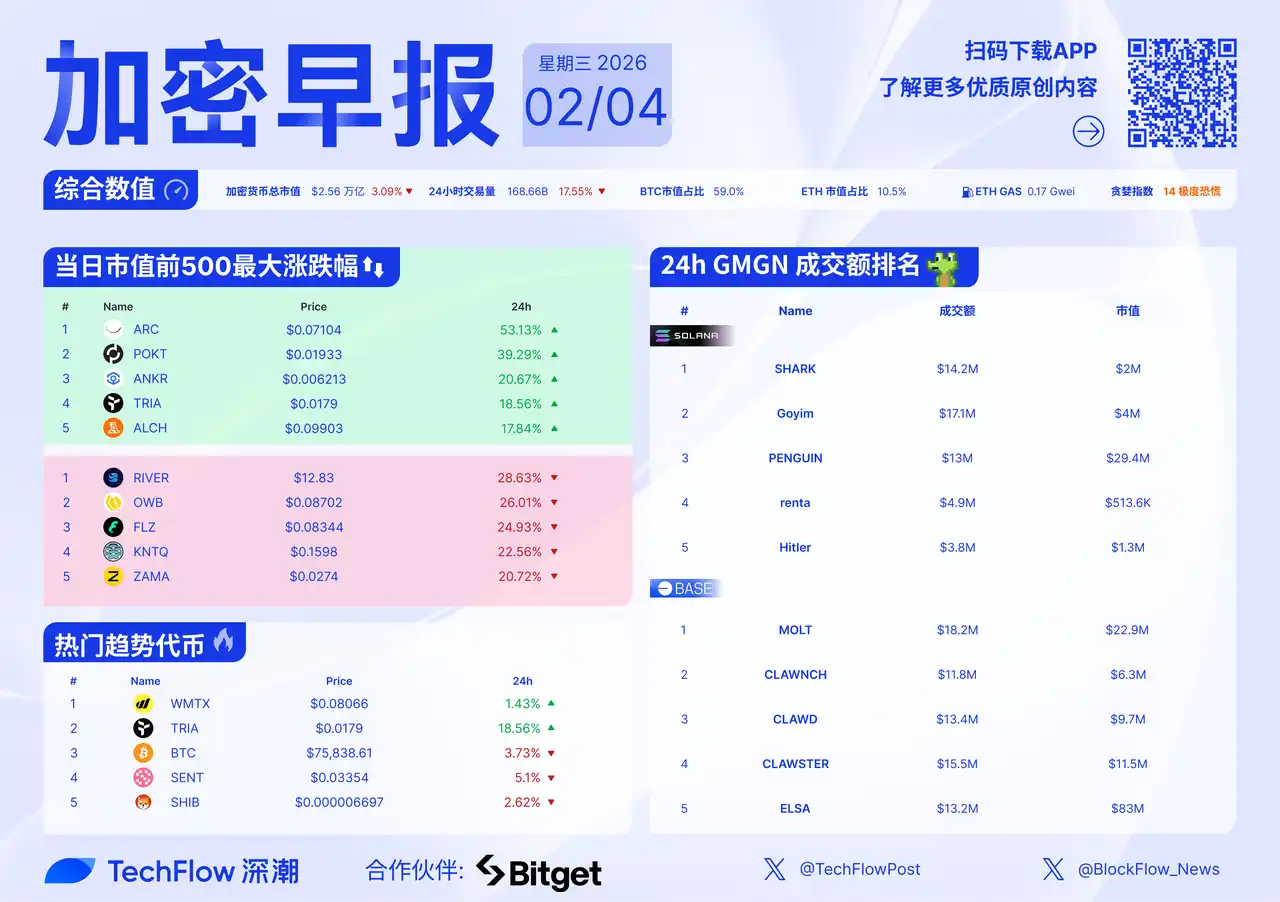
Market Dynamics
Recommended Reading
SpaceX Swallows xAI, Musk's Trillion-Dollar 'Internal Cycle'
This article analyzes Musk's strategy of integrating his companies (such as SpaceX, xAI, Tesla, etc.) to build a "super narrative." This narrative centers on space and artificial intelligence, aiming to create enormous market value for the upcoming IPO. However, this integration has also raised questions from investors, particularly dissatisfaction among Tesla shareholders.
Conversation with Tom Lee: Gold Targets $8900, ETH $2400 is the Bottom, U.S. Stocks May Correct 20% Mid-Year
This article is an analysis and outlook on the global market, cryptocurrency, precious metals, AI technology, robotics, and international market trends in 2026. Through expert interviews and market data interpretation, the article explores the potential opportunities and challenges the market may face in the future.
Market Bleeds, $HYPE Stands Out: Understanding Hyperliquid's HIP-4 Upgrade Entering the Prediction Market
This article reviews Hyperliquid's product iteration process from HIP-1 to HIP-4, showcasing its strategic transformation from a perpetual contracts DEX to a full-category on-chain derivatives platform. The article also mentions the recent rise of the HYPE token and its underlying market logic, as well as an analysis of future prediction market demand and regulatory challenges.
February 3 Market Summary: U.S. Stocks and Gold Rebound Together, Fed Still Mired in Independence Crisis
This article discusses recent dynamics in the global financial markets, including price fluctuations in gold and Bitcoin, the rebound in U.S. stocks, the Federal Reserve's independence crisis, and the impact of future economic data on the market.
Virtuals Launches '60-Day Trial': Projects Can Tokenize Without Betting the Farm, Full Refund if Unsuccessful
This article introduces the "60-Day Trial" framework launched by Virtuals Protocol, a reversible tokenization experiment mechanism designed to help AI founders test crypto-native distribution and monetization methods without bearing irreversible risks. Through public building and market testing, founders can decide within 60 days whether to commit to continuing the project or exit and get a refund.






