Crypto Morning Brief: Meme Coins Rally, Michael Saylor Releases Bitcoin Tracker Info

marsbit2026-01-05 tarihinde yayınlandı2026-01-05 tarihinde güncellendi

Özet

In the latest crypto market update, meme tokens are experiencing a rally, while MicroStrategy founder Michael Saylor hints at further Bitcoin purchases by sharing a Bitcoin Tracker update. Key developments include an economist predicting five Fed rate cuts in 2026 due to a potential U.S. unemployment surge, and reports of major U.S. newspapers withholding news of a secret operation in Venezuela. Trump Media sees a rise in short positions ahead of a potential merger, and his family’s crypto project WLFI passes a proposal to boost USD1 adoption. Flow network resumes full operations post-outage, and Ranger announces an ICO on Solana. PwC increases its crypto focus amid U.S. regulatory shifts, and SlowMist warns of a critical vulnerability in HitBTC. Blue Origin now accepts Ethereum for space travel payments, and a major $1.8B crypto money laundering case is uncovered in Shanghai.

Author: Deep Tide TechFlow

Yesterday's Market Dynamics

Economist: U.S. Unemployment Wave Imminent, May Force Fed to Cut Rates 5 Times This Year

According to Jinshi Data, David Rosenberg, who previously worked at Merrill Lynch and has been running his own firm Rosenberg Research since 2020, stated that the U.S. economy will face significant challenges in 2026, with the job market likely to contract sharply, weakening the economy and forcing the Federal Reserve to respond with substantial interest rate cuts.

The U.S. unemployment rate has risen from 4% at the beginning of 2025 to 4.6% in November 2025. Rosenberg believes the unemployment rate will soon break above 5% and "likely test 6% by the end." Rosenberg stated that the collapse of the labor market and the ensuing recession will force the Fed to cut rates by 125 basis points to 2.25% (i.e., five 25-basis-point cuts) by the end of the year.

Notably, Rosenberg's view differs significantly from the general consensus among Wall Street economists, who expect the labor market to remain stable in 2026, with the Fed implementing one or two rate cuts. The median forecast from Fed officials is for one rate cut this year. However, the central bank has emphasized that it sees downside risks in the labor market. The Fed's latest staff projections note that "weaker labor market conditions and heightened economic uncertainty increase the risk of a more pronounced slowdown than expected."

Semafor: New York Times and Washington Post Knew About U.S. Secret Operation in Venezuela Before It Happened

According to a report by U.S. media site Semafor, The New York Times and The Washington Post were informed about the U.S. secret raid operation in Venezuela before it began but agreed to delay publication at the government's request to avoid endangering U.S. troops. President Trump approved the operation at 10:46 PM on Friday, which ultimately succeeded in capturing the President of Venezuela. Despite the tense relationship between the Trump administration and mainstream U.S. media, American media maintained traditional restraint regarding high-stakes national security operations. The Washington Post's editorial strongly supported this operation.

Previous news indicated that three suspected insider wallets placed bets in advance on the ouster of Venezuelan President Maduro, profiting over $630,000 in total. Affected by this, U.S. Congressman Ritchie Torres plans to propose a bill to prohibit federal officials from using insider information for trading on prediction markets.

Short Positions in Trump Media Company Surge; Trump's Personal Stake Would Drop to ~20% Upon Merger with TAE

According to a Reuters report, data from financial analysis firm S3 Partners shows that short positions in Trump Media & Technology Group surged recently after the company announced last month that it was seeking a $6 billion all-stock merger with Google-backed nuclear fusion energy company TAE Technologies. Short positions increased by 31% to nearly 16 million shares,接近 the highest level since October. It is reported that Trump himself holds approximately 115 million shares of Trump Media & Technology Group, representing about 40% of the company's shares. Due to equity dilution from the merger, Trump's stake would drop to about 20% upon merging with TAE.

WLFI Community Passes Proposal to Use Treasury Funds to Incentivize USD1 Adoption with 77.75% Support Rate

Trump family crypto project WLFI announced on platform X that a governance proposal to use part of the unlocked treasury funds to accelerate USD1 adoption passed with a 77.75% approval vote.

Flow: Network Fully Restored, Detailed Technical Post-Mortem Report to Be Released Within 48 Hours

According to an official announcement, the Flow network has been fully restored. Currently, 99.9% of accounts have full operational permissions in both execution environments. The Flow ecosystem is gradually recovering. The decentralized finance ecosystem has begun to resume operations, with decentralized exchanges like KittyPunch and IncrementFi back online and processing trades. Bridge partners are actively working on recovery protocols and are expected to resume operations after final verification.

Flow officials stated that a detailed technical post-mortem report, including the full attack vector, forensic analysis, and remediation methods, will be released within 48 hours. The network is currently secure, operational, and processing transactions in both execution environments. A full ecosystem recovery is expected to be completed this week.

Ranger Announces ICO Launch on January 7th

According to an official announcement, Solana生态 crypto derivatives exchange Ranger will launch a 4-day ICO starting January 7, 2026, at 00:00 UTC+8, with a minimum fundraising target of $6 million. This ICO will be conducted through MetaDAO, allocating 10 million RNGR tokens, representing 39.02% of the total supply. Tokens for ICO participants will be 100% unlocked at TGE, while team tokens will be unlocked upon meeting price milestone triggers.

PwC Significantly Increasing Efforts in the Cryptocurrency Space

According to the Financial Times, as the Trump administration embraces digital assets, PwC, one of the 'Big Four' accounting firms, has decided to increase its investment in this领域 after years of caution towards cryptocurrency.

PwC US lead Paul Griggs stated in an interview that this strategic pivot occurred last year against the backdrop of the U.S. appointing pro-crypto regulatory officials and Congress passing several new laws regulating digital assets, such as stablecoins.

Griggs said: "The Genius Act and the regulatory details around stablecoins will, I believe, boost market confidence in this product and asset class. Asset tokenization will also inevitably continue to evolve, and PwC must be within this ecosystem."

SlowMist: Discovers Potential Critical Vulnerability in HitBTC Exchange

According to an official message from SlowMist, the organization has discovered a potential critical security vulnerability in the HitBTC exchange. SlowMist stated that it had privately disclosed the information to HitBTC in advance but has not yet received a response.

It is reported that HitBTC is an established cryptocurrency exchange founded in 2013. The exchange's trading volume in the past 24 hours was $111,487,461.

Market News: Bezos' Blue Origin Now Accepts Ethereum for Space Travel Payments

According to Solid Intel, Jeff Bezos' space company Blue Origin now accepts Ethereum as a payment method for space travel.

Shanghai Prosecution Discloses a Job-Related Crime Case Involving Virtual Currency Money Laundering, Amounting to 1.8 Billion Yuan

According to a disclosure on the Shanghai Procuratorate's official account, the Shanghai Baoshan District Procuratorate, while handling a job-related crime case, conducted穿透式审查 (penetrative review) of funds, tracked the capital flow chain, and successfully initiated supervision over 24 cases involving 24 individuals. The prosecutor stated that the underground banking团伙 (syndicate) involved had a large number of accounts, making the case difficult to handle, with huge transaction volumes and money laundering amounts reaching 1.8 billion yuan. Ultimately, through pursuit and prosecution, money laundering activities involving cross-border transfer of illicit proceeds via virtual currency were cracked down on. Targeting new and complex money laundering crimes such as those involving underground banks and virtual currency, the Baoshan District Procuratorate guided public security organs to穿透资金账户 (penetrate fund accounts), clarify the source and destination of funds, secure electronic data, ensure precise and effective charges, and fully guarantee the quality and efficiency of money laundering case investigations.

Michael Saylor Again Releases Bitcoin Tracker Information, Hinting at Possible Further BTC Purchases

MicroStrategy founder Michael Saylor again released information related to the Bitcoin Tracker, stating, "Orange or Green?"

Based on previous patterns, MicroStrategy has always disclosed Bitcoin purchase information the day after related messages are posted.

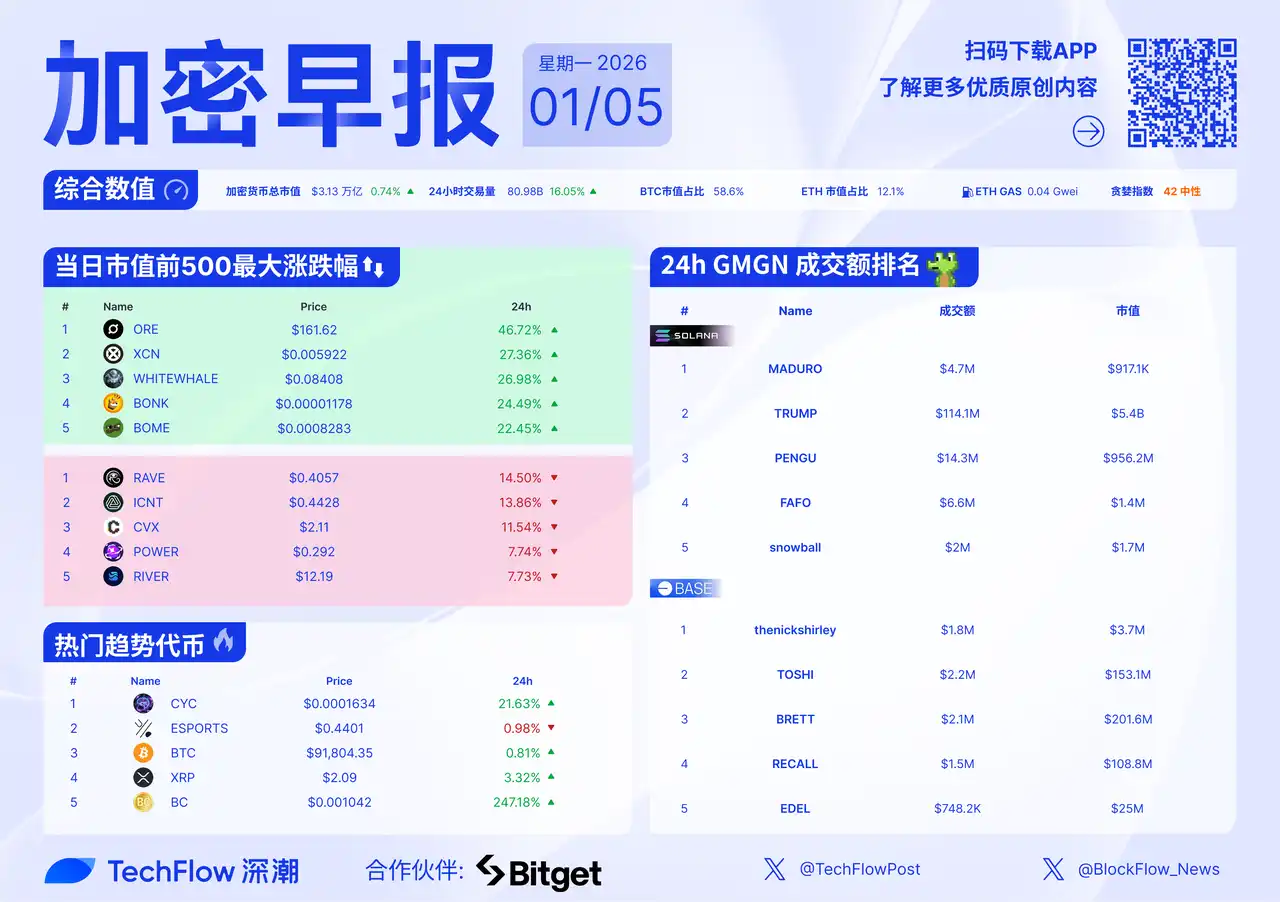
Market Trends
Recommended Reading

The Demise of the Petro: A Microcosm of Venezuela's Failure

This article recounts the failure of "Petro," the world's first sovereign state-backed digital currency launched by Venezuela. The Petro was initially held with high hopes to solve Venezuela's severe economic crisis and counter U.S. sanctions. However, due to technical issues, public indifference, external sanctions, internal corruption, and structural economic defects, the Petro ultimately failed, becoming a microcosm of national governance failure.

Pentagon's Pizza, Polymarket's Money

This article explores the phenomenon of predicting major military operations by analyzing changes in order volumes at pizzerias near the Pentagon. It reviews the history from Soviet agents monitoring Pentagon lights and vehicle numbers during the Cold War to using Google Maps and pizzeria customer traffic to predict war outbreaks today. It also mentions cases where individuals profited from such information on prediction markets and the ensuing discussions on information transparency and insider trading.

Analysis of All x402 Transaction Data in December: Nearly 60% Used for Practical Purposes, Not Speculation

This article primarily discusses the current state and development potential of the x402 protocol, analyzing transaction data from December 2025 and exploring trends in the micro-payment sector and its application potential in AI and blockchain. The article also mentions x402's solutions to payment issues, future challenges, and comparative advantages over other payment platforms.

Multicoin: Why We Are Bullish on Stablecoins Becoming FinTech 4.0?

This article delves into the development history of fintech and the revolutionary impact of stablecoins within it. It reviews the evolution from FinTech 1.0 to 4.0, analyzes the limitations of traditional financial infrastructure, and points out how stablecoins have changed the economic model of financial services through open, programmable networks. The emergence of stablecoins allows fintech companies to reduce operational costs, focus on serving specific niche markets, and achieve higher economic efficiency and deeper user understanding.

Four-Year Cycle Invalidated: 30 Institutions Bet on the New Crypto Landscape of 2026

This article discusses the major transformation the crypto industry will undergo in 2026, transitioning from "adolescent restlessness" to "adult steadiness," entering the so-called "industrialization phase." Various institutions have made predictions about future crypto trends, including decreased Bitcoin volatility, scaled commercial use of stablecoins and real-world assets (RWA), and deep integration of AI and blockchain. The article also mentions potential divergences and challenges, such as the quantum computing threat and competition in the AI payment layer.


İlgili Sorular

QAccording to economist David Rosenberg, how many times does he predict the Federal Reserve will be forced to cut interest rates in 2026?

ADavid Rosenberg predicts the Federal Reserve will be forced to cut interest rates 5 times (a total of 125 basis points) by the end of 2026.

QWhat action did Michael Saylor take that is often a precursor to his company, MicroStrategy, announcing a new Bitcoin purchase?

AMichael Saylor posted information about the 'Bitcoin Tracker' with the message 'Orange or green?', a pattern that has historically preceded announcements of Bitcoin acquisitions by MicroStrategy.

QWhich major accounting firm is increasing its focus on the cryptocurrency sector, as reported by the Financial Times?

APricewaterhouseCoopers (PwC) is increasing its focus and investment in the cryptocurrency sector.

QWhat was the outcome of the WLFI community governance proposal regarding the use of treasury funds to promote the adoption of USD1?

AThe WLFI community governance proposal to use part of the unlocked treasury funds to accelerate the adoption of USD1 passed with a 77.75% approval rate.

QWhich aerospace company, founded by Jeff Bezos, has begun accepting Ethereum as payment for space travel?

ABlue Origin, the aerospace company founded by Jeff Bezos, now accepts Ethereum as payment for space travel.

İlgili Okumalar

Silicon Valley 'Startup Guru' Steve Hoffman: Web3 + AI Could Be a Trap

Silicon Valley investor and "Godfather of Startups" Steve Hoffman warns that combining Web3 with AI is likely a trap, not a promising venture. In an interview, Hoffman argues that while AI is a foundational technology touching all industries, Web3 adds complexity, friction, and regulatory risk without solving mainstream consumer or business needs. He advises founders to focus on deep, specialized applications where startups can out-iterate giants, rather than on generic features easily replicated by large tech companies. Hoffman observes that Silicon Valley will lead foundational AI research, while China excels at rapid, large-scale application and commercialization, particularly in robotics. He stresses that AI-driven autonomous agents capable of collaborative, multi-step tasks are 2-4 years away, which will cause significant job displacement. The solution is not to slow AI but to redesign business models around human-AI collaboration and reform social systems like education and retraining. For startups, Hoffman recommends focusing on vertical, expertise-heavy domains to build defensibility. He sees major opportunities in AI fraud detection and cybersecurity. Key founder mindsets include systemic thinking over feature-focus, relentless customer centricity, building adaptive teams, and deeply understanding AI's capabilities and limits. Hoffman is also leading a non-profit initiative to establish university centers aimed at training future leaders in responsible, human-value-aligned AI innovation.

marsbit3 dk önce

Silicon Valley 'Startup Guru' Steve Hoffman: Web3 + AI Could Be a Trap

marsbit3 dk önce

Token Inefficient, Economy Tokenless

The article "Tokens Aren't Economical, Economics Aren't Tokenized" analyzes a pivotal shift in the AI industry from a technology-driven narrative to one dominated by capital efficiency. It highlights two concurrent trends: a severe capital shortage due to the exorbitant and recurring costs of compute (e.g., OpenAI's high burn rate) and a wave of corporate spin-offs where major tech companies are separating their AI units (like Kuaishou's Kling and Baidu's Kunlunxin). The core argument is that AI's "anti-internet" business model, where user growth increases costs rather than profits, has created a disconnect between high valuations and actual cash flow. Spin-offs address this by allowing AI assets to be valued independently. Within a parent company, they are seen as cost centers, but as standalone entities, they are priced based on their growth potential and scarcity in the primary market, leading to massive valuation premiums (e.g., Kling's estimated value tripling post-spin-off). The industry is at an inflection point, moving from "model worship" to "value realization." The competition is evolving from a pure compute (GPU) race to a broader focus on systemic efficiency and full-stack engineering (involving CPUs and orchestration) to achieve viable commercialization. The year 2026 is framed as a critical moment where the industry must definitively answer how to economically translate AI capability into tangible business value, reshaping the sector's future power structure.

marsbit8 dk önce

Token Inefficient, Economy Tokenless

marsbit8 dk önce

Crossing the 'Memory Wall': The Wafer-Level Revolution and Computing Power Routes in the AI Inference Era

In 2026, a historic shift occurred in AI as major cloud providers' inference spending surpassed training spending for the first time, signaling a move from "building large models" to "using large models." This shifts the core challenge from computing power to the "memory wall"—the bottleneck of data movement (model weights, activations, KV Cache) between external DRAM and processors, where energy and latency from data transfer far exceed computation itself. Companies like Nvidia face GPU idle time due to bandwidth limits. In contrast, Cerebras Systems adopts a radical "wafer-scale" approach with its Wafer-Scale Engine (WSE). Instead of cutting a silicon wafer into many chips, Cerebras uses almost the entire wafer as one massive chip (WSE-3). This design provides 44GB of on-chip SRAM, delivering memory bandwidth thousands of times higher than traditional HBM (e.g., 21 PB/s vs. Nvidia B200). For LLM inference, weights are streamed layer-by-layer from external MemoryX storage to the chip, avoiding HBM bottlenecks. This results in token generation speeds 1.5–5 times faster than Nvidia's B200 in some models and significant advantages in first-token latency and long-context tasks. Additionally, Cerebras's architecture offers much lower interconnect power consumption (0.15 pJ/bit vs. GPU's ~10 pJ/bit). However, Cerebras faces challenges: SRAM scaling has slowed with advanced nodes, limiting future capacity gains; the chip requires specialized liquid cooling and custom software stacks; and its external I/O bandwidth (150 GB/s) is low compared to NVLink, hindering multi-system scaling for very large models. Competition is intensifying. Major players are pursuing three paths: 1) Developing proprietary inference ASICs (e.g., Google TPU, Microsoft Maia), 2) Leveraging advanced packaging (e.g., TSMC's SoW) to democratize wafer-scale-like integration, potentially eroding Cerebras's process advantage within a few years, and 3) Exploring optical interconnects for ultimate bandwidth. Commercially, Cerebras is transitioning from a hardware vendor to a service provider, facing the immense challenge of building high-power, specialized data centers to meet large contracts (e.g., 250MW/year from 2026–2028). In conclusion, the AI inference era presents a fundamental architectural trade-off. Cerebras opts for extreme physical optimization for low-latency, single-task performance, while Nvidia prioritizes versatility and massive cluster throughput. The path forward remains uncertain, with technology and business models still evolving in the race toward advanced AI.

marsbit14 dk önce

Crossing the 'Memory Wall': The Wafer-Level Revolution and Computing Power Routes in the AI Inference Era

marsbit14 dk önce

Has Bitcoin's 'Rebound Ended', Officially Entering the Late Bear Market Phase?

**Title: Has Bitcoin's Rebound Ended, Entering the Late Bear Market Phase?** **Summary:** Bitcoin's price has declined by 13% this week, signaling a potential return to late-stage bear market conditions. The price fell to around $67k, positioned between the Realized Price and Realized Cap Weighted Average. For the first time since early 2022, the Short-Term Holder cost basis has dropped below this key average, confirming a hallmark of late-cycle bear markets. Profitability metrics have collapsed sharply. The 7-day average of the Realized Profit/Loss ratio plummeted from a local high of 3.16 to 0.29, mirroring the February panic sell-off. Critically, the 90-day average never breached the threshold of 2, indicating the recent rally to $82k was a bear market bounce, not a structural shift. Realized losses surged to $1.35 billion daily, with $770 million coming from Long-Term Holders selling at a loss. This accelerating redistribution of supply from weak to strong hands is a necessary but ongoing process for a market bottom. The rally stalled almost precisely at the aggregate cost basis (~$83k) of US spot Bitcoin ETF investors, turning that level into strong resistance and leaving the average ETF holder underwater again. Spot market flows have turned decisively negative, showing sellers are dominating order books despite the price drop. While a significant futures long liquidation event cleared over $400 million in leverage, providing a potential reset, sustained spot demand is yet to materialize. Options markets continue to price in higher future volatility (Implied Volatility) than recent price action (Realized Volatility) has shown, with a persistent skew towards put options, indicating ongoing demand for downside protection. In conclusion, multiple metrics point to a fragile market structure. Resistance at the ETF cost basis, accelerating realized losses, dominant spot selling, and cautious options pricing all suggest the bear market trend persists. A sustainable recovery likely requires a resurgence of spot demand, ETF holders returning to profit, and a clear reduction in selling pressure.

marsbit14 dk önce

Has Bitcoin's 'Rebound Ended', Officially Entering the Late Bear Market Phase?

marsbit14 dk önce

TechFlow Intelligence Agency: Anthropic Calls for Global Pause in AI Development While Preparing for Trillion-Dollar IPO; SpaceX IPO Roadshow Heats Up, But S&P 500 Rejects Fast-Track Inclusion

In today's TechFlow Intelligence Briefing, several major tech stories highlight a growing theme of trust and credibility gaps across AI, crypto, and finance. AI company Anthropic has publicly called for a global pause in AI development, citing risks from Claude's "recursive self-improvement." Ironically, this coincides with reports the company is preparing for a massive IPO targeting a near $1 trillion valuation. This perceived hypocrisy, coupled with widespread user complaints about Claude's declining performance, is sparking debate over whether the safety warning is genuine or a competitive tactic. Meanwhile, in a substantive security move, Anthropic open-sourced a framework for AI-powered vulnerability discovery. In the crypto market, Bitcoin's price drop below $61,000 triggered over $1.16 billion in liquidations, flipping the market into a state where more BTC is held at a loss than at a profit, a historical bearish signal. On the corporate front, SpaceX's highly anticipated IPO is generating immense Wall Street excitement, with Goldman Sachs projecting 100x revenue growth by 2030. However, the S&P 500 has refused to fast-track the company's inclusion post-IPO, potentially limiting immediate institutional demand. Separately, ByteDance's AI app Doubao lost over 6 million monthly active users after introducing a subscription model, highlighting the challenges of AI monetization. Other notable developments include Nvidia certifying HBM4 memory from Samsung, SK Hynix, and Micron; Cloudflare's acquisition of front-end tooling company VoidZero; and its CEO warning that bot traffic now exceeds human traffic online. The underlying narrative connects these events: a trust crisis. From AI firms' contradictory actions and crypto volatility to the clash between SpaceX's hyped narrative and institutional rules, a pattern is emerging where stated intentions and actual practices are increasingly misaligned.

marsbit29 dk önce

TechFlow Intelligence Agency: Anthropic Calls for Global Pause in AI Development While Preparing for Trillion-Dollar IPO; SpaceX IPO Roadshow Heats Up, But S&P 500 Rejects Fast-Track Inclusion

marsbit29 dk önce

İşlemler

Spot
Futures

Popüler Makaleler

MEME 2.0 Nedir

Memecoin 2.0: Kripto Para Dünyasında $MEME 2.0'ın Yükselişi Giriş Kripto para dünyasının sürekli gelişen yapısında, yeni bir rakip olarak Memecoin 2.0 ortaya çıktı. $MEME 2.0 sembolüyle öne çıkan bu proje, meme coinlerinin kavramını heyecan verici bir yeni seviyeye taşıyor. Orijinal Memecoin'in bir yan ürünü olarak, bu proje, odağını geleneksel finansal teşviklerden, katılımcı ve eğlenceli bir deneyime kaydırarak kripto topluluğunun dikkatini çekmeyi başardı. Ethereum blockchain'inde faaliyet gösteren Memecoin 2.0, kripto alanında topluluk katılımını cesurca yeniden tanımlıyor. Memecoin 2.0, $MEME 2.0 Nedir? Memecoin 2.0, temelinde topluluk ruhunu ve meme kültürüyle ilişkilendirilen eğlenceyi öncelikli olarak benimseyen bir kripto para projesidir. Pratik kullanım alanlarına ve somut faydalara odaklanan geleneksel kripto paralardan farklı olarak, Memecoin 2.0 dijital para biriminin daha hafif yönünü benimseyerek kendini gösteriyor. Proje, herhangi bir fayda, yapılandırılmış bir yol haritası veya finansal getiri vaadi olmadan varlığını sürdürüyor ve bunun yerine memelere ve ortak keyfe odaklanmış canlı bir topluluk oluşturmayı hedefliyor. Bu sayede, çevrimiçi alanda meme kültürünün artan trendine hitap ederek dijital varlıklar dünyasında benzersiz bir oyuncu haline geliyor. Memecoin 2.0'ın Yaratıcısı, $MEME 2.0 Memecoin 2.0'ın kökenleri üzerine yapılan kapsamlı araştırmalara rağmen, yaratıcısının kimliği belirsizliğini koruyor. Bu anonimlik, birçok projenin sahne arkasında kalmayı tercih eden bireyler veya gruplar tarafından yönetildiği kripto topluluğunda alışılmadık bir durum değil. Yaratıcının kamuya açık bilgilere sahip olmaması, topluluk katılımına odaklanarak bireysel ünlülük yerine topluluğun önemini vurgulayan stratejik bir hamle olarak görülebilir. Memecoin 2.0 Yatırımcıları, $MEME 2.0 Memecoin 2.0 için yatırımcılar veya mali destek ile ilgili bilgiler sınırlıdır. Bu bilgi eksikliği projenin ya kendi kendini finanse ettiğini ya da geleneksel yatırım yapılarına kıyasla topluluğa odaklanmasının farklı bir destekçi türünü çektiğini öne sürebilir. Meme coinlerinin dünyası tipik olarak daha fazla taban katılımı içerdiği için bu yaklaşım, topluluk odaklı projelerin etikleriyle uyumlu bir yapı sergiliyor. Memecoin 2.0, $MEME 2.0 Nasıl Çalışır? Memecoin 2.0 tamamen Ethereum blockchain'inde faaliyet gösteriyor ve bu sayede güvenlik özelliklerinden ve ölçeklenebilirliğinden yararlanıyor. Ethereum'un güçlü yönlerinden faydalanarak, Memecoin 2.0 kullanıcı etkileşimleri için güvenli bir ortam sunarken, işlemlerin hem verimli hem de maliyet etkili olmasını sağlıyor. Memecoin 2.0'ın benzersiz özelliklerinden biri topluluk odaklı yapısıdır. $MEME 2.0 tokeninin değeri ve popülaritesi, kullanıcıların aktif katılımlarından geliyor, içsel faydadan ziyade. Bu tasarım, projenin kripto para biriminin eğlence yönüne odaklanmasını pekiştirerek, gülmenin ve topluluk etkileşiminin başarısını sağlayan gerçek para birimleri olduğunu ima eder. Ayrıca, proje, meme coinlerinin daha geniş ekosisteminin bir parçası olarak yer alıyor; burada her meme coininin değeri, kültür, trendler ve topluluk katılımına göre dalgalanıyor, geleneksel ekonomik prensiplerden ziyade. Memecoin 2.0'ın Zaman Çizelgesi, $MEME 2.0 Memecoin 2.0'ın evrimini ve kilometre taşlarını daha iyi anlamak için, tarihindeki önemli olayları vurgulayan bir zaman çizelgesi: 2024: Memecoin 2.0'ın ortaya çıkışı, orijinal Memecoin'in bir yan ürünü olarak kabul edilir ve Ethereum blockchain'inde faaliyet gösterirken meme coinlerinin gelişen bağlamında kendini konumlandırır. 13 Temmuz 2024: Memecoin 2.0, Ethereum ağında topluluk odaklı bir meme coin olarak resmi bir konum alır ve kullanıcıların katılımını ve büyümeye katkı sağlamasını teşvik eden eğlence odaklı yaklaşımını vurgular. Memecoin 2.0'a Dair Anahtar Noktalar, $MEME 2.0 Memecoin 2.0'ı tanımlayan birkaç kritik özellik: Topluluk Merkezli Yaklaşım: Memecoin 2.0'ın temel misyonu, memetik kültürden elde edilen ortak keyfi kullanarak eğlenceli ve katılımcı bir topluluk deneyimi yaratmaktır. Ethereum Üzerinde İnşa Edilmiş: Ethereum blockchain'inde faaliyet göstermek, projeye güvenlik ve ölçeklenebilirlik sağlayan temel bir altyapı sunar. Fayda veya Yol Haritası Yokluğu: Geleneksel kripto paralardan çarpıcı bir şekilde farklı olarak, Memecoin 2.0 herhangi bir faydalı özellik veya finansal getiri vaadinde bulunmamakta, topluluk katılımı ve sosyal etkileşime olan bağlılığını pekiştirmektedir. Memetik Kültüre Odağı: Mem fenomeninin mizahi ve kültürel yönlerini benimseyerek, Memecoin 2.0 kullanıcıların kripto ile çevrimdışı ve çevrimiçi etkileşimde bulunması için bir platform sağlar. Ek Bağlam: Meme Coinlerinin Önemi Meme coinler, kabaca mizah ve ticarete yönelik hafif bir yaklaşım tarafından yönlendirilen belirgin bir kripto para sınıfı olarak ortaya çıkmıştır. Bu paralar genellikle önemli bir fayda veya gelişim yol haritasından yoksundur ve kullanıcıları eğlence, topluluk etkileşimi ve kültürel relevans vaadiyle çeker. Daha geniş kripto ekosisteminde, meme coinler topluluk katılımının önemini yeniden canlandırırken, yalnızca kar odaklı yaklaşımlara karşı bir duruş sergiliyor. Memecoin 2.0 gibi projeler, eğlencenin finansal hedeflerle uyum sağlamasını sağlayarak, blockchain'i yaratıcılık ve sosyal etkileşim için bir oyun alanı haline getiriyor. Sonuç Memecoin 2.0, veya $MEME 2.0, topluluk katılımını katı finansal yapıların üzerinde önceliklendirerek yeni bir kripto para dalgasını temsil ediyor. Mizah ve sosyal etkileşime odaklanarak, meme kültürü etrafındaki ilgiden faydalanıyor. Ethereum blockchain'inde faaliyet göstererek, Memecoin 2.0, teknolojinin yeteneklerinden yararlanırken dijital para biriminin eğlence değerine olan bağlılığında kararlılığını koruyor. Kripto para alanı gelişmeye devam ederken, Memecoin 2.0, dijital varlıkların geleceğinin ortak deneyimlere, gülmelere ve sağlam topluluk bağlantılarına bağlı olabileceğinin bir kanıtı olarak hizmet ediyor. Kripto dünyası belirsiz olsa da, belki de neşe, geleneksel finansal kazanç kadar değerli olabilir.

137 Toplam GörüntülenmeYayınlanma 2024.04.04Güncellenme 2024.12.03

MEME 2.0 Nedir

MEME Nasıl Satın Alınır

HTX.com’a hoş geldiniz! Memeland (MEME) satın alma işlemlerini basit ve kullanışlı bir hâle getirdik. Adım adım açıkladığımız rehberimizi takip ederek kripto yolculuğunuza başlayın. 1. Adım: HTX Hesabınızı OluşturunHTX'te ücretsiz bir hesap açmak için e-posta adresinizi veya telefon numaranızı kullanın. Sorunsuzca kaydolun ve tüm özelliklerin kilidini açın. Hesabımı Aç2. Adım: Kripto Satın Al Bölümüne Gidin ve Ödeme Yönteminizi SeçinKredi/Banka Kartı: Visa veya Mastercard'ınızı kullanarak anında Memeland (MEME) satın alın.Bakiye: Sorunsuz bir şekilde işlem yapmak için HTX hesap bakiyenizdeki fonları kullanın.Üçüncü Taraflar: Kullanımı kolaylaştırmak için Google Pay ve Apple Pay gibi popüler ödeme yöntemlerini ekledik.P2P: HTX'teki diğer kullanıcılarla doğrudan işlem yapın.Borsa Dışı (OTC): Yatırımcılar için kişiye özel hizmetler ve rekabetçi döviz kurları sunuyoruz.3. Adım: Memeland (MEME) Varlıklarınızı SaklayınMemeland (MEME) satın aldıktan sonra HTX hesabınızda saklayın. Alternatif olarak, blok zinciri transferi yoluyla başka bir yere gönderebilir veya diğer kripto para birimlerini takas etmek için kullanabilirsiniz.4. Adım: Memeland (MEME) Varlıklarınızla İşlem YapınHTX'in spot piyasasında Memeland (MEME) ile kolayca işlemler yapın.Hesabınıza erişin, işlem çiftinizi seçin, işlemlerinizi gerçekleştirin ve gerçek zamanlı olarak izleyin. Hem yeni başlayanlar hem de deneyimli yatırımcılar için kullanıcı dostu bir deneyim sunuyoruz.

647 Toplam GörüntülenmeYayınlanma 2024.12.12Güncellenme 2026.06.02

MEME Nasıl Satın Alınır

Tartışmalar

HTX Topluluğuna hoş geldiniz. Burada, en son platform gelişmeleri hakkında bilgi sahibi olabilir ve profesyonel piyasa görüşlerine erişebilirsiniz. Kullanıcıların MEME (MEME) fiyatı hakkındaki görüşleri aşağıda sunulmaktadır.

活动图片