Crypto Morning Brief: Backpack Plans to Offer Equity to Stakers, WLFI Claims USD1 Was Attacked

marsbit2026-02-24 tarihinde yayınlandı2026-02-24 tarihinde güncellendi

Özet

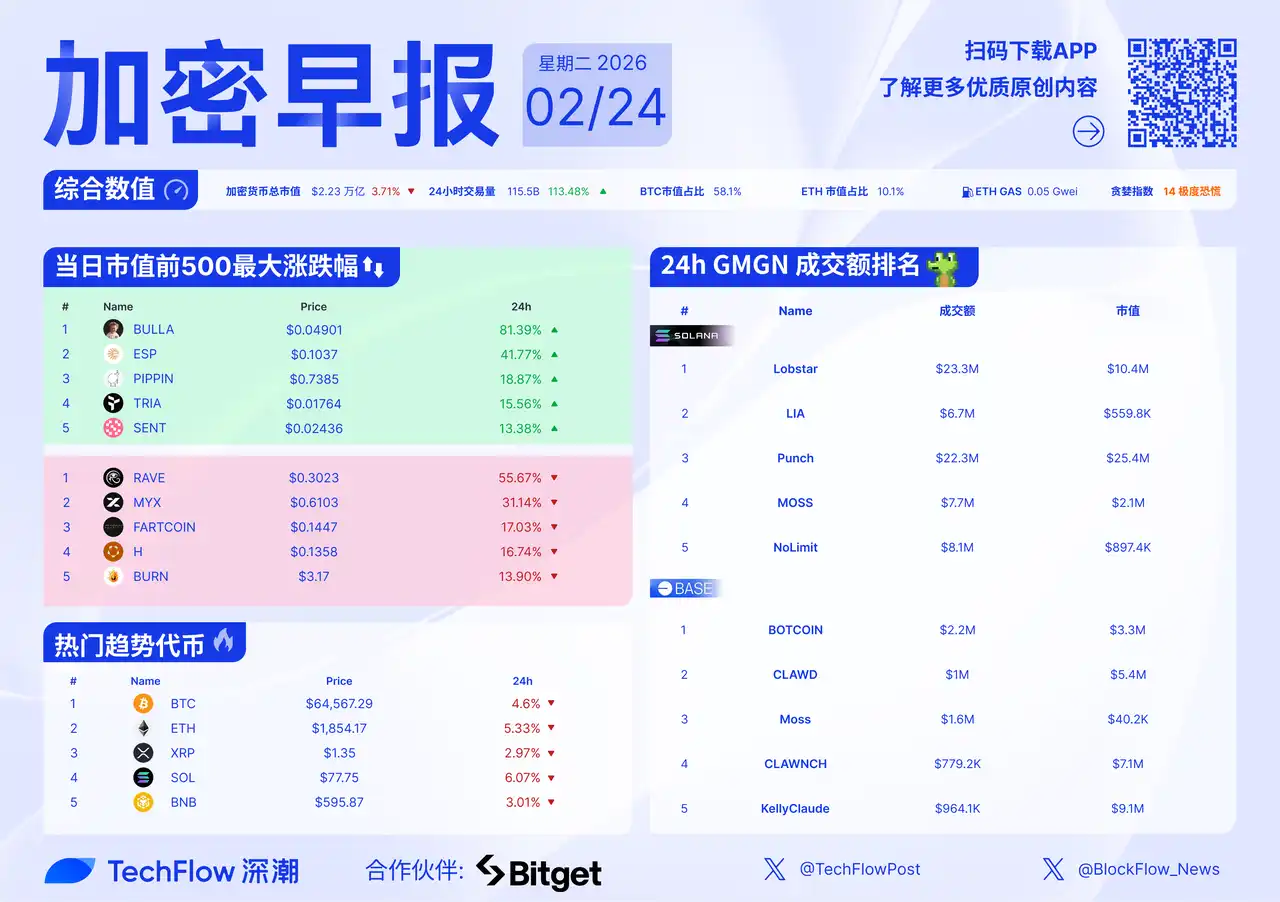
Crypto Daily Digest: Key market developments include Backpack's announcement to offer equity to token stakers, allocating 20% of company shares for this program. WLFI reported an attack on its USD1 stablecoin, claiming attackers targeted co-founder accounts to spread FUD and short the token, but the stablecoin held its peg due to its 1:1 asset backing. In policy news, the Trump administration is considering new national security tariffs on six industries, including batteries and telecom equipment. Tether will discontinue its offshore yuan stablecoin (CNH₮) due to low demand. Meanwhile, China’s regulatory approach now distinguishes RWA tokens from virtual currencies, allowing conditional overseas issuance. Ethereum Foundation established a dedicated DeFi team to support permissionless and censorship-resistant protocols. Meme coin TRUMP unveiled a growth plan involving up to 5% of its supply for ecosystem expansion. Bitcoin miner Bitdeer clarified its BTC sales are for liquidity preparation amid land acquisition plans. Other highlights: SBI Holdings launched a $64.5M blockchain bond offering XRP rewards, and private credit firm Blue Owl Capital sold $1.4B in loan assets, sparking concerns about market stress. Market analysis sections cover AI agent teams, yen carry trade impacts on Bitcoin, and shifting institutional capital from tokens to equity.

Author: Deep Tide TechFlow

Yesterday's Market Dynamics

US Media: Trump Administration Considers New National Security Tariffs on Six Major Industries, Covering Batteries, Pig Iron, and Iron Fittings, etc.

According to the Wall Street Journal, the Trump administration is considering imposing new "national security tariffs" on six industries. Sources familiar with the matter revealed that the scope of the tariffs under consideration may cover large batteries, pig iron and iron fittings, plastic pipes, industrial chemicals, as well as power grid and telecommunications equipment industries. These tariffs will be levied under Section 232 of the Trade Expansion Act of 1962. The new US tariffs on the six major industries will be implemented separately from the new global 15% tariff. It is currently unclear when the investigations, which are the responsibility of the Department of Commerce, will be announced, and when the tariffs will ultimately be imposed. Section 232 requires a lengthy investigation before tariffs can be imposed, but once implemented, the president can modify them unilaterally.

US Trade Representative: US Bilateral Trade Agreements Remain Valid After Supreme Court Tariff Ruling

According to Jinshi, US Trade Representative Greer said on CBS's "Face the Nation" on Sunday that those agreements reached with countries such as the EU and South Korea are still valid. He sought to distinguish these agreements from the 15% global tariff that Trump announced plans to implement on Saturday. Greer said: "We want them to understand that these deals will be successful deals. We will fully support these deals. We also expect our partners to fully support these deals." He also stated that other US trade tools, including means to investigate the trade practices of other countries, will provide the US with advantages. He spoke with EU officials this weekend and will also communicate with officials from other major US trading partners to convey a message of reassurance.

WLFI Response: Attacker Hacked WLFI Co-founder's Account to Spread FUD and Heavily Short, But the Attack Was Not Successful

World Liberty Financial officially issued an announcement on social media stating:

"This morning, a coordinated attack was launched against USD1. The attacker hacked the accounts of several WLFI co-founders, hired KOLs to spread panic, and heavily opened short positions on WLFI, attempting to profit from this artificially created chaos.

But this attack was not successful.

Thanks to USD1's robust minting and redemption mechanism and fully 1:1 asset backing, USD1's trading price has remained stable at par value. No fraudster can shake the long-term commitment of the entire WLFI team and co-founders to USD1.

Reminder to users: Please only obtain accurate information through verified official channels."

Meme Coin TRUMP Team Plans to Deploy No More Than 5% of Tokens for Ecosystem Growth Plan

According to official news, the Meme coin TRUMP team announced the next phase of development, focusing on improving market liquidity depth, expanding application scenarios, and promoting long-term value growth through more disciplined capital operations. Based on community feedback, the project will simultaneously advance three initiatives: a revenue and liquidity plan, institutional-grade market structure optimization, and strategic inventory management, to improve trading quality and strengthen the ecosystem.

In terms of liquidity, holders will soon be able to participate in the revenue plan through the Kamino vault, receiving TRUMP and stablecoin rewards. The related incentive scale exceeds $10 million at most to support on-chain liquidity and DEX capital efficiency. At the same time, new professional market makers will strengthen liquidity support in centralized and decentralized markets, improving price discovery capabilities and trading execution stability.

In addition, TRUMP will, according to the public token unlock schedule, strategically use no more than 5% of the unlocked tokens in the coming months for ecological investments, partnerships, and growth plans. This includes an ecological fund of up to $3.5 million, potential acquisitions and partnerships, as well as entertainment and gaming layouts promoted by The TRUMP Game Studio, with the first project being the Web3 game TRUMP Billionaires Club.

Bitdeer Responds to Bitcoin Sale Decision: Preparing Liquidity in Advance for Land Acquisition, Hashrate Growth Plan Unchanged

Bitdeer (BTDR), the bitcoin mining company under Wu Jihan, stated, "The company's decision to sell bitcoin should not cause market-level concerns. This move is aimed at preparing liquidity in advance for several non-binding power land acquisition opportunities currently under evaluation. The company emphasizes that the hashrate will continue to grow, and it will continue to mine for the benefit of shareholders."

Ethereum Foundation Establishes DeFi Team to Support New Protocol Development, Reiterates Belief in "DeFipunk" Philosophy

According to The Block, the Ethereum Foundation is establishing a dedicated decentralized finance (DeFi) department under its Application Relations team to support new protocol development. The Foundation appointed Charles St. Louis, former CEO of DELV and MakerDAO governance architect, as DeFi Protocol Expert, and Ivan (ivangbi), co-founder of Gearbox Protocol, as DeFi Coordinator.

The Ethereum Foundation stated: "We want to see DeFi flourish, but we have a clear view of what it should be: permissionless, censorship-resistant, privacy-first, self-custodial, and open-source." St. Louis added on platform X: "The Ethereum Foundation believes in DeFipunk: not finance that is slightly better than traditional finance, but finance that would not be possible without Ethereum."

The team will support existing DeFi projects while focusing on the development of "tomorrow's DeFi," including innovative directions such as user-controlled artificial intelligence and high-throughput on-chain futures markets.

Backpack Plans to Offer Company Equity to Token Stakers, Company Has Already Reserved 20% of Equity for This Plan

According to Decrypt, the cryptocurrency exchange Backpack plans to allow holders of its upcoming token to obtain company equity through staking. According to a statement by Backpack CEO Armani Ferrante on social media, users can convert their staked tokens into company equity at a fixed ratio after staking for at least one year. The company has already reserved 20% of its equity for this plan.

Ferrante stated that this move aims to improve the existing model, as many projects have failed to deliver on the promise of supporting tokens based purely on utility value. The exchange has not yet announced a token issuance date but has asked users to verify their personal information to determine eligibility for claiming.

Tether Announces Discontinuation of Support for Offshore RMB Stablecoin CNH₮

February 21, according to an official announcement, Tether announced on February 20, 2026, that it will gradually phase out its CNH₮ stablecoin service. Effective immediately, Tether has stopped issuing new CNH₮ tokens and will completely terminate redemption support after one year.

This decision is based on changes in market conditions, low product interest, and limited community demand relative to other assets. Holders of CNH₮ are advised to redeem their assets as soon as possible and must complete the operation before the redemption deadline.

Director of Shanghai Finance and Development Laboratory: Regulators Distinguish RWA Tokens from Virtual Currency for the First Time and Do Not Mandate Absolute Decentralization

Caixin published an article "Strict Management of Overseas RWA," in which Zeng Gang, Director and Chief Expert of the Shanghai Finance and Development Laboratory, stated that the 42nd document jointly issued by eight departments adopts a regulatory framework of "prohibition domestically, strict management overseas," distinguishing RWA tokens from virtual currency for the first time. The China Securities Regulatory Commission (CSRC) has designated "asset-backed security tokens" as the first operable type of RWA, opening a specific path for compliant overseas issuance by domestic enterprises. The regulatory authorities neither deny the potential value of RWA tokens as new financing tools nor relax risk prevention. The 42nd document emphasizes the use of "encryption technology and distributed ledger or similar technology" and does not mandate absolute decentralization. The core principle is: the entire process of overseas issuance must ensure that domestic entities do not come into contact with token transactions, funds entering the country must go through compliant cross-border investment and foreign exchange management channels, and an event reporting mechanism must be established post-issuance to ensure that major events are reported to the CSRC in a timely manner.

US Private Credit Giant Blue Owl Capital Announces Sale of Approximately $1.4 Billion in Loan Assets

According to CoinDesk, US private credit giant Blue Owl Capital announced the sale of approximately $1.4 billion in loan assets to match investor redemption demands from its retail-oriented private credit fund (Blue Owl Capital Corp II). The fund will return about 30% of its net asset value (NAV) to qualified investors, with the assets sold at a price equivalent to 99.7% of face value. Affected by this, Blue Owl stock (OWL) fell nearly 15% this week, with a cumulative decline of over 50% compared to the same period last year; stocks of other private equity firms such as Blackstone, Apollo Global, and Ares Management also fell significantly.

Experts compare this to the "canary in the coal mine" signal before the 2007 financial crisis (such as the Bear Stearns hedge fund collapse), warning that overexpansion in the private credit market (especially AI-related investments) may trigger systemic risks, credit crunches, and bank contagion. If the pressure intensifies, forcing central banks to cut interest rates and inject liquidity, it could replay the post-2020 pandemic scenario, injecting momentum into the Bitcoin and crypto markets and driving the next bull run.

SBI Holdings Launches 10 Billion Yen On-Chain Bond, Rewarding Investors with XRP

According to CoinDesk, Japanese financial giant SBI Holdings announced the issuance of an on-chain bond "SBI START Bonds" worth 10 billion yen (approximately $64.5 million). The bond targets retail investors and is issued, managed, and settled entirely on the blockchain platform "ibet for Fin." Qualified investors (holding an SBI VC Trade account and investing over 100,000 yen) can receive XRP rewards equivalent to the investment amount at the time of issuance and subsequent interest payment dates (until 2029), with every 100,000 yen corresponding to 200 yen worth of XRP. The bond has a three-year term and offers a fixed interest rate. Secondary trading will commence on the Osaka Digital Exchange on March 25, 2026.

Market Dynamics
Recommended Reading

Google Senior AI Product Manager: 6 Agents Take Over My Daily Tasks, Costing Less Than $400 per Month, Running 24/7

This article details how to build a team of autonomous AI Agents that work together through six different role-based Agents to complete tasks such as research, content creation, code review, and newsletter production. The author shares practical experience, including file structure, cost details, problem-solving, and step-by-step setup suggestions.

In-Depth Analysis: Unwinding of Yen Carry Trade Triggers Chain Reaction of Bitcoin Selling

This article analyzes the mechanism by which the unwinding of the yen carry trade affects Bitcoin price volatility through cross-asset deleveraging and liquidity conditions. Through yen exchange rate fluctuations and official statements, it reveals the potential impact of yen financing channels on the global risk situation and crypto markets, and provides a five-signal early warning framework to identify deleveraging windows.

80% of New Tokens Fall Below Issue Price, Institutional Capital Shifting from Tokens to Crypto Equity

This article explores the capital flow trends in the cryptocurrency market, pointing out that institutional investors are gradually shifting from tokens to crypto equity investments. Behind this trend are the dual drivers of institutional compliance requirements and realistic valuation systems. The article analyzes the price performance of new tokens after listing, noting that most tokens depreciate quickly after listing, while crypto-related IPO and M&A activities have grown significantly. The article also explains why investors prefer crypto equity and the difference between tokens and real businesses.

Wintermute CEO: The Crypto Industry Is Lost, Only Personal Sovereignty Is the Path Worth Taking

This article is a manifesto on the philosophy of the crypto industry written by Wintermute CEO Evgeny Gaevoy, analyzing the current state of the crypto industry and future path choices. Starting from the concept of the "Golden Path" in "Dune," he criticizes the current迷失 (lost state) of the crypto industry and emphasizes the importance of personal sovereignty and independence, while analyzing three possible future development paths and emphasizing the necessity of building systems that cannot be controlled.

First Rise in the Year of the Horse, AI Stocks Go Crazy

This article discusses in detail the performance of the AI large model field in the capital market, focusing on the soaring stock prices of two domestic AI large model companies in the Hong Kong stock market—Zhipu and MiniMax—and the wealth creation effect behind them. The article also mentions the financing situation of other AI large model enterprises and future competition trends in the capital market.


İlgili Sorular

QWhat is Backpack's plan for its token stakers and how much equity has been reserved for this initiative?

ABackpack plans to allow its upcoming token holders to stake their tokens for at least one year to receive company equity at a fixed ratio. The company has reserved 20% of its equity for this program.

QAccording to WLFI, what was the nature of the attack on USD1 and what was the outcome?

AWLFI stated that attackers hacked the accounts of several WLFI co-founders, hired KOLs to spread FUD (Fear, Uncertainty, and Doubt), and took large short positions on WLFI in an attempt to profit from the artificially created chaos. The attack was unsuccessful, and the price of USD1 remained stable at its face value due to its robust minting and redemption mechanism and full 1:1 asset backing.

QWhat major decision did Tether announce regarding its CNH₮ stablecoin and what was the reason behind it?

ATether announced it will gradually cease its CNH₮ (offshore Chinese yuan) stablecoin service. It has stopped issuing new CNH₮ tokens and will completely terminate redemption support after one year. This decision was based on changing market conditions, low product interest, and limited community demand relative to other assets.

QWhat new team has the Ethereum Foundation established and what are its core principles for DeFi?

AThe Ethereum Foundation has established a dedicated DeFi team under its Ecosystem Support Program. The team's core principles for DeFi are that it should be permissionless, censorship-resistant, privacy-first, self-custodial, and open-source. They refer to this belief as 'DeFipunk'—finance that is not just slightly better than traditional finance, but finance that would not be possible without Ethereum.

QWhat significant move did the Japanese financial giant SBI Holdings make involving XRP?

ASBI Holdings issued a 10 billion yen (approximately $64.5 million) on-chain bond called 'SBI START Bonds' on the 'ibet for Fin' blockchain platform. Qualified retail investors who hold an SBI VC Trade account and invest over 100,000 yen will receive XRP rewards equivalent to 200 yen for every 100,000 yen invested, both at issuance and on subsequent interest payment dates until 2029.

İlgili Okumalar

Is AI Creating a New Class of 'Information Poor'?

AI is generating a new kind of "information poverty." The core issue isn't that AI denies answers to the poor; it's that it provides abundant, cheap, and plausible-sounding answers to everyone. This availability shifts the true scarcity from obtaining answers to possessing the **judgment to evaluate them** and the access to turn them into real-world opportunities. New information poverty thus describes those who have AI tools and outputs, but lack the complementary skills, authorization, and contextual experience to critically assess and act on them. Research reveals a multi-layered divide: access to AI is stratified by income and platform design (e.g., premium vs. free, embedded tools). In workplaces, usage heavily favors higher-paid, more experienced, or formally trained employees, with AI often automating entry-level tasks that were traditional stepping stones. Crucially, the heaviest users are often mid-career professionals whose existing expertise allows them to effectively judge and leverage AI outputs, while novices risk over-relying on them without building judgment. While controlled experiments show AI can significantly boost low-skilled workers' performance, real-world adoption and benefit are constrained by unequal social and organizational structures. Historically, general-purpose technologies first reward those with existing complementary capital. AI, by affecting judgment-based work, may accelerate and deepen this initial inequality gap, even if it narrows over decades. The danger lies in the illusion of competence it creates, potentially stunting the very critical thinking needed in an era where judgment is paramount.

marsbit21 dk önce

Is AI Creating a New Class of 'Information Poor'?

marsbit21 dk önce

Jensen Huang 'Saves' South Korean Stock Market: Locks In SK Hynix Memory, Chip Shortage to Continue

On June 5th, South Korea's stock market experienced a sharp decline, with major chipmakers like Samsung and SK Hynix dropping nearly 10%. Amidst the turmoil, NVIDIA CEO Jensen Huang's visit to Seoul played a dramatic role in boosting market sentiment. Following a dinner meeting with SK Group Chairman Chey Tae-won and SK Hynix CEO Kwak Noh-Jung, Huang confirmed that NVIDIA's new Vera CPU will utilize SK Hynix DRAM. The companies announced a multi-year technical partnership to co-develop next-generation memory for NVIDIA's AI infrastructure, covering products from data centers to personal AI and robotics. This collaboration extends beyond memory supply. SK Hynix is integrating NVIDIA's AI and Omniverse platform into its own semiconductor design and manufacturing processes, including computational lithography and creating digital twins of its fabrication plants for autonomous operation. While strengthening ties with SK Hynix, NVIDIA is diversifying its supply chain for the upcoming HBM4 memory, with Samsung, SK Hynix, and Micron all certified as suppliers for its Vera Rubin platform. Despite this, Huang warned that the global chip shortage, driven by relentless demand from AI factory construction, is expected to persist for several years across the entire supply chain. His visit underscores NVIDIA's systematic effort to deepen integration with South Korea's broader tech industry.

marsbit1 saat önce

Jensen Huang 'Saves' South Korean Stock Market: Locks In SK Hynix Memory, Chip Shortage to Continue

marsbit1 saat önce

Nasdaq Plunges 4.2% in a Single Day: Does "Black Friday" Burst the U.S. Stock Market Bubble?

The Nasdaq plunged 4.18% on June 5, 2026, its worst single-day drop in over a year, as a much stronger-than-expected US jobs report triggered fears of economic overheating and delayed Federal Reserve interest rate cuts. The selloff, centered on high-valuation tech and AI stocks like Nvidia and Broadcom, spread across major indices. The article examines whether this signals a market top. The strong May non-farm payrolls data, nearly double expectations, pushed bond yields higher, directly hurting rate-sensitive tech stocks. This exposed vulnerabilities in the crowded AI trade, where valuations had soared on narratives of infinite growth, despite emerging signs of slowing order momentum and corporate AI monetization challenges. Prior to the drop, market indicators flashed warning signs: historically high valuations (e.g., Shiller CAPE ratio near 39.5), extreme bullish sentiment, and high levels of leverage. Technical charts showed key support levels being breached. Wall Street is divided on the outlook. Bears, citing risks of "stagflation" and AI bubble comparisons to the dot-com era, warn of a potential significant correction. Bulls view the drop as a healthy correction within a bull market, underpinned by a strong economy and expected corporate earnings growth of around 7% in 2026. The immediate future hinges on upcoming key events: the May CPI inflation data and the mid-June FOMC meeting. Their outcomes will critically shape market expectations for the Fed's rate path. The article concludes that conditions for a major market top are aligning, marking a fragile transition from narrative-driven gains to a phase demanding validation from macroeconomic data and corporate fundamentals. Caution is advised.

marsbit1 saat önce

Nasdaq Plunges 4.2% in a Single Day: Does "Black Friday" Burst the U.S. Stock Market Bubble?

marsbit1 saat önce

Nasdaq Plunges 4.2% in a Single Day, Did 'Black Friday' Pop the U.S. Stock Bubble?

The Nasdaq Composite plummeted 4.18% on June 5, its biggest single-day drop since April 2025, triggering widespread debate over whether the U.S. stock market has peaked. The sell-off was sparked by a stronger-than-expected U.S. non-farm payrolls report, which fueled fears of economic overheating and pushed back market expectations for Federal Reserve rate cuts, leading to a sharp rise in Treasury yields. The AI sector, the primary driver of the recent bull market, suffered severe losses, with the Philadelphia Semiconductor Index crashing over 10%. Stocks like Nvidia, Broadcom, and Micron led the decline. Concerns are mounting about the sustainability of AI capital expenditures and high valuations, with signs of order cuts for next-generation chips emerging. Analyses point to several warning signs: historically high market valuations (e.g., elevated Shiller CAPE ratio, Buffett Indicator), extreme bullish sentiment indicators, and significant insider selling. The sell-off also caused a key technical breakdown, with the S&P 500 breaking below its short-term moving average and testing its 200-day moving average. Wall Street is divided on the outlook. Bears warn this could be the start of a bubble deflation or a "stagflation" scenario, while bulls view it as a healthy, overdue correction within a bull market driven by solid corporate earnings growth. A more moderate view suggests the easy liquidity-driven rally is over, and markets are entering a phase of fundamental stock-picking with potential for consolidation. The immediate future hinges on key upcoming events: the May CPI report and the mid-June FOMC meeting. Their outcomes will be critical in determining whether this is a temporary pullback or the beginning of a more significant trend reversal. The consensus is that the era of one-directional market gains may be ending, requiring increased investor caution.

Odaily星球日报1 saat önce

Nasdaq Plunges 4.2% in a Single Day, Did 'Black Friday' Pop the U.S. Stock Bubble?

Odaily星球日报1 saat önce

The First Case on AI Agents: What Was Adjudicated?

"The First 'Agent' Ruling: What Was Decided?" On April 30, the Guangzhou Internet Court issued a ruling—China's first behavior preservation order in the intelligent agent (AI agent) field. The defendant, an open-source AI agent software, was ordered to stop downloads, cease actions that bypassed a platform's technical protection measures, and delete related tutorials and data. The core issue: the software used the operating system's "accessibility service" permissions to automate user interactions within other apps without those platforms' authorization. This mirrors a recent US case where Amazon sued Perplexity for similar reasons—bypassing Amazon's API to directly scrape and interact with its pages—and won a preliminary injunction. Both rulings establish a crucial legal boundary for the AI agent era: agents cannot operate unchecked. The article argues the fundamental legal principle emerging is one of **dual authorization**. An AI agent requires both **user consent** AND **platform consent** to operate legitimately within that platform's ecosystem. Bypassing platform rules through system-level permissions, even with user permission, undermines platform responsibilities for content moderation, data security, and user privacy, creating liability issues. The piece uses the evolution of "Doubao Phone" (an AI-integrated smartphone) as a case study. Its initial, aggressive version that bypassed platform controls faced roadblocks. Its upcoming 2.0 version is reportedly pivoting to negotiate API access and authorization deals with major platforms (like Alibaba's ecosystem), seen as a strategic adaptation to the new regulatory reality. A global trend is identified: the era of unregulated, "wild west" growth for AI agents is ending, replaced by a **compliance race**. This raises barriers to entry, as securing platform authorizations becomes a new cost. Open-source status is also not a legal shield if the code facilitates bypassing technical protections. In conclusion, these first rulings target not the largest, but the most **aggressive and representative** cases. By setting precedent with them, regulators are efficiently steering the entire industry towards a new, more regulated operating paradigm defined by dual authorization and platform cooperation.

marsbit1 saat önce

The First Case on AI Agents: What Was Adjudicated?

marsbit1 saat önce

İşlemler

Spot
Futures

Popüler Makaleler

WLFI Nasıl Satın Alınır

HTX.com’a hoş geldiniz! Official World Liberty Financial (WLFI) satın alma işlemlerini basit ve kullanışlı bir hâle getirdik. Adım adım açıkladığımız rehberimizi takip ederek kripto yolculuğunuza başlayın. 1. Adım: HTX Hesabınızı OluşturunHTX'te ücretsiz bir hesap açmak için e-posta adresinizi veya telefon numaranızı kullanın. Sorunsuzca kaydolun ve tüm özelliklerin kilidini açın. Hesabımı Aç2. Adım: Kripto Satın Al Bölümüne Gidin ve Ödeme Yönteminizi SeçinKredi/Banka Kartı: Visa veya Mastercard'ınızı kullanarak anında Official World Liberty Financial (WLFI) satın alın.Bakiye: Sorunsuz bir şekilde işlem yapmak için HTX hesap bakiyenizdeki fonları kullanın.Üçüncü Taraflar: Kullanımı kolaylaştırmak için Google Pay ve Apple Pay gibi popüler ödeme yöntemlerini ekledik.P2P: HTX'teki diğer kullanıcılarla doğrudan işlem yapın.Borsa Dışı (OTC): Yatırımcılar için kişiye özel hizmetler ve rekabetçi döviz kurları sunuyoruz.3. Adım: Official World Liberty Financial (WLFI) Varlıklarınızı SaklayınOfficial World Liberty Financial (WLFI) satın aldıktan sonra HTX hesabınızda saklayın. Alternatif olarak, blok zinciri transferi yoluyla başka bir yere gönderebilir veya diğer kripto para birimlerini takas etmek için kullanabilirsiniz.4. Adım: Official World Liberty Financial (WLFI) Varlıklarınızla İşlem YapınHTX'in spot piyasasında Official World Liberty Financial (WLFI) ile kolayca işlemler yapın.Hesabınıza erişin, işlem çiftinizi seçin, işlemlerinizi gerçekleştirin ve gerçek zamanlı olarak izleyin. Hem yeni başlayanlar hem de deneyimli yatırımcılar için kullanıcı dostu bir deneyim sunuyoruz.

527 Toplam GörüntülenmeYayınlanma 2025.09.01Güncellenme 2026.06.02

WLFI Nasıl Satın Alınır

Tartışmalar

HTX Topluluğuna hoş geldiniz. Burada, en son platform gelişmeleri hakkında bilgi sahibi olabilir ve profesyonel piyasa görüşlerine erişebilirsiniz. Kullanıcıların WLFI (WLFI) fiyatı hakkındaki görüşleri aşağıda sunulmaktadır.

活动图片












