Author: Chloe, ChainCatcher
The U.S. Senate Banking Committee will hold a key vote on the "Digital Asset Market Structure Act (CLARITY Act)" on January 15. Although the Agriculture Committee has delayed its review until the end of January due to issues with DeFi-related definitions and bipartisan consensus, it is undeniable that this is the most important piece of crypto legislation since the "GENIUS Act."
This article will provide an in-depth analysis of the core controversies of the current bill: from the banking industry's "deposit protection war" against the high yields of stablecoins, to whether DeFi developers should bear criminal responsibility for their "code," and the political tug-of-war over the "ethics clause" involving the Trump family. This is not just a legislative vote; it is a direct confrontation between traditional financial forces and decentralized mechanisms. The outcome may determine the development direction of the global crypto market for the next decade.
Reshaping the Regulatory Landscape: The Jurisdictional Battle Between the SEC and CFTC
At 10:00 AM on January 15, the U.S. Senate Banking Committee will proceed with the review of the "CLARITY Act" as scheduled. Although the market had originally hoped that the two committees (Banking and Agriculture) would advance in sync, the current situation is clearly more complex.
One Committee Advances, the Other Retreats?
Senate Banking Committee: Led by Tim Scott, its core task is to define the legal framework for digital assets under the "Securities Act." The bill is expected to end the SEC's current regulatory practice of indefinitely classifying tokens as securities based solely on "investment expectations," instead establishing a clear exit mechanism and legal process for "transitioning from securities to commodities." This committee will proceed as scheduled, aiming to set clear boundaries for the SEC's jurisdiction.
Senate Agriculture Committee: Led by John Boozman, it oversees the revision of the "Commodity Act" and the division of CFTC jurisdiction. Due to ongoing disagreements between the two parties on core details such as the technical definition of DeFi and stablecoin interest yields, the committee has decided to delay its review until the end of January. The goal is to buy more time to reach bipartisan consensus, ensuring that key Democratic votes are secured during the final vote and avoiding a polarized deadlock in the Senate.
SEC's Shift in Attitude: Seeking to Bring Crypto Out of the Regulatory Gray Area
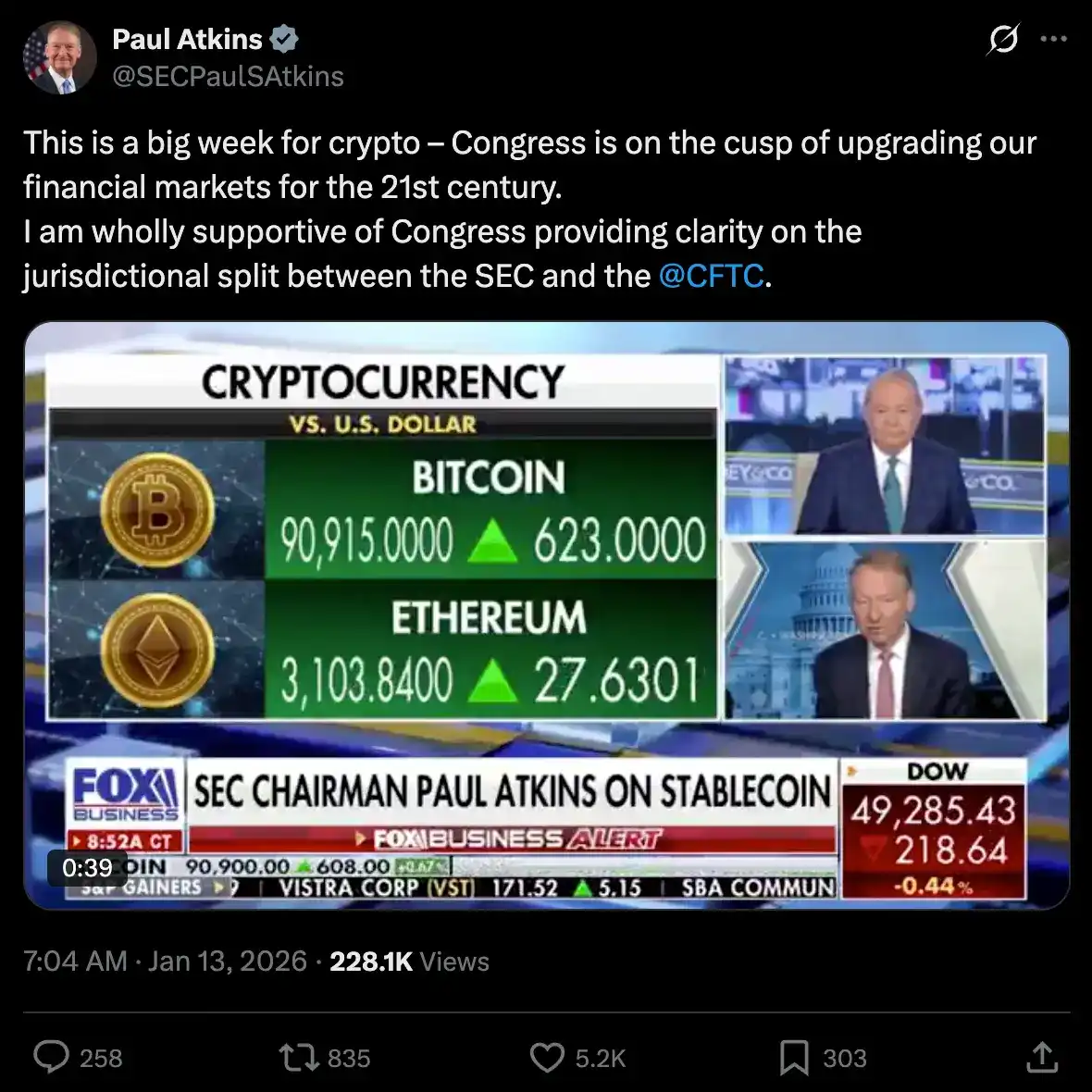
SEC Chairman Paul Atkins emphasized in a post on X on January 13 that this week is of milestone significance for the cryptocurrency industry. He publicly supported Congress's efforts to clearly delineate the jurisdictional boundaries between the SEC and CFTC, a stance distinctly different from the criticized "regulation by enforcement" approach of his predecessor. Atkins advocates for promoting a legislative framework to bring the crypto market out of the regulatory gray area.
He also noted that enhancing market certainty is highly consistent with Trump's vision of making the U.S. the "cryptocurrency capital of the world." Atkins is optimistic that the bill will be approved and signed into law within the year, expecting it to significantly promote the long-term development of the crypto market while strengthening investor protection.
The Deposit Protection War: Should Stablecoin "Yields" Be Completely Banned?
One of the current points of controversy stems from a patch-like amendment to the "GENIUS Act." While the act explicitly prohibits stablecoin issuers from paying interest, it does not impose limits on "distributors," sparking strong dissatisfaction among traditional financial institutions.
Take Coinbase as an example. The platform currently offers approximately 3.5% rewards to users holding USDC. Since Coinbase acts as a distributor rather than an issuer (Circle), this is legal under the current "GENIUS Act" framework. However, the American Bankers Association (ABA) is vigorously lobbying to require lawmakers to extend the interest ban to affiliated companies and partners of stablecoin issuers.
The Banking Industry's Three Core Concerns
1. Deposit Outflow: The banking industry fears that if stablecoin yields continue to exceed traditional savings rates, it will trigger a large-scale migration of funds. The American Bankers Association (ABA) cited Treasury data, warning that without strict interest ban, up to $6.6 trillion in U.S. bank deposits could be at risk of outflow.
2. Weakened Lending Capacity: The outflow of deposits would directly impact the core business model of traditional banks, particularly the lending capacity of community banks. Banks use deposits to provide crucial loans to local businesses, farmers, students, and homebuyers. If the funding pool shrinks due to competition from stablecoins, it could severely disrupt local lending operations.
3. Unfair Competition: Stablecoins are often marketed as products with functions similar to bank deposits but lack the substantive protection of federal deposit insurance (FDIC). The ABA criticizes that cryptocurrency exchanges, through extensive advertising, deliberately downplay the risk differences, constituting unfair competition and exposing consumers to financial risks.
The Crypto Industry's Counterattack
Coinbase Chief Policy Officer Faryar Shirzad countered the banking industry's accusations. He pointed out that U.S. banks earn over $360 billion in annual profits from payment and deposit businesses. The banking industry's rush to ban stablecoin rewards is essentially about defending vested interests, not prudent regulation.
Furthermore, Shirzad cited independent research from Charles River Associates (CRA) and Cornell University, confirming that there is no significant correlation between the growth of stablecoins and bank deposit outflows, and that rewards would need to reach as high as 6% to have a substantial impact. He warned that while the U.S. is debating internally, China has announced it will pay interest on its digital yuan. If the U.S. weakens the competitiveness of stablecoins due to banking lobbying, it would be tantamount to ceding dominance in the global competition of digital currencies, threatening dollar hegemony.
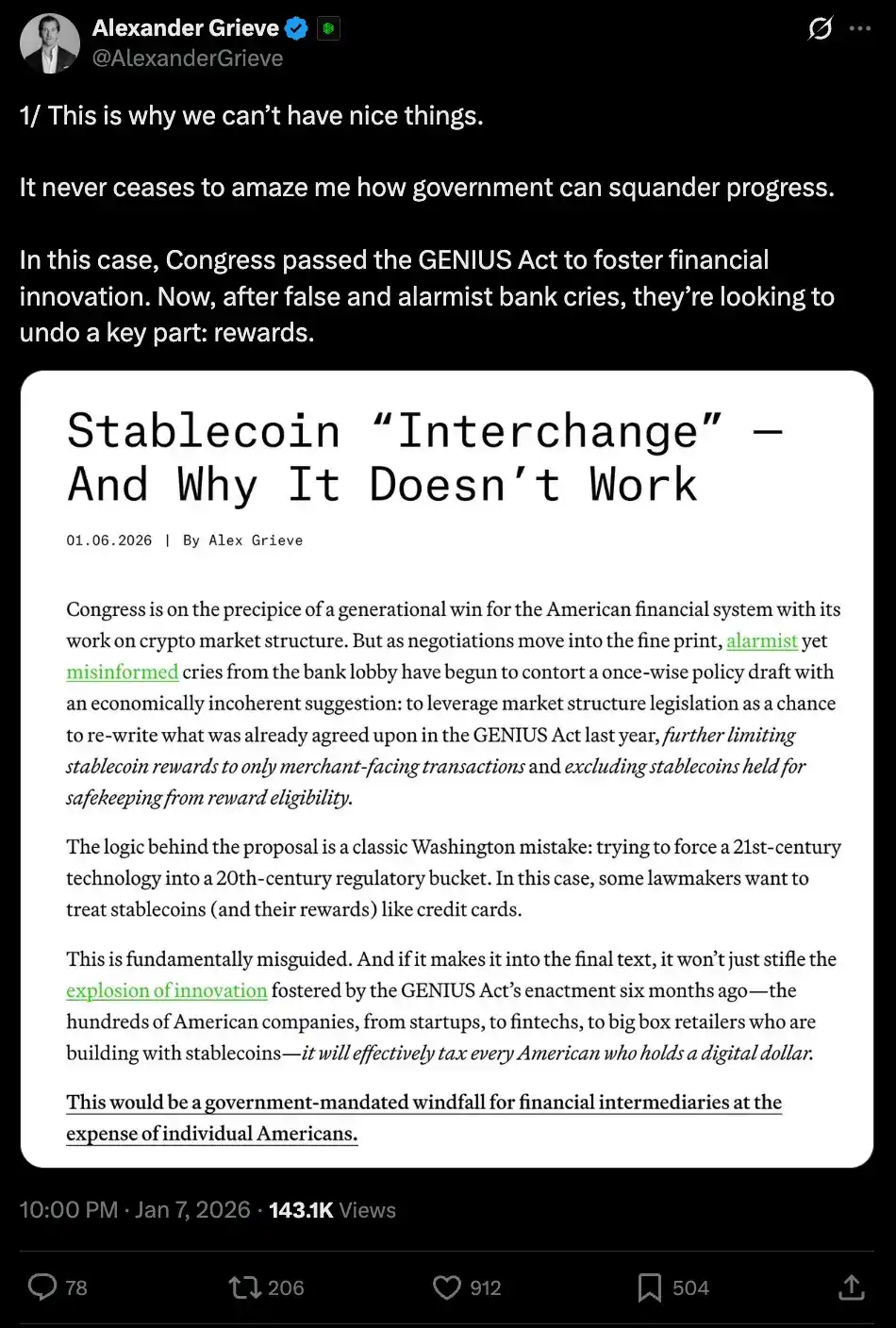
On the other hand, Alexander Grieve, Vice President of Government Affairs at Paradigm, characterized the banking industry's demands as "false and alarmist" political interference. He argued that if lawmakers are forced to amend the reward条款 in the "GENIUS Act" to prohibit distributors from paying收益, it would essentially equate to an "implicit holding tax" on stablecoin holders, allowing middlemen to intercept profits that rightfully belong to consumers. Grieve warned that such actions, sacrificing technological advancement to protect traditional financial profits, would severely削弱 the international appeal of the U.S. stablecoin ecosystem and cause the U.S. to fall behind comprehensively in the competition for Web3 financial infrastructure.
DeFi Controversy: Is Writing Code Considered "Engaging in the Business of Money"?
This is the most technically complex issue in the bill and the main reason for the Agriculture Committee's delay. The point of contention is: Should the person who writes the code be held responsible for its automatic execution?
The U.S. Department of Justice has prosecuted mixer developers (e.g., Tornado Cash co-founders) under the "unlicensed money transmission" law, based on the legal assumption that "code is an intermediary." Regulators argue that developers who write and deploy code with fund-processing functionality are essentially creating an automatically operating "money transmission business." In other words, developers must be responsible for the subsequent execution of the code. This legal interpretation, equating "software development" with "financial operation," is seen by the Web3 industry as a fundamental threat to technological innovation.
In response, the DeFi Education Fund (DEF) and core practitioners argue that this is an unworkable logical paradox in technical practice. Traditional financial institutions can bear compliance obligations precisely because they have "substantive control" over transactions; however, once a truly decentralized protocol is deployed, it becomes immutable and自动执行, and developers completely lose the ability to intercept transactions or freeze assets. Requiring a "developer" who cannot interfere with the software's operation to shoulder the same compliance responsibilities as a bank is akin to requiring an automobile manufacturer to bear criminal charges for every instance of speeding on the road.
If the bill adopts the current stringent definition, developers could face criminal risks because their published smart contracts are used by third parties for illegal purposes. This would not only destroy the technical foundation of DeFi but also trigger a large-scale exodus of R&D talent, ultimately leading to the marginalization of the U.S. in the global competition for next-generation financial infrastructure.
Ethics Clause: The Trump Family and Conflicts of Interest
With the Trump family's deep involvement in the DeFi platform World Liberty Financial (WLF) and its stablecoin USD1 rapidly expanding (market cap has reached $3.4 billion), political ethics have become a key variable in whether the "CLARITY Act" can achieve bipartisan consensus.
WLF's entity formally applied for a "National Trust Bank Charter" from the Office of the Comptroller of the Currency (OCC) last week. This move immediately sparked a political storm, with the core controversy being: Does a regulatory head appointed by the President have the authority to review a commercial bank application from a company控股 by the President's family? Democratic leader Elizabeth Warren promptly issued a statement, directly addressing the conflict of interest:
"President Trump's crypto company has just applied for a federal bank charter, and this application will be reviewed by a regulator appointed by the President. We have never seen financial conflicts or corruption on this scale. When the Senate considers the market structure bill in the coming days, it must directly address this issue: the duty of bank regulators is to ensure the fairness and stability of the economic system, not to profit the private businesses of their boss (the President)."

In response to the aforementioned controversies, Elizabeth Warren and other Democratic senators insist on including an "ethics clause" in the "CLARITY Act." This clause aims to prohibit senior federal officials and their immediate family members from deriving personal benefits from digital asset enterprises during their tenure. Although the House of Representatives chose to avoid this issue during its review to ensure passage, Senate Democrats have made it clear: if限制条款 targeting conflicts of interest for high-level government officials are not included, they will block the final vote. This adds another layer of political struggle to the technical deliberations of the January 15 vote.
This Moment Will Set the Tone for the Crypto Industry's Next Decade
The vote on the "CLARITY Act" is essentially an attempt by the U.S. government, after confirming the strategic position of crypto assets, to incorporate them into the existing financial and political system. Regardless of the final outcome, the "gray area" between the crypto industry and traditional finance is gradually fading. This vote will have profound impacts on three levels:
First, regulatory certainty will trigger large-scale "compliance premiums." If the "CLARITY Act" can clarify the jurisdictional boundaries between the SEC and CFTC, it will彻底终结 the turmoil of "regulation by enforcement" and bring certainty for trillions of dollars of institutional funds to enter the digital asset market. At that point, cryptocurrency will officially transition from a marginal speculative asset to a mainstream financial product and tool.
Second, this is a geopolitical competition about the focus of innovation. Whether it's the restrictions on stablecoin yields or the definition of responsibility for DeFi developers, it essentially tests the upper limit of the U.S.'s tolerance for technological innovation. If the bill ultimately leans towards conservative banking protectionism or imposes harsh criminal penalties on code, it could likely trigger a brain drain of R&D talent. Conversely, if it preserves flexibility for innovation, the U.S. could potentially secure its position as the "cryptocurrency capital of the world" and further consolidate the dollar's hegemony in the digital age.
Finally, the bill vote marks the "deep integration" of Web3 with traditional power. From the interest争夺 over stablecoins and bank deposits to the ethics clause targeting the presidential family, cryptocurrency is no longer a utopia for tech geeks but a center of real power and capital博弈.